
Author Archives: Ned Lunn

Into Culture: Cathedral Pastoral I

What does it mean to know a Cathedral? Or any place for that matter? How does one describe it to others?

As I cross the Cathedral precinct in the relative quiet of the early morning, I instinctively survey the Close seeing the usual two cars parked in their customary places. There has never been set spots for each staff member but these two always park in the same spaces; they belong to the administrative staff and it pleases me that they are creatures of habit.

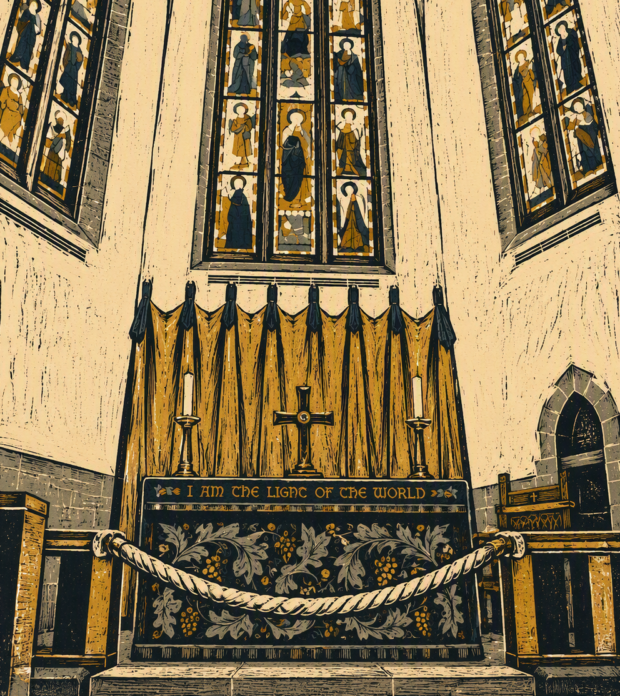
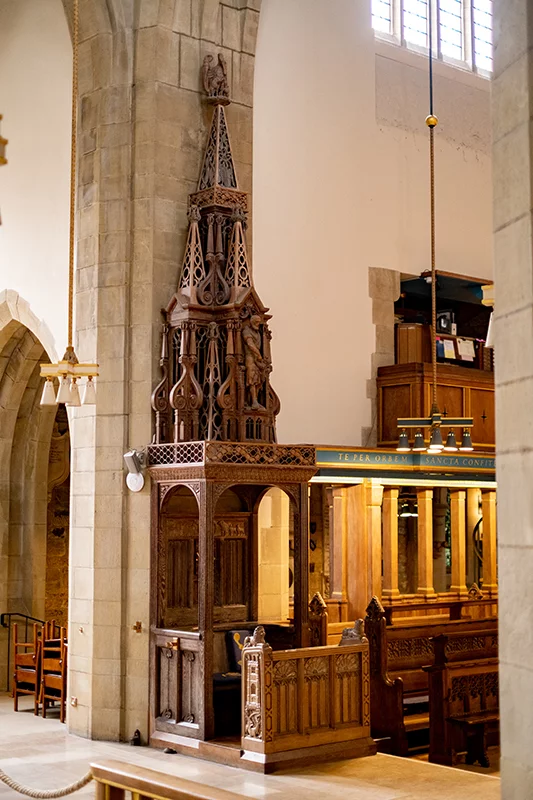
I unlock the back door of the Cathedral and, despite having seen the cars of staff who arrive earlier than I can tear myself away from my toddling son, I still feel an instinctive alertness awaiting the alarm to go off. I head straight to the Lady Chapel that is awash with unbalanced summer morning light. This is caused by a mixture of William Morris & Co. windows, required to take pride of place at this east end position despite the architect of the 20th century extension’s dislike against stained glass, and a single clear window that acts as his perpetual protest against this historic stipulation. I automatically flick on the two bottom light switches regardless of the sun. I stopped using the top light switch as that unit hums above and I know we have not got the money or inclination to fix it or replace it with an LED strip, although I did commission a free and thorough design and quote to replace lots of our old lighting system when I was responsible for our Net Zero planning and strategy. That, like many other things has sat in the metaphorical long grass for years; the plans gathering electronic dust in a folder on my computer.

After setting up the technology required to host the online prayer community in half an hour’s time, I head to pick up the prayer folder that sits in the sacristy due to it previously holding confidential information but hasn’t done so for months. The sacristy is named as a place that holds the ‘sacred’ things and I can tell a lot about staff, volunteers and members of our congregations if they call it a vestry. I don’t blame them for calling it a vestry as it is the place where clergy and vergers vest (robe) themselves but historically the clergy robed in the main office on a Sunday in order to be at the west end to process at the start of our main service; a practice that died out before I arrived at the Cathedral.

As I enter the sacristy I notice that our Head Verger isn’t sat at her desk and I know that something is not right. Monday is the day when both full time vergers are in due, again, to a historic pattern that, in this time of transition, hasn’t been kept to and is unclear as to whether we are due to return to it or find another new form of working shifts. With two vergers in the building the Head Verger usually takes the opportunity to do desk work whilst her deputy goes and does the practical things necessary to open our building to the public after morning prayers. I notice my stomach churn as I prepare myself for pastoral chat with the Head Verger who, like me, finds ambiguous and unintentional change difficult. We have been in such a state for over a year now and it is taking its toll on the both of us.

By the time I sit in my stall in the Lady Chapel, chosen by me when we first moved prayers here over three years ago; the seat which has a clear view of the depiction of the prophet Ezekiel, hands clasped together imploring God, my mind is already racing with what might have caused the usually dependable, predictable Head Verger to be away from her morning post. Instead of opening up my theological reading for the morning (at the moment, a commentary and reflections on ARCIC II) I scroll through the shared calendars to try and deduce what has happened since I left the building after the Sunday morning service the day before.

I miss the gentle shuffling movement of our Education and Visitors Director who, during term time, would be setting up for a school visit. I wait for the Finance Assistant to arrive usually with a podcast or Youtube video blaring out of her phone as she descends the stairs and enters the otherwise quiet peace of the Cathedral in early morning.

I never set out to notice all of this. I never intended to inhabit these idiosyncrasies of this building and the people who live and move within it. Yet here I am; and despite feeling, at times, lost, frightened and frustrated with serving in this place, I still feel my heart stir when I think about what a Cathedral like ours could do to change the narrative of a city like Bradford.

When you stay somewhere long enough you do begin to notice things. You begin to know why they are there, to see what has been lost, what has been inherited and what might yet be possible.

I have been thinking about this since reading James Rebanks’ book, English Pastoral. In his usual autobiographical style, Rebanks blends his personal experiences of farming his inherited land in the Lake District with reflections and insights on the wider agricultural industry. This particular book circles around issues of inheritance and the attempt to salvage something of the traditional in an ever-complex world that requires innovation in order to survive.

By the end I found myself inspired and challenged at the deep knowledge Rebanks has of his ‘valley’. He doesn’t, however, end by proclaiming answers to the many remaining questions about the future shape of farming despite the inherited wisdom he possesses. Instead, he finds that the more he knows the more he has learnt to accept the complexity of the landscape he is called to steward; he resists the simplification that so many have tried to enforce onto farmers that have, in the longer term, wreaked havoc on the soil, crops and animals.


I’m in a conversation with the new Dean of Bradford and he has just used the phrase that he repeats: ‘a singular point of dependency’. It is one of his main observations and critiques of the way we have been working in Bradford. Since he started pointing it out, I have found myself noticing it more and more. I nod in agreement as we come to this same conclusion to the particular problem we are discussing in this conversation. I note, as I have increasingly done in recent weeks, my uncertainty as to whether this diagnosis is for a symptom or a cause and, at the same time, what my colleague’s answer to that question is. The difference will be born out in our proposed solutions to this problem.

It is absolutely true that Bradford Cathedral, like most others, suffers from a silo-ing tendency. The causes of this are many and varied and so recent attempts at counteracting it in our context have been likewise. When we have failed to solve it in the specific cases we go back to the drawing board but when we have been successful, we struggle then to implement it in another situation. This suggests to me that we are talking about this problem of isolation as a symptom rather than a cause.

My recent personal wrestling with questions of vocation and role is, perhaps, an acute case of ‘single point of dependency’. I have become someone who knows how quite a lot of things work and why. Some of that is simply the consequence of having been here for a while and some of it relates to personal struggles with my sense of responsibility. All of that, however, has been further compounded by the particular shape my role has taken during this period of considerable transition; when people leave, someone has to pick things up and remember in order to pass it on to the next person. In addition, I find that when people leave relationships are broken and when those relationships sit between two parts of an organisation it is easy for that to get forgotten. I have unconsciously tried to take on the role of trying to hold the shape of those relationships until there is time to work out their new shapes.

You might already see why I’m finding it so hard to stop. I have recently sent to the Dean, at his request, a list of tasks that I’d like to pass to someone else. The creation of that list was hard and the result: meagre. Two of the four suggestions cannot be passed on as the person is not yet in post and it will take time for them to embed. The other two I struggle to see how the person being given the task will know how to do it or why. So, as I stand with the new Dean as he discusses how he has implemented those proposed changes; my first reaction is gratitude that he is trying to help me break an embedded pattern of work but then there’s that secondary feeling; I don’t feel better for it. I know I am a single point of dependency and that I don’t want to be a single point of dependency, but I’m not convinced that simply removing that dependency from me and reminding me that everything doesn’t or shouldn’t solely rely upon me is the solution.

The deeper questions might be why I was the person who knew? What relationships did I happen to be holding together? What institutional memory has accumulated in one place? Why was I left to remember the reasons behind decisions? How do we induct new staff into our common life so that these things can be more freely shared?

I do not think the answer is that everyone should know everything; that would simply create a kind of collective exhaustion. The Head Verger does not need to become the Finance Assistant. The Finance Assistant does not need to run a school visit. I still think distinct roles are good and that responsibility should sit somewhere but I am trying to name the reality that exists between everyone doing their own thing and everyone being able to do everyone else’s thing. I think it’s found by encouraging the ability to know how your thing belongs to theirs.

What makes English Pastoral so compelling to me is not simply his criticism of industrial agriculture, but his description of what happens when a landscape is divided into increasingly specialised functions. The agricultural revolution brought extraordinary gains in productivity, but it also separated things which had once lived together: crops from livestock, fields from hedgerows, farming from wildlife, production from the wider health of the soil. The problem was not that any one part stopped working but that the relationships between the parts were weakened.

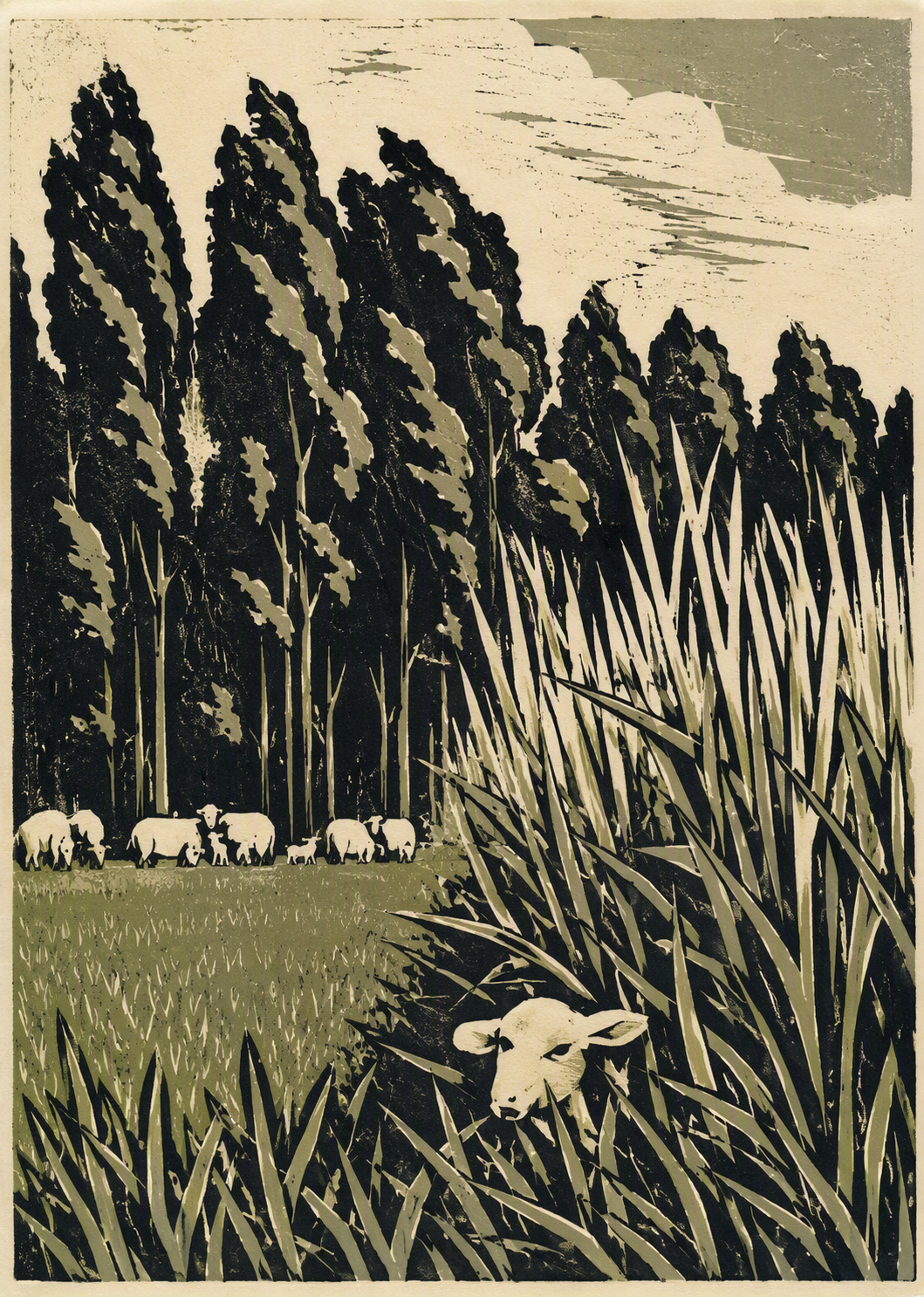
The old mixed farm was not efficient in the way an industrial farm could be efficient. Sheep grazed the fields and fertilised them; crops fed the animals; hedgerows provided shelter and habitat. Water, soil, plants, animals and people existed within the same ecological system. The point wasn’t that everything did everything; it was that the different things belonged to the same ecology.

The problem with a “single point of dependency” is not simply that too many tasks sit with one person. It is that, over time, knowledge about how the different parts belong together can accumulate in one place. And that cannot always be solved simply by moving the tasks.

We tend to solve organisational problems by making them more abstract. We talk about roles, tasks and processes because these are the things we can describe, delegate and measure. If someone leaves, we identify their tasks and list them on a handover document. Someone then holds them on an interim basis and they fulfil the urgent jobs and leave the longer term development tasks to the unknown person who will take on this role more permanently. I think I have become a single point of dependency because my official role is less about tasks and more about long term development and imagination. I have put those on ice in order to hold some more immediately pressing, more tangible jobs.

As we adopt a more role, task and process lens to our life together, roles like mine become confusing and inefficient. What do I actually do when I am not performing tasks that should sit elsewhere in a more definable role?

Organisations do need roles and processes. People need to know what they are responsible for and how we know whether something is working but something gets lost when we remove the people and their relatedness from the picture. Our Head Verger is not simply her role. The Finance Assistant is not simply a list of her tasks. All of us are particular people, with particular histories, personalities, habits, motivations and ways of seeing the place. What’s more, we work alongside other particular people with their own histories, personalities, habits, motivations and ways of seeing.

I haven’t simply been remembering tasks: I have been remembering people and the relationships between them; why this person needs that conversation handled in a particular way; why that relationship matters; why something that looks insignificant on a spreadsheet is important to somebody who has been part of the Cathedral for twenty years. This can seem impossibly complex, and it is.

The mixed farm is not a collection of interchangeable units. Its strength comes from particular things being in relationship with other particular things; the sheep are not simply livestock; the hedgerow is not simply a habitat; the soil is not simply a medium for production. The same is true of a Cathedral.

Its resilience depends upon cultivating the relationships between the particular people who inhabit their different roles. This is why, I think, after several years at Bradford, I find myself noticing things I never intended to notice. The cars in the Close, the faulty light, the rhythm of the different staff and the predictable dance they perform around our shared space on a Monday morning. None of these things appear on our organisational chart but, together, they are important and telling things within its ecology.

What cannot be passed on as part of a six week induction is this way of seeing beyond the structures and to become attentive to notice the relationships that make a place what it is. Rebanks has made me realise that this kind of attention is not incidental to stewardship. It is the primary part of it.

A landscape, so Rebanks concludes, can be managed from a distance but it has to be known, over time, to be truly cultivated. The same is true of a Cathedral and so the question cannot simply be how do we keep Cathedrals alive?: it’s how do we cultivate them and pass them on?

Part II will follow. Watch this space!

Into Culture: Beyond Complaint

This month I have found myself thinking a great deal about complaints and criticism. There have been an increasing number of both formal and informal complaints and grumbles from different people. Some have been entirely justified and predictable, but others have come out of nowhere and have revealed more about cultural, collective or, at times, personal anxieties than about the stated content of the criticism. Some have been resolved quickly whilst others have lingered, rather painfully.

With each new comment or criticism, however well-meaning they are presented, I have found myself becoming increasingly uneasy and weary. It seems that complaint has become the posture of our culture as social media is programmed around monetising it, populism, defined by it and social commentary, increasingly, rewarded for it.  Read the comments beneath almost any news article, let alone the news articles themselves, and it is there. Sit in enough meetings, whether in churches, charities or businesses, and before long the conversation drifts towards identifying what has gone wrong, who has failed, what should have happened and why someone ought to have done something differently.

None of this, of course, is entirely new; human beings have always complained. The Psalms are full of lament. Israel argued with God. The prophets denounced injustice. Jesus himself overturned tables and wept over Jerusalem. The Christian tradition has never confused silence with holiness: nor should it! We should complain about abuse and the lack of protection of the vulnerable. We should call institutions to account. These are not only legitimate; they are indispensable. A society without criticism is rarely healthy.

What has unsettled me, however, is something rather different.

Complaint now seems to possess an extraordinary cultural gravity. It gathers attention with remarkable ease, shaping our conversations, consuming organisational energy and, even, defining how whole communities understand themselves. A single grievance can eclipse hundreds of quiet acts of generosity without anyone consciously choosing for that to happen. That, I think, is the thing that has stayed with me.

While hours have been spent reading carefully worded emails, reviewing procedures and trying to understand difficult situations, countless other things have simply continued: children have rehearsed music, volunteers have arranged flowers, someone has quietly unlocked the building each morning and offered to make coffee for colleagues.

None of these things have announced themselves, demanded attention or became the subject of long conversations. So, I have found myself wondering whether our culture has become remarkably good at noticing what has/is broken and surprisingly poor at noticing what quietly continues to work. In addition, and probably more significantly, I have asked myself why this is?


Evolutionary psychologists have long argued that negative experiences command our attention far more powerfully than positive ones. Bad news or critique keeps us up at night far more than praise and gratitude. Do we, therefore, recognise that to give such negative comments to others we will have a greater impact upon them? Add to this the declining trust in institutions, increased social fragmentation and the widespread sense that we may no longer possess any meaningful influence over the decisions that shape their lives; complaint becomes one of the few ways in which people can exercise agency.

Daniel Taub, in his recent book Beyond Dispute, offers a rather more hopeful observation. Drawing upon the Jewish tradition of argument, he reminds us that disagreement need not be destructive but as a sign of strength. Properly held, argument enlarges understanding if we enter into it assuming that neither side possesses the whole truth. The book gave me some hope, yet, reading it alongside the increasing number of complaints I was managing, left me still asking why it so often feel so corrosive? Perhaps the problem is not that we have forgotten how to disagree but what kind of common life makes disagreement fruitful in the first place.

As well as Taub’s book, I have also been (slowly) working my way through the Confessions and in a passage about the creation story of Genesis, he reflects on the nature of darkness. He sees darkness, not as something but as a non-thing. We think of darkness and, indeed things conceptually associated with it, as though they have a presence, weight and/or power. We fear them. We imagine them ‘advancing’ or ‘rising’ but darkness, Augustine insists, possesses no existence of its own; it’s simply the absence of light. The same is true, as I say, of, let’s say ‘evil’.

Evil is not another substance competing with goodness, as though the universe were locked in an eternal struggle between two equal powers. Evil has no independent existence. It is a privation, a lack, a corruption or a diminishing of what ought to be there.

With that in mind, we could ask whether complaint or the spirit of cynicism, resentment and certain forms of populism get their apparent strength not because they are growing stronger but because something else is quietly growing weaker? If we think of it in this way our response to them changes: instead of asking, “why are people so negative?” we could begin by asking, “what has been lacking to create this experience of grievance?”

Let’s be honest: it’s easy to identify what is wrong with our public life. There’s no shortage of commentators willing to do that and, depending upon your political instincts, you can blame globalisation, neoliberalism, identity politics, social media, declining religious participation, consumer capitalism or institutional failure. Each diagnosis might capture and express something important but this insight from Augustine invites us into a stranger possibility: to respond to an absence rather than an opposing force requires not to argue it into submission but to proactively replace or create something to fill it.

So, if complaint has become the dominant languages of our age, and many of them feel like legitimate grievances, then can we talk of it as an absence? I wonder if I’ve been asking the wrong question. Rather than seeing complaint itself as an absence, perhaps it is our attempt to name it. The difficulty is that we are much better at recognising that something is wrong than discerning what that actually is. If that is true, then perhaps the first task is not to answer every complaint but to learn to diagnose it more carefully.

To put it another way, complaints often eloquently express absence and they tell us that something has been lost but what they rarely do (and this is just as true of my own complaints as anyone else’s) is identify accurately what that loss actually is. The presenting grievance is often real; the diagnosis is often incomplete. For example, someone complains about a decision; what has really become absent is trust. I guess I’m trying to say that the presenting issue is rarely the whole story.

Good doctors know that symptoms are useful only to point beyond themselves. Treating the symptom while missing the underlying condition/s brings temporary relief but rarely full healing. This is also true of our common life. Our problem is we have become increasingly good at responding to the presenting grievance whilst becoming less confident in asking what deeper absence that grievance might be revealing.

This is not to dismiss complaints (quite the opposite). As Taub argues persuasively, disagreement can become one way a community discovers the truth. I suspect Augustine would quietly add that disagreement also becomes the way a community discerns what it has lost. Note that argument through this lens is not working out who is right and who is wrong but discerning, together, what we have lost.

This train of thought feels strangely unfamiliar in our current culture. We’re more accustomed to asking who should take responsibility, who should apologise and, unfortunately, who should pay the price. Those might be important questions at times and, certainly, there are times when justice demands clear answers but they are not always the deepest questions that would lead to a fuller healing.

In fact, repeated misdiagnosis can even deepen illness. Every unsuccessful treatment reinforces the feeling that nothing works and I wonder whether that is what is happening culturally. We seek to respond to the complaint that has been voiced, only to discover another complaint quickly takes its place. This experience leads us to think that some people are impossible to satisfy when in reality we have relieved their stated symptom but left the deeper absence untouched.

What I’m trying to say is that when facing the experience of disappointment, anger, frustration, etc. that leads to complaint and grievance, a deeper, more wholesome question might be: what has quietly diminished between us that has made this disagreement possible? That seems to me a much more uncomfortable question because it refuses easy villains as well as refusing easy heroes.

This all leads me to another thought: the Eucharist.

I have, perhaps, celebrated the Eucharist thousands of times. I have preached about it, prepared others for it and stood alongside people receiving bread and wine in moments of extraordinary joy and profound grief. This month, as I pondered this issue around ‘complaint’, I have found myself wondering whether I have become so familiar with the liturgical shape of the Eucharist that I’ve stopped noticing how quietly radical it is.

The word ‘Eucharist’ simply means thanksgiving. At its heart, therefore, is the act of receiving; not achieving or giving. Receiving. Bread is brought and wine is poured but neither of these, however, should be viewed as a possession. We talk about them both, first, as gifts: they are offered, blessed, broken and then shared, in order that they might be received once more. It is such a familiar rhythm that it is easy to miss what it is teaching us.

The Eucharist is not simply an occasion for giving thanks either. It should be a school where we learn how to inhabit a different reality: that life itself begins as gift. Only then does the opening chapter of Romans where St Paul describes humanity’s gradual turning away from God, strikingly, show us where that story begins. We notice, through this Eucharistic lens, that it doesn’t begin with spectacular wickedness but with,

…they did not honour him as God or give thanks to him, but they became futile in their thinking, and their senseless minds were darkened.

Romans 1:21

Notice where Paul begins. Humanity does not first become violent, idolatrous or corrupt. It first ceases to give thanks and that lack of gratitude is not presented as merely poor manners but as a failure to perceive reality truthfully. That’s an astonishing theological claim and, perhaps, something similar is happening when complaint becomes our dominant posture. We begin with a real experience of absence and we might recognise that something is wrong but, because we no longer instinctively receive our common life as gift, we then struggle to recognise what has actually been lost. We name the symptom but miss the deeper good.

I’m hesitating, however, to merely offer gratitude as the solution. Gratitude, detached from the Eucharist, can become little more than spiritual optimism. What I mean is that there’s a version of gratitude that simply asks people to count their blessings and stop complaining. That’s too sentimental and, in situations of genuine injustice, deeply offensive. The Psalms would have no patience with it and nor would Jesus! The thanksgiving of the Eucharist is something altogether different.

It does not deny suffering nor pretend our wounds are not real or as painful. Instead, it insists that even in the midst of suffering, reality itself remains fundamentally gift before it becomes problem. That is a profoundly different way of inhabiting the world and, I suggest, is one of the Church’s most neglected callings.

I am not proposing we silence complaint or, even, to strive to resolve every disagreement, but to become communities capable of discerning what good has become absent before rushing to argue about who is to blame.

That is slower work and requires patience, deeper friendship and (here I return heavily to a common theme for me) institutions willing to ask questions that cannot be answered by a robust complaints’ procedure alone. Most of all, it requires communities who keep rehearsing, week by week, another way of seeing the world.

Every time bread is taken, blessed, broken and shared, Christians practise receiving before possessing, thanking before demanding and offering before withholding. We rehearse a pattern of life that is becoming increasingly difficult to recognise elsewhere.

So if Augustine is right, the darkness of the shadows should never become our primary concern. Sure, they matter, but only because they tell us something about the light that we might be losing sight of. In much the same way, then, our current age of complaint should asking us to look again, not first at the grievances themselves, but at the common goods whose absence they are revealing.

The challenge for the Church is to shape ourselves to be people not who are better at winning arguments but better at helping our communities to recognise, receive and restore the gifts without which no common life can endure.

Into Culture: The Institutional Horizon

Last month I attended the National Cathedrals’ Conference in Bristol. I mentioned a particular panel at the conference in last month’s post but the wider conference was helping us to reflect on a report, produced by Theos in partnership with the Association of English Cathedrals, called ‘Living Stones’. The report is encouraging reading because it articulates, forcefully, the remarkable contribution cathedrals continue to make to life in England with the millions of visits each year contributing to, amongst other things, local economies. As well as this, cathedrals preserve heritage, support wellbeing, nurture musical excellence, provide educational opportunities and convene civic spaces. At a time when the conversation in the Church remains dominated by a narrative of decline, this report was evidence that cathedrals buck a trend and still matter.

The report seemed to be answering lots of the usual questions that are asked within the cathedral ‘sector’. It demonstrated that cathedrals create value, that we produce definable outcomes and we generate measurable benefits for individuals and communities. Yet as the discussions at the conference unfolded I became increasingly aware of a question lurking beneath the conversation; a question I was not convinced the report was helping us to answer. The question, if it isn’t answered, would suggest that all the data in the world would mean nothing. It is a question our culture is increasingly asking every institution: why should you (we) continue to exist?

The distinction between the metrics and the deeper meaning matters more than it first appears. After all, many of the things we cathedrals do can be done elsewhere: music venues can hold concerts, museums can preserve heritage, community centres can provide gathering spaces, schools can educate and counselling services can support wellbeing. 

The same observation can be made about many institutions: healthcare can be provided by private companies, television and radio can be produced by commercial broadcasters, learning can happen without universities, education can happen beyond schools. If institutions are simply collections of services, then the obvious question becomes: who can provide those services most effectively?

Yet most of us instinctively sense that something important is missing from that kind of analysis. People speak differently about the NHS than we do about a healthcare company. We speak differently about the BBC than we do about streaming platforms. We speak differently about a university than we do about other training providers.

The question is ‘why?’


I found myself listening to Angela Tilby reflecting on the distinction between organisations and institutions on the Re-Enchanting podcast whilst she promoted her new book on the Church of England. Her observation helped illuminate what I had been struggling to articulate.

I’ve always thought there was a big distinction to be made between an institution and an organisation. An organisation exists for a purpose: if you’re going to sell widgets, then you set it up to sell widgets in the most efficient and practical and profitable way you can.. but institutions aren’t quite like that, because they actually exist to propagate themselves and to carry something forward into the future that is of value in itself…They think about themselves as being there for future generations, and not just for now. So they have a rather different approach. It’s not just about widgets. It’s also about their impact on wider society as bodies.

Angela Tilby, interview by Justin Brierley and Belle Tindall-Riley, “Re-Enchanting… The Church of England,” Re-Enchanting, podcast audio, May 13, 2026

Organisations exist to achieve purposes. They solve problems, deliver services and produce outcomes. Their success is largely measured by whether they accomplish the task for which they were established.

Institutions certainly do these things, but they are not exhausted by them. One of the historic functions of institutions has been to help societies identify and sustain things that cannot be reduced to efficiency, profitability or immediate usefulness. Organisations help us to achieve goals; institutions help us to discern which goals are worth pursuing in the first place. The NHS, for example, is not simply a mechanism for delivering healthcare; it embodies a commitment that healthcare should be available according to need rather than wealth. The BBC is not simply a producer of content; it acts in the public interest to, amongst other things, ‘to reflect the United Kingdom, its culture and values to the world’.

Whether these institutions always live up to those commitments is another matter. In fact, justifiable, harsh criticism have arisen precisely because they sometimes fail to do so. Yet their failures are judged against an underlying purpose that extends beyond mere, organisational efficiency.

This led me to think about that underlying question about cathedrals and to broaden it out to other institutions. Perhaps the crisis we’re all facing is not simply that institutions are losing the public’s trust but that we increasingly describe ourselves primarily as organisations.

Consider how the NHS, say, justifies itself with waiting times, appointment numbers and efficiency targets. The BBC tells us about audience reach and engagement figures and, in cathedrals, we talk, both internally and externally, about visitor numbers, economic impact, volunteer hours or educational encounters.

None of these things are unimportant; they matter greatly. Public institutions should be accountable and transparent and should be able to demonstrate that entrusted resources are being used wisely. The difficulty comes, however, when these measurements cease to be servants and become masters so that cathedrals that primarily describe ourselves through visitor statistics, or economic impact begin to sound remarkably like just another heritage attraction, cultural venue or community hub.

The challenge facing institutions is not that we measure too much. The challenge is that we increasingly only remember what we are asked to and can measure. This is not entirely our fault: funders ask for outcomes and impacts and trustees ask for performance indicators. We are required to describe ourselves in organisational terms because organisational language is what the system rewards. The danger is that we eventually begin to believe that this language tells the whole story. So I am not denying that a cathedral should know how many visitors enter our doors but we should also always ask whether by entering our doors we have helped them to feel our local community can sustain trust across difference. The NHS should measure waiting times whilst never forgetting that they only matter if human dignity has been maintained in the interactions between patient and medical staff. The BBC should ensure people still tune into their content (across mediums) but only if facilitates a deeper experience of British values.

If an institution begins to explain and justify itself organisationally then we should not be surprised, therefore, that we are judged organisationally. The more the language of purpose is replaced by the language of performance the more an institution will know what it does but becomes less certain why it does it. At which point our identity and purpose becomes that of comparative, organisational performance. If healthcare is simply healthcare, why should we not choose whichever provider is most efficient? If broadcasting is simply content production, why not choose whichever platform is most entertaining? And if a cathedral is simply a venue, why not replace it with any other venue?

The institutional argument has already been conceded.

This, I think, helps to explain why so many institutions feel, simultaneously, anxious and defensive. We are trying to justify ourselves within a competition in which we can’t win without significant time and resources (which we don’t have) and we feel, whilst fighting the losing battle, unable to adequately account for what makes us truly distinctive.

The theologian Daniel Hardy observed, back in 2001,

…so many of the fundamental institutions of society struggle with their sense of purpose and with their role in the advancement of life; many are now beleaguered and fearful. The result can be one of two things. One is that the institutions become over-cautious and self-protective, thereby losing their capacity to move us forward to the good…

Daniel W. Hardy, ‘Finding the Church’ p.63

I have observed and, in weaker moments, participated in conversations where we in the cathedral are merely talking about protecting ourselves, our budgets, our relevance rather than how we continue to serve the ‘good’ that originally gave rise to us. The institution might survive but our horizon will have shrunk.

…The other is that they ‘go with the flow’, uncritically following wherever the prevailing pressures lead them.

Ibid.

When institutions lose a sense or confidence in our distinctive contribution and simply follow prevailing cultural currents, we adopt whatever language appears most persuasive, whatever priorities appear most fashionable and whatever measures appear most rewarded.

It seems that the binary options are: retreat into nostalgia or dissolve into ‘relevance’; become a fortress or become a weather vane. Neither inspires confidence because neither can clearly answer the question: what are we for?

This strikes me as a particularly important challenge for churches and cathedrals as there is a temptation to become defensive and to speak primarily about survival, finance and decline. There is, however, the equal temptation to become indistinguishable from every other civic or cultural organisation in the hope of remaining relevant.

The question should not be whether institutions survive; the question should be whether we continue to serve ‘goods’ worth preserving. By ‘goods, I mean those things society judges to be valuable in and of themselves rather than merely useful for achieving something else. They are the kinds of things that make common life possible and meaningful. Each generation must decide whether these ‘goods’ should be preserved, renewed and handed on. At which point another question emerges: who decides which goods are worth preserving and handing on?

Historically, institutions often assumed considerable authority in answering this question. Churches, universities and governments frequently believed they possessed the right to define the common good on behalf of the wider society. Modernity and postmodernity has changed that and, often, for good reason. Many institutions have proven themselves to have been blind to their own failures; excluding voices that deserved to be heard and confusing their own interests for the interests of the communities they claimed to serve.

The sceptic is therefore right to ask difficult questions: whose goods are being stewarded? who gets to define them? who benefits? who is excluded?There is, also, another difficulty emerging alongside this justifiable critique and that is that we are now confident in questioning inherited goods but we are less skilled at identifying any shared goods. We’re great at deconstruction but no one seems to be able to rebuild afterwards. Hence the rise of populism, characterised as clearly exposing problems but unclear in articulating what should endure and how.

The result is that public life increasingly becomes a contest between competing interests rather than a conversation about shared purposes. This is not simply a problem for institutions; it’s a problem for the whole of society itself. If fewer institutions are capable of naming shared goods, fewer spaces remain in which shared purposes can be imagined, debated and, potentially, renewed.

These ponderings around the decline of institutions and my wrestling with frustrations about how we, cathedrals are talking about ourselves, hit home locally when I was participating in a review of City of Culture and reflecting on the council shift from Labour to Reform in Bradford. 

As Bradford celebrated being UK City of Culture during 2025 the year was filled with creativity, culture and diversity but as that was happening, political shifts continued to reveal anxieties around belonging, trust, identity and representation. Many would have been tempted to treat these as separate conversations but as I thought about it deeper I realised that they were connected. The underlying question I had during 2025 is whether a diverse city, like Bradford, could ever identify, again, goods worth pursuing together? This is not whether Bradford could agree: Bradford has never been a city defined by agreement. The question is whether a city marked by profound difference could still identify goods worth pursuing together. Could we remain distinct without becoming divided? Could we disagree without becoming enemies? Could diversity become more than coexistence and mature into a genuinely shared life?

At a time when unity is often mistakenly understood as synonymous with agreement, how would an ontologically diverse place like Bradford express a common life that is something more than mere coexistence? Such a thing requires shared commitments. What might they be? And is there a willingness to remain in relationship, however uncomfortably, across disagreement? What kind of goods are there, without which a city struggles to remain a city?

This is where institutions become important; not because we possess the answers or because we should dictate the common good, but because we might provide places where society could ask, together, what is worth preserving? what requires repentance? what deserves renewal? and what should be handed on? If institutions cease performing that role, it becomes increasingly unclear where such conversations now happen.

And so, as Bradford Cathedral approaches 1400 years of Christian presence on our site, I find myself wondering how we mark this anniversary so that it’s not just about what has been preserved but promoting what has been judged worthy of preservation over the centuries. This is where we could be distinct from other heritage organisations. Museums ask what should be remembered whereas an institution asks what should be handed on. Although those sound the same, the distinction matters. To hand something on requires discernment and judging what continues to serve life and the greater good and what no longer does.

That discernment can’t be done by markets, opinion polls or social media feeds, nor can it, however, be entrusted uncritically to institutions themselves. It requires ongoing conversation, argument, listening and reflection with all communities and that requires a structure or process capable of holding difficult questions about the future while remaining rooted in the past.

Throughout this reflection, however, I have assumed that we still know how to identify shared goods. Increasingly, I’m not sure we do.

I spoke earlier about how contemporary culture finds it easier to diagnose problems than to dream of solutions. We are very good at knowing what we fear but are less certain about what we hope for. As political movements regularly tell us what they want to dismantle, organisations explain what they are trying to achieve and institutions tell us what they are trying to protect, who is helping us imagine the future we are trying to build together? 

A society that cannot imagine a shared future will inevitably struggle to identify goods worth handing on and a city that cannot articulate its hopes will find itself arguing endlessly about its fears. If institutions cannot describe the future towards which we point, we will eventually become either defensive, adrift or, more troubling, we forget why we emerged in the first place.

Institutions exist, essentially, because each successive generation eventually confronts the same question: what from our shared life is worth carrying forward? And perhaps our deepest purpose is not simply to preserve yesterday, nor merely to accommodate today, but to help us answer that question together before tomorrow arrives.

I think the crisis facing institutions, including cathedrals, isn’t ultimately a crisis of trust, funding or governance: it’s a crisis of imagination. We have become increasingly uncertain about what goods are worth stewarding because we have become increasingly uncertain about the future towards which those goods point. And as we do, society itself loses some of its capacity to imagine and pursue a common future.

This may explain why so much public life feels trapped between nostalgia and anger. We know what we fear losing and we know what we want to dismantle and change. What we are far less certain about is what we hope to build. So, maybe, the greatest danger then, is not that cathedrals, the NHS, the BBC or any other institution disappear but that we survive while continuing to forget to help society imagine a future worth inhabiting.

If that happens, what exactly are we handing on?

Into Culture: 1984/Julia

Ok. I admit it: reading 1984 during the weekend of the local election results was a bad idea.

As the news cycles revealed, in real time, the continued and solidifying fragmentation of our politics and commentators all reacted with a familiar mix of shock and inevitability, reading a book the famously ends with a bleak acceptance of a totalitarian world of confusion and contradiction was a mistake.

The claims of Orwellian realities in our political life are still, in my mind, overplayed. I don’t want to belittle or undermine genuine experiences of subjection under totalitarian regimes by claiming solidarity in our relative freedom. It’s just morally unserious to collapse our experience of algorithmic annoyance, institutional frustration and social media outrage and equate them with the horrors endured under genuine authoritarian regimes. Reading a new ‘companion’ to 1984, Julia, by Sandra Newman has raised my own questions and opened up deeper observations of our present political and social reality. 

The book unsettled me in a strangely familiar way (particularly as someone who occupies that, now culturally freighted, category of ‘straight white male’). The feminist retelling of the dystopian work from the perspective of Julia, has strange, subtly, almost contradictory blend of faithfulness to the classic text and an undermining of its very moral and metaphysical assumptions that gives 1984 its enduring force. The result is that it feels simultaneously inside Orwell’s world whilst being suspicious, even condescending, of it.

As I reflect on the book and observe afresh, through its lens, the ongoing conversations around truth and identity, the more I wonder whether the deepest cultural shift taking place around us is not into political polarisation but a slow erosion of confidence that there could ever be such a thing as a genuinely shared reality at all.


At a conference I attended this month there was a panel exploring Gen Z’s growing interest in religion and the ways cathedrals are engaging or could engage young people. As part of the Q&A I asked whether, at a moment where truth is increasingly contested and negotiated, how might we still have a genuinely shared story? One of the Gen Z panellists paused for a moment before responding. 

I don’t think I understand the question.

The question was repeated and, again, they paused before replying, this time with a kind of bemused clarity.

No wonder I didn’t understand the question. We’re past that now, aren’t we? We’re post-truth. We’ve discussed that for years. It’s not about agreeing on some single concept of truth.

What followed was a discussion on subjectivity, the importance of personal narratives and of creating spaces where differing experiences could coexist without requiring a resolution into a singular account of reality. I found myself quickly tiring of the exchange. The panel’s responses reflected a widespread cultural sensibility; one that has emerged, at least in part, from understandable suspicion toward institutions that have claimed objective truth whilst often perpetuating forms of exclusion, domination and/or harm. What unsettled me was not disagreement, per-se, but something deeper. There was a renewed realisation of the failure of mutual intelligibility.

I had assumed, in my question, the possibility that a shared story still mattered, even if it was contested. The Gen Z panellist clearly lives with the assumption that it has already collapsed. The more I have reflected on it, the more I have realised this may be one of the defining conditions of our age. We no longer simply disagree about truth but, increasingly, we disagree about whether truth itself remains a meaningful category around which we can/should gather.

This is partly why Julia unsettled me so deeply. The novel inhabits this same assumption. Orwell’s world in 1984 is terrifying, in my mind, because truth still matters strongly enough for it to be violated. Winston’s tragedy only works because there remains something within him that longs for reality, memory and coherence. Newman’s novel is different, written, as it is, for a postmodern audience. Its world is populated by people surviving with the postmodern value on performance, irony, compartmentalisation and negotiated identities. With this new vision of the narrative world the self becomes less stable and truth more contingent. This shift reflects something about our current moment but I increasingly wonder whether it also reveals a deeper exhaustion and weariness that is not merely about political fragmentation but also a kind of metaphysical fragmentation. Are we all worn out by a growing inability to even imagine a shared reality robust enough to hold us together without collapsing into coercion?

A different panellist on the same panel described a Bible study with a group of largely unchurched Gen Z participants reading the story of Jesus and the Samaritan woman at the well. Their interpretation, the panellist explained, was that Jesus appeared unsafe: a creepy patriarchal figure intruding upon a vulnerable woman alone in a semi-secluded space. Their instinctive response was that the woman should leave the encounter as quickly as possible.

The room did not erupt in applause but nor did anyone dismiss the reading outright. Instead, another response came from the Gen Z panellist,

Those people can now have access to conversation partners in queer and feminist readings of Scripture.

Again, I found the exchange deeply revealing.

Historically, the Samaritan woman has been read as a story of grace, revelation, and restoration. Christ crosses ethnic, religious and moral boundaries to encounter someone isolated and ashamed. The woman is transformed, not through coercion but recognition, into one of the first evangelists in John’s Gospel. The interpretative instincts operating in that room of Gen Z explorers were fundamentally different. The moral centre of gravity had shifted before interpretation even began.

Now, to be clear, I do not think such instincts emerge from nowhere. Cultures shaped by abuses of power, patriarchal harm and institutional betrayal will inevitably develop heightened sensitivities around vulnerability, consent and asymmetrical authority. In many ways, such attentiveness represents genuine moral seriousness but I wonder whether suspicion has become our default hermeneutic. The problem with this, if it’s true, is that suspicion cannot lead to or sustain communion that we seem to pong for. Cynicism and scepticism may protect us from certain forms of naivety but they also erode the conditions under which trust and shared meaning become possible.

It is here that I found myself returning again to the theological reflections of Paul Fiddes in Participating in God. Reflecting on suffering and outlining, what he calls, ‘a theodicy of stories’, Fiddes writes:

…an appeal is simply made to the power of stories of others who have suffered, which can help us to find some meaning in the story of our own lives and our own suffering… That is why we like to go to the theatre and watch the tragedies of Shakespeare; they give us a story in which we can find ourselves, by which we can interpret our lives.

Paul Fiddes, Participating in God: a pastoral doctrine of the Trinity (London:Darton, Longman and Todd, 2000) p.157

That observation feels increasingly important.

The fact is that we don’t, despite what our culture seems to encourage, merely consume stories. We naturally inhabit them. Stories provide us with a shared symbolic world through which, not only our suffering, but also our identity and hope can become intelligible. Theatre, art, music; these do not remove pain but they do allow suffering to participate in a larger human drama as we recognise ourselves within them. What happens, then, when suspicion towards inherited narratives becomes so total that we can no longer trust the stories enough to enter into them? Surely at that point texts cease to be places of encounter but instead become objects primarily to be interrogated, corrected or morally filtered through our contemporary frameworks. Perhaps this is one reason why so much contemporary culture feels simultaneously hyper-interpreted and spiritually exhausted.

Fiddes writes elsewhere:

We attribute to God political notions of power assuming that it means coerciveness.

Fiddes, Participating in God, p.139

That sentence has lingered in my mind as it seems to illuminate something profoundly important about both Orwell’s and our present cultural moment.

One of the great misunderstandings of power is that we assume that domination represents its highest form. Political systems often reinforce the instinct that the stronger force compels the weaker, authority means control and truth is established through enforcement. Orwell understood something more subtle. 

In 1984, Big Brother’s apparent omnipotence concealed a deep failure. The Party controlled bodies, language, memory, economics and even thought to a remarkable degree, but it remained haunted by one thing it could not genuinely create: freely given love. The regime did not merely want obedience: it wanted inward participation and this is why it was so terrifying. It sought authority over reality itself and yet coercion can never finally generate communion; it can manufacture compliance but not love.

This is where Fiddes’ theology hits hard. Divine power, he argues, works not primarily through domination but persuasion and invitation. God does not annihilate creaturely freedom because coercion cannot produce the kind of union God desires and perhaps this reveals something equally dangerous within our fragmented post-truth culture. We rightly fear coercive truth claims because history has shown how easily they become oppressive but if all claims to shared truth become suspect, we risk losing the possibility of communion as we seek to rid ourselves of domination. We become isolated interpreters, negotiating unstable realities rather than participants within a shared horizon of meaning.

Which leaves us with a difficult question: if coercion cannot create communion but fragmentation dissolves the possibility of shared truth altogether, then what kind of truth might still allow us to belong to one another without domination?

That is the question quietly haunting me in our current cultural moment.

So, as the local election results unfolded that weekend, what struck me was not simply political fragmentation itself but the strange emotional atmosphere surrounding it. Commentators oscillated between outrage and inevitability. Every result was interpreted as either civilisational collapse or long-overdue correction. Entire political visions appeared increasingly incapable not only of persuading one another but even of recognising a shared reality within which persuasion might still occur.

That is the deeper anxiety beneath all our talk of polarisation: not that we disagree (we have always disagreed), but that we are slowly losing confidence that there exists any horizon of truth beyond ourselves capable of holding us together without coercion.

One of the reasons 1984 remains so powerful is that it understands the nature of totalitarianism. Dictatorships do not simply want power over institutions or bodies (individual and collective), they want to control reality itself. The scary experience portrayed by Orwell is the collapse of certainty in truth so completely that people become dependent on the regime to judge reality and to shape the shared story in which one finds meaning.

The irony is that genuinely shared truth cannot finally be created through this form of coercion. All that is created if a forced unanimity but it is not communion. Compliance is not participation. Love itself cannot be compelled without ceasing to be love. That is why the Christian claim that Christ is not merely a teacher of truth but the truth remains so radical and difficult.

The truth Christians proclaim is encountered relationally before it is understood intellectually. It does not erase difference or freedom; nor does it collapse into mere subjectivity. Christ does not coerce participation instead, he invites, unsettles, reveals, heals, confronts, gathers and this matters enormously in a culture increasingly trapped between those two exhausted alternatives: coercive certainty or endless fragmentation. One seeks unity through domination but the other abandons unity altogether.

The Christian tradition has always, at its best, gestured toward a more demanding possibility: communion without erasure. This is why I cannot quite accept either the authoritarian instinct that attempts to impose shared reality by force or the post-truth resignation that treats all reality as infinitely negotiable. The first crushes the person beneath power whilst the latter slowly dissolves the possibility of a genuinely shared world.

What I sensed in that conference conversation, and in my reaction to Julia, was not simply generational or cultural difference but a deeper civilisational uncertainty about whether we still believe meaningful communion is possible at all. Can we still belong to one another without domination? Can truth still unite without coercing? Can difference remain real without becoming absolute separation?

These are not just political questions now; they are theological ones because if truth is only power, then Orwell was right to terrify us. If truth is finally personal, participatory and grounded in love rather than coercion, however, then perhaps the task before the Church is not to win the culture war for “objective truth” nor to baptise fragmentation as liberation, but to become again a community capable of holding truth and communion together. We don’t need to do it perfectly, nor without disagreement, repentance and failure but faithfully enough that, amid the noise of our increasingly disintegrating public life, people might still glimpse the possibility that shared reality need not end either in domination or despair.

Perhaps that is what feels most fragile in this moment and, perhaps, too, it is what makes the Church’s calling both more difficult and more necessary than it has been for a very long time.

Into Culture: Tarshish

I remember, some years ago, my dear friend, Dave, coming back from a leadership training course. We met to reflect together on what he had gleaned and one thing has stuck with me ever since. They had been studying the story of Jonah and had asked a different question to that which most of ask when engaging in this tale of the reluctant prophet. They were asked not “what is your Nineveh?”, that familiar prompt about the place you would rather not go, but instead, “what is your Tarshish?”, the fantasy you reach for to justify your avoidance.

I can’t remember how Dave, personally, responded to that question but I do remember, in the course of our conversation, him turning to me and, in the way only close friends can, saying, “Ned, your Tarshish is academic monasticism.” It hit me hard and I continue to carry those words with me. It was said with knowledge and love and I knew, immediately, there was deep truth in it. I do find myself in times of pressure and uncertainty, retreating to a world of books, ideas and ordered thought. This imagined place is where I dream of complexity being contained, rather than encountered.

I am in such a season at the moment in ministry where the demands are increasing, and the metaphorical plates are wobbling. My everyday experience is of managing experienced chaos and change. I have also been helping to induct a new Dean whilst we continue to navigate staff departures, shifting responsibilities and the quiet accumulation of strain that comes when there are too few people to carry too much. We are, at present, feeling a certain amount of fragility with that sense that what is being held together is being held by attention, goodwill and, at times, sheer endurance.

It is in that context, I found myself in a conversation with my new colleague about my own sense of vocation. We, inevitably spoke about theology and its place within the life of the Church. A suggestion that I have heard before was to consider whether theological education is what God is calling me to. My response, slightly rehearsed, was dismissive: I have been burnt by rejection for such roles in the past and then, Dave’s comment surfaced again. Is this ‘fit’ and personal desire, Tarshish? I also am noting the return of the impulse to pursue doctoral studies. This seems foolish when my life is so full of the necessary duties of holding a community and organisation at this time.

And finally, I found myself sitting with a friend who is part of an informal group called Café Theology. We meet at times to ‘geek out’ about theology. It is a group of people who have either done or are engaged in doctoral studies and for whom conversations on a more academic subject is pleasing and encouraging. On this occasion he had called a meeting at the request of a bishop who wanted to reflect on the theology at the heart of a practical challenge in the diocese. In the course of the conversation I found myself asking, perhaps, a deeper question: what is theological work for, in a cathedral, in a diocese or in the Church that often feels as though it no longer quite knows how to make space for it?


I have been reading the Pastoral Rule of Gregory I. It’s striking, reading it through the lens of a season like this, how little sympathy Gregory has for the idea that one might simply step away. He writes as one who knows both the attraction of withdrawal and the cost of responsibility and refuses to allow either to become absolute. 

The pastor, he insists, must be ‘near to all in sympathy’ and yet ‘lifted above all in contemplation’. The tension is not a problem to be solved but a vocation to be inhabited. Gregory is acutely aware of the temptation to choose one side at the expense of the other. There are those, like me, he suggests, who long for the quiet of contemplation not because they are necessarily called to it but because they wish to avoid ‘the burden of others’. Equally, however, there are those who are so immersed in activity that they lose any sense of God, in whose name they act. The danger lies not simply in withdrawal or not, but in the imbalance between the two. To flee into the cell can be avoidance; to remain endlessly in the crowd can be another form of it.

What Gregory refuses, therefore, is the clean distinction I find myself wanting to make. The question is not whether I am called to Nineveh or to Tarshish, but whether either can become a way of evading a deeper call to be stretched between attention to God and the service with and for others. And yet, alongside Gregory’s resistance, there sits another voice, for me. It is quieter, more interior but no less demanding and it’s in the opening of the Proslogion by Anselm of Canterbury.

Come now, insignificant man [sic.], leave behind for a time your pre-occupations; seclude yourself for a while from your disquieting thoughts… Attend for a while to God and rest for a time in him. Enter the inner chamber of your mind and shut out all else except God…

Anselm of Canterbury, Proslogion, in Hopkins, J. and Richardson, H.W. (trans.), Anselm of Canterbury, vol.1 (London: SCM Press, 1974) p.91

It is difficult to read those words without feeling the invitation to do something that sounds, at first, dangerously like Tarshish. In a context of institutional fragility and accumulated demand, the invitation to step away, to shut the door and to seek God in the ‘inner chamber of the mind’, feels less like temptation and more like necessity. Anselm does not apologise for this movement inward. He insists upon it. There is, he suggests, a kind of attention to God that cannot be sustained in the noise of constant activity.

But even here the movement is more complex than it first appears. Anselm’s ‘escape’ is not a destination but a discipline. It is bounded, ‘for a time’, ‘for a while’. It is ordered towards a return, not a permanent, sustained removal. The one who withdraws does so, not to abandon the world, but to re-enter it more truthfully, more attentively and more capable of love. The inner chamber may not be a refuge from vocation but a condition for it.

The difficulty, of course, is that the line between discipline and desire is rarely clear. What begins as a necessary withdrawal can become a preferred one. The space in which we seek God can slowly become the place in which we hide from everything else. And so Dave’s question lingers, uncomfortably. When I imagine a life of study, reading and theological depth, am I responding to a call or constructing an escapist fantasy?

Perhaps the more unsettling possibility is that the categories themselves have become unstable. If Gregory is right, then neither action nor contemplation can stand alone. If Anselm is right, then without some form of withdrawal, even our action becomes disordered. Which leaves the question not simply of what I should do, but of where such a life is meant to be held. What kind of ecclesial space could sustain both the inward attentiveness Anselm demands and the outward responsibility Gregory refuses to relinquish? And, more pressingly, do our current structures make that kind of life possible or do they quietly force us to choose between them?

It is worth returning, at this point, to that small but significant moment with my friend from Café Theology. When faced with a practical challenge in the shared life of the diocese, a bishop responded to the suggestion that we did not begin with strategy, policy, or management frameworks, but with the theology at the heart of issue and asked for my friend to “assemble the avengers” (direct quote from the bishop!) There is, in the request, something both deeply traditional and quietly radical. It gestures toward a vision of the Church in which theology is not an optional extra, nor a specialist pursuit for the few but the very medium through which we discern, decide, and act together.

And yet, the fact that this request felt noteworthy is itself revealing to me. It suggests, again, how unusual it has become to expect theological reflection to sit at the centre of our common life rather than on its margins. In previous posts, I have found myself circling this absence: the way in which theological seriousness can feel fragile within our ecclesial structures; the way cathedrals, in particular, risk becoming places of aesthetic excellence, liturgical provision, or cultural engagement but not sustained sites of theological rigour. It’s not that we have abandoned theology, exactly, but we have, perhaps, lost confidence in where it properly belongs.

Historically, of course, the answer was, perhaps, clearer. The cathedral is not simply a large, symbolic church. It is the cathedra; the seat of the bishop’s teaching ministry. It is, or ought to be, the place where the Church’s thinking life is gathered, tested, and offered back, not in abstraction from its realities, but with deep engagement with them. A bishop should teach not only through personal pronouncements, but through a community, a body of clergy and laity, who can attend to Scripture, tradition and context with patience, depth and imagination.

Which raises a possibility that feels, at once, obvious and strangely neglected: what if our cathedrals were more intentionally configured as centres of theological reflection for diocesan life? What if Deans and Residentiary Canons were recognised, not simply as senior administrators, liturgists, or public figures, but as theological reflectors within the life of the Church? Not producing theology at a distance, but engaging the lived questions of the diocese with seriousness, time, and disciplined attention.

I have, in quieter moments, tried to name something like this before. In my last Ministerial Development Review, I found myself tentatively suggesting that part of my vocation might lie in precisely this space of holding together pastoral responsibility, liturgical life, and sustained theological work for the sake of the wider Church. The response, though not entirely dismissive, was marked more by scepticism than curiosity. It did not quite fit the current, available categories. There was, it seemed, little sense that such a role could, or even should, be intentionally shaped.

Perhaps that is the deeper issue: without recognised spaces in which theology and ministry are held together, the tension Gregory names and Anselm qualifies does not disappear; it simply becomes privatised. It is pushed back onto the individual who must decide whether to carve out time for study (at the risk of appearing disengaged) or to surrender it entirely (at the cost of theological depth). In such a context, it is hardly surprising that doctoral study begins to look like, for me, Tarshish, but what if that is a failure not of my individual discernment but of ecclesial imagination? What if the question is why the Church finds it so difficult to sustain thinking within its own life? The bishop’s keenness to begin with theology suggests that the desire has not totally disappeared. The question now is whether we have, or can create, the forms, the habits and the shared commitments to make that instinct something more than occasional.

If Gregory is right, then the Church needs ministers who can live between contemplation and action. If Anselm is right, then such a life requires disciplined spaces of withdrawal and attention. The challenge then is not simply personal, but structural. The task is to imagine communities in which this tension is not borne alone but held in common. It may be that the cathedral, properly understood and re-configured, remains one of the few places where such an imagination could begin to take shape.

If that imagination is to take shape, however, it cannot remain at the level of aspiration. Organisational re-structuring won’t hold it, nor will titles generate it. Even a renewed vision of a cathedral as a centre of theological reflection will falter if it is not sustained by something more ordinary, more demanding and more easily resisted: a shared pattern or Rule of Life.

This is not a new idea, as many long time readers of my blog, or readers of my book (self promotion: Ash Water Oil: why the Church needs a new form of monasticism) should know by now. Historically, the very word canon gestures toward it. The residentiary clergy of cathedrals were not originally just office-holders. They were those who lived according to a canon/rule. My own academic work on Hugh of St Victor and the Augustinian Rule has only deepened my awareness of this inheritance and shaped my own vision of clergy who inhabit a shared rhythm of prayer, study and common life, in which theology is not an occasional activity but a habitual way of being. More recently, I have found myself drawn to the life of the Oratory of Saint Philip Neri: a community without vows, yet bound by a shared commitment to prayer, conversation, and intellectual seriousness held within friendship.

It is, perhaps, telling that I find myself looking at these resources because in the present moment such a life is rarely named or lived. In the absence of a shared rule at Bradford Cathedral, I’ve begun (tentatively and imperfectly) to articulate something like a personal Rule for Theological Living. I shaped it to structure my life to ensure the demands of ministry don’t crowd out those things that keep me connected to God in the way in which I tend to encounter him.

At its heart is a simple conviction that theology is not something I occasionally do but, rather, something I am called to live. That every sermon, conversation, meeting and moment of study participates, however partially, in the Church’s ongoing attempt to think truthfully about God and to do so in a way that builds communion rather than fragments it. That conviction, however, requires form if it is to survive contact with reality and so the Rule attempts to name, in deliberately modest ways, a set of commitments and rhythms.

The Rule seeks to name a set of virtues that are less about intellectual capacity and more about posture: humility, in recognising the provisional nature of all our speech about God; clarity, in refusing to hide behind unnecessary complexity; hospitality, in making space for others to think and speak; and courage, in naming what needs to be named, even when it unsettles. These are, I feel, the difference between theology that builds up and theology that merely performs.

Perhaps most practically (and most challengingly) the Rule attempts to establish daily, weekly and monthly rhythms that carve out space for sustained attention. There is an invitation, at the start of each day, to a short period of prayer and reading. Then there is a more extended engagement, again, each day, of study and writing. There’s a weekly period of deeper focus and, finally, a monthly act of public reflection (these blog posts currently act as those!). None of this is meant to be heroic. All of it is fragile but it is an attempt to resist the slow erosion of theological attentiveness under the pressure of immediate demands.

As part of Bradford Cathedral’s vision, we began to explore the possibility of a more intentional shared rule of life among the residentiary clergy. We didn’t want a strict monastic way of life that was inaccessible to others who didn’t live on site but some common pattern of prayer, study, conversation and rest that might encourage discipleship across our community. What might it mean to hold one another to account not only for outputs and responsibilities but for attentiveness to God and to the Church’s thinking life? To create, together, spaces in which Anselm’s “inner chamber” is not an individual escape, but a shared discipline and in which Gregory’s call to remain “near to all” is sustained, rather than eroded, by that attentiveness?

If such a life were even partially realised, it would begin to shift the questions with which I started and to my friend, Dave’s probing discernment which still unsettles me. 

At this moment in time, the thought of doctoral study and a more ordered intellectual life feels like a relief I desire more than anything. It is an imaginative place where the noise quietens and the demands are, if not fewer, then at least more containable and I cannot pretend that this is not, at times, a form of Tarshish. I am less convinced than I once was, though, that the answer lies in simply refusing it. The deeper question I find myself asking is not whether I should go to Nineveh or flee to Tarshish, but why the journey feels so starkly divided in the first place.

If the reflections of Gregory the Great and Anselm of Canterbury are to be taken seriously, then the problem is not the tension itself, but our inability to hold it well. If that is the case, then the answer cannot be found in individual acts of discernment alone (important though they are) but in the kinds of communities we are able and willing to form.

At present, I suspect our structures do, more often than not, quietly force the choice. We reward activity and sideline attentiveness or we isolate theological study in ways that remove it from the shared life of the Church. The Church seems to perpetuate the binary that makes Nineveh relentless and Tarshish alluring and, in so doing, leave many of us attempting to hold together, alone, what was never meant to be borne individually.

This faint outline of another possibility has begun to emerge of a cathedral that is not only a place of worship and welcome but also a community of theological attention. A community that lives, however imperfectly, by a shared rule in which thinking, praying, and acting are not separated but sustained together. In such a place, the journey to the “inner chamber” would not be an escape from responsibility, but a shared discipline that deepens it.

In that kind of life, the caution Dave gave me still remains but it no longer is,  “where am I escaping to?” but “how are we learning to stay, together?”

Into Culture: Consiglieri

I have often found myself drawn to and flourishing in the role of second-in-command, the lieutenant  rather than the figurehead. I have served in this position on a number of occasions and, depending on the main leader, these have been some of the most enjoyable and affirming periods of my ministry.

Before he left Bradford Cathedral in January, my working relationship with Andy Bowerman was one of the most satisfying I have known and I have missed him and that relationship very much over the last two months. We had a creative trust between us: room to think, to test, to challenge, to shape. With him I discovered that the work itself, whether Chapter business, strategic planning, or pastoral oversight, was more than the sum of our parts. 

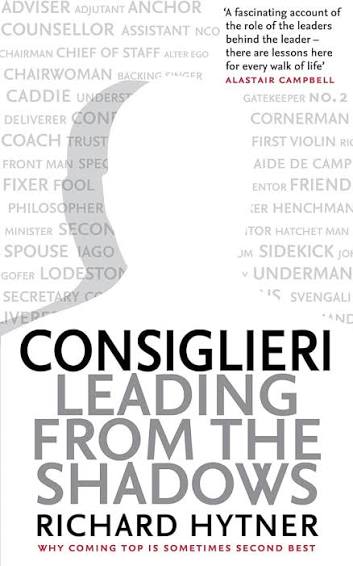
In preparation for his leaving, I read Consiglieri by Richard Hytner. It was recommended to me after a conversation with an Archdeacon about my vocation and leadership style. In that conversation, I found myself repeating a familiar refrain I have said over the years, “I’m just more of a Gordon Brown than a Tony Blair.” It is a generalisation that gestures towards a personal view of myself and my strengths and weaknesses. My natural habitat is not at the podium but in the room behind it, not in the delivery of the speech but in the shaping and phrasing of its argument.

My personality, both as I experience it and whenever I have been ‘profiled’, is one of behind the scenes as an advisor or consultant. I am an INTJ (Myers Briggs), ‘Executive’/‘Innovator’ (Belbin), Type 1 (Enneagram). Gallup Strength Finder identifies my particular strengths in: ‘Input’, ‘Strategic’, ‘Learner’, ‘Achiever’ and ‘Restorative’. Essentially I am best researching, gathering and processing data and information, learning new things and connecting them in creative ways with other ideas. I work independently but need others to feed me information and data in order that I can help the group achieve new things and get jobs done to the highest level.

Last month I shared some ministerial images (click here) that have continued to emerge as ‘narrative setters’: the watchman who surveys the horizon from the walls, alert to shifts and movements that others might overlook. It is the mountain goat, navigating difficult terrain that is inhospitable, not because the lush fields below are wrong or unworthy, but because the path above requires skill, attention, and courage. It is the pioneer, clearing space within inherited settlements so that new life can emerge without abandoning what has been entrusted.

Now, as I welcome a new Dean to Bradford Cathedral I am reflecting again on what this vocational shape looks like in a cathedral context as well as in the wider Church? What might this all mean for me personally and vocationally over the next five, ten, or twenty years? How can this particular instinct inform the design of roles, the formation of communities, and the cultivation of ecclesial attention?


Hytner’s account of the consiglieri rescues the adviser from caricature: the shadowy fixer or manipulator behind the throne. Instead, he presents a figure of judgment, discretion, and relational intelligence. The consiglieri stands close enough to influence, but far enough away not to be consumed by power or pressure. They observe, they test, they counsel; they can restrain without domination, guide without claiming. To use Tolkien language: this is Gandalf.

This resonates with my own sense of vocation. Those vocational images (watchman, mountain goat, and pioneer) are all about careful attention, deliberate navigation and courageous, often hidden, labour. Seeing patterns, holding tensions longer than others and shaping decisions without claiming them all feel profoundly aligned with the way I serve. Yet Hytner’s model assumes a single, clearly defined centre: the leader. Authority, even exercised with wisdom, is derivative. “I” is always in relation to someone else. In the Church, however, authority should rarely be reduced to a single individual. The bishop, priest, deacon, lay leader, etc. exercise particular responsibilities, yet all operate within a wider, relational economy of discernment. Power if done appropriately in the Church is dispersed, mediated by communal practice, and ultimately offered back to God. Leadership is never only a function of personality or office; it is a shared vocation.

Hytner presents the consiglieri as an individual. Reading him ecclesially, however, encourages a subtle shift: from role to rhythm, from individual person to shared practice. My question of Hytner’s assessment is: if the consiglieri’s function is so valuable in a single-leader context, what might happen when it is distributed across a community? What if the quality of spacious, patient attentiveness could be embedded into the culture of, say, a cathedral chapter, a diocese, or in any form of church leadership team? Could the Church itself cultivate the capacity to advise itself faithfully, rather than relying on the presence of a singular adviser to a singular leader?

This is where the various monastic traditions offer insight. Monastic rules have long grappled with the question of authority distributed across community life. Each tradition provides distinct approaches to forming leaders who can hold tension, offer counsel, and shape decisions without resorting to domination.

The Rule of St Benedict (probably the most well known of the monastic Rules) has as its second chapter ‘the qualities of the abbot’. That says something in itself: that after a prologue and a chapter on different types of monks and customs, Benedict decides to outline the role of abbot. What follows is not a job description but a theological vision of leadership as a form of accountable, relational and deeply attentive stewardship. 

I have had the privilege of encountering several Benedictine abbots/abbesses in my time and they never strike me as CEOs or managerial leaders. They, in line with the tone and character of the Rule, “hold the place of Christ” in the monastery. They never hold the position as a claim to authority for its own sake but as, I would say, a profound burden of representation in which every decision is weighed not only for its efficiency but for its justice, its mercy, and its formative impact on the whole community.

Benedict insists that the abbot must adapt to the needs of each member of the community: firm with some, gentle with others, always attentive to the particularity of the person before them. Leadership is agile and adaptable; not flattened into uniformity but stretched across difference, held together by a kind of unifying attentiveness. The abbot is seen less as a controller of outcomes and more a cultivator of the shared life as an environment in which others can flourish. 

Crucially, the abbot is bound into a web of accountability. They must listen to the counsel of the community, especially in matters of importance, as they will give an account before God for how they have exercised his care. Authority is reframed not as possession but as responsibility held in tension: decisive, yet porous; directive, yet listening. The abbot must lead, but they must also be led by the Rule, by the community, and ultimately by God.

What begins to emerge is a model of leadership that resonates deeply with the consiglieri instinct but relocates it within a communal and theological frame. The abbot remains the leader, bearing responsibility and, at times, making decisions that cannot be deferred, but does so as one continually shaped by the counsel of the community. They are not a solitary decision-maker but a leader formed within an advising body.

The attentiveness, discernment, and relational intelligence we might associate with the consiglieri are not concentrated in a single figure alongside him, either. Those qualities are diffused across the life of the monastery and drawn into its leadership through listening. In this sense, Benedict does not eliminate the consiglieri function so much as distributes it. Authority is exercised from within a shared discipline of attention.

It is important to note at this point that the abbot, in most monastic communities, is never permanently set apart from this dynamic. In time, they relinquish the office and return to the community as one among others. Leadership, then, is not an identity to be possessed but a role temporarily inhabited within a wider ecology of discernment. It is this ecology, rather than the individual office, that ultimately carries the wisdom of the community.

Alongside this, the Rule of St Augustine offers a slightly different but complementary vision. Where Benedict begins with the abbot, Augustine begins with the community itself. His Rule opens not with hierarchy, but with unity: “live together in harmony, being of one mind and one heart on the way to God.” Authority is not absent, but it is deliberately de-centred, embedded within a shared life ordered towards charity. The superior is present, but almost understated; what matters most is the cultivation of a common disposition: humility, mutual submission, and a willingness to place the good of the whole above the assertion of the individual will.

Leadership, in the Augustinian frame, emerges from attentiveness to relationship. Correction is to be exercised carefully, privately where possible, always with the aim of restoration rather than control. The Rule resists the temptation to formalise authority too tightly, instead trusting that a community formed in charity will generate its own patterns of accountability. To lead, in this context, is, primarily, about guarding unity: to notice when relationships begin to fracture, when speech becomes careless, when possession or status begins to distort the common life.

The Oratorian tradition, shaped by Philip Neri, introduces yet another inflection. Unlike the more formalised structures of the Benedictine or, to a lesser extent, the Augustinian life, the Oratory resists binding itself to a single, prescriptive rule. Instead, it develops a pattern of life grounded in prayer, conversation, preaching, and pastoral attentiveness, with leadership exercised in a markedly relational and improvisational manner.

Here, the superior holds authority, but it is softened by the ethos of fraternity and friendship. Decisions emerge through conversation, through sustained attentiveness to the movement of the Spirit within the community. Leadership remains responsive to people, to context, to the unexpected. Stability is not abandoned, but held lightly, allowing adaptation without loss of identity.

What is striking in each of these examples is the way the consiglieri instinct becomes almost ambient. It is not concentrated in a role but the community itself becomes a kind of living advisory body, capable of responding dynamically to new challenges without collapsing into either rigidity or chaos. Taken together, these traditions suggest that the same core qualities are being formed, but through more ecclesial grammars.

If the monastic traditions suggest that the consiglieri instinct can be distributed and diffused across a community, then The Undefended Leader by Simon Walker offers a practical framework for recognising how these dynamics take shape in lived leadership.

Leadership,  Walker suggests, operates across two key axes: frontstage and backstage, and strength and weakness. The frontstage is the visible space of action, communication, and decision-making; the backstage is where reflection, processing, and relational work take place. Strength names the capacity to act, decide, and hold direction; weakness, in Walker’s reconfiguration, is not failure but a deliberate openness and an ability to listen, to receive, and to remain vulnerable to others and to God.

In addition, Walker names a third dimension to the four quadrants created by the key axes: expansion and consolidation. Some leaders are oriented towards growth, change, and new initiatives; others towards coherence, stability, and the careful integration of what already exists. Healthy leadership, he argues, requires movement across all of these spaces, rather than over-identification with one at the expense of the others. One should try to identify where their instincts lie so as to remain alert to stagnating in one area or to working too much in ‘natural spaces’.

My own instincts are to sit quite clearly within the frame of backstage rather than frontstage. I tend to prefer the work of consolidating rather than expanding but tend to find these are not opposites so much as interwoven movements, i.e. expanding by consolidating and consolidating by expanding. I also move between strength and a deliberate, attentive form of weakness.

Walker helps to make an important development to our reflections: the backstage is not simply a place one, individually, happens to occupy. It is a location in which particular kinds of work are done. It is where patterns are recognised, where tensions are held without premature resolution, where relationships are tended to, and (this is where it is important) it is where the conditions for faithful and effective frontstage action are formed.

Seen in this light, the “consiglieri instinct” is not merely about proximity to a leader, but about cultivating a capacity to hold and release: to gather insight, to weigh it carefully, and, when the moment comes, to allow it to inform action without needing to control it.

This begins to reframe the challenge for cathedral and Church leadership. The question is no longer simply who occupies which role, but how different modes of leadership are recognised and integrated. Backstage, consolidating leadership is not a lesser form; it is part of the ecology that allows the whole to function. Without it, frontstage leadership becomes reactive, isolated, and, ultimately, unsustainable.

What Hytner identifies in the individual, and the monastic traditions embed in community, Walker names as a pattern: leadership as a dynamic interplay of visibility and hiddenness, strength and receptivity, action and attentiveness.

Returning to the question I began with (what does it mean to have a consiglieri instinct in the Church) no longer feels like a question about role. It is a question of ecology and culture and how the Church learns to cultivate attentiveness, discernment, and relational intelligence not simply in individuals, but within its shared life.

I am not called, as I thought at the start of this year, simply to be a consiglieri. I am called to inhabit that instinct in a way that helps the Church itself become more more attentive, more patient, more able to hold tension without fragmentation or haste. That will mean continuing the work I recognise as my strengths: consolidation, pattern recognition, the careful holding together of people, ideas, and possibilities that do not easily cohere but it will also mean resisting the temptation to allow that work to remain hidden. If it is truly part of the Church’s life, it must, at times, be named, shaped, and even taught.

It may also mean contributing to the way we reimagine leadership in the Church of England more broadly: in cathedral chapters, diocesan teams, and national structures. Not by replacing existing models, but by deepening them and recovering a sense that leadership is not only about visibility or initiative, but about the disciplined work of attention.

Provisionally, but with increasing clarity, I find myself naming this as a vocation: to stand in the in-between spaces where authority is negotiated, unity is strained, and meaning is still emerging and to help hold those spaces open long enough for something faithful to take shape. If that sounds like the work of a consiglieri, it is; but no longer in Hytner’s sense of proximity to a single leader. It is closer to what the monastic traditions suggests as a participation in a shared discipline of discernment.

The watchman does not leave the city; he guards it.
The mountain goat does not abandon the flock; it finds the paths the flock may one day need.
The pioneer does not found a rival settlement; he clears space so that what already exists can breathe again.

In that sense, the vocation is not to stand behind the leader, but to help the Church itself become more fully what it already is: a body capable of attending, discerning, and acting together under God.

Into Culture: Borrowed Portfolios

For the past nine months, amongst other things, I have been holding the traditional Canon Precentor’s portfolio; overseeing the liturgical logistics and the quiet choreography that, together, go into creating the invisible landscape that leads people into worship. As I sat, therefore, in a gathering of Canon Precentors from all the Cathedrals in England and Wales, I felt entirely capable of following the conversation, I could track the discussion, I could contribute and I could even anticipate where some of the pressure points would surface.

It had been a privilege to be invited to join my colleagues and friends. The invitation, in my current situation, however, carried a certain ambiguity because during the introductions the Chair referred to me, kindly and casually, as “our non-Precentor canon.” It landed with a double sensation: recognition and dislocation arriving at the same time. For a moment, if I am honest, it felt faintly like an insult, but I know it wasn’t intended as such. I realised later, reflecting on that repeated sensation throughout the day, that competence and belonging are not always the same thing. I can learn the patterns of a role, I can carry its weight for a season, I can even begin to speak the language with some fluency, but that doesn’t mean the same thing as vocation.

What I felt in that moment was not exclusion. It was something more subtle and, again, if I am honest, more theologically interesting. I was both inside the conversation and slightly adjacent to it. Trusted to contribute but named as other. Which, as it turns out, is not a bad place from which to begin thinking about a larger question that has been quietly gathering weight over the past year for me at Bradford Cathedral: what happens when your ministry becomes defined by the things you are temporarily holding together? Or, perhaps more precisely, how do you remember what you feel called to when the institution quite genuinely needs you to be several other things first?


To understand the question properly, you should know something more of the current context I’m inhabiting at Bradford Cathedral.

This has been, by any reasonable measure, a stretched season: the inevitable frustrations as organisational cultural and strategic change is further embedded, staffing transitions and, on top of that, UK City of Culture year. All of this is the ordinary, unspectacular fragility that institutions can carry more visibly in some years than in others. Aside for the City of Culture, all of these pressures and strains are not unique to us and many cathedrals will recognise the pattern with perhaps more intense financial challenges than we have.

In the space of change, roles begin to behave differently. Over recent months I have found myself covering various significant aspects of leadership in the Cathedral. In addition to inhabiting much of the operational and liturgical responsibility of the Canon Precentor, I have been supporting parts of the events management space, working closely alongside vergers and operations to keep the daily life of the cathedral moving with some degree of grace, and in the last month or so, covering aspects of the Dean’s portfolio.

None of this has felt inappropriate. Still less has it felt unwelcome. There is something deeply proper about stepping into the gaps that inevitably appear in any living institution. Cathedrals, perhaps more than most ecclesial bodies, run on a kind of invisible elasticity. People stretch. Roles flex. Goodwill does a remarkable amount of heavy lifting. If you have spent any time in cathedral life, you will know this instinctively. Job descriptions are worked from, not to and the reality is a web of relationships and responsive adjustments, but elasticity, if sustained indefinitely, begins to carry its own cost. The real danger, in times like this is vocational amnesia.

There comes a point (and it rarely announces itself loudly) when the necessary act of holding things together begins quietly to reshape how you are perceived, and eventually how you perceive yourself. What began as provisional cover starts to solidify into assumed identity.

I have become increasingly aware that the inherited model of residentiary canon roles presumes a level of boundary clarity that contemporary cathedral life does not always permit. The assumption is that it is possible to have distinct portfolios, relatively stable domains of responsibility and a certain institutional tidiness. I have found that it is much more porous than that and porous leadership is not, in itself, a problem. In fact, there is something ecclesiologically healthy about a clergy team that can flex, respond, and redistribute energy where it is most needed. The Body of Christ is always spoken of organically and not in mechanistic terms; it was never meant to operate as a set of sealed compartments.

But…

Porous must not become formless. Without some intentional attentiveness, flexibility can slide into diffusion and responsiveness can become reactive drift. Individuals who are temperamentally inclined to say “yes”  (and I include myself in that category) can wake up to discover that their ministry has slowly reorganised itself around institutional necessity rather than a vocational centre.

Augustine, who has become a regular companion in my own thinking, is helpfully perceptive at precisely this point. One of his most enduring contributions to Christian moral theology is the idea often summarised as the ordo amoris (the ordering of loves). He developed this idea most clearly in his De Doctrina Christiana and within his vast argument of The City of God. The idea is deceptively simple. The problem with human beings, he suggests, is not usually that we love bad things outright. It is that we love good things in the wrong order, with the wrong weight and/or with an urgency that quietly displaces what should properly come first.

For Augustine, wisdom is not primarily about intensity of devotion but about proportion. We are created to love God above all and to love our neighbour rightly. Created goods are to be received gratefully, but not allowed to occupy the centre of our attention. Disorder creeps in not only through obvious vice but through subtle misalignment of what we prioritise.

It is disarmingly searching when I apply it to what I have been doing over the past nine months. Supporting colleagues, sustaining worship, ensuring the cathedral’s daily life continues to function with integrity; there is nothing here that Augustine would want to rebuke. In fact, much of it is, in itself, unquestionably good and yet the Augustinian question presses gently but persistently: what happens when everything becomes equally urgent, every portfolio feels temporarily necessary and when the immediate institutional need begins to flatten the hierarchy of attention?

Borrowed responsibility, if we are not careful, can begin subtly to dis-order calling. Not dramatically, and not through any obvious failure of faithfulness, but through a slow recalibration of where energy, imagination and identity are most consistently invested.

There is another layer here which intersects with what I have elsewhere called inclusive othering. In that moment in the Precentors’ Conference, I was inhabiting a curious vocational liminality. I was fully engaged in the work but not fully located within the identity being named around the table. I was both participant and, gently, an outsider. The temptation at such moments is usually to resolve the tension too quickly. Either to insist on full belonging or to withdraw into defensive distance. Neither move feels particularly right to me.

Cathedral life, it seems to me, increasingly requires the capacity to remain present within such tensions. Many of us residentiary canons are operating in spaces that are neither entirely ours nor entirely alien. The institutional map no longer corresponds neatly to the portfolio shaped assumption of previous generations. Which is where, again, provisionality becomes not just descriptive but theological.

Bradford, at present, is living through a genuinely provisional season (I have begun to argue that we will always be doing so). Decisions are being made with partial information and structures are being held lightly enough to adapt. There is, if we are honest, a fair amount of holy improvisation taking place, which, for me, is great. Improvisation, however, still requires a key signature.

The Church, at it’s best, has always known how to live provisionally. The danger comes when the provisional quietly hardens into the assumed, or when the temporary becomes so extended that we forget it was ever meant to be temporary at all.

It would be easier, at this point, to resolve the tension neatly. To say either, “this is simply the season we are in; get on with it,” or, “this drift must be corrected immediately; redraw the lines.” The truth, as usual, is less obligingly tidy.

I am deeply grateful for the trust that has been extended to me over this past year. There has been real joy in some of the work. Real satisfaction in helping to steady parts of the cathedral’s life during a time of transition. I have learnt things I would not otherwise have learned. Seen the institution from angles that have sharpened rather than diminished my affection for it. None of that is to be forgotten or remain unsaid. Yet, alongside the gratitude there is a slowly growing awareness, not quite resentment but of gravitational drift. There is a quiet sense that the centre of my ministerial energy has shifted, almost imperceptibly over time, and will continue to do so if it is not occasionally re-examined.

The truth is, I can do many things, but competence is not vocation.

I have found myself recently returning to an idea from Jostein Gaarder’s The Christmas Mystery. He suggests ‘there are two ways of becoming wise.’

One way is to travel out into the world and to see as much as possible of God’s creation. The other is to put down roots in one spot and to study everything that happens there in as much detail as you can. The trouble is that it’s impossible to do both at the same time.

Jostein Gaarder, The Christmas Mystery (London: Phoenix, 2004) p.55

I suspect part of what I have been feeling at Bradford is not simply the pressure of workload but the quiet pull between these two wisdoms. Over the past nine months my ministry has necessarily leaned toward the second mode: staying, tending, stabilising, noticing the fine grain of how the cathedral’s daily life actually holds together. There is real grace in that work but, if I am honest, much of the energy that has historically animated my priesthood lives closer to Gaarder’s first path. I am most alive when I’m learning something new, finding new connections between ideas, mining different disciplines of thought for ‘the theory of everything’. Which is another way of saying: I can inhabit the rooted work for a season. I am less convinced I am called to live there indefinitely.

What has been slowly surfacing for me over these months is not the discovery of a new vocation but the reappearance of a very old one. Every few months it seems to return, usually when institutional life has required me to settle more fully into maintenance mode than I instinctively inhabit. At first it comes as a mild restlessness, then as a question I cannot quite silence and eventually, if I am paying attention, as a recognition.

I have been here before.

Over the years I have reached for different images to name that vocational nudge, each one catching part of the truth but never quite exhausting it. Sometimes it has felt like standing on the walls as a watchman, scanning the horizon not because danger is certain but because someone needs to pay attention to what is coming into view. This is the language of the prophet, not in any grand or dramatic sense, but in a quieter, more uncomfortable calling to notice what others might prefer to step around.

At other times the image is less dignified and more like a mountain goat picking its way across harsh and uncertain terrain while, somewhere below, the sheep graze contentedly in the lush fields. It is not that the fields are wrong, still less that the sheep are foolish. It’s only that I seem constitutionally drawn to the challenging environments where the air is thinner and the footing less secure.

Then there remains in my imagination something of the pioneer, repeatedly finding myself drawn toward spaces where something new is trying to emerge and where the path, if there is one, is not yet clearly marked. If that particular image risks sounding like a love affair with novelty, then that needs correcting. My instinct has never been toward the new simply because it is new. Nor am I interested in dismantling what is old in order to feel prophetic. The tension I experience is not between stability and adventure but between different forms of fidelity.

I find myself returning, again and again, to the words of Oscar Romero, who warned that unconditional attachment to what is old can hamper the Church’s progress and restrict its catholicity, while an unbounded spirit of novelty becomes an impudent exploration of what is uncertain and a betrayal of the Church’s rich inheritance. His conclusion was neither reactionary nor reckless: “think with the Church.”

That phrase has always mattered to me. To think with the Church is not to freeze it in time, nor drag it impatiently into whatever appears fashionable. It means to love it enough to help it renew itself from within. Which means that the watchman image is not about abandoning the city but guarding it. The mountain goat is not scorning the lush field below but navigating terrain the flock will one day need to cross. The pioneer, if that word is to be used at all, is not founding a rival settlement but clearing space so that the old settlement can breathe again.

This is why the tension in this season feels more complex than a simple pull towards adventure in opposition to staying put. My passion for the intellectual and strategic exploration has always been inseparable from a desire for institutional reformation and detailed correction.

It is not accidental that many of the Church’s reforming figures that I have been drawn to lived precisely at this intersection. Augustine did not set out to invent a new Christianity; he wrestled to recalibrate inherited faith in a moment of crisis. Martin Luther did not begin by founding a new ecclesial body; he began by calling the existing one to account. In different centuries and under very different pressures, both stood uncomfortably close to the centre while also refusing to ignore what they saw on the horizon. Reform is rarely born from detachment or abandonment but emerges from those who love the institution enough to risk standing at its fault lines.

If these reflections were simply about my personal internal bandwidth or external capacity it would not be worth a whole blog post. What I suspect may resonate beyond my own ministerial balance is the larger ecclesial as well as the nuanced vocational questions that sit underneath my current lived experience.

What if residentiary roles in cathedrals were shaped more explicitly around charism rather than merely function? What if cathedral chapters became more intentional about naming when elasticity is a short-term grace and when it is quietly becoming a long-term distortion?

None of this requires a retreat into rigid role protection. That would be neither realistic nor particularly faithful to the collaborative instincts of cathedral life at its best. It might, however, require a more deliberate attentiveness to the difference between the roles we can faithfully cover and the vocations we are actually called to inhabit over time.

The question before me, at least, is not whether I am called to the edge or to the centre, but how to inhabit the edge in order to serve the centre faithfully.

Bradford, for all its current pressures, has often shown a willingness to experiment in this kind of space. There is room here, I think, for some careful, hopeful reimagining of what residentiary life might look like in a more fluid ecclesial landscape. Perhaps something more consciously aligned with the particular gifts that each canon brings into the shared life of the cathedral.

I find myself returning, as I close, to that conference room moment and the phrase that has lingered longer than I expected: “our non-Precentor canon.” There was no need to resist the description; in a straightforward sense, it was true, but the more interesting question is not whether I am or am not a Precentor. It is whether, in this stretched and searching moment, we might learn again how to recognise the difference between the responsibilities we faithfully hold for a time and the vocations we are actually being called to remember.

Some priesthoods are shaped primarily in the centre of the field. Mine, it seems, keeps being led back to the edges of the hill not to abandon the flock, but to help the whole landscape breathe again.

Into Culture: The Tiber

Last month I wrote about some indirect criticisms I received following my appearance on the BBC Christmas service from Bradford Cathedral (here). Many have since felt the need to jump to my defence and, in doing so, have fallen foul of the very danger I was trying to name in that reflection. In navigating the conversation that followed, and in trying to attend carefully to the kind of posture I am attempting to cultivate in polarised public debate, I have found myself returning to an earlier, more controversial post on the Anglican Communion.

In that post I explored my sense that the Anglican Communion has lost sight of the need for theological rationale to its polity. That idea was entirely overlooked by some readers and critics due to my, admittedly, sloppy framing of the argument, with an under-researched statement about Archbishop Sarah Mullally. Debate became fixated on my perceived position on gender and cultural and political alignment, rather than on the question I was actually trying to raise.

What I still find interesting (and revealing) is not simply that the argument was missed, but why. Why was the conversation so quickly drawn toward identity, representation, and position, and so reluctant to engage the deeper claim? Might it be because there is already a widespread and often unexamined acceptance that the Church of England has, as several critics of my Christmas Day appearance put it, “lost its way”? And might it be that we are not yet ready to reflect on the theological anaemia that makes such loss possible?

These questions were reignited when I recently watched a video in which a General Synod member for the Diocese of London was strongly defending the view, ‘as an elected member of General Synod’ (as though that gives a person moral authority), that abortion is not the killing of a human being. When the interviewer asked the member of Synod whether they believed that Jesus was fully human in the womb and from the moment of conception, the responder faltered. There was a stutter and then silence.

The interviewer went on to outline, theologically, the argument against the Nestorian heresy, and why the moral position of the person defending abortion as not the killing of a human being might be problematic. The silence that followed was painful to watch. What struck me was the confidence with which election to General Synod was invoked, and the apparent belief that the political process to the privileged position in the conciliar life of the Church of England automatically granted them authority to shape its doctrine without any corresponding sense that theology might interrupt, challenge, or even judge what is being said.

It is this same lack of confidence in theological rigour among those discerning and debating the doctrine, faith, and order of the Church of England, and in a lesser way the Anglican Communion, that lay at the heart of the post that became more about the person of Sarah Mullally rather than about the deeper principle I was trying to name: theology is no longer even assumed to be a necessary consideration when appointing, or authorising, those who shape the life of the Church.


I have wanted to read Holly Ordway’s Tolkien’s Faith since listening to her podcast interview back in 2024. At the start of this month, I finally managed to get round to delving into this unique biography of a man whose literary output has inspired me in multiple ways. This biography is not a recitation of the chronology of his life nor a decoding of his fictional Middle Earth and its characters. It is, instead, a search for the spirituality of Tolkien and how that was expressed, yes, in his fictional writing, but more insistently in his letters, relationships and decisions.

Halfway through reading this 480-page book I began to feel a growing unease and dissatisfaction. Tolkien’s own approach, his seriousness, towards his Catholic faith and how that informed his academic work, as well as his literary writing, stirred something in me. It enlivened a deep, perhaps slightly romantic, longing for a form of academic life where theology is not an optional add on but is unapologetically a governing discipline. It was the people and saints that Tolkien lauded and was inspired by, however, that really touched a nerve. Figures such as John Henry Newman, in particular, whose theology and spirituality have long resonated with me. These were not simply historical influences for Tolkien; they were living interlocutors that shaped his moral imagination and intellectual posture. For someone who was once Catholic and later became Anglican, such figures have also given shape to my own ecumenical instincts

The unease began to formulate into a question to myself, “Why do so many Anglicans, ‘cross the Tiber’ and become Roman Catholic?”

Now there are lots of obvious reasons why, particularly in Tolkien’s time, this has been common: Anglican cultural dominance and Catholic social martyrdom that lead to a quiet heroism of dissent, etc. As someone who has travelled against the stream the other way, I did find myself wondering whether I had made a mistake. Which Anglican ancestors do I look too who made a similar choice to move away from the Magisterium and historic centre of gravity of the Church, towards the Anglican polity and (I do believe there is one) theology?

This is why, in part, I followed my reading of Tolkien’s Faith with Paul Avis’ The Identity of Anglicanism. I am thankful, as ever, for Avis’ writing and passion. This book grounded me back in the church I intentionally chose and continue to choose, despite the weakening of its self-confidence or self-understanding.

And yet, reading Avis alongside Ordway, I was still left with some troubling questions: does Anglicanism possesses theological depth and coherence? Does it have the resources to sustain seriousness of doctrine, faith, and order and why does it so often speak of itself as though it does not? Why is confidence in Anglican theology so fragile, so quickly displaced by process, representation, or political legitimacy? And why, when theological questions press most urgently, do we so often reach first for mechanisms of governance rather than habits of thought?

There is one piece of analysis that Avis offers that particularly chimed with me: Anglicans are prone to describe their own tradition as incoherent, provisional, or as a pragmatic result of history. Proponents of this view (some of which I hold in high regard, like Michael Ramsay) often offer this self-deprecation as a mark of humility, or even generosity. But, like Avis, I am not convinced that either is true.

In the preface of my book, Ash Water Oil, I wrote,

The curses spoken over the Bride of Christ have been so constant that it is rare to hear her speak positively of herself. She has become so self-critical that she has begun to talk only of a complete make-over akin to surgical enhancements and distortions.

Ned Lunn, Ash Water Oil: why the Church needs a new form of monasticism (Sheffield: Society of the Holy Trinity, 2020) p. xv)

This habitual tendency of the Church of England, in particular, reveals, to my mind, a lack of confidence in, and a reluctance to speak clearly about, doctrine. Avis reminds his reader that when the debate around the ordination of women was had in the 1980s, ‘the Doctrine Commission was not put to work on any doctrinal implications; the Faith and Order Advisory Group was not consulted about the ecclesiological and ecumenical aspects; and the General Synod did not take the opportunity to set up a commission of all the talents that could have examined the theological, ecumenical and pastoral arguments for and against.’  He then goes on to say that when it came to the debate on women’s ordination to the episcopate, on the other hand, there were theological resources produced, but the process and use of these resources was ‘half hearted’ (Paul Avis, The Identity of Anglicanism (London: T&T Clark, 2007) p.119).

This is why the video of the General Synod member begins to feel less like an isolated moment and more like a symptom of something larger. What was striking was not the position being defended, nor even the faltering silence that followed the interviewer’s Christological question. It was the apparent assumption that election itself conferred to them an authority to speak decisively on matters that are, at their heart, doctrinal. That a political process within the Church could grant moral standing without any corresponding obligation to theological coherence, was the question I was trying to raise in my poorly framed post on the Anglican Communion.

When theology as a guiding discipline is no longer trusted to carry authority, something else must inevitably takes its place. What we now seem to rely on are the mechanisms of governance: election, representation, process, public opinion and mandate. These are not wrong or unimportant; they are necessary to any social order, but they cannot bear the weight we are increasingly asking them to carry. When procedural legitimacy is allowed to stand in for theological judgement, the Church risks confusing how decisions are made with whether those decisions are right or true.

This helps me to understand why my earlier post was so readily reframed as a comment on gender or cultural and political alignment. Those are the categories we have learned to reach for; they are familiar and seemingly more intelligible. Theology, by contrast, is slower, more demanding, and far less easily mobilised. To engage it seriously would require us to admit that not all questions can be resolved by process alone, and that some forms of authority are not conferred but received.

I agree wholeheartedly with the view that a strength in Anglicanism is its provisionality. Where I disagree with those who use it to underplay the need for theology to become a governing discipline of our life together, is in what areas we can claim, with confidence, that provisionality. The disagreement is not, therefore, about whether Anglicanism is provisional, but about what provisionality is for.

They have described it as incomplete, temporary and destined to lose itself in a greater whole. This sounds rather noble and altruistic until we ask whether there are, in fact, any extant expressions of the Church that should not be regarded as provisional but as final and permanent.

Avis, The identity of Anglicanism, p.156

Augustine’s use of the concept of provisionality is different to the one outlined in Avis’ characterisation of his opponents. Provisionality, for Augustine, is not an excuse to fall into a state of impasse or uncertainty. Rather, it is the opposite. It is the reason to keep striving towards greater understanding and into deeper communion with the mystery at the heart of our faith.

I guess we all have a tendency to be selective as to what we want to resolve and what we’re happy to remain open and curious about. I acknowledge that I’m more ready to pursue the complexity and sit with it longer than most when it comes to philosophy and theology (as explored in Pursuing Mystery). At the same time, I also admit that when uncertainty touches more relationally or personally I push for definition and resolution.

What I felt reading Ordway’s description of the Tolkien’s faith and the wider Catholic Church in his day, was a deep and sustained seriousness about the primacy of coherent and historically rooted theology that can hold throughout the ebbs and flows of public opinion and cultural change. The reason, however, that I left the Roman Catholic Church was its tendency to be too inflexible to reason and ressourcement. Anglican theological methodology sings when it ‘tries neither to be centralized nor fragmented, neither authoritarian nor anarchic. It is comprehensive without being relativistic.’ (Avis, The identity of Anglicanism, p.169)

Our current social media-driven world demands quick certainty. Positions and statements are better than ongoing dialogue, relational discernment and deeper appreciation of the beauty of mystery. It is my hunger for a life centred on the experience of communal and ecclesial discovery that inspires me about Tolkien and his influences. What keeps me Anglican, however, is the conviction that its tradition still carries resources we have not finished using, questions we have not finished asking, and a seriousness we have not yet relearned how to inhabit. The question is not simply why some Anglicans leave, but whether those who remain are prepared to do the work that staying now requires.

To remain Anglican at this moment, then, is not an act of complacency but of labour. It requires resisting the temptation either to apologise for the tradition or to abandon it in search of firmer ground elsewhere. It asks something harder: the willingness to stay and to insist, gently but persistently, that theology matters: not as ornament, but as orientation.

That work will not be accomplished by louder processes or more efficient governance. It will require the slow recovery of theological confidence. Not certainty, not rigidity, but the confidence to allow doctrine to interrupt us, to judge us, and, at times, to leave us momentarily silent for the right reasons.

Into Culture: Between Humours

On Christmas morning I stood in the Cathedral and read the Gospel. I did not simply read it aloud; I ‘performed’ it. I moved between voices, I was an angel, I had a small rod puppet shepherd, and then there was the holy family. I was conscious that this story is not an abstract text but a narrative meant to be heard and inhabited.

There was a moment, brief and intentional, where the oddness of the scene was acknowledged: I, a bearded man, had to embody a pregnant Mary. The biblical text stated it, twice. Rather than pretending otherwise, I named it. People laughed, gently. The laughter was not the point; what followed was. The room relaxed. The congregation listened. In that moment something unspoken was shared: a trust that we were listening together, not auditioning one another for ideological purity.

For many in the room and, indeed, some familial viewers at home, my reading was a highlight; a focal point around which the rest of the service hung. I had worked with the BBC to ensure that it was the gateway to the liturgy, the sermon and the music.

Later that morning, on my phone, I encountered a different reception of the same moment.

On social media, particularly on X, the Gospel reading was redescribed in language I barely recognised. It became “prancing”. It became “a man pretending to be pregnant”, as though I were making a pro-trans statement. It became evidence that the Church had “lost its way”. One comment suggested that people like me were “mentally ill” and should not be given a platform on Christmas morning. Others contrasted the service with a more solemn broadcast elsewhere, as though Christianity were a consumer choice between aesthetic packages.

I was not especially hurt by this (maybe a little!). What struck me more was how quickly the moment was absorbed into a wider narrative that had already decided what it was seeing.

Why did this particular reading of the Gospel become a flashpoint? Why was humour interpreted as mockery rather than hospitality? And why did Christmas, once again, become the moment when Christianity was enlisted into cultural battle lines that long pre-dated the service itself?


I want to be clear about my intention here. I want to avoid simply justifying myself, but because intention and reception are now so rarely allowed to meet, I want instead to explore how our culture, shaped by the speed and incentives of social media, has become so individualised that any sense of sociality is quietly eroding. Grace, space, and curiosity are skipped over in favour of statement and performed certainty.

The humour in that Gospel reading was not there to provoke or to undermine reverence. It was there because I know how people listen. I know how easily attention can become trapped by surface strangeness, by the question of why this is happening rather than what is being said. By naming the oddness up front, I was trying to release the congregation from it. The humour functioned as a pastoral gesture; it said: you do not need to fixate on this, you can stay with the story.

In the room, that is what happened.

Online, the gesture was read very differently, either deliberately or through a lack of imaginative practice. What had been an attempt to open space became, in some accounts, evidence of contempt. The humour was not simply missed; it was reinterpreted as threat.

This is where social media culture becomes significant. Humour depends on trust, shared presence, and a willingness to be vulnerable together; it assumes a mutual commitment not to rush to the most hostile possible reading. These are precisely the things platforms are least able to sustain. Online, context collapses, intention is flattened, and the most suspicious interpretation is often the most rewarded.

It would be easy to attribute this simply to bad faith or a lack of imagination. But something more structural is at work. We are increasingly shaped by environments that discourage curiosity and train us to interpret quickly, defensively, and alone.

The reaction to the Bradford service did not occur in a vacuum. It came amid an ongoing argument about Christianity, nationalism, and belonging, sharpened recently by the controversy surrounding a carol service associated with Tommy Robinson.

Some Church of England clergy were quick to condemn that service, framing it as a distortion of Christianity and a capitulation to racism or extremism. In response, others accused the Church of despising the working class, of sneering at Reform voters, of aligning itself with a liberal elite that no longer understands national loyalty or cultural loss.

What struck me was how quickly both sides reached for caricature.

On one side, supporters of Robinson were reduced to racists or reactionaries, their fears dismissed as morally illegitimate. On the other, clergy and institutions were portrayed as decadent, faithless, and contemptuous of “ordinary people”. In both cases, the same move was made: complex human motivations were collapsed into moral shorthand, and with that collapse came the withdrawal of any obligation to listen.

This is where I find myself increasingly unable to stand comfortably with either camp.

I have no interest in baptising nationalism, nor in pretending that Christianity belongs naturally to any ethnic or political identity. But neither am I convinced that the Church serves the Gospel well when it treats national feeling, cultural grief, or anger at social change as inherently suspect or morally inferior.

Both responses are animated by fear. Both seek clarity through exclusion. Both prefer the certainty of an enemy to the risk of uncomfortable understanding. In different ways, both sides step away from a shared responsibility to treat one another as participants in a common moral world, rather than as symbols to be managed or threats to be neutralised.

The tragedy is that each believes it is resisting precisely what it is mirroring.

Social media does not create these dynamics, but it dramatically intensifies them once they are fed into the system. Platforms reward certainty over curiosity. They reward speed over attentiveness. They reward moral performance over moral risk. Across ideological spaces the same pattern appears, though it wears different clothes. Progressive platforms reward denunciation dressed as justice. Conservative ones reward outrage framed as defence.

In both cases, distance is created quickly. People become avatars rather than neighbours. Disagreement becomes pathology. The language used against me, particularly the leap to mental illness, is not unique. It is a familiar tactic across ideological lines: to name something as sick is to absolve oneself of the obligation to listen.

What concerns me most is not the aggression itself, but how readily it is normalised, including by Christians. Well-meaning colleagues on the left, myself included at times, can assume that the right kind of moral clarity excuses a lack of charity. Those on the right, again including myself at times, can assume that defending tradition excuses a lack of self-examination. Social media offers both sides endless opportunities to reinforce their own virtue by refusing complexity.

It would be easy at this point to conclude that X is simply broken, that the loudest voices are marginal, and that nothing of value is being lost. But that conclusion feels too easy, and too costly.

The sadness is not that people were angry. It is that the informal agreements that make shared life possible, the habits of patience, generosity, and interpretive restraint, feel increasingly thin. To dismiss these exchanges as inevitable noise is to accept the erosion of a social contract we rarely name because it once felt so obvious: that we owe one another enough time, care, and attention for meaning to emerge at all. The loss is not merely of civility, but of a common life in which faith, disagreement, and imagination can still meet.

So where does this leave me?

It leaves me deliberately standing in a space that is uncomfortable and increasingly unpopular. A space between easy alliances. A space where difference is acknowledged without being weaponised, and unity is sought without pretending differences do not matter.

This is not neutrality. It is a commitment of a different kind.

It means refusing to dismiss those who reacted angrily to the service as simply bigoted or backward, while also refusing to allow anger and fear to define the boundaries of Christian faith. It means challenging colleagues on the ecclesial left when critique slips into contempt, just as it means challenging nationalist readings of Christianity that collapse the Gospel into cultural defence.

It also means continuing to take risks in worship, not as acts of provocation, but as acts of trust; small, embodied ways of repairing the fragile agreements that allow us to listen to one another at all. Trust that the Gospel can survive misunderstanding. Trust that the Church does not need to harden itself into a single cultural posture in order to remain faithful.

Christmas does not offer us control. It offers us presence.

Social media will continue to demand sides. It will continue to reward outrage and simplify complexity. But the Church still has choices to make: about how it speaks, how it listens, and where it is willing to remain when misunderstanding arises.

The Gospel suggests that God does not resolve conflict by choosing a faction, but by inhabiting the space between. Perhaps the task now is not to shout louder from one trench or another, nor to abandon the public square altogether, but to stay, patiently and vulnerably, in that difficult middle ground where listening is still possible, where shared responsibility has not yet been surrendered, and where incarnation, against all odds, continues to take place.

Into Culture: Long Form Virtue

Fool(ish), the long form improv group I am a part of, returned to York Theatre Royal’s Old Paint Shop season last month. We decided to abandon the last vestiges of the safety net of short-form improv: the quick-fire sketches based on games that reflect the pace and fashions of our social media culture. Instead, we committed to the slower discipline of long-form, trusting that an audience who might never have seen it could stay with us through discovery rather than direction.

The second half was a Lugares, a form we have adapted that begins with us ‘painting’ the outline of several spaces in a location: describing in detail the discreet environments that we will then populate with pairs of characters. We then discover, through inhabiting the spaces and responding to how we interact with the context and the other person, ordinary people whose lives overlap in small, surprising ways. Over 40 minutes, those fragments of stories return and interweave. A shared world emerges almost imperceptibly until, in the final scene, everyone gathers in the one location left untouched, and the web reveals itself. There’s no script, no plot to aim for, only attention, listening, and trust that meaning will arise from relationship.

My first scene that night in York began in silence. I sat, flicking through a mimed Yellow Pages; my fellow performer entered, quietly miming the ritual of making tea. For nearly a minute we said nothing but all were aware that that didn’t mean nothing was happening. When I finally spoke, a comment about a plumbing firm’s bad pun based name, the audience laughed because it came from an established place not explained to them but still known. Something human had appeared amongst us without words.

In that minute of silence, I remembered why I love improvisation. It isn’t the cleverness of invention but the trust of discovery: the way characters and relationships come alive before plot, the way truth surfaces when no one forces it. The scene was mimed, yet it spoke volumes.

Later, I found myself wondering why that silence had felt so alive. Why do we spend so much of our lives trying to explain, defend, and declare what we mean, when sometimes meaning only emerges when we stop speaking?


So much of what passes for communication today feels like the opposite of that moment. Everywhere, we are told to “find our voice,” “make our case,” “speak our truth.” We live in a culture that prizes expression above all else. Virtue has become performative. To care rightly, one must post about it. To belong, one must declare allegiance. Even silence must be justified with a statement explaining why one is silent.

It is not that speaking out is wrong. It’s that the moral imagination of the West has become addicted to visibility. We equate articulation with authenticity. The louder and more urgent the performance of virtue, the more ethically alive we feel. But like short-form improv, this constant performance of moral clarity leaves little space for depth or discovery. The characters we play are two-dimensional, designed to land a point rather than reveal a person.

In my previous Into Culture reflection, A Communion Between Trenches, I described the growing pressure on Church leaders and cathedrals to take stances on every issue. There is an expectation that bishops must act as moral activists and cathedrals as platforms for campaigns. The assumption is that if the Church isn’t making a public noise about justice, it isn’t being faithful. Yet this demand to perform moral virtue can easily become another form of cultural conformity: a noisy mimicry of the world’s way of being right.

Our culture’s obsession with moral expression often disguises a fear of interiority. We prefer the quick applause of alignment to the slow work of conversion. The philosopher Byung-Chul Han notes how modern life has abolished mystery: everything must be made visible, explained, confessed. Silence is treated as guilt; opacity, as deceit. This insistence on total expression, Han warns, leads not to truth but to exhaustion. 

And yet, truth often hides itself in silence. The deepest transformation is rarely able to be declared. Think of the stillness before dawn or in a monastery, where prayer takes the form of breathing; or the long pauses at a deathbed, when words fall away and only presence remains; lovers reconciling not through eloquence but through the quiet willingness to stay in the room. In each case, silence is not absence but gestation (note the same etymological root to gesture) where meaning gathers itself before being spoken.

The mimed improv scene at York wasn’t about withholding speech; it was about trusting the silence enough to let meaning arise. The audience wasn’t excluded; they were invited in. They became co-creators in the quiet. There’s something profoundly ethical in that. It’s a shared act of vulnerability: will we stay with this moment long enough for it to become real?

That same question haunts our public life. Can we, as a society, stay with ambiguity long enough for genuine understanding to emerge? Or are we too impatient, too anxious to demonstrate that we are on the right side of history, theology, or politics?

Ethics in our time has become an exercise in performance anxiety. We are constantly auditioning for moral approval. The Church, too, risks confusing proclamation with performance; mistaking the saying of good news for the showing of costly grace.

Improvisation offers another way. It begins with listening. TJ and Dave, the Chicago duo whose work is shaping our group’s ethos, start every show with the words, “Trust us, this is all made up.” But what they model is not chaos; it’s attentiveness. They prove that the richest meaning comes not from premeditated plots or premises but from a deep faith in relationship. Every gesture, every silence, every hesitation becomes an invitation. The ethic is not “How do I express myself?” but “How do I attend to what’s being offered?”

It’s here that I find both inspiration and tension with theologians like Stanley Hauerwas and Samuel Wells, who have long drawn on improvisation as a model for Christian ethics. For them, the Church’s moral life is like an act of improvisation: we inhabit a story whose script is Scripture, learning the habits of virtue by rehearsing within its narrative. This has been a deeply generative image, restoring ethics to the communal, embodied, and narrative. Yet the language of “script” carries a danger. A script, however sacred, can become a closed text tempting us to control rather than trust, using it as a mechanism of checking each move against a fixed storyline. In theatre, such ‘blocking’ kills the scene; in theology, it can stifle the Spirit.

Scripture, by contrast, is not a theatrical prompt. It is not a set of lines waiting to be recited, nor even a set of stage directions. It is embodied story: the living account of God’s continual improvisation with creation. It is a rule in the older sense of regula: a dynamic pattern that guides growth, not a fence that polices boundaries; not to shut down improvisation, but to form us in the habits of divine responsiveness. To live by Scripture, then, is not to recite it but to breathe with it, to let its rhythm tune the body’s movements. We do not protect the story by freezing it; we keep it alive by trusting that God still speaks through its silences.

To treat Scripture as script risks turning the moral life into a performance of correctness. To receive it as rule is to participate in God’s ongoing offer. In theatrical terms, Scripture is not the script that dictates our next line; it is the offer that invites our faithful “yes, and.” It’s the grace to respond.

Walter Burghardt writes that contemplation is “a long, loving look at what is real” (Walter Burghardt, Graying Gracefully (Kentucky: Westminster John Knox Publishing, 1997) p.19-26). It’s a description that could just as easily define good long-form improv. Both demand patience, attention, and the courage not to fill the air too quickly. The contemplative, like the improviser, learns to wait for meaning to arise rather than manufacture it. Hauerwas is right when he writes,

…performance that is truly improvisatory requires the kind of attentiveness, attunement and alertness traditionally associated with contemplative prayer.

Stanley Hauerwas, Performing the Faith (London: SPCK, 2004) p.81

Thomas Merton echoes this rhythm of attentiveness when he says,

When we have really met and known the world in silence, words do not separate us from the world nor from other men, nor from God, nor from ourselves because we no longer trust entirely in language to contain reality.

Thomas Merton, Thoughts In Solitude (Boston: Shambala Publications, Inc., 1993) p.93

Silence, then, is not the absence of language but the condition in which real communication becomes possible.

Our culture, by contrast, performs a kind of short-form improv with truth. Scenes begin with bold declarations: “This is who I am,” “This is what I believe,” “This is what’s wrong with the world”. The problem is, no one stays long enough to see what might unfold if we simply waited, listened, or allowed another to reshape our offer. Each line must land a punch or signal virtue before the next topic begins. The result is what improvisers call talking heads: scenes where characters explain themselves rather than relate to one another. We mistake articulation for authenticity, commentary for connection.

In the monastery (and in good improv) something different happens. Words become secondary to presence. The silence between gestures is not dead space but the field where relationship takes root. Both the monk and the improviser resist the temptation to control the scene. They trust that truth will appear if they attend to what is given rather than impose what they expect.

This contemplative stance is the exact inversion of our cultural instinct. We are trained to perform certainty; the monk learns to dwell in unknowing. We seek applause for instant clarity; the contemplative waits for grace to surface through obscurity. Where society rewards the loudest voice, the monastic tradition honours the quietest attention.

Such silence is profoundly active. It refuses to reduce encounter to statement; it withholds commentary long enough for communion to happen. It resists the violence of words that restlessly attempt to make reality yield its meaning too soon. In both theatre and theology, the urge to explain everything can kill what is alive. The scene dies the moment we decide what it’s “about.”

To be silent before God, as in good improvisation, is to trust that the next moment will come as gift. It is a prophetic refusal to play the world’s favourite game of short-form virtue: a noisy succession of moral one-liners, choosing instead the long-form patience of divine story.

This long-form attention is not reserved for monks or improvisers. It is the moral imagination our culture has forgotten, and one the Church must remember on behalf of the world. If the monastery is where this discipline is learned, then the cathedral is where it must be shown. What the cell cultivates in solitude, the nave can offer in public: a space large enough for silence to be shared.

Perhaps cathedrals could become cathedrals of attention: places that teach the city how to listen. Their very architecture already whispers this vocation. The high nave slows the body; the echo of footsteps demands patience. Light and stone conduct a kind of liturgical silence even when no service is taking place. Yet we too often rush to fill that space with programming, commentary, and noise, as though stillness were failure.

Cathedrals, like many institutions, face pressure from media, dioceses, and even from within, to prove relevance through activism. Every controversy demands a statement; every crisis, a campaign. But prophetic witness may require a different kind of courage: the courage not to perform.

What if cathedrals offered, instead, a public quiet: a civic silence that neither withdraws nor shouts but reveals another rhythm of being human? In a fragmented world, silence might be the most inclusive language we share. It holds the possibility of what I have called inclusive othering: acknowledging difference without domination, presence without possession. Silence says, “you belong, even when I do not understand you.”

This is not retreat but engagement at depth. In the hush of Evensong, strangers sit side by side, their differences suspended in the resonance of unforced harmony. The choir’s pauses are as important as the notes. The silence after the final “Amen” lingers longer than any sermon. That silence, like the minute on stage at York, is charged with meaning.

If cathedrals are to be schools of virtue for the common good, perhaps they must first re-learn the virtue of quietness: the strength to resist immediacy, the grace to wait for sense to emerge. Their witness could be less about declaring truth and more about showing what patient attention looks like.

Improvisation teaches that meaning is never manufactured; it is revealed through trust. The best scenes are those in which each player honours what has been given rather than chasing what they want to say. Likewise, holiness may be less about articulating right doctrine than about receiving reality as gift.

In a culture of performance, this can sound like weakness. But the Incarnation itself begins in silence; the Word spoken into the stillness of Mary’s consent. The resurrection dawns in the wordless awe of an empty tomb. The Church’s story is born from pauses between sentences.

Perhaps ethics, too, begins in those pauses. Moral life is the art of waiting upon meaning, of allowing the world to speak before we answer. It is improvisation in its truest form: neither chaos nor control, but consent.

In Lugares, the show ends when all the scattered characters finally gather in the one location. Stories intersect; fragments cohere. What began in silence ends in a chorus of presence. Yet even then, the best groups know when to stop speaking. The scene resolves not with a punchline but with a breath.

I imagine the Church in that closing tableau: a community gathered, many voices, yet listening. No spotlight, no closing speech, just the stillness of recognition: something human, something holy, has appeared between us without words.

And so we wait.

And breathe.

And trust that meaning is already here …

waiting to be revealed …

in the silence…