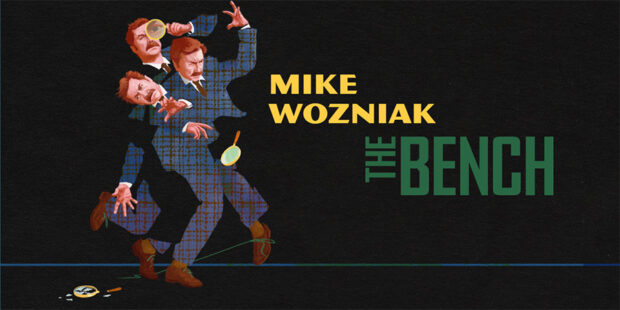

Earlier this month I went to see Mike Wozniak’s one-man show, The Bench. It’s pitched as a small-town mystery with the eponymous memorial bench having been vandalised at night. Wozniak presents himself as an affable, overly informed resident who is trying to find the culprit and solve the puzzle.
The first half is essentially Wozniak laying out the structure of the case, presenting various pieces of evidence, most of which is accompanied by a plethora of tangents and added character colour. I spent most of the time desperately trying to remember different characters’ names and potentially relevant details. The complex level of detail given to the world in which this mystery is set is impressive.
What is cleverer, however, is that this is totally fictional. The events and the characters are all made up; including, in part, Wozniak himself. The persona on stage is a fictional mask put on by the creator of the world of the story. If you don’t intentionally remind yourself of this as an audience member, you might forget that, despite the show starting with the proclamation that, “this is a live situation”, it’s a planned show with a predetermined conclusion.
After laying out the basic story and case, Wozniak, lets us in. We are invited to choose which people or elements of the story we want to hear more about. Then, in the second half, we are asked for theories or invited to ask questions. This is where it gets interesting, structurally. Wozniak, the character, is fielding live, unplanned questions and theories about a mystery he hasn’t solved but, at the same time, Wozniak, the creator of the world, knows who did the crime and how. He must answer and respond in a way that hides the answer but, ultimately, wants to reveal it in time for the final curtain.
The show got me thinking about the difference between knowing what is going to happen and determining what happens and, more fundamentally, what it means for an action to be genuinely free if the future is already settled.
I have also finally got round to reading Justin Brierley’s book, The Surprising Rebirth of Belief in God. It’s an account of the rise and decline of the New Atheism movement that reached, in his assessment, its peak in the early noughties. In one of the later chapters, he explores how the materialist account of reality promoted by prominent New Atheists thinkers such as Richard Dawkins and Christopher Hitchens has led, he argues, in part, to the movements decline in popularity.
Materialism, in Brierley’s depiction of it, is the view that our physical reality is all there ultimately is. Our beliefs and experiences are merely products of physical processes, particularly the chemical reactions in our brains. This materialism has, so Brierley argues, a ‘twin’: determinism. This is the idea that, given everything that has already happened and the laws that govern the universe, there’s only one thing that can happen. Imagine a vast machine in which every movement has a cause, and every cause another cause stretching backwards through time. If everything is governed by these fixed physical laws, the future appears to be simply the next stage in a sequence already set in motion. What we experience as choice, therefore, may feel real to us, but, beneath the surface, the machinery is already doing what it was always going to do.
Brierley, drawing particularly on Iain McGilchrist, suggests that this picture is proving unsatisfying. Arguably, he suggests, it undermines the very argument of the New Atheist materialists use to establish the truth of this reality. If our beliefs are simply the inevitable products of prior physical causes, then our capacity to reason our way towards the truth becomes harder to explain. The deterministic picture doesn’t merely tell us that our choices are constrained; it threatens the very possibility that our choices are genuinely choices at all.
So what might be the alternative philosophical options available to us? Some argue that determinism and freedom can coexist. This position, usually called compatibilism, says that I can be free when I act according to my own desires and reasons, even if those desires and reasons themselves have causes. The distinction here, is that freedom doesn’t, necessarily, require freedom from causation. If I choose the chocolate cake because I genuinely want the chocolate cake, then, for a compatibilist, my choice can still be free even if everything that led me to want chocolate was itself caused by what came before. I remain unconvinced, because it seems to me this view preserves the basic picture of a future that is already settled while giving us a different account of what it means to call an action ‘free’.
I take a different view. In my mind, for a choice to be genuinely free, more than one future must actually be possible. This is sometimes called a libertarian account of freedom but I, again with others who work within what is known as Open Theism, see the future containing genuine possibilities because it has not yet been settled, even for God. I believe God knows everything that can be known, but some things cannot yet be known as they are not settled facts because they have not yet happened.
The terminology can become complicated and rather academic fairly quickly. The underlying question, however, should remain relatively simple. Imagine that tomorrow you are invited for coffee with a friend. You might accept or you might decline that offer. If you are genuinely free to decide then both options are real possibilities before you answer. If, however, everything about the universe has already made your response inevitable, then your, so-called, choice means something rather different. It means only that we did not know what you were going to say.
I have used the following quote from Gregory Boyd before, but it articulates the distinction well,
Genes, parenting, and spiritual forces do condition who we are. But for believers whose spirits have been regenerated by the Holy Spirit these conditioning factors cannot determine who we are unless we choose to allow them to do so.
Gregory Boyd, God of the Possible: a biblical introduction to the open view of God (Grand Rapids: Baker Books, 2000) p.147
This distinguishes between ‘conditioning’ and ‘determining’. We are all the result of our pasts: we inherit genes, families, cultures, experiences, habits and circumstances. These genuinely shape us, but to say that they influence us is not the same as saying that they decide who we will become. The one final distinction that matters is that an open future does not necessarily mean a random future. If I ask you a question, there are countless things you could say but your response surely will be shaped by who you are, what I have said, our previous relationship and interactions, the language and culture that we share (or not) and the particular context in which our conversation is happening. You are constrained but you’re not programmed in how you might respond.
One reason, I think, we are so often drawn towards a more deterministic account of reality is that it gives us certainty. It gives us a means of predicting the future because the past is not simply what has happened but also seems to enable us to see our destiny. Our genes, upbringing, culture, experiences and circumstances all shape us. An institution’s history and inheritance, as I have written recently, should shape the present and the future. There are situations where some possibilities really are closed to us but there is a difference between saying that something conditions what is possible and saying that it determines what must happen. If what has happened determines what happens next, then history closes down the future.
Previous failures become evidence of what we will always be capable of. Patterns of inequality become apparently inevitable. Institutions reproduce the assumptions of their past because those assumptions are mistaken for the conditions of their future. Even our attempts to change can begin to look like merely another link in a chain whose direction was already fixed. None of this follows automatically from believing in divine providence, and I don’t want to caricature Christians who hold strongly deterministic accounts of God’s sovereignty. The problem is more subtle. A belief that can provide profound comfort at the level of personal faith can become restrictive when it’s used to describe what people, communities or societies are capable of becoming.
It matters, therefore, whether the future is merely unknown to us or genuinely unsettled. If it is only unknown, then everything that will happen already exists in some sense as a settled fact: we simply have not discovered it yet. If, however, some aspects of the future are genuinely open, then the past can shape what happens without determining it. That matters ethically because it leaves room for repentance, forgiveness and conversion to be more than changes in our knowledge of a predetermined story. It also matters socially because people can encounter one another as agents rather than just as products of their histories.
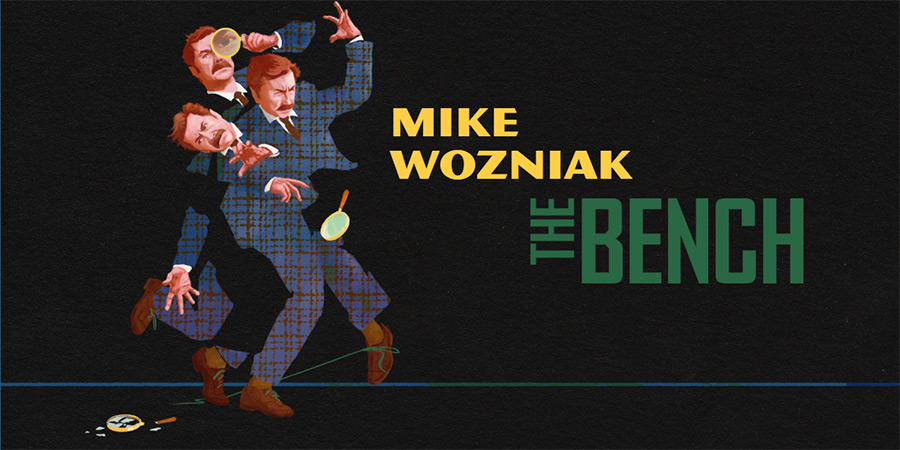
The Bench is not a model of an open future; in fact, it’s almost the opposite. Wozniak knows the destination and the audience’s contribution takes place within a story whose conclusion has already been determined. The show does still make visible something that interests me, though: Wozniak does not have a script for every interaction. He has prepared the world, the characters and the mystery, but he has to respond to what the audience actually says.
A script tells us what happens next, but improvisation starts somewhere else: “this is where we are, this is what we have been given, these are the possibilities available to us, so what do we do now?” Improvisation gives us a concrete picture of responsive action within conditions that are not of our own choosing. The difference I am interested in is not between order and chaos; it is between an outcome being determined in advance and agents participating in what happens next. This raises a question that I think is more important than whether improvisation provides a useful metaphor for Open Theism: if the future is genuinely open, what does agency look like?
It’s tempting to imagine freedom as the absence of constraint. If I am free, perhaps nothing should determine what I do. This, however, just creates another problem: a completely unconstrained action starts to look less like freedom and more like randomness. Improvisation gives us another possibility.
Anyone who has actually improvised knows that openness does not mean being unprepared. The musician needs an instrument and a deep grasp of musical vocabulary. The actor needs to know the conventions within which they are working. Those things do not determine the next note, line or movement. They are what allow the performer to respond when something unexpected happens.
This is why I find the distinction between constraint and determination so useful. A constraint limits what can happen without deciding exactly what will happen. The same may be true of our lives because we inherit a world we did not make. We inherit bodies, histories, institutions, relationships, cultures and wounds. We are shaped by things we did not choose. Sometimes possibilities really are closed to us, but being shaped is not the same as being determined.
If the future is genuinely open, then agency cannot simply mean choosing from a predetermined menu of possibilities. It means participating in what becomes possible through our responses to one another. That is a more relational understanding of agency. My action matters, but so does yours. What I do changes the circumstances in which you respond. What you do changes what becomes possible for me. The future is not simply a series of individual choices made independently of one another; it’s something we participate in making together.

As I have written elsewhere (particularly in my book, Ash Water Oil), the Christian doctrine of the incarnation makes a disruptive claim: God does not remain outside the contingency of creation; he enters into it.
God became flesh. God took on a particular body, in a particular place, at a particular moment in history. Jesus encountered particular people and responded to what was actually happening around him. He was, more importantly for our explorations here, interrupted. The encounter with the Syro-Phoenician woman in Mark 7 is one striking example of a person’s response altering the direction of the conversation and, apparently, the scope of Jesus’ response. He asked questions and responded to what people actually said to him. This is not a picture of God standing safely outside the world pulling the strings while everyone else performs a script.
I have found the language of improvisation helpful for thinking about this. I don’t mean that God is simply an improviser in the same way that a performer on a stage is. The usefulness of the image is that it gives us another way to imagine divine action, somewhere between detached control and passive observation. The biblical story is one of God reaching out and calling people, some respond, some resist. He uses prophets to change the course of history but equally people’s actions change God’s stated plans. Jesus encountered people whose responses mattered to what happens next.
The Christian story does not require us to imagine God as less than sovereign in order to take those encounters seriously. Indeed, the incarnation suggests something more radical: divine sovereignty need not be demonstrated by God’s ability to prevent contingency, but can instead be understood as God’s willingness and capacity to remain faithful within it.
This is where the analogy with The Bench reaches its limit because Wozniak is improvising within a story whose ending is already known. If the future is genuinely open, God is not simply improvising a route towards an ending already known in every detail. Some things really are not yet settled. If that is so, the question is no longer simply, “Does God know what is going to happen?” but, “What kind of agency makes sense in a world in which what happens next is genuinely affected by what we do?”
The question, though, matters beyond theology; it matters practically. If another person is genuinely an agent, then I cannot simply incorporate their contribution into a plan I have already made. Their presence must be capable of changing the possibilities available to both of us. This changes what we mean by participation. The practical question, therefore, is not simply whether we can become better at listening; our highly corporate culture is full of listening exercises, consultation processes, focus groups and public forums. These can go a long way to give people opportunities to speak and experience being heard but can struggle to move that to concrete decisions or change. Genuine encounter requires something more than tolerance, representation or even understanding. The more important question is whether anyone in these processes have enough agency so that what they say can change what happens next.
This is where the language of ‘no man’s land’ becomes useful and by ‘no man’s land’ I don’t mean a neutral space in which everyone suspends their convictions. I have argued that cathedrals could and should be forms of ‘no man’s land’ but I don’t mean they could or should become a blank space in the public square. A cathedral has a Christian identity, a tradition, a history and particular convictions. No man’s land means something more specific. It’s a space in which those particular commitments can meet others without the outcome being settled in advance.
That matters because much of our public life now seems trapped between two inadequate responses to difference. One is control: establish the right framework, define the acceptable answers and manage the disagreement towards a predetermined outcome. The other is stalemate: recognise that people disagree and conclude that nothing substantial can really be done.
Improvisation offers a third possibility: establish conditions without determining outcomes. We should be able to bring our own commitments, knowledge and resources into an encounter while recognising that other people will affect what becomes possible. We can make decisions without knowing all the consequences. We can act without knowing in advance whether the result will be the one we had hoped for. That’s not indecision, just a different understanding of agency and this requires a different understanding of hope.
Christian hope does not need to mean confidence that everything will turn out according to a predetermined plan. If the future is genuinely open, hope cannot be certainty about the outcome. It could, however, be a confidence that faithful action can make a difference even when the outcome is not guaranteed.
This brings us back to The Bench. Wozniak has created a world with its own history, characters, relationships and rules. He has prepared extensively and knows the mystery and where the story will end; but he still has to listen. An audience member could ask a question he didn’t anticipate. Someone could notice a detail he has deliberately placed in the story or a theory could take the conversation in an unexpected direction. Wozniak has to take what is actually offered and work with it.
The audience, therefore, is not completely free. The world of The Bench has been constructed for them and its conclusion is already determined. Yet their contributions are not entirely meaningless either; they affect the route by which the story is told.
This is why I find the show useful, even though it is not actually a model of an open future. The show allows us to see that responsiveness does not require the absence of structure and, also, that preparation doesn’t mean scripting every interaction. This, I’m suggesting, gives us a better way to think about agency in a world that is neither completely determined nor completely random. The improvisational alternative is not to deny the forces that shape us or to imagine that freedom requires a world of complete randomness but, rather, to recognise that being shaped is not the same as being determined.
We inherit a world we did not make. We inherit institutions, histories, relationships, wounds and possibilities. We enter stories that are already underway but we also can participate in what happens next. That is how improvisation gives me language for something else: not a world without structure, without limits, in which anything is possible, but a world in which what we do can genuinely make a difference to what becomes possible next.
The future may be constrained. It may be frightening. It may be shaped by forces we did not choose. But constrained is not the same as closed.
And that, perhaps, is the most interesting thing about The Bench; not that Wozniak had prepared so much but that, even within a prepared world, he still had to ask the question that improvisers always face: what might happen next?