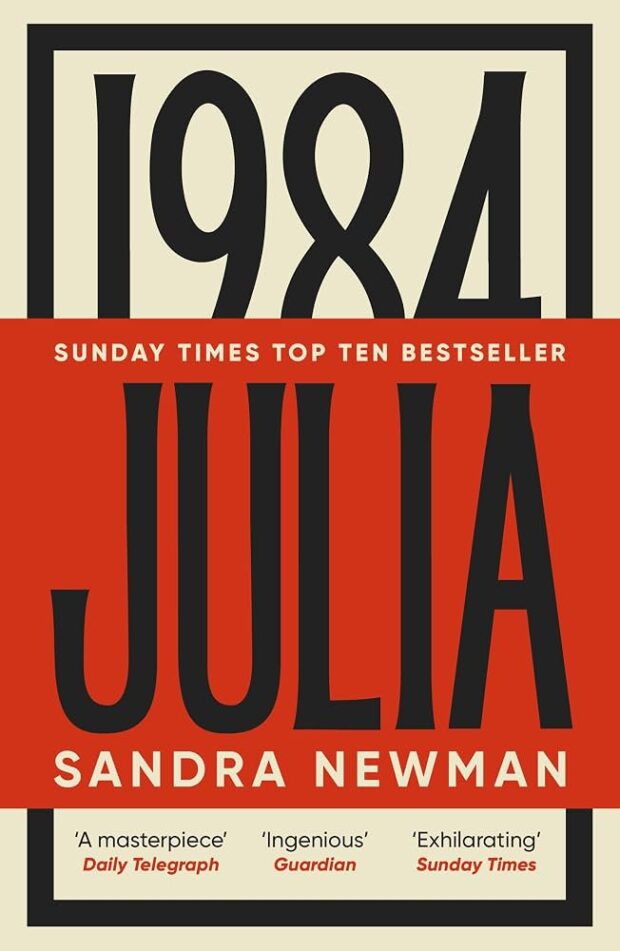

Ok. I admit it: reading 1984 during the weekend of the local election results was a bad idea.
As the news cycles revealed, in real time, the continued and solidifying fragmentation of our politics and commentators all reacted with a familiar mix of shock and inevitability, reading a book the famously ends with a bleak acceptance of a totalitarian world of confusion and contradiction was a mistake.
The claims of Orwellian realities in our political life are still, in my mind, overplayed. I don’t want to belittle or undermine genuine experiences of subjection under totalitarian regimes by claiming solidarity in our relative freedom. It’s just morally unserious to collapse our experience of algorithmic annoyance, institutional frustration and social media outrage and equate them with the horrors endured under genuine authoritarian regimes. Reading a new ‘companion’ to 1984, Julia, by Sandra Newman has raised my own questions and opened up deeper observations of our present political and social reality.
The book unsettled me in a strangely familiar way (particularly as someone who occupies that, now culturally freighted, category of ‘straight white male’). The feminist retelling of the dystopian work from the perspective of Julia, has strange, subtly, almost contradictory blend of faithfulness to the classic text and an undermining of its very moral and metaphysical assumptions that gives 1984 its enduring force. The result is that it feels simultaneously inside Orwell’s world whilst being suspicious, even condescending, of it.
As I reflect on the book and observe afresh, through its lens, the ongoing conversations around truth and identity, the more I wonder whether the deepest cultural shift taking place around us is not into political polarisation but a slow erosion of confidence that there could ever be such a thing as a genuinely shared reality at all.
At a conference I attended this month there was a panel exploring Gen Z’s growing interest in religion and the ways cathedrals are engaging or could engage young people. As part of the Q&A I asked whether, at a moment where truth is increasingly contested and negotiated, how might we still have a genuinely shared story? One of the Gen Z panellists paused for a moment before responding.
I don’t think I understand the question.
The question was repeated and, again, they paused before replying, this time with a kind of bemused clarity.
No wonder I didn’t understand the question. We’re past that now, aren’t we? We’re post-truth. We’ve discussed that for years. It’s not about agreeing on some single concept of truth.
What followed was a discussion on subjectivity, the importance of personal narratives and of creating spaces where differing experiences could coexist without requiring a resolution into a singular account of reality. I found myself quickly tiring of the exchange. The panel’s responses reflected a widespread cultural sensibility; one that has emerged, at least in part, from understandable suspicion toward institutions that have claimed objective truth whilst often perpetuating forms of exclusion, domination and/or harm. What unsettled me was not disagreement, per-se, but something deeper. There was a renewed realisation of the failure of mutual intelligibility.
I had assumed, in my question, the possibility that a shared story still mattered, even if it was contested. The Gen Z panellist clearly lives with the assumption that it has already collapsed. The more I have reflected on it, the more I have realised this may be one of the defining conditions of our age. We no longer simply disagree about truth but, increasingly, we disagree about whether truth itself remains a meaningful category around which we can/should gather.
This is partly why Julia unsettled me so deeply. The novel inhabits this same assumption. Orwell’s world in 1984 is terrifying, in my mind, because truth still matters strongly enough for it to be violated. Winston’s tragedy only works because there remains something within him that longs for reality, memory and coherence. Newman’s novel is different, written, as it is, for a postmodern audience. Its world is populated by people surviving with the postmodern value on performance, irony, compartmentalisation and negotiated identities. With this new vision of the narrative world the self becomes less stable and truth more contingent. This shift reflects something about our current moment but I increasingly wonder whether it also reveals a deeper exhaustion and weariness that is not merely about political fragmentation but also a kind of metaphysical fragmentation. Are we all worn out by a growing inability to even imagine a shared reality robust enough to hold us together without collapsing into coercion?

A different panellist on the same panel described a Bible study with a group of largely unchurched Gen Z participants reading the story of Jesus and the Samaritan woman at the well. Their interpretation, the panellist explained, was that Jesus appeared unsafe: a creepy patriarchal figure intruding upon a vulnerable woman alone in a semi-secluded space. Their instinctive response was that the woman should leave the encounter as quickly as possible.
The room did not erupt in applause but nor did anyone dismiss the reading outright. Instead, another response came from the Gen Z panellist,
Those people can now have access to conversation partners in queer and feminist readings of Scripture.
Again, I found the exchange deeply revealing.
Historically, the Samaritan woman has been read as a story of grace, revelation, and restoration. Christ crosses ethnic, religious and moral boundaries to encounter someone isolated and ashamed. The woman is transformed, not through coercion but recognition, into one of the first evangelists in John’s Gospel. The interpretative instincts operating in that room of Gen Z explorers were fundamentally different. The moral centre of gravity had shifted before interpretation even began.
Now, to be clear, I do not think such instincts emerge from nowhere. Cultures shaped by abuses of power, patriarchal harm and institutional betrayal will inevitably develop heightened sensitivities around vulnerability, consent and asymmetrical authority. In many ways, such attentiveness represents genuine moral seriousness but I wonder whether suspicion has become our default hermeneutic. The problem with this, if it’s true, is that suspicion cannot lead to or sustain communion that we seem to pong for. Cynicism and scepticism may protect us from certain forms of naivety but they also erode the conditions under which trust and shared meaning become possible.
It is here that I found myself returning again to the theological reflections of Paul Fiddes in Participating in God. Reflecting on suffering and outlining, what he calls, ‘a theodicy of stories’, Fiddes writes:
…an appeal is simply made to the power of stories of others who have suffered, which can help us to find some meaning in the story of our own lives and our own suffering… That is why we like to go to the theatre and watch the tragedies of Shakespeare; they give us a story in which we can find ourselves, by which we can interpret our lives.
Paul Fiddes, Participating in God: a pastoral doctrine of the Trinity (London:Darton, Longman and Todd, 2000) p.157
That observation feels increasingly important.
The fact is that we don’t, despite what our culture seems to encourage, merely consume stories. We naturally inhabit them. Stories provide us with a shared symbolic world through which, not only our suffering, but also our identity and hope can become intelligible. Theatre, art, music; these do not remove pain but they do allow suffering to participate in a larger human drama as we recognise ourselves within them. What happens, then, when suspicion towards inherited narratives becomes so total that we can no longer trust the stories enough to enter into them? Surely at that point texts cease to be places of encounter but instead become objects primarily to be interrogated, corrected or morally filtered through our contemporary frameworks. Perhaps this is one reason why so much contemporary culture feels simultaneously hyper-interpreted and spiritually exhausted.

Fiddes writes elsewhere:
We attribute to God political notions of power assuming that it means coerciveness.
Fiddes, Participating in God, p.139
That sentence has lingered in my mind as it seems to illuminate something profoundly important about both Orwell’s and our present cultural moment.
One of the great misunderstandings of power is that we assume that domination represents its highest form. Political systems often reinforce the instinct that the stronger force compels the weaker, authority means control and truth is established through enforcement. Orwell understood something more subtle.
In 1984, Big Brother’s apparent omnipotence concealed a deep failure. The Party controlled bodies, language, memory, economics and even thought to a remarkable degree, but it remained haunted by one thing it could not genuinely create: freely given love. The regime did not merely want obedience: it wanted inward participation and this is why it was so terrifying. It sought authority over reality itself and yet coercion can never finally generate communion; it can manufacture compliance but not love.
This is where Fiddes’ theology hits hard. Divine power, he argues, works not primarily through domination but persuasion and invitation. God does not annihilate creaturely freedom because coercion cannot produce the kind of union God desires and perhaps this reveals something equally dangerous within our fragmented post-truth culture. We rightly fear coercive truth claims because history has shown how easily they become oppressive but if all claims to shared truth become suspect, we risk losing the possibility of communion as we seek to rid ourselves of domination. We become isolated interpreters, negotiating unstable realities rather than participants within a shared horizon of meaning.
Which leaves us with a difficult question: if coercion cannot create communion but fragmentation dissolves the possibility of shared truth altogether, then what kind of truth might still allow us to belong to one another without domination?
That is the question quietly haunting me in our current cultural moment.

So, as the local election results unfolded that weekend, what struck me was not simply political fragmentation itself but the strange emotional atmosphere surrounding it. Commentators oscillated between outrage and inevitability. Every result was interpreted as either civilisational collapse or long-overdue correction. Entire political visions appeared increasingly incapable not only of persuading one another but even of recognising a shared reality within which persuasion might still occur.
That is the deeper anxiety beneath all our talk of polarisation: not that we disagree (we have always disagreed), but that we are slowly losing confidence that there exists any horizon of truth beyond ourselves capable of holding us together without coercion.
One of the reasons 1984 remains so powerful is that it understands the nature of totalitarianism. Dictatorships do not simply want power over institutions or bodies (individual and collective), they want to control reality itself. The scary experience portrayed by Orwell is the collapse of certainty in truth so completely that people become dependent on the regime to judge reality and to shape the shared story in which one finds meaning.
The irony is that genuinely shared truth cannot finally be created through this form of coercion. All that is created if a forced unanimity but it is not communion. Compliance is not participation. Love itself cannot be compelled without ceasing to be love. That is why the Christian claim that Christ is not merely a teacher of truth but the truth remains so radical and difficult.
The truth Christians proclaim is encountered relationally before it is understood intellectually. It does not erase difference or freedom; nor does it collapse into mere subjectivity. Christ does not coerce participation instead, he invites, unsettles, reveals, heals, confronts, gathers and this matters enormously in a culture increasingly trapped between those two exhausted alternatives: coercive certainty or endless fragmentation. One seeks unity through domination but the other abandons unity altogether.
The Christian tradition has always, at its best, gestured toward a more demanding possibility: communion without erasure. This is why I cannot quite accept either the authoritarian instinct that attempts to impose shared reality by force or the post-truth resignation that treats all reality as infinitely negotiable. The first crushes the person beneath power whilst the latter slowly dissolves the possibility of a genuinely shared world.
What I sensed in that conference conversation, and in my reaction to Julia, was not simply generational or cultural difference but a deeper civilisational uncertainty about whether we still believe meaningful communion is possible at all. Can we still belong to one another without domination? Can truth still unite without coercing? Can difference remain real without becoming absolute separation?
These are not just political questions now; they are theological ones because if truth is only power, then Orwell was right to terrify us. If truth is finally personal, participatory and grounded in love rather than coercion, however, then perhaps the task before the Church is not to win the culture war for “objective truth” nor to baptise fragmentation as liberation, but to become again a community capable of holding truth and communion together. We don’t need to do it perfectly, nor without disagreement, repentance and failure but faithfully enough that, amid the noise of our increasingly disintegrating public life, people might still glimpse the possibility that shared reality need not end either in domination or despair.
Perhaps that is what feels most fragile in this moment and, perhaps, too, it is what makes the Church’s calling both more difficult and more necessary than it has been for a very long time.