

Tag Archives: Community

Into Culture: Tarshish

I remember, some years ago, my dear friend, Dave, coming back from a leadership training course. We met to reflect together on what he had gleaned and one thing has stuck with me ever since. They had been studying the story of Jonah and had asked a different question to that which most of ask when engaging in this tale of the reluctant prophet. They were asked not “what is your Nineveh?”, that familiar prompt about the place you would rather not go, but instead, “what is your Tarshish?”, the fantasy you reach for to justify your avoidance.

I can’t remember how Dave, personally, responded to that question but I do remember, in the course of our conversation, him turning to me and, in the way only close friends can, saying, “Ned, your Tarshish is academic monasticism.” It hit me hard and I continue to carry those words with me. It was said with knowledge and love and I knew, immediately, there was deep truth in it. I do find myself in times of pressure and uncertainty, retreating to a world of books, ideas and ordered thought. This imagined place is where I dream of complexity being contained, rather than encountered.

I am in such a season at the moment in ministry where the demands are increasing, and the metaphorical plates are wobbling. My everyday experience is of managing experienced chaos and change. I have also been helping to induct a new Dean whilst we continue to navigate staff departures, shifting responsibilities and the quiet accumulation of strain that comes when there are too few people to carry too much. We are, at present, feeling a certain amount of fragility with that sense that what is being held together is being held by attention, goodwill and, at times, sheer endurance.

It is in that context, I found myself in a conversation with my new colleague about my own sense of vocation. We, inevitably spoke about theology and its place within the life of the Church. A suggestion that I have heard before was to consider whether theological education is what God is calling me to. My response, slightly rehearsed, was dismissive: I have been burnt by rejection for such roles in the past and then, Dave’s comment surfaced again. Is this ‘fit’ and personal desire, Tarshish? I also am noting the return of the impulse to pursue doctoral studies. This seems foolish when my life is so full of the necessary duties of holding a community and organisation at this time.

And finally, I found myself sitting with a friend who is part of an informal group called Café Theology. We meet at times to ‘geek out’ about theology. It is a group of people who have either done or are engaged in doctoral studies and for whom conversations on a more academic subject is pleasing and encouraging. On this occasion he had called a meeting at the request of a bishop who wanted to reflect on the theology at the heart of a practical challenge in the diocese. In the course of the conversation I found myself asking, perhaps, a deeper question: what is theological work for, in a cathedral, in a diocese or in the Church that often feels as though it no longer quite knows how to make space for it?


I have been reading the Pastoral Rule of Gregory I. It’s striking, reading it through the lens of a season like this, how little sympathy Gregory has for the idea that one might simply step away. He writes as one who knows both the attraction of withdrawal and the cost of responsibility and refuses to allow either to become absolute. 

The pastor, he insists, must be ‘near to all in sympathy’ and yet ‘lifted above all in contemplation’. The tension is not a problem to be solved but a vocation to be inhabited. Gregory is acutely aware of the temptation to choose one side at the expense of the other. There are those, like me, he suggests, who long for the quiet of contemplation not because they are necessarily called to it but because they wish to avoid ‘the burden of others’. Equally, however, there are those who are so immersed in activity that they lose any sense of God, in whose name they act. The danger lies not simply in withdrawal or not, but in the imbalance between the two. To flee into the cell can be avoidance; to remain endlessly in the crowd can be another form of it.

What Gregory refuses, therefore, is the clean distinction I find myself wanting to make. The question is not whether I am called to Nineveh or to Tarshish, but whether either can become a way of evading a deeper call to be stretched between attention to God and the service with and for others. And yet, alongside Gregory’s resistance, there sits another voice, for me. It is quieter, more interior but no less demanding and it’s in the opening of the Proslogion by Anselm of Canterbury.

Come now, insignificant man [sic.], leave behind for a time your pre-occupations; seclude yourself for a while from your disquieting thoughts… Attend for a while to God and rest for a time in him. Enter the inner chamber of your mind and shut out all else except God…

Anselm of Canterbury, Proslogion, in Hopkins, J. and Richardson, H.W. (trans.), Anselm of Canterbury, vol.1 (London: SCM Press, 1974) p.91

It is difficult to read those words without feeling the invitation to do something that sounds, at first, dangerously like Tarshish. In a context of institutional fragility and accumulated demand, the invitation to step away, to shut the door and to seek God in the ‘inner chamber of the mind’, feels less like temptation and more like necessity. Anselm does not apologise for this movement inward. He insists upon it. There is, he suggests, a kind of attention to God that cannot be sustained in the noise of constant activity.

But even here the movement is more complex than it first appears. Anselm’s ‘escape’ is not a destination but a discipline. It is bounded, ‘for a time’, ‘for a while’. It is ordered towards a return, not a permanent, sustained removal. The one who withdraws does so, not to abandon the world, but to re-enter it more truthfully, more attentively and more capable of love. The inner chamber may not be a refuge from vocation but a condition for it.

The difficulty, of course, is that the line between discipline and desire is rarely clear. What begins as a necessary withdrawal can become a preferred one. The space in which we seek God can slowly become the place in which we hide from everything else. And so Dave’s question lingers, uncomfortably. When I imagine a life of study, reading and theological depth, am I responding to a call or constructing an escapist fantasy?

Perhaps the more unsettling possibility is that the categories themselves have become unstable. If Gregory is right, then neither action nor contemplation can stand alone. If Anselm is right, then without some form of withdrawal, even our action becomes disordered. Which leaves the question not simply of what I should do, but of where such a life is meant to be held. What kind of ecclesial space could sustain both the inward attentiveness Anselm demands and the outward responsibility Gregory refuses to relinquish? And, more pressingly, do our current structures make that kind of life possible or do they quietly force us to choose between them?

It is worth returning, at this point, to that small but significant moment with my friend from Café Theology. When faced with a practical challenge in the shared life of the diocese, a bishop responded to the suggestion that we did not begin with strategy, policy, or management frameworks, but with the theology at the heart of issue and asked for my friend to “assemble the avengers” (direct quote from the bishop!) There is, in the request, something both deeply traditional and quietly radical. It gestures toward a vision of the Church in which theology is not an optional extra, nor a specialist pursuit for the few but the very medium through which we discern, decide, and act together.

And yet, the fact that this request felt noteworthy is itself revealing to me. It suggests, again, how unusual it has become to expect theological reflection to sit at the centre of our common life rather than on its margins. In previous posts, I have found myself circling this absence: the way in which theological seriousness can feel fragile within our ecclesial structures; the way cathedrals, in particular, risk becoming places of aesthetic excellence, liturgical provision, or cultural engagement but not sustained sites of theological rigour. It’s not that we have abandoned theology, exactly, but we have, perhaps, lost confidence in where it properly belongs.

Historically, of course, the answer was, perhaps, clearer. The cathedral is not simply a large, symbolic church. It is the cathedra; the seat of the bishop’s teaching ministry. It is, or ought to be, the place where the Church’s thinking life is gathered, tested, and offered back, not in abstraction from its realities, but with deep engagement with them. A bishop should teach not only through personal pronouncements, but through a community, a body of clergy and laity, who can attend to Scripture, tradition and context with patience, depth and imagination.

Which raises a possibility that feels, at once, obvious and strangely neglected: what if our cathedrals were more intentionally configured as centres of theological reflection for diocesan life? What if Deans and Residentiary Canons were recognised, not simply as senior administrators, liturgists, or public figures, but as theological reflectors within the life of the Church? Not producing theology at a distance, but engaging the lived questions of the diocese with seriousness, time, and disciplined attention.

I have, in quieter moments, tried to name something like this before. In my last Ministerial Development Review, I found myself tentatively suggesting that part of my vocation might lie in precisely this space of holding together pastoral responsibility, liturgical life, and sustained theological work for the sake of the wider Church. The response, though not entirely dismissive, was marked more by scepticism than curiosity. It did not quite fit the current, available categories. There was, it seemed, little sense that such a role could, or even should, be intentionally shaped.

Perhaps that is the deeper issue: without recognised spaces in which theology and ministry are held together, the tension Gregory names and Anselm qualifies does not disappear; it simply becomes privatised. It is pushed back onto the individual who must decide whether to carve out time for study (at the risk of appearing disengaged) or to surrender it entirely (at the cost of theological depth). In such a context, it is hardly surprising that doctoral study begins to look like, for me, Tarshish, but what if that is a failure not of my individual discernment but of ecclesial imagination? What if the question is why the Church finds it so difficult to sustain thinking within its own life? The bishop’s keenness to begin with theology suggests that the desire has not totally disappeared. The question now is whether we have, or can create, the forms, the habits and the shared commitments to make that instinct something more than occasional.

If Gregory is right, then the Church needs ministers who can live between contemplation and action. If Anselm is right, then such a life requires disciplined spaces of withdrawal and attention. The challenge then is not simply personal, but structural. The task is to imagine communities in which this tension is not borne alone but held in common. It may be that the cathedral, properly understood and re-configured, remains one of the few places where such an imagination could begin to take shape.
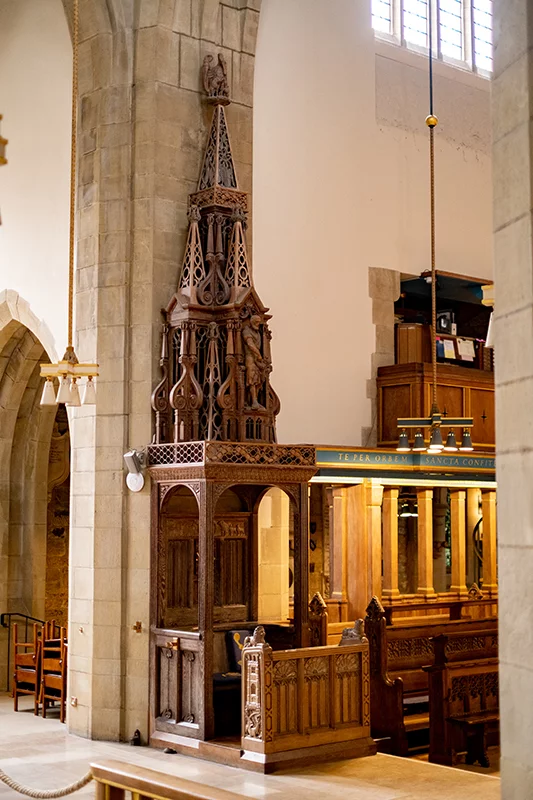
If that imagination is to take shape, however, it cannot remain at the level of aspiration. Organisational re-structuring won’t hold it, nor will titles generate it. Even a renewed vision of a cathedral as a centre of theological reflection will falter if it is not sustained by something more ordinary, more demanding and more easily resisted: a shared pattern or Rule of Life.

This is not a new idea, as many long time readers of my blog, or readers of my book (self promotion: Ash Water Oil: why the Church needs a new form of monasticism) should know by now. Historically, the very word canon gestures toward it. The residentiary clergy of cathedrals were not originally just office-holders. They were those who lived according to a canon/rule. My own academic work on Hugh of St Victor and the Augustinian Rule has only deepened my awareness of this inheritance and shaped my own vision of clergy who inhabit a shared rhythm of prayer, study and common life, in which theology is not an occasional activity but a habitual way of being. More recently, I have found myself drawn to the life of the Oratory of Saint Philip Neri: a community without vows, yet bound by a shared commitment to prayer, conversation, and intellectual seriousness held within friendship.

It is, perhaps, telling that I find myself looking at these resources because in the present moment such a life is rarely named or lived. In the absence of a shared rule at Bradford Cathedral, I’ve begun (tentatively and imperfectly) to articulate something like a personal Rule for Theological Living. I shaped it to structure my life to ensure the demands of ministry don’t crowd out those things that keep me connected to God in the way in which I tend to encounter him.

At its heart is a simple conviction that theology is not something I occasionally do but, rather, something I am called to live. That every sermon, conversation, meeting and moment of study participates, however partially, in the Church’s ongoing attempt to think truthfully about God and to do so in a way that builds communion rather than fragments it. That conviction, however, requires form if it is to survive contact with reality and so the Rule attempts to name, in deliberately modest ways, a set of commitments and rhythms.

The Rule seeks to name a set of virtues that are less about intellectual capacity and more about posture: humility, in recognising the provisional nature of all our speech about God; clarity, in refusing to hide behind unnecessary complexity; hospitality, in making space for others to think and speak; and courage, in naming what needs to be named, even when it unsettles. These are, I feel, the difference between theology that builds up and theology that merely performs.

Perhaps most practically (and most challengingly) the Rule attempts to establish daily, weekly and monthly rhythms that carve out space for sustained attention. There is an invitation, at the start of each day, to a short period of prayer and reading. Then there is a more extended engagement, again, each day, of study and writing. There’s a weekly period of deeper focus and, finally, a monthly act of public reflection (these blog posts currently act as those!). None of this is meant to be heroic. All of it is fragile but it is an attempt to resist the slow erosion of theological attentiveness under the pressure of immediate demands.

As part of Bradford Cathedral’s vision, we began to explore the possibility of a more intentional shared rule of life among the residentiary clergy. We didn’t want a strict monastic way of life that was inaccessible to others who didn’t live on site but some common pattern of prayer, study, conversation and rest that might encourage discipleship across our community. What might it mean to hold one another to account not only for outputs and responsibilities but for attentiveness to God and to the Church’s thinking life? To create, together, spaces in which Anselm’s “inner chamber” is not an individual escape, but a shared discipline and in which Gregory’s call to remain “near to all” is sustained, rather than eroded, by that attentiveness?

If such a life were even partially realised, it would begin to shift the questions with which I started and to my friend, Dave’s probing discernment which still unsettles me. 

At this moment in time, the thought of doctoral study and a more ordered intellectual life feels like a relief I desire more than anything. It is an imaginative place where the noise quietens and the demands are, if not fewer, then at least more containable and I cannot pretend that this is not, at times, a form of Tarshish. I am less convinced than I once was, though, that the answer lies in simply refusing it. The deeper question I find myself asking is not whether I should go to Nineveh or flee to Tarshish, but why the journey feels so starkly divided in the first place.

If the reflections of Gregory the Great and Anselm of Canterbury are to be taken seriously, then the problem is not the tension itself, but our inability to hold it well. If that is the case, then the answer cannot be found in individual acts of discernment alone (important though they are) but in the kinds of communities we are able and willing to form.

At present, I suspect our structures do, more often than not, quietly force the choice. We reward activity and sideline attentiveness or we isolate theological study in ways that remove it from the shared life of the Church. The Church seems to perpetuate the binary that makes Nineveh relentless and Tarshish alluring and, in so doing, leave many of us attempting to hold together, alone, what was never meant to be borne individually.

This faint outline of another possibility has begun to emerge of a cathedral that is not only a place of worship and welcome but also a community of theological attention. A community that lives, however imperfectly, by a shared rule in which thinking, praying, and acting are not separated but sustained together. In such a place, the journey to the “inner chamber” would not be an escape from responsibility, but a shared discipline that deepens it.

In that kind of life, the caution Dave gave me still remains but it no longer is,  “where am I escaping to?” but “how are we learning to stay, together?”

Into Culture: Improvisational Leadership

This month I have been blessed to perform twice in York; once with my wonderful long-form improvisation comedy troupe, Fool(ish), and the other as a regular at the monthly Right Here Right Now at Friargate Theatre. In preparation for the Fool(ish) show Not Gonna Lie at York Theatre Royal we had an intensive run of weekly rehearsals which meant I had to drive across to York from my home in Bradford. These creative outlets/escapes from everyday life and ministry are an absolute lifeline to my wellbeing and I love the community that exists with my fellow performers.

I have also been reading Tony Blair’s new book, On Leadership, and I have found myself drawn to his concept of a leader’s ‘hinterland’. Blair suggests that behind every great leader is a rich personal depth, a hinterland filled with passions, interests, and creative pursuits that feed their inner life. It’s a reminder that leadership isn’t just about what you do on the public stage; it’s about who you are behind the scenes, the broader life you cultivate outside the demands of your role. This interaction between the public performance and the private ‘rehearsal’ space has meant I have been reinvestigating my own leadership and drawing learning from my knowledge and experience of improvisation.


Improvisation, at its core, revolves around trust and generosity. On stage, without a script, the story is built through the free and generous exchange of offers—gifts between performers. This demands immense trust in your fellow actors to receive and build on what you offer, rather than rejecting or blocking it. In improvisation, accepting offers leads to a process of reimagination, where the unexpected becomes an opportunity to explore new narratives and ideas. Therefore, before going public on stage, groups must build that trust between performers. Without this the performances are stale and hard work. If you manage to build it, however, you experience the magic of co-creating ideas from nothing. In leadership, this same principle applies.

Generosity, in both performance and leadership, is about giving space to others; to let them contribute, fail, and grow. In Fool(ish) Improvisation, we practice a collaborative approach, not just in shows but also in how we run the company. Decisions about publicity, communication, and rehearsals are shared responsibilities. Although Paul Birch and I started Fool(ish), everyone’s contributions are equally valued, and we rely on each other to bring their best. Paul and I always hoped to build this culture of sacrificial generosity. We’re so glad to experience it and we know it is not easily built nor easily maintained, but it’s the heart of what we do.

At Bradford Cathedral, we are navigating a period of uncertainty and change, where trust can feel fragile. Financial pressures and organisational transitions have left people understandably cautious. In this context, rather than leaning into this improvisational spirit, embracing the unknown and trusting the process, I have found myself trying to control the narrative, inadvertently stifling the creativity and contributions of those around me. This instinct stems from a desire to ensure that everything runs smoothly, but it undermines the very principles of generosity and collaboration that I value. In my attempt to make a good public performance I have neglected the essential rehearsal process.

This has become a learning point for me. Blair’s hinterland concept challenges me to reconnect with my deeper self and rediscover my improvisational and ‘kenotic’ leadership style: one that embodies generosity and humility. Kenosis, the theological concept of self-emptying, invites me, as a leader, to prioritise the needs and voices of others, allowing space for their contributions to flourish. In the same way that kenosis calls for a letting go of one’s own control, improvisation requires a performer to relinquish their need to dictate the outcome. Instead, the focus shifts toward co-creating a shared experience, trusting others to contribute, fail, and grow.

In improvisation, the most powerful moments come when you step back, allowing others to take the spotlight, and trust that their offers will move the scene forward. This self-emptying, this kenotic release, is not passive but actively generous, making space for the unknown to emerge. In leadership, the same principle applies: a kenotic leader, much like an improviser, seeks not to dominate but to empower others. This mindset of releasing control, whether on stage or in community, fosters an environment where collective creativity can thrive.

In both improvisation and leadership, kenosis demands vulnerability. By prioritising the success of others over your own needs, you create the conditions for something greater to emerge, whether it’s a compelling improvisational scene or a thriving community. The leader, like the improviser, is called to a posture of generosity, making space for the voices around them to shape the collective narrative.

A hinterland is not just about reminding the leader that there is a life outside of their role; it also ensures they remain rooted in trusting relationships with people who interact with them out of role. A leader with these important, grounding, personal communities draws from their own reserves, giving to others who are hesitant the trust they have experienced in their hinterland. This requires patience and courage. It is not just about expecting people to meet us halfway; it’s about leading from a place of abundance. When we cultivate our own personal depth—our hinterland—through passions, creativity, and reflective practice, we can give without expecting immediate reciprocity.

In both theatre and ministry, trust and generosity are foundational to building a strong community. Theologically, these concepts are grounded in grace—leading with an open heart, offering yourself and your leadership freely without demanding anything in return. Christ’s leadership, rooted in self-giving love, provides a profound model for leading through times of uncertainty. Even when his disciples doubted and faltered, Christ trusted them, allowing space for them to grow.

However, in today’s political landscape, we are witnessing an increase of polarisation and a pervasive sense of mistrust and, just as individuals in the political sphere feel disillusioned, the same sense of disenchantment can emerge when trust is fragile within our own circles. The erosion of trust, whether in politics or community leadership, undermines the foundations of collaboration and shared purpose.

In improvisation, when trust breaks down, we return to the principles of generosity and collaboration to rebuild the creative process. This same return to first principles is essential in leadership, whether navigating smaller communities or a broader social context. When political discourse becomes transactional rather than relational, and when leadership focuses on control rather than trust, we risk losing the very bonds that hold communities together. In this sense, improvisational practices offer a model for rebuilding societal cohesion: just as a scene is co-created through shared trust on stage, so too must we foster collaboration and openness in leadership, both in our communities and beyond.

The creative space of theatre, like the one I find in Fool(ish) and Right Here Right Now, offers a counter-narrative to this political disillusionment. In our life together both the private rehearsals and the public performances, we seek to model a different way of being together; where ideas are shared generously, where vulnerability is celebrated, and where each person’s contribution is lovingly handled and grown. This stands in stark contrast to the often adversarial nature of contemporary political and social dialogue. By embodying these principles of trust and generosity, we not only enhance our performances but also create a microcosm of what is possible in the wider world.

An improvisational approach to leadership at Bradford Cathedral could significantly influence our communal life and contribute positively to our broader social context. By fostering an environment where creativity thrives and every voice, generously offered, is heard within a trusting community, we could encourage collaboration within our community. This will help us navigate the uncertainties we face, inviting others to take part in co-creating solutions rather than merely following directives.

This spirit of reimagination underpins a new series of events, Re:Imagine, at Bradford Cathedral. These events are designed to ignite our collective imagination and envision a different future for our community, drawing on the rich entrepreneurial spirit that has shaped our beautiful city. Each event will be unique, but they will share a commitment to fostering creativity, innovation, and collaboration—principles deeply rooted in the practices of improvisation.

By intentionally integrating improvisational principles into Re:Imagine, we aim to create a collaborative atmosphere where participants feel empowered to share their ideas freely, knowing that their contributions will be valued. Just as in improvisation, where every performer’s input shapes the narrative, these events will prioritize the process of co-creation, encouraging attendees to build upon one another’s contributions without the fear of rejection. Each session will begin with open-ended prompts that invite participants to explore topics from multiple perspectives, mirroring the improvisational practice of “yes, and…” a technique that fosters a culture of acceptance and expansion. In this way, we hope to cultivate an environment where trust can flourish, allowing diverse voices to be heard and new ideas to emerge organically. I have been experimenting with this improvisational approach since starting at the cathedral. You can read about it here and, in more explicitly ways in my published article, “Improvisation As Intercultural Practice

I’ve come to realise that the principles of trust, generosity, and collaboration are essential practices for me and can transform communities and society in general. Reflecting on my experiences in both improvisation and ministry, I recognise the importance of my hinterland, not just how it helps me to lead effectively but also how it roots me in a community that nurtures creativity and trust. I’m learning again to lean into my hinterland: a place of curiosity, joy and silliness where my people, foolish people, ground me, trust me and are abundantly generous to me. My visits to this place remind me of the person and leader I want to be. I hope to be a patient, trusting, and generous leader, believing that together, my community can co-create, out of nothing, something greater than any one of us could achieve alone. I want to encourage my colleagues to join me in cultivating an environment where every voice is heard and valued, where we can co-create a future filled with possibility. Though we face uncertainties, I am hopeful that by embracing an improvisational approach to leadership, we can navigate these challenges together and create a vibrant, trusting community. Ultimately, my commitment to embodying trust and generosity is not just about my role as a leader; it is about fostering a culture where creativity can flourish, and where together, we can craft narratives that reflect the richness of our shared experiences.

Chapter 1.v Be willing to hold all things in common…

Let those that have property in the world, as they enter the monastery, be prepared to willingly hold it all in common.

It would be amiss of me not to mention, for those of you who have not been reading the poetry I have published over the last two months, that on Friday 6th July my wife, Sarah, died. Words still cannot express the devastation that I am still experiencing. The vast abyss that now characterises my inner life and the challenges I face in the chaos of my external life is exhausting and often overwhelming. I have had no inclination to do anything and continue to struggle to know which direction to move in. Slowly, however, I am becoming accustomed to this new state of being. The wound is slowly scarring and I am daring to look forward to the day when I can, like all scars, speak of healing, hope and God’s redemptive power… that day is not yet nor on the horizon, but it is a whisper of a future I cannot see but trust will be.

I start by talking about my lack of motivation in part to explain why reflecting on how the Rule of St. Augustine speaks to the strategy and structure of the Church has been far from my mind. I share my current situation, also, to say that it is in this context that I pick up the Rule of St. Augustine and continue to read on the importance of sharing property and possessions if a community is ever to share one heart and mind. This current verse is paired with the next which is its reverse, ‘Those that have no property in the world must not, in the monastery, look for those things that, outside, they were unable to have.’ I did consider putting the verses together and tackle both simultaneously but decided against it. I chose not to for the simple reason that the next verse is accompanied by further, significant teaching on ‘frailty’ and the state of poverty itself. Although I will touch on this subject here I want to say much more about it than can fit into this post.

From the outset I need to be upfront on my own particularity: I am middle class. I come from a relatively wealthy family; ‘comfortable’, we would say. I can count on one hand the times when I have experienced personal poverty in regards to possessions/material wealth and so this verse is clearly speaking to me and those in my economic bracket. It needs to be said as well that the Church of England is almost totally made up of people like me. Yes, there are wonderful exceptions, but the clergy and, therefore, bishops are mainly replicas of me, economically speaking. This verse, therefore, speaks to the Church of England. As I stated at the beginning of this series, I am interested in how the Rule of St Augustine speaks not primarily to me personally but to the wider Church as I ask how we might ‘monasticize first the clergy, by imposing on them a standard of life previously reserved for monks, and then the entire world.’ (Giles Constable, The Reformation of the Twelfth Century (Cambridge: Cambridge University Press, 1996) p.6)

When I came to my current context there was a clear intent to reach out to the estate which constitutes over half of our parish. This estate, like the one in my last parish, is not large nor does it have the levels of depravation seen in other parts of the country but it still has its profound issues with poverty. “Why,” I asked myself, “if there is such a desire to serve the estate, are we not encountering the people of that estate very often?” Like my previous parish there was a conscious effort to reach out and ‘impact’ the estate but nothing seemed to be making a difference. I battled with this missional confusion for many years. It was not until I started reading the testimonies of the Oxford Movement’s slum priests and their spiritual descendants who served in my very parish context that I realised the problem. It was not about them, the situation or the model. It was about us.

It is too easy to subtly and unconsciously slip into doing things for or to ‘the poor’. When we talk about reaching out it can, due to our deep-seated fear and insecurities, be changed in our mind to feel we are called to reach out to ‘them’. We should not berate ourselves too much, however, as this is understandable but we should name it and face the truth. Since this realisation I have been deliberate in talking about becoming a ‘church of the poor’ not just for the poor. This means that we are to seek not to offer aspirations of material and cultural wealth, to merely alleviate financial difficulty but to seek to be transformed, ourselves, in order to have relationship with others. In this way we become more like the Christ presented by St. Paul in Philippians 2:1-8 and 2 Corinthians 8:9, who gave up the riches of heaven and became poor in order to have relationship with us.

How, therefore, do we become poor whilst also seeking to help the poor?

There is a story in the gospels of Jesus being asked by a ‘certain ruler’ what did he need to do in order to inherit eternal life. Jesus responds by listing some of the Ten Commandments (interestingly he does not list them all but, I would argue, he lists only those that legislate human relationships: adultery, murder, stealing, lying and honouring our father and mother. For more on this and the rest of the passage listen to my sermon on it here.) to which the ruler responds, “All these I have kept since I was a boy.” Jesus replies, “You still lack one thing. Sell everything you have and give to the poor, and you will have treasure in heaven. Then come, follow me.” There are several things I struggle with in this passage but I want to name just two of them: 1. Sell my property to whom? and 2. Who are the poor?

Buying and selling is a transaction where two parties agree on the relative value of certain items in order to give a fair exchange for them. When Jesus suggests the ruler sells everything he has this would require the ruler to give measurable value to all the items he he has and find someone who could give him the equivalent in return; most likely in currency (gold, silver, etc.) This is an important exercise for us all to do. What value do we give to the things we possess? What are we investing our time and money in? The gospel writers, at this point tell us that the ruler went away sad because he was ‘very rich’. He may have quickly totted up a handful of items and gave them significant market value and that would require the ruler to sell the property/possessions to another rich person. Consider the next step though. After exchanging these items for money Jesus suggests giving it all to the poor who will then use that money to buy similar items that had been sold from other people: the rich. Certainly the ruler would become poor but it would not deal with poverty itself. It will not help the poor in anyway it will only help the rich. The poor would no doubt struggle to purchase the same items at the same value, the rich would be seeking to make a profit from the purchase and so will sell it for higher value. Jesus isn’t attempting to solve the economy of the time but is talking about a personal response to wealth and where this particular person invests value. Selling everything and giving to the poor is not a catch all command. I am not suggesting that it is not a good thing to be challenged to do but we underestimate the deeper lesson being taught here.

The ruler’s initial question betrays his individualistic vision of the life of faith: “what must I do to inherit eternal life?” For this ruler, the life of faith is a private individualistic endeavour which does not impact other people. Eternal life is another possession he can have. Others can also have it but he doesn’t need to share it. The pursuit towards eternal life, for Jesus, is a shared journey; we inherit eternal life. That’s why, I think, Jesus only mentions the social commandments. To tackle this problem Jesus begins to prod the rich ruler towards the heart of his personal issue. This command to sell everything is about his attitude to those possessions, the value he invests into them and the lack of value the ruler truly gives to the pursuit of eternal life. Selling our possessions doesn’t solve economic issues. Our current economic issues are symptomatic of our messed up value system. Consider briefly the hierarchy of financial value we, as a society, give to different jobs. Or consider what we as a society spend our money on and why. Buying and selling only ever benefits those who control the value system of the society in which they operate. For the ruler, as with us, we must begin to enter into a new value system.

The second concern, who are the poor that Jesus speaks of, may seem pretty obvious but let us ponder the question further.

When the rich man sells everything, he no longer possesses anything. All he has at this point is a pocketful of cash and no pockets because he has sold all his clothes! Where is he going to live? What is he going to wear? Makes me think of this great sketch by Richard Herring and Stewart Lee.

When the ruler gives money to the poor he is handing over his only possibility of survival. From that day on he will be reliant on the generosity of other people giving to him. He is entering into the life of poverty where he can no longer afford to be alone in the world. ‘The poor’ to whom he gives his money may be some of the people he will rely on and so he will return to them and beg for some of the money back. I wonder how he might phrase that request for alms. Maybe he will give his money to some distant poor who he won’t encounter again and, therefore the people to whom he goes to beg from will not know his situation nor his history.

The reason I am investigating this aspect of the story is to draw our attention to the final bit of Jesus’ suggestion, “Then come, follow me.” This is the only real answer to the ruler’s initial question. How do I inherit eternal life? Firstly I do not inherit eternal life but I share in the inheritance of eternal life given to those who pursue it together with one heart and mind. The way we inherit eternal life is by following Jesus, drawing close to him, relying on him to lead and direct our every thought and choice. The rest of life is given its proper value through the lens of Christ. If we look at the world without that lens we misvalue everything and we struggle. Jesus challenges the rich ruler as he should challenge us on our value system.

Since Sarah died I have spent time sorting through her possessions. I have had to make decisions on what I should keep and what should be given away. In order to decide what goes where I have tried to ask myself, “why did Sarah buy this?” This is trying to discern what value did Sarah give to the item and what new value do I give to it. There have been some items I couldn’t get rid of quick enough, mainly because Sarah bought them during one of her many fads/short lived hobbies. Others I got rid of because I was never going to use them, e.g. toiletries and make up. Most of her clothes were given to her friends and the rest given to charity shops for other people to enjoy (I have kept some items for the time being to act as mementos as I continue to grieve and say goodbye.) Most items, however, I have kept because we shared the. They were no longer hers or mine but ours. There are lots of things she bought for herself but I have used so often that I consider them mine. There are items, like her craft equipment, which I may use once in a blue moon but I am not sure where to put them or send them to.

St. Augustine commands that those with property and possessions, earthly riches are to be willing to hold those things in common with the community. To become poor, in this way, is to re-evaluate the riches we have. To consider that what we possess in earthly things is of little value compared with the goal of our true pursuit. To hold things for usefulness but to share out that use to others. In this way we continue to enter into the mindset we discussed last time.

So abundant was the outpouring of spiritual grace in the Early Church, that not only were the faithful content with little, but they esteemed it joy of the highest kind to feel that they had nothing of their own. “Having nothing, yet possessing all things” (2 Cor. 6:10)(Hugh of St. Victor, Explanation, p.12)

In Hugh of St Victor’s commentary he suggests there are ‘two things we must renounce for God’s sake: the right to possess and the wish to acquire.’ (Hugh of St. Victor, Explanation, p.13) By being willing to sell everything we have if necessary is a process of letting go of our right to possess anything at all. Giving that money away is relinquishing our capability to acquire new things. For the rich ruler this impacts not just his earthly life but his eternal life too in that he must let go of his right to possess eternal life through some moral superiority of fulfilling criteria and relinquishing his capability of acquiring eternal life through his own strength, rather relying on others to inherit it with him.

To monasticize the clergy and indeed the whole Church, therefore, begins by intentionally re-evaluating our values and our assets, both earthly and spiritual and ensuring that we prioritise all these gifts in proportion. Selling and buying only benefits those who control the value system, so how might we be a church of the poor whilst helping the poor in times of great financial crisis? I suggest it is about offering an alternative value system that judges the poor to be poor. St. Augustine is inviting us to consider that we let go of our sense of entitlement to value and possession and to see them as gift and then to relinquish our desire to invest value in objects rather than relationship. When we prioritise the relationship with brothers and sisters in pursuit of following Jesus then we receive back infinite value which possessions never return. This is the first step to growing a unity of heart and mind.

Therefore our Lord says in the Gospel: “Every one of you that doth not renounce all that he possesseth cannot be my disciple” (Lk 14:33). And again: “If any man will come after Me, let him deny himself” (Lk 9:23). The first of these divine utterances refers to earthly goods: the second to the will. For it is not enough to give up exterior possessions, unless we cut off all interior concupiscence as well.(Hugh of St. Victor, Explanation, p.13)

Chapter 1.iv Each one receives whatever they have need of

Do not call anything your own, but hold all you have in common. Food and clothing will be distributed to each of you by your superior, not equally to all, because you do not have the same strength, but to each one according to their needs.

Most of the first chapter of the Rule of St. Augustine centres on the sharing of property between members of the community. We will explore this across the next few weeks as we go through each verse. I want to focus this time on the issues of equality and equity within verse 4 to set us on a particular course of interpretation for the coming verses. A point must be made now, however, that will feed through the next few weeks’ reflections but is important to make now: sharing possessions is essential if we are going to share our lives.

In order for persons to give, they must have. I suggested last time that,

Mutual Flourishing will never work when the focus is to ensure our own flourishing but rather when we begin to sacrifice our own flourishing for the sake of someone else’s. My most powerful relationships are the ones forged in the crucible of radical, risky self-denial when we dared to decide to outdo each other in love and honour and thus dismiss our own compulsion to look after ourselves first. It is when we have served one another, not looking for our own needs to be met but to meet the needs of the other, that our needs do indeed get met and, often, I have found that my perceived needs were not needs at all but wants. It is in this mutuality of love that I have found peace in being gifted the care and wisdom of others over my limited understanding of my own requirements.

This form of relationship is indeed risky and is entered into with great daring! For it to take root in reality and for us to really rely on others in community we must trust that there is mutuality in sharing; otherwise power is abused and the will to give is eroded and ultimately lost. In order for persons to give love/trust, they must have love/trust. The sharing of heart and mind will cost us heavily as we sacrifice our own will for the will of the community. None of us can jump from isolation and self-reliance to mutuality and trust in community. The sharing of possessions is a good first step towards this ultimate goal. Those who can be trusted with little may be trusted with more.

The owning of resources and means of attaining resources is a position of power. This position becomes increasingly valuable when resources are seen as scarce or hard to come by. In abundance individuals are allowed to graze freely for themselves as the impact on the wider society is not felt in the short term. When there is much to go round, each individual can own equally as much as everyone else; the aim is to ensure everyone has the same amount of resources as others. When the resources become harder to come by, that freedom to take and have whatever we desire is challenged and we move into more legislated distribution. In more meagre times, the management of materials is an imposition which, if we have experienced the benefits of bounty, we may balk at. In these stricter times, society can’t ensure all the same stock. Decisions must be made, therefore, as to who needs resources and who can do without.

Imagine there is a harvest of 1040 units of wheat, and each unit of wheat is able to feed a person for a week. The community consists of 100 people. There is ample in that harvest to give to each individual double portions for each week of the year. Despite the person only needing 1 unit they can own 2 units, if they desire and it is the agreement with others. Now imagine that the harvest yields the same amount (roughly) each year for a decade or so. The members of the community will get used to having access to 2 units of wheat each week. Then the harvest only yields 520 units of wheat. This still ensures each member can have their 1 unit of wheat and survive. Some will complain that the life they were accustomed to is no longer around but there’s still enough to feed everyone. There may well be conversations about how to ensure fair distribution but there is enough for everyone to have their basic rations met. Now imagine that the harvest only yields 260 units of wheat! This means that there is not enough to ensure everyone has the 1 unit a week to feed themselves. It is in this situation (presuming no saving has taken place) that some will go without at some time. How do you choose who gets what?

The above picture of a two-dimensional community who only eat wheat helps us to open up a conversation on the difference between equality and equity. When resources are scarce the distribution of them becomes significant in the survival of the community. Sharing equally, giving everyone the same amount of resources, is fine when there’s enough to give basic necessity but when there is not enough, sharing equally is not good as everyone will suffer due to no-one getting their basic amount to survive. The people who burn off energy to attain the resource (net givers) may require more than those who do not (net receivers) in order to survive and potentially return the yield to abundance later. This, however, means that some who are unable to work don’t get to survive.

There is a famous image of the difference between equality and equity which shows three people of different heights trying to watch a baseball game over a fence. In the picture of equality they all stand on the same size box meaning that the shorter person cannot see the game and the medium sized person can only just see the game. In the picture of equity the taller person doesn’t need a box, the medium sized person requires one box and the shorter of the three needs two boxes to see over the fence. This is helpful to separate out the problem we faced with the wheat-eating community above and can be distinguished as ‘equality of opportunity’ and ‘equality of outcome’. Equality of opportunity ensures everyone starts the race at the same time. Equality of outcome ensures everyone finishes the race at the same time.

Equality of opportunity, where everyone receives the same, seeks to create a level playing field but it fails to take into consideration particular needs and the advantages/disadvantages each member has. It is unfair that the tall person gets help when they don’t need it and the same amount doesn’t even help the shorter person to see the game. Equality of outcome, seems much fairer on the face of it as it ensures everyone ends up with the same amount and that all advantages/disadvantages are actually eradicated. It is still unfair, however.

In the pictures, height is the deciding differential factor; height, therefore, usually represents pre-conditioned wealth or social status, but what if it represents talents/strengths, skill/experience? If you were to look at the image from the other side of the fence you’d see all three persons as equal in talent/strength without being able to acknowledge the help that one had particularly received. Imagine you were the tall person and you had worked hard to get that tall (the analogy breaks down, I know, but stay with me!) but then another person who had it handed to them on two boxes was praised equally for the results, you’d consider that unfair. It would affect how much you were willing to work if, the distributers of the boxes were going to ensure everyone ends up being seen as the same. This is the issue that arises when we reward all players of games equally whether they won or not.

I have been reading a fascinating book by Simon Sinek called, ‘Leaders Eat Last: why some teams pull together and others don’t’. This book explores the natural hormones that made our primitive ancestors survive and thrive in the wildernesses of pre-history. Sinek suggests that a balance of, what he calls, ‘selfish hormones’ (Endorphin – the pain-masking hormone and Dopamine – the goal achieving hormone) and the ‘selfless hormones’ (Serotonin – the responsibility hormone and Oxytocin – the relationship hormone) ensures we experience happiness and success. Serotonin is released when we are thanked/praised for efforts made or for good behaviour. In the example of equality of outcome, the reality is that the tall person who contributed the most on their own will not be given the relative praise they are due and thus will not receive enough serotonin to make it worth while. They will ask, “Why did I bother contributing all that when my colleague did little (excuse the pun) and was praised just as highly?” The shorter person, however, receives a great kick of dopamine as they have achieved something but it’s short lived and relied on unfair help. Sinek argues that the environments we live and work in effect our hormone release and we must remain aware of what hormones our culture is encouraging to be released in us. Our current culture runs on the release of dopamine, the quick fix of achieving at any cost. In pre-history, this hormone ensured the cavemen (and it was men) went out to hunt for food. In modern day we are rewarded for reaching goals and targets but this means that we seek to achieve to the detriment of other people; this makes us highly competitive and individualised. Whilst we continue to seek the kick of dopamine, the most powerful of our hormones and the hormone connected with addictions of all kinds, we will not begin to counteract the painful effects of the negative hormone cortisol, our internal alarm system.

When we experience trauma or pain our bodies learn to associate certain stimulus with pain. Thus when we experience those stimuli again our bodies release another type of hormone called cortisol which puts us on our guard and triggers our ‘flight’, ‘flight’, or ‘freeze’ responses. This is called ‘being triggered’. When you hear a noise in the night or you suspect someone is threatening you your body release cortisol to ensure you are alert. Cortisol, if not used/burnt off, sits in your body and does great harm to our internal organs. Our bodies are like a smoke alarm which can detect smoke but can’t differentiate between the smoke of a fire or the natural smoke created when cooking bacon under a grill. It will release the same alarm (cortisol) whether there is a real danger or not. If we imagine danger we get the same injection of hormone than when there is real danger. If our bodies release cortisol unnecessarily the hormone that counteracts it and hinders it from doing damage, is oxytocin (the relationship hormone). Oxytocin is released when we feel safe and protected within a group or community and the hormone that encourages us to seek out oxytocin? Serotonin. The importance of trust within an organisation cannot be overstated. It is the ‘circle of safety’, the feeling that others will ensure you not only survive but thrive, that will encourage and inspire you to co-operate, collaborate and to innovate to ensure the success of the organisation and, only then, your own success.

The main problem, however, with the illustration of the three spectators of baseball is that it presumes the three individuals a)need to see the game and b)need to see the game at the same time. What if there was only one box and not three? Not everyone could be able to see the game. The shorter person would not be able to even if they had one box because they need two boxes to see but  the medium sized person would be able to benefit. Under the rules of equality of outcome, however, none of the people could watch the game as the taller person would be encouraged to stoop down to be of the same height as their shorter counterpart.

We are, in our highly individualised society, starved of oxytocin and addicted to dopamine. We are also riddled with cortisol as we continue to live stressful, anxious and paranoid lives. In this environment we have learnt that, in order to feel happiness, we must get that addictive high of the quick-release but short lived dopamine by fulfilling our goals and attaining what we value in our society; material wealth and power. When these are in short supply then we fight for them rather than consider the seeking out of the slow-release but long term high created by serotonin or oxytocin. When the three persons watching a baseball game begin to invest in relationship and start to consider themselves as a community, they would be able to collaborate, co-operate and ensure those of them who needed (not just wanted) to see the game could and they would no longer need to compete against one another for the resource of boxes and then the whole would benefit from the watching of the game.

St. Augustine, in his sermon on Psalm 132, writes,

If each person owned and held his own goods for himself alone, then he would have only his own. But when you share your own goods in common, then the goods of others become your goods too.(St, Augustine, Exposition on Psalm 132, cited in Tarsicius J. Van Bavel, The Rule of St. Augustine (London: Darton Longman and Todd, 1996) p.50)

If we can begin to see ourselves not as isolated individuals but a part of one body in unity of multiplicity, then we can begin to share out the resources attained by the community in a way which benefits the whole not just a few. When the body receives nourishments from food it distributes the necessary items to the correct part of the body but every part of the body benefits from the nutrition. In this way sharing becomes a way of eradicating need but not just by satisfying that need.

Hugh of St. Victor, in his commentary on the Rule of St. Augustine discusses the New Testament’s description of the Early Church as a community where ‘there was not a needy person among them.’

So abundant was the outpouring of spiritual grace in the Early Church, that not only were the faithful content with little, but they esteemed it joy of the highest kind to feel that they had nothing of their own. “Having nothing, yet possessing all things” (2 Cor. 6:10)(Hugh of St. Victor, Explanation, p.12)

He goes on to differentiate between want and need,

In this matter, then, regard must be had, not to the desire of the flesh, but to each one’s natural constitution. The satisfaction of the desires of sensuality involves much more than bare necessity. So that under the precept of providing what is needed for everyone, the practice to be adopted is that the flesh be nourished in such a way that it may be fit to give its due service, and on the other hand, that it be kept under so that it may not proudly revolt against the spirit.(Ibid.)

I don’t believe that the Christian community in Acts 4 all had abundant resources and no need, rather, I interpret it as the community found satisfaction in what they shared and understood that all available resources were available to them and each was given resources according to their need. I am often reminded, when we pray ‘give us today our daily bread’, of Shane Claiborne’s teaching on this phrase.

…we are to pray this day for “our daily bread.” We are not to pray “my daily bread,” as if I can separate my own sustenance from my brother’s or sister’s…”our” means “us”. We are not to pray for our daily steak, but for the simple nourishment of bread. We are not to pray for tomorrow’s bread or next week’s bread…just today’s.(Shane Claiborne and John M. Perkins, Follow Me To Freedom: leading and following as an ordinary radical (California: Regal, 2009) p.156)

To counteract our competitive, consumerist and individualised society the Rule of St. Augustine, and the monastic life in general, challenges our personal understanding of what we need and what we deserve. It raises our heads from the scarcity of our solitary possessions set in the story of seclusion and exposure to the sustainable setting of shared social safety. We must, if we are to enter into this united life of simplicity, look carefully at the cultural environment in which we live and ensure that it encourages the balanced release of the all four happiness hormones and that includes oxytocin – the relationship hormone.

Why is it so difficult for sisters and brothers to be of one heart? Because they are struggling among themselves for possession of the earth…They must strive after possessions that cannot be divided, then they will always be of one heart. For what is the reason that discord arises among sisters and brothers? What is it that interferes with love? All people have indeed come forth from the one womb. Why, then, are they not of one spirit? For what other reason than that their spirit is concentrated upon themselves and everyone is mindful only of his own share.(St, Augustine, Sermon 359,i-ii, cited in Tarsicius J. Van Bavel, The Rule of St. Augustine (London: Darton Longman and Todd, 1996) p.51-2)

Chapter 1.iii Being of one heart and mind in God

Before all else, the reason that you are gathered together is that you live in harmony in one house, being of one heart and mind in God.

In an introduction to the Rule of St Augustine, Tarsicius J. Van Bavel OSA suggests,

Pachomius, Basil and Augustine all laid great stress on community life. The reason for this was that they were convinced that the orientation to one’s own self and individualism formed the greatest obstacle to the realisation of the gospel.

For those who have been reading my blog for some time will not be surprised to hear that I agree wholeheartedly with Pachomius, Basil and Augustine. It is the pervasive perversion of the gospel by our increasingly narcissistic culture that must be addressed before all else and it is this which Augustine (after some short preliminary sentences) begins his Rule.
Chapter 1.3, quoted above, is filled with ‘oneness’; the community is gathered ‘as one‘(tr. together), to live in ‘one spirit'(tr. harmony) in one house being of one mind and one heart in God. This oneness, however, is rooted in reality of plurality of persons within community. This is not about being single or unique, cut off and divorced, as if we are to achieve some atomised autonomy; rather the complete opposite. The oneness Augustine is alluding to is a simplicity of life, for him, achieved only in community. In his sermon on Psalm 4, Augustine concludes,

…singleness is observed among the saints: of whom it is said in the Acts of the Apostles, “and of the multitude of them that believed, there was one soul, and one heart.” (Acts 4:32) In singleness, then, and simplicity, removed, that is, from the multitude and crowd of things, that are born and die, we ought to be lovers of eternity, and unity, if we desire to cleave to the one God and our Lord. (St. Augustine, Exposition on Psalm 4,x)

It is in sharing a single-mindedness in God which is the source of unity. We are to, if we are to achieve the oneness expressed in Acts 4:32, cast off the multiplicity of this world, all things temporal and transient and seek the eternal, the things of our totally united, one God. It is the trinitarian unity that is our goal not some individualised peace.

This touches on an important lesson I continue to learn in our current debates on unity within the Church. We have adopted the language of tolerance which is a poor attempt at unity. Tolerance asks us to accept the presence of difference as a necessary price for peace but fails to demand the movement into true relationship with another. Tolerance says, “You’re ok as long as I don’t have to interact with you.” Tolerance keeps difference at a distance, small as that may be. Peace, the kind given by God, brings difference into a unity. This is impossible for us humans to achieve because we are hardwired to self-protect. Tolerance is an outward peace; we are to seek an inner peace of perfect unity.

In another sermon, this time on Psalm 132, Augustine observes,

Only those in whom love for Christ is perfect truly live together in unity. For those in whom love for Christ is not perfect may well live together, but they are unpleasant, troublesome and rebellious… Many sisters and brothers in religious communities are like this; only to outward appearances do they live together. (St, Augustine, Exposition on Psalm 132, 2 and 12, cited in Tarsicius J. Van Bavel, The Rule of St. Augustine (London: Darton Longman and Todd, 1996) p.44)

It is not sufficient for Augustine for people just to live together side by side sharing an outward life together. If there is not a shared conviction that they seek to be united in mind and heart then there outward unity means nothing. Hugh of St. Victor suggests, ‘it is of no avail that the same walls encompass us if difference of will separate us.’ (Hugh of St. Victor, Dom. Aloysius Smith (tr.), Explanation of the Rule of St Augustine (London: Sands and Company, 1955) p.3) Our attitude to difference in the church interests me immensely. We seem to use the celebration of difference as a form of ‘get out of jail free’ card. This is not to say that I dislike difference or believe it should be eradicated; no. We do, however, too often claim ‘the celebration of difference’ when we feel the challenge to engage with it in our inner life. In celebrating it we hold it up as an object outside of our heart. We can continue to be us, separate from the other without any compulsion to relate intimately with them. Our celebration avoids the discomfort that should compel us to love as Christ loved us, at great cost.

This causes me to speak briefly on ‘Mutual Flourishing’.

I serve a parish in the diocese of Sheffield which, last year, was gripped by fierce division over the appointment of +Philip North as Diocesan Bishop. +Philip North is a traditionalist bishop who does not agree with the ordination of women. How would a Diocesan Bishop preside over the ministry of the Church in communion when they do not recognise the ordained ministry of nearly half his priests and deacons? As people protested and everyone shared their opinion, demanding one thing or another, a conversation on the 5 principles of mutual flourishing arose. It seemed that these principles, the single piece of legislation which enabled women to be ordained into the episcopacy, was good if it achieved the desired outcome (women flourishing as bishops) but when the principles impacted us negatively (those who disagreed were allowed to flourish) we began to question their validity.

I don’t agree with +Philip North on the issue of the ordination of women. I need to say that in case I’m pigeon-holed! I did, however, support his appointment and was willing to work with him in discovering with the whole Church how we worked towards ‘Mutual Flourishing’. I was deeply pained, therefore, with the way in which he was treated and the way in which many brothers and sisters spoke to, and about, one another. It was clear, throughout the sorry process that our love for Christ was not perfect. The form of political discourse that now runs rampant within God’s Church is unbecoming of the Bride of Christ and destroys her unity with each manoeuvre made by opposing polemical forces. For me, again and again, it is not the legislation which needs the work but the inner hearts and minds of Christ’s disciples. Our outward unity (the little scraps that remain) means nothing if we are not intentionally seeking an inner unity.

Hugh of St. Victor writes,

For what chiefly conduces to concord is that each one study to do the will of another unto good, rather than his own. This is the sign of great humility… if I seek my own will and another is intent upon following hers, forthwith divisions arise and quarrels, anger and dissensions spring up, all which are the works of the flesh.(Hugh of St. Victor, Explanation, p.4)

As Christ’s Church we must seek to learn, in humility, what it means to work towards other people’s flourishing. Mutual Flourishing will never work when the focus is to ensure our own flourishing but rather when we begin to sacrifice our own flourishing for the sake of someone else’s. My most powerful relationships are the ones forged in the crucible of radical, risky self-denial when we dared to decide to outdo each other in love and honour and thus dismiss our own compulsion to look after ourselves first. It is when we have served one another, not looking for our own needs to be met but to meet the needs of the other, that our needs do indeed get met and, often, I have found that my perceived needs were not needs at all but wants. It is in this mutuality of love that I have found peace in being gifted the care and wisdom of others over my limited understanding of my own requirements.

This unity of mind and heart, for Augustine, repeatedly is stated as being ‘in God’ for it is in true relationship with him that we have access to the eternal unity of his very being. It is in the way the Trinity interact with one another that we are to be shaped. Perfect love is modelled in the self giving of each person to the other. Each receives honour from the others and, in their difference, unity in love is outpoured.

This is the kind of love that the world so desperately needs to see and know. It begins, not with those other Christians understanding and growing in love, but me. The judgement which I pass on those mistaken Christians who selfishly push their own will on to others, demanding to be heard and to have an impact, must be turned and used to remove the log of pride which blinds me. I must set my will on seeking the growth and flourishing of my brothers and sisters and trust that the Lord will honour my attempts at love and surround me with a mutually loving community. This community must, therefore, be intentional at sharing this single-minded will to be formed into the likeness of Christ, the image of God, Trinity in unity. Without this unity as the epitome of life the rest is useless.

Since the Psalm says, “Behold, how good and how pleasant is it, that brethren should dwell together in one”, why then should we not call Monks so? For Monos is one. Not one in any manner, for a man in a crowd is one, but though he can be called one along with others, he cannot be Monos, that is, alone, for Monos means one alone. They then who thus live together as to make one man, so that they really possess what is written, “one mind and one heart”, Acts 4:32 many bodies, but not many minds; many bodies, but not many hearts; can rightly be called Monos, that is, one alone (St. Augustine, Exposition of Psalm 133,v)

Monasticize the World


I read a quote recently which struck at the heart of my thinking and its implications for the Church and the world.

There was a common concern at the time, and especially in the period from 1100 to 1160, with the nature of religious life and the ideal of personal perfection. A set of values as well as a way of life, embodied in various institutions, was at the heart of the movement of reform, which can be seen as an effort to monasticize first the clergy, by imposing on them a standard of life previously reserved for monks, and then the entire world (Giles Constable, The Reformation of the Twelfth Century (Cambridge: Cambridge University Press, 1996) p.6)

I found the quote in a book on the theology of Hugh of St. Victor who was a canon regular in Paris during the twelfth century renaissance. Canon Regulars are priests who live together and follow a common rule and share their property in common. Most, but not all, follow the Rule of St Augustine written during the fourth century over 100 years prior to the Rule of St. Benedict. Carolyn Bynum, in her article on the spirituality of the Canon Regulars saw these priests falling between the clerical reforms of Pope Gregory VII and the Cistercian reforms of monasticism taking place at the same time. This movement saw a shift away from the monastic ideals of shared property and common life to embrace a more pastoral and evangelical ideal. Bynum distinguishes three characteristics of the canonical movement:

  1. a conviction that contemplative action is superior to the purely contemplative life.
  2. an emphasis on preaching.
  3. a renewed emphasis on sacraments and history.

Hugh of St. Victor is a fascinating writer whose work centres on the theme of reformation, both personal and ecclesiastical. Again and again he writes on our need to seek God’s restoration of our nature from the fallen state that we find ourselves and to allow God to build within us a dwelling place for Himself. For Hugh this was an ordered and systematic work of prayer, study and active service. In his time the Church needed a total structural overhaul and Hugh saw this starting with a disciplined life of learning and teaching within the Church. Discipleship was an ordered way of life aimed at creating people who participated in the wisdom of God.

I am an ordained priest in the Church of England serving in a parish with a history with The Company of Mission Priests. This is important as this parish has a history of ‘monasticized’ clergy who took the service of those suffering in poverty seriously. I have been asking myself what it might look like to return to that form of ministry. I have been exploring and studying the New Monastic movement for many years, with a particular interest in the historic examples of how the monastic tradition has led the Church through renewal and reform in the past. I have a deep sense of vocation to a form of monastic life but, being married, I am limited in the way I can engage in this vocation through traditional paths. I have explored tertiary and oblate schemes as well as dispersed new monastic communities but it is the sharing of common life that is at the heart of my calling. A deeply sacramental model of parish ministry and a commitment to a social gospel, particularly in areas of deprivation, is emotionally demanding. I often feel alone in the pressures of living with such immediate and unavoidable pain and suffering. I have been praying for a community to share with me in this radical and sacrificial ministry. I am not alone, either. I have a few ordained friends who are crying out for a life of living and working alongside others, sharing the joys and struggles of ministry among the most needy in our society.

I also have a particular focus on reformation and restoration within my ministry. At this time of ‘Renewal and Reform’ I often ask myself how much are we genuinely seeking to listen to the monastic tradition as our forebears did (often after a struggle!) Hugh of St Victor’s methodical approach to the construction of an inner Ark to house the presence of God and to his commitment to the monasticizing of the clergy and, indeed, the world strikes me as deeply important and relevant to our urgent need at this time.

Whilst I served my curacy I reflected on the Rule of St. Benedict, asking myself what it might look like to live out a Benedictine life in the parish context. Many people found these reflections helpful and interesting but by the end of the project I was more convinced of my monastic vocation and, therefore, more grieved by the lack of community to share my life with. Having now moved to a new context and started a new ministry, I am returning to those deep questions of what it is God is calling me to. My journey in Parish Monasticism? was a personal one, asking questions of the individual things I could do to engage in this monastic spirituality. I am now asking more structural questions and the increased urgency for reformation causes me to think beyond the personal and seek to challenge the Church wider to take seriously the fading ‘fad’ of new monasticism.

Renewal and Reform are not new to the Church of Christ. We would be foolish to miss out on Hugh of St. Victor’s extensive writing on the subject. I want to start to explore this theme using the Rule of St. Augustine which he lived under and used to shape his life and of which he wrote an excellent commentary/explanation on. The Rule of St. Augustine is small treatise on the life within community but it is, compared to St Benedict’s later Rule, relatively bare on details. Augustine rather uses it to flesh out his major theological themes in lived relationships. Hugh and Augustine share many ideas and concepts; they share a love of urban environments, a distress at the fallenness of humanity and an appreciation for the beauty of order. I hope to sit with them both and listen to what they teach. As I learn from them I hope to pass on the wisdom and thus embrace a more canonical approach. Bynum observed,

Canonical authors see canons as teachers and learners whereas monastic authors see monks only as learners. (Carolyn Walker Bynum, “The Spirituality of Regular Canons in the Twelfth Century”, Jesus as Mother: studies in the spirituality of the High Middle Ages (Berkeley: University of California Press, 1982) p.36)

Once more unto the breach, dear friends. I pick up the Rule of St Augustine this time and, rather than ask ‘Parish Monasticism?’, proclaim ‘Monasticize the World’. I do hope you will join me.


Di-Vesting Authority


General Synod is an addiction for me; I know it’s bad for me and causes me great harm but yet I can’t resist engaging in it!

The latest gathering of Synod, like the recent gatherings before it, was rife with painful discord before it had even begun. As I prepared myself for social media outlets to fall into confusion and bitter rivalries (as it seems to do daily now!) I looked at an item on church vestments and thought

“At least there’s a relatively trivial debate on frocks!”

Having said that, despite the two larger decisions to be passed at Synod, it was this ‘trivial’ one that causes me to reflect most theologically about the state of the Church of England at present. As a mixed tradition mongrel of Roman Catholicism and Charismatic Evangelical I have already thought deeply about my use of vestments and, although many would say I am conflicted in my current practice, choosing to wear vestments at times and at other times not, I do know where I stand on this issue (see my post on vestments here.) This piece of legislation, for me, was going to be merely a naming of my current practice but has caused me to reflect again on that practice and the implications it presents.

My current practice is that for baptism and Holy Communion I robe for anything else I don’t. I’m Roman Catholic for their sacraments, charismatic evangelical the rest of the time! It’s not fool-proof but it’s what I have settled with for the moment. The other thing I’d want to stress is that I am, of course, contextually sensitive; if a context demands or requests I wear robes I do and if they would cause the congregation distraction I don’t.

The reason this decision has caused me to reflect, however, is an ecclesiological one. This albeit minor decision betrays the current confusion and division over the Church of England’s understanding of church and authority. This small, ‘harmless’ legislation again highlights the underlying conflict at the heart of Anglicanism in the 21st century and like the turmoil 500 years ago which caused the Great Reformation and 500 years before that the Great Schism and 500 years before that the establishing of the Great Councils it is caused by a lack of clarity on authority.

The cause of this uncertainty of authority stems from several sources sweeping across Synod and disrupting, distorting and severing fellowship and peace. One source is the individualising of society by our subjective post-Enlightenment libertarian/liberal philosophy. I have written on this so much I don’t want to unpack it anymore (if you’re interested read any other blog post and it’ll be there!) This is truly a massive problem when it comes to our understanding of Christian community.

The second source is, on it’s own, not a negative force (in fact it is quite the opposite): the rise in charismatic evangelical theology of which I am a son.

The charismatic movement began with the Pentecostal revival at the start of the 20th century and came to prominence in this country during the latter parts of the century. One aspect of this theological movement is a more egalitarian ecclesiology. If all God’s people are able to be filled with God’s Spirit, be used by God and receive prophetic words and pictures then power is no longer placed in one specific person but within the Body. The understanding of the priest as a kind of conduit for prayer and worship is dismantled. This is a good and proper challenge for the Church.

The prime time when this is exercised is in charismatic worship/prayer events where the gathered community wait on God and speak out words of knowledge and prophecy, speak in tongues and (often forgotten) interpretation of tongues. To keep in line with St Paul’s deep desire for order in church services there is a suitable place of weighing up words and pictures but ultimately everyone is encouraged to encounter God and share what they hear from Him. All voices are given a hearing. St. Paul emphasises in his important discussion on worship in 1 Corinthians 11-14 the necessity for order and the need for ‘one to interpret’ and to ‘weigh what is said’. (I don’t want to go into the exegesis of the refusal of the female voice in this context!)

In these events the ‘leader’ may well be a lay worship leader assisted by another ‘leader’ or vice versa. That ‘leader’ does not have to be ordained and they become, quite rightly, more of a facilitator. This role is key but is rarely trained with the gravity and import it deserves. People are released to lead these gatherings and imitate others without any rigourous understanding of authority. This enabling of lay leadership is rightly to be encouraged, however, but it is in this context that vestments becomes a potential stumbling block.

Vestments, historically, have sought to be signifiers of authority within the worshipping life of a congregation. The clothing is, in this respects, uniform, identifying the person in a particular role. This has meant that bishops, priests, deacons, lay readers, etc., all of whom have specific roles in a worshipping community have had these visible signs of those roles. In the new context where lay leadership is being encouraged vestments are a sign of restricting power to ordained/licensed individuals. To truly allow the laity to thrive we must, understandably, remove the vestments from the ordained but in so doing we must also remove sole authority too.

The charismatic tradition, particularly when wedded to the evangelical tradition, within the Church has really flourished over the last few decades and is one of the largest growing traditions in the Church in England. I want to stress how indebted I am to this inheritance and believe God is using it for His glory in His Church but…

It is not hard to see that within a culture where authority is placed solely on the individual and their perceived experience of the world the charismatic evangelical tradition has a lot to offer. The evangelical tradition gives, if not carefully taught, a highly individualised faith experience; salvation is for the individual, it is not a communal experience. Mix that with the charismatic tradition where the emphasis is on the personal experience of God we have created worship which is, collective in that it is expressed best with others but the experience remains rooted in the individual. The ecclesiology of the charismatic evangelical tradition is individualised, experiential and struggles to present a truly communal reality.

In his article “Human Capacity and Human Incapacity”, John Zizioulas outlines the difference between traditional philosophical thought on personhood and the unique Christian understanding.

…Western thought arrived at the conception of the person as an individual and/or personality, i.e., a unit endowed with intellectual, psychological and moral qualities centred on the axis of consciousness.

For the Christian, however,

…being a person is basically different from being an individual or ʻpersonalityʼ in that the person can not be conceived in itself as a static entity, but only as it relates to. Thus personhood implies the ʻopenness of beingʼ, and even more than that, the ek-stasis of being, i.e. a movement towards communion which leads to a transcendence of the boundaries of the ʻselfʼ and thus to freedom. (John Zizioulas, “Human Capacity and Human Incapacity: A Theological Exploration of Personhood”, T.F. Torrance and J. K. S. Reid (eds.), Scottish Journal Theology Vol 28 (1975), p.406)

I have argued repeatedly that the UKʼs capitalist liberal democracy has shaped the way we participate in Christian community, i.e. limited us on the individual participants own experience of God. It is in this view that Zizioulasʼ statement is important.

Zizioulas’ ʻopenness of beingʼ lends itself to the charismatic experience seen in many of the growing churches in the UK. Charismatic theology emphasises the importance of a transcendent experience and is achieved by creating an expectation of receptivity to God’s gifts. The challenge comes when attempting to be open to God, allowing others to be used by God to speak to you whilst remaining an autonomous individual; the central authority in our post-modern philosophy.

Samuel Wells takes this idea of receiving gifts and discusses an improvisational device called ʻoveracceptingʼ as a potential tool for Christian ethics.

Overaccepting is accepting in the light of a larger story. The fear about accepting is that one will be determined by the gift, and thus lose oneʼs integrity and identity. The fear of blocking is that one will seal oneself off from the world, and thus lose oneʼs relevance and humanity. Overaccepting is an active way of receiving that enables one to retain both identity and relevance… Christians imitate the character of God to the extent that they overaccept the gifts of creation and culture in the same way God does. (Samuel Wells, “Improvisation in the Theatre as a Model for Christian Ethics”, Trevor Hart and Steven Guthrie, Faithful Performance: Enacting Christian Tradition (Aldershot: Ashgate, 2007) p.161)

Within this framework we can go someway in achieving both communion with others whilst remaining unique enough to have an identity. Zizioulas’ further development in his understanding of personhood challenges individualism by suggesting we must de-individualise Christ.

In order that Christology may be relevant to anthropology, it must ʻde- individualiseʼ Christ, so that every man may be ʻde-individualisedʼ too. (John Zizioulas,
“Human Capacity and Human Incapacity”, p.438)

Christʼs de-individualisation is, for Zizoulas, pneumatologically conditioned because it was only ʻof the Spiritʼ that Christ united the human, one individual, and the divine, another individual. In this way the Spirit makes it possible for one to be many and so constitutes, for Zizioulas, the church.

…the mystery of the Church is essentially none other than that of the “One” who is simultaneously “many”. (John Zizioulas, Being as Communion: Studies in Personhood and the Church (London: Darton Longman and Todd) p112)

Zizoulas goes on to suggest that

If the Church is constituted through… Pneumatology, all pyramidal notions disappear in ecclesiology: the “one” and the “many” co-exist as two aspect of the same being. (Zizoulas, Being Communion, p.139-141)

Zizioulasʼ belief that this will ʻremove any pyramidal structutures’, as understood by our current culture, is undermined, however, by his continued assertion of the importance of the presence of a bishop, as representative of Christ, within the community. This order of precedence raises the “one” above the “many” and thus creates, for our culture, a hierarchy. Indeed, it is the role of bishops and, to a certain degree, clergy in general that has been seen as the undermining of the full realisation of an egalitarian, flat leadership encouraged within charismatic theology and the wider culture. It is the vote on vestments that deconstructs further the role of clergy within the church which have held sway over the Church, for better or worse.

Jürgen Motlmannʼs ecclesiology offers us a helpful addition.

The doctrine of the Trinity constitutes the church as a “community free of dominion.” The Trinitarian principle replaces the principle of power by the principle of concord. Authority and obedience are replaced by dialogue, consensus, and harmony… The hierarchy which preserves and enforces unity is replaced by the brotherhood and sisterhood of the community of Christ. (Jürgen Moltmann, The Trinity and the Kingdom: The Doctrine of God (Minneapolis: Fortress Press, 1993) p202)

Moltmannʼs social Trinity is a communion free from dominion and authority and offers an ecclesiology for our generation who are hungry for the intimacy of community whilst maintaining autonomy of individualism.

Moltmann outlines three different paradigms of the church: The Hierarchical paradigm of God the Father, the Christocentric paradigm of God the Son and the Charismatic paradigm of God the Spirit. He suggests that in the Early Church there was a monarchic social structure seen through the authority of the Father and manifested itself in Papal supremacy. This caused a social rebellion in the form of the Reformation, which replaced such a view with a brotherhood of believers based on the centrality of sola scriptura. Moltmann admits,

Of course, practically speaking the distinction between trained theologians and people without any theological training has taken the place of priestly hierarchy. (Moltmann, Sun of Righteousness, Arise! God’s Future for Humanity and the Earth (Minneapolis: Fortress Press, 2010) p23)

Tony Jones, an ecclesiologist writing about Moltmannʼs theology, suggests,

While Moltmann admits the christocentrism did not entirely overwhelm the hierarchical church, he fails to acknowledge… that hierarchy has been just as prevalent in his own Reformed tradition.(Tony Jones, The Church is Flat: The Relational Ecclesiology of the Emerging Church Movement (Minneapolis: JoPa Group, 2011) p144)

In the last of these paradigms, it is God the Spirit that brings unity whilst encouraging plurality. In the charismatic congregation, Moltmann suggests,

no one has a higher or lower position than anyone else with what he or she can contribute to the community.

In this context vestments become void of any purpose and all symbols of hierarchy and power can be dismissed. This paradigm, however, can be, and, as I am arguing, has been, too easily adopted by the individualism of our age as Moltmann goes on to say,

…all are accepted just as they are…Everyone is an expert in his or her own life and personal calling. (Moltmann, Sun of Righteousness, Arise! God’s Future for Humanity and the Earth (Minneapolis: Fortress Press, 2010) p23-25)


And there it is: the mantra for the Church at the present time. No one can tell anyone what is right or wrong. All must be accepted and placed as equally authoritative and by so doing authority is displaced and no longer shared.

The Church of England is currently facing a new social rebellion akin to the Great Reformation and again it is about power and authority. The Reformation caused authority to be placed in Scripture and thus power/authority was placed in the hands of any who could read and interpret the text. Richard Hooker, who I would argue is the the architect of Anglican ecclesiology, later stated the need for three authorities: Scripture, tradition and reason, with Scripture having a form of primacy.

I believe we have seen an ascendance of reason as the primary authority under which the others must fall but, with the advent of charismatic theology, there is a need to rightly emphasise the Holy Spirit’s authority in the Church which has morphed intellectual reason to ‘experience’. I would say that the Holy Spirit is in all of these but I understand the move from reason to experience and it comes down to semantics for me. I would argue, however, that this ‘experience’ has been adopted by our individualised culture, abandoning objective truth and making ‘reason’ subjective experience and this is now our sole authority. It is the individualised experience, by way of the charismatic evangelical tradition being allowed to continue without rigorous ecclesiological questions being asked, that is now seen in Synod debates. The vast majority of decisions now are made on the basis of individualised experience which is a distorted understanding of reason and from this Scripture is re-interpreted and tradition is changed.

The decision on vestments opens for us the gaping hole in our ecclesiology and the social rebellion occurring in the church will only end in division if authority is not placed somewhere safe to bring about St. Pauls’ order and decency.

On Discipleship Within The Monastic Tradition

This is the text of a paper presented at the first Postgraduate Research Morning hosted at St Hild’s College in Sheffield on Monday 5th June 2017.


I want to talk about discipleship today from within, what many are calling, ‘the New Monastic Movement’ of which I am part. This movement has emerged out of a protest against the steady increase of individualism prevalent in our Western culture. Many would argue that the individualisation of our society began in the Enlightenment with philosophical thought becoming more introspective and focussed on the subjective interpretation of reality famously summarised in René Descartes, “I think, therefore, I am.” The Church has not been immune to this social deconstruction and this has led to a powerfully individualised faith experience. This erosion of the corporate understanding of faith has impacted the Church’s discipleship and life together.

With the secularisation following on from the Enlightenment project and the further mechanising and fragmenting of all aspects of our lives, the place of community has diminished. In the late 20th century, with the Church increasingly  unwilling or unable to offer intensive forms of Christian discipleship, some have gathered together to re-discover what it means to live out the communal life as described in the New Testament. The faithfulness of the monastic and mendicant saints throughout history became wells around which these small groups were nourished, inspiring them to live counter-culturally. These ‘pioneers’ discovered that the shared life they dreamt of had long been practiced by communities like the Franciscans, Benedictines and the Jesuits, among many. Others arrived at a similar place by a different route, having sought, in the first place, to rediscover the spiritual fortitude and charisms of the very same saints of old and so to re-dig wells of Grace in the ‘places’ where God has worked for generations before. Regardless of the path towards a contemporary articulation of the monastic way of life, they all learned that the historic forms were in need of some re-imagining for the new context in which we now live. In this way these expressions of communal discipleship can all be reasonably described as ‘new monastics’.

The term ‘New Monasticism’ was first used by Dietrich Bonhoeffer in a letter he wrote on 14th January 1935. This is what he said,

the restoration of the church will surely come only from a new type of monasticism which has nothing in common with the old but a complete lack of compromise in a life lived in accordance with the Sermon on the Mount in the discipleship of Christ.  I think it is time to gather people together to do this. (Dietrich Bonhoeffer, Testament to Freedom (San Francisco: HarperSanFrancisco, 1997), p.424)

Two years later, Bonhoeffer published ‘The Cost of Discipleship’ in which he seems to expand on his view of classic monasticism. He writes,

The expansion of Christianity and the increasing secularization of the church caused the awareness of costly grace to be gradually lost…. But the Roman church did keep a remnant of that original awareness.  It was decisive that monasticism did not separate from the church and that the church had the good sense to tolerate monasticism. Here, on the boundary of the church, was the place where the awareness that grace is costly and that grace includes discipleship was preserved…. Monastic life thus became a living protest against the secularization of Christianity, against the cheapening of grace. (Dietrich Bonhoeffer, Discipleship (Minneapolis: Fortress Press, 2003) p.46-47)

This ‘toleration’ of monasticism by the Church, however, relativized the discipleship lived out in the monastic houses. The Church was able to avoid the criticism of secularisation by living the life of holiness vicariously through the achievements of these monks who obeyed the radical call to forsake all earthly things and follow Jesus Christ in discipleship.

Bonhoeffer argues that Martin Luther’s journey through the monastic life led him to see how the monastic life had failed the Church by perpetuating this lie that Christians could pay others to be ‘disciples’ on their behalf. The monastic houses had become, by the time the Reformation began, propped up by the financial donations by the Roman Church paying a select few monks to be obedient for the rest of God’s Church. Luther’s protest was an attempt to release the radical  obedience to follow Christ, found in the charisms of monastic life, and invite all Christians to participate in this form of devoted life of monasticism.

I say all this, yes, in order to justify the New Monastic movement as a continued protest for the Church to embrace the way of life outlined in the founding documents of the Benedictines, Franciscans, Jesuits and others. But I also say it in order to acknowledge and outline the popular portrayal of monastic life and the criticisms that it therefore receives. I want to argue that it is the early monastic life, articulated most purely in the Rule of St Benedict, that holds the key for us todayas to how to live as ‘a living protest against the seculariztion of Christianity, against the cheapening of grace.’

Listen, my son, and with your heart hear the principles of your Master. Readily accept and faithfully follow the advice of a loving Father, so that through the labour of obedience you may return to Him from whom you have withdrawn because of the laziness of disobedience. My words are meant for you whoever you are, who laying aside your own will, take up the all-powerful and righteous arms of obedience to fight under the true King, the Lord Jesus Christ. (RB Pro:1-5)

Thus starts the Rule of St Benedict. It begins with an unswerving command to obedience, not a popular command in our individualised, self-autonomous culture but the monastic life centres on the vow to stability, obedience and conversion of life. Columba Cary-Elwes helpful highlights that ‘the very word obedience has a treasure hidden in its history.’ She writes,

If you unpack it, ob audiere, to listen intently is the language of love. When you really love, you listen intently to know what the one you love wants to happen. (Columba Cary-Elwes, Work and Prayer:the rule of St. Benedict for lay people (London:Burns & Oates, 1992) p.182)

This understanding of obedience is acceptable in the context of our personal relationship with Christ but it becomes problematic for many in our post modern, subjective culture. To love and obey another is seen by our self-autonomous society as oppressive and open to all manner of abuse. In outlining the role of the abbot in his Rule, St Benedict, on more than one occasion, however, quotes Christ, “Whoever listens to you, listens to me.” Christ imparts authority to his disciples in order that they may speak on his behalf to others. The abbot in the monastic community is to represent Christ to his monks. The risk of abuse to that kind of power is real and Cary-Elwes acknowledges as much when she states,

No doubt also an abbot can go beyond his rights, and what is wrong or evil should not be obeyed. Yet all that happens is under divine providence and God’s wise guidance of the world, and this includes commands of superiors. (Cary-Elwes, Work and Prayer, p.40)

St Benedict spends many chapters portraying what an abbot should and should not do; he spends so much time that it begs the question, “why is it so important?” It is important because the role of the abbot directly impacts the discipleship of the rest of the community. ‘The first thing that defines the abbot,’ Esther de Waal writes, ‘is not the position at the head of an institution but his relationship with sons’ She links this with the model of discipleship undertaken by monks.

The learning process is more analogous to that of apprenticeship by which one person learns a skill from another. In the ancient world skills were handed down from father to son, and so apprenticeship also carries with it the implication of a father-son relationship. It involves imitation and long, patient watching and copying, a shared learning that owes much to the fact of daily living together.(Esther de Waal, Seeking God: the way of St. Benedict (London: Fount, 1985) p.130)

Discipleship, within the monastic tradition, begins with obedience; to listen intently to God through His Spirit and His people under authority. Rowan Williams paints a beautiful image of this model of discipleship as he suggest that being a disciple ‘is a state of being in which you are looking and listening without interruption.’

You are hanging around; you are watching; you are absorbing a way of being that you are starting to share. You learn by sharing life; you learn by looking and listening. (Rowan Williams, Being Disciples: essentials of the Christian life (London: SPCK, 2016) p.3)

‘Obedience is not an imposed subservience to an external authority but a condition of inward growth,’ as Dominc Milroy writes,

The monk who is not authentically obedient to his abbot and his brethren will not be a happy monk; the carpenter who is not obedient to the laws of governing joints will make an unreliable table. All disobedience represents, in this sense, the pursuit of illusory freedom which obstructs the acquisition of real freedom. (Dominic Milroy, “Education According to The Rule of St. Benedict”, Ampleforth Journal, no.84 (Autumn 1979) p.4)

As well as obedience, discipleship, within the monastic tradition, also begins with stability. Brian C Taylor says,

The Benedictine vow of stability is a vow to a community of people… In this sense it is a marriage…The grass is not greener “over there”: one must work out one’s problems with this person because, if one doesn’t, one will have to work it out with that person. This is precisely what is so freeing about the vow of stability, both in monastic life and family life. To have to work it out is to demand growth, as painful as it is, and that is freeing. Faithfulness is a limit that forces us to stop running and encounter God, self, and other right now, right here. (Brian C. Taylor, Spirituality For Everyday Living: an adaptation of the rule of St. Benedict (Minnesota: The Liturgical Press, 1989) p.17)

Or to put that more succinctly, Meister Eckhart wrote: ‘The meaning of stability: God is not elsewhere.’

If obedience is about listening intently, then stability aids our silencing of unnecessary distractions ‘for stability says there must be no evasion.’ There must be no escaping into a fantasy world or the day dreams of how we’d do great things if only… ‘At the heart of stability,’ Metropolitan Anthony bloom suggests, ‘is the certitude that God is everywhere, that we have no need to seek God elsewhere, that if I can’t find God here I shan’t find Him anywhere.’

Both obedience and stability combine with the commitment to seek out the conversion of our lives and gives the framework within which discipleship occurs in the monastic tradition. Conversion of life is about life-long, inner transformation which ensures discipleship is not a course to complete but a way of life to journey deeper into. Thomas Merton argues that a commitment to total inner transformation is to be regarded as ‘the end of the monastic life, and that no matter where one attempts to do this, that remains the essential thing.’

The Rule of St Benedict is immensely practical and pragmatic and can be used as a manual for a devoted life to following Christ. What we need to learn from it and the wider monastic heritage is the communal necessity of this way of life. Discipleship for Benedict, Francis and the other monastic fathers and mothers can only be done with others. Love can only be practised in the cut and thrust of community life. If the vows to stability, obedience and the ongoing conversion of one’s life can be seen as the soil in which monastic discipleship is rooted and from this the tree of discipleship can bear good fruit then we must acknowledge that all three require other people to be faithful and obedient to and to be changed by.

The monastic tradition has always rejected a form of life that attempts to replicate the religious life outside of a communal setting. John Cassian describes a type of monk called Sarabaites in a derogatory manner,

They… go on living in their homes just as before, carrying on the same work; or they build cells for themselves, call them ‘monasteries’ and live in them as they please… Shirking the austere rule of a community: living two or three together in a cell; under no direction: aiming above all else at having freedom from the elders, of going where they like, and of satisfying whatever passion they like. (John Cassian, The Conferences of Cassian, “Conference 18: Conference of Abba Piamun on the three sorts of monks”, Owen Chadwick (trans.), Library of Christian Classics Volume XII: Western Asceticism (London: SCM Press, 1958) p.268-269)

St Benedict also depicts this type of monk as,

…unschooled by any rule, untested, as gold is by fire, but soft as lead, living in and of the world… They live together in twos or threes, more often alone, without a shepherd in their own fold, not the Lord’s. Their only law is the pleasure of their desires, and whatever they wish or choose they call holy. They consider whatever they dislike unlawful. (RB 1:7-9)

The monastic life, I would argue, is still ‘a living protest against the secularization of Christianity, against the cheapening of grace.’ But in our modern context this requires us embracing the challenge of community life as outlined in the Rule of St Benedict. In this portrayal of community life discipleship is intrinsically linked with the submission of our self wills to the discipline of the larger community’s apprenticeship training. This is not the romantic, sentimental community life that we all easily describe in our dreams of missional communities but a very real and costly life which demands obedience and stability in order to enter into the inner change of discipleship.

Without this ultimate commitment to the other monks, to wife or husband, to child or parent, change is difficult at best because it lives under the threat of abandonment. With a commitment to stability, change is no longer a threat but something to be undertaken together. One can change or ask for change in the other when one knows that one is loved and that this request will not drive the other away.

What the monastic tradition offers the Church today is a communal way of life that challenges our cultures hyper-individualism by demanding the sacrificing of the idol of self and ‘a complete lack of compromise in a life lived in accordance with the Sermon on the Mount in the discipleship of Christ.’ We must discover that on the boundary of the Church today the monastics still preserve ‘the awareness that grace is costly and that grace includes discipleship.’

Chapter 73: all perfection is not herein attained

cropped-color-calgary-header-3

For what page or word of the Bible is not a perfect rule for temporal life?

Isn’t this just about being a Christian?

I sat amongst the emerging community holding the proposed Rule of Life for the possible Society of the Holy Trinity, a New Monastic Society aimed at bringing together communities across the UK (and hopefully further afield) under a common rule and constitution. As we read the prologue to this Rule and reflected on what it said, there was an obvious thing to say,

Isn’t this just about being a Christian?

I had sat with Ian Mobsby, Gareth Powell and others for three days a month before and shared the stories of our different communities as they grew and developed. The Rule of Life, mainly written by one of the communities, had spoken to the other communities represented around the table. In our discussions we were clear that we needed this Rule to be a broad umbrella so that communities from across the Anglican communion may gather under it but it couldn’t be so broad as to lose any definition.

In a paper I was asked to write for the upcoming New Monastic Conference, entitled ‘An Understanding Of Religious Life Based On “New Monasticism: new forms of missional & religious life in the 21st century”’, I attempted to articulate what the New Monastic movement understands by a ‘Rule of Life’.

A Rule of Life is fundamental to the identification with the New Monastic movement. A Rule of Life is not just an agreed statement of belief or purpose but a set of commitments which are formally accepted by way of promises/vows. For all Christians, for every community, every monastery, every intentional grouping, the Gospel is the Rule of our life, the measure of our faithfulness to Christ. In this sense, no other rule is necessary. The tradition of the monastic Rule evolved as the deposit of the Gospel for a particular group at a particular time. Thus intentional communities need to be clear about the way in which they respond to the call of the Gospel. There are many possible ways: a community may feel called to follow a classic Rule; another may have felt called to write a Rule that is, for the members, their invitation to the Gospel life; another may have evolved a covenant document that identifies certain key practices that hold the members in their common vocation. (Ned Lunn, ‘An Understanding Of Religious Life Based On “New Monasticism: new forms of missional & religious life in the 21st century”’, Position Paper for ‘New Monasticism: a UK gathering of new forms of missional and religious life’, 14th April 2016)

With this understanding it is a natural response when reading any Rule of Life to say, ‘but that’s just being a Christian’ but the reality is many Christians struggle to specifically embody the gospel in their lives. The life of faith demands to live and move within context. The Spirit of God does not calls us to live anywhere but calls us to live in the time and place we find ourselves. Jesus lived in history, at a particular time and in a particular culture.

One of the ways in which the Society of the Holy Trinity distinguishes our specific vocation is to acknowledge that we are all communities living in urban contexts. This is not to say that we refuse to engage in the gospel elsewhere but the reality is we experience the life of faith is in the city environment. God has called us to live out the gospel in the City and so we have different questions to ask and a unique perspective on God’s vision for the new creation from communities who exist in the countryside.

I was initially uncomfortable with limiting the Rule of Life of the Society of the Holy Trinity to urban life but God showed me his specific call to bless the city. Living in a context requires us to continually return to the specific questions God asks of us and we must ask of each other. ‘How then shall we live here and now?’ It is easy to lose focus and to shift it from one thing and then to another; a Rule of Life forces us to sit with questions longer than we would naturally.

The Early Church wrestled with the question of context. St Paul argued pragmatically that Christians living in the Hellenistic cities of the Roman Empire as slaves and wives of Greeks or Romans did not have the luxury to distance themselves from the company of Gentiles as the Jewish Christians would want. It was easier for new Christian converts to live the Jewish life in Jerusalem but it was not practical or reasonable to ask those elsewhere to live to that standard. The Early Church discovered the need for some contextual common sense in the discipleship of new Christians.

The danger of context, however, is that we err too far the other way and use the charge of ‘context’ to encourage individualism. There is a risk that by adopting the ‘that’s alright for you but I am different’ subjective approach to life that we are never challenged by the cost of discipleship. There are some who are exploring New Monasticism who feel they can tailor make their own Rule of Life so that it works for their life as it is. When this Rule of Life starts to cost something of our life and comfort, they re-assess and change it to suit new priorities, etc. This makes me feel particularly uncomfortable. A Rule of Life must be shared with others to ensure that iron sharpens iron. That is why, even though there are some parts of the proposed Rule of Life of the Society of the Holy Trinity that I am not keen on, I’m happy to sit with it and would love, in the future, to vow to live by it.

A Rule of Life, like the Bible, demands of us to wrestle with the text and seek to hear God reveal himself through the tangible words. A Rule of Life is a lens we use to help us to hear and understand God’s life-giving story as it calls us to participate in it and it is a lens which we need to share with others to ensure we don’t impose our own agenda and distorted ideas onto it. A Rule of Life must not become an idol, formed into our image, but rather must point us to the revelations of God’s love and grace towards us and the world around us.

Esther de Waal, who I have enjoyed journeying with through the Rule of St. Benedict, puts it beautifully at the end of her book ‘A Life Giving Way: a commentary on the Rule of St Benedict’,

The rule of Benedict is a way of life, a life-giving way. To encounter the text in all its fullness and complexity is like a source and stream, always the same and yet always different, or like a tapestry where I follow first one thread and then another and so get different glimpses of the whole. I return to it time and time again throughout my life. Benedict and his practical manual of the love of Christ are always there to help me on my journey, the coming home of the prodigal to the loving embrace of the father. (Esther de Waal, A Life Giving Way: a commentary on the Rule of St Benedict (New York: Continuum, 1995) p.215)

Reflection

Christianity is not a spirituality because it forces us to embrace our humanness; the fleshy, tangible life. We are not dualists, yearning for the separation of our souls from our bodies. We are not a people focussed on some spiritual nirvana achieved by asceticism or prayerful meditation in the hope of transcending our flesh. We are bodily present, rooted in history and geography, in the world we see, hear and breathe in.

The gospel is about the redemption of the world not an escape route from it. Rowan Williams writes,

The only history to be taken seriously is bodily history; and so the redemption of humanity must be located in bodily history. (Rowan Williams, The Wound Of Knowledge (London: Darton, Longman and Todd, 1990) p.28)

The beautiful revelation of God through Jesus Christ is that God cares for this world and his eschatological plan is bound up in the atoms and particles of creation. The incarnation is good news for us that our earthly lives are not accidental but have a divine purpose: redemption.

The parish system should help us to remember the particularities of our life. Where we live is important. Our neighbours lives demand our attention. The communities of which we are a part are not distractions but the priority of our God who walks that landscape seeking out the lost and proclaiming another world is possible. We can easily forget these truths and realities and that is why a Rule of Life is helpful to hold us in that place of asking the question, ‘how then shall we live?’ How do we live out the gospel in this place at this time? It will be different from those in different contexts but the challenge is, as it has been since the early Christians first discovered God’s vocation given to them by the Holy Spirit at their baptisms, how do we remain united in the demands of different contexts?

Almighty God, through your Holy Spirit you created unity in the midst of diversity;
We acknowledge that human diversity is an expression of your manifold love for your creation;
We confess that in our brokenness as human beings we turn diversity into a source of alienation, injustice, oppression, and wounding. Empower us to recognize and celebrate differences as your great gift to the human family. Enable us to be the architects of understanding, of respect and love; Through the Lord, the ground of all unity, we pray. (“Prayers for Diversity”, Jesuit Resources, http://www.xavier.edu/jesuitresource/online-resources/Prayers-for-Diversity.cfm)

Come, Lord Jesus.