
Author Archives: Ned Lunn

Into Culture: A Communion Between Trenches

When the announcement came that Rt Revd Sarah Mullally is to become the next Archbishop of Canterbury, I must admit, I felt deflated. Not because of her gender (I’ve long supported women in episcopal ministry) but because of her theological formation: a diploma. That was it. In a moment when the Church of England so desperately needs a leader who can think with depth, speak with nuance, and defend the faith in the public square, we appointed another administrator. Bring back Rowan Williams, I muttered, half in jest, half in longing.

My wife’s response? Disappointment. The reason for that? Her answer surprised me. She said.

Because she’s a woman.

My wife is ordained so that was obviously not out of opposition to women’s ministry! She explained that what she meant was what it (sadly) meant for the Anglican Communion. “It will lead to further division,” she said quietly.

Her instinct was relational; mine was theological. These two instincts named, together, the twin wounds of the Anglican Church: a loss of theological depth and a loss of relational trust. One names the mind, the other the heart; both reveal a body stretched thin, a Church caught between trenches, where administration has replaced contemplation and isolationism has replaced communion.

Joshua Penduck, in his critique of the Living in Love and Faith process, describes how the episcopate’s calling to hold the Church in unity was compromised by the demand to “show leadership.” Bishops, he argues, were drawn into activism or taking sides. Bishops, who should stand as a sign of unity across difference, were pressured into becoming campaigners within it, choosing visibility over presence, statement over symbol. It wasn’t personal failure so much as a symptom of our culture’s logic: we must be seen to stand somewhere.

And I recognise that same pull within cathedral life. We, too, live under our culture’s pressure to pick a side, to speak out, to declare our alignment. That’s just the air we breathe: a world that equates silence with complicity and visibility with virtue. We want to be known as good, relevant, righteous. And so, we raise our flags above the trenches, often before we have knelt to pray.

But cathedrals, like bishops, are called to something harder. We are meant to inhabit the space between the trenches: that costly, grace-filled No Man’s Land where relationship is risked and reconciliation remains possible. Yet our culture pulls us elsewhere. It rewards clarity over compassion, performance over presence.

This is not an accusation, but a confession. The temptation to posture rather than to pray, to curate identity rather than to cultivate encounter, touches us all. It is the logic of an anxious age that has forgotten how to wait, how to listen, how to hold.

So when the announcement of a new Archbishop came, our disappointment was not about Sarah, who has been called to take on an unenviable role, but about the Church’s captivity to trench-thinking. One of us lamented the loss of theological rigour, the other the loss of communion; but both named the same drift. We will honour her election, support her ministry, and pray for grace in the immense task she now shoulders. Our reactions were not rejections of her, not at all, but lament for a Church that has become adept at speaking from its dugouts and reluctant to step into the space between.


This is not a new situation for the Anglican Communion. We are not strangers to fracture and threats of fracture. This does feel, however, like a new threshold. The appointment of Sarah Mullally as Archbishop of Canterbury has accelerated what was already a painful unraveling.

The Nairobi–Cairo Proposals, published last Advent, were intended as a last attempt to hold the Communion together. They were meant to be a vision of differentiation-in-communion, where churches/provinces might disagree without disowning one another. It was a document written in the spirit of hope, but, more significantly, born from exhaustion.

Then, this October, GAFCON issued a statement declaring that Canterbury had “forfeited moral authority.” They would, they said, “walk apart for the sake of truth.” That phrase ‘for the sake of truth’ has an ancient ring to it. It is the same reasoning that tore Christ’s seamless robe into denominational rags. It sounds noble, but it so easily sanctifies separation rather than purifies community.

And yet, GAFCON’s protest reveals something genuine: a fear that the Church has lost confidence in her own faith. Their anger exposes an ecclesial malaise and the sense that what once bound us theologically has been replaced by managerial diplomacy. Beneath all of it though, lies a deeper disagreement: what kind of unity the Church is called to embody.

GAFCON’s theology is, in its own way, apophatic. It defines faithfulness by what it cannot affirm. Truth is drawn in negatives: not this, not that. Its lineage runs more through Cyprian than Augustine, through a vision of the Church as pure community, a moral body kept untainted by error. There is something admirable here: holiness matters; integrity matters; doctrine matters. Unity without truth is sentimentality.

But Cyprian’s purity is brittle. It risks equating separation with sanctity, mistaking clarity for charity. The Church becomes a fortress rather than a body. It can be a system built to exclude.

Augustine, by contrast, begins from grace. He saw the Church as a corpus permixtum, a mixed body of saints and sinners, wheat and tares, gathered and held by mercy. Unity, for him, was not an achievement but a gift: something received through patience and penance, not control. It is a humility that trusts grace to work through imperfection.

The weakness of Augustine’s approach, of course, is complacency and the danger that inclusion slides into indifference. Yet his vision recognises what Cyprian’s cannot: that the holiness of the Church is not ours to secure. It is Christ’s, and we live within it by grace.

Between Cyprian’s zeal for holiness and Augustine’s patience of grace, Anglicanism has always tried to live; sometimes awkwardly, sometimes beautifully. The tragedy of our current situation is that neither side seems capable of trusting the other’s virtue. Holiness fears that grace will excuse sin; grace fears that holiness will harden into judgment. That Anglican tension might still have been creative, redemptive even, were it not for something else: the Church of England’s turn towards management.

As Penduck points out, the Living in Love and Faith process became a case study in procedural religion, an attempt to heal deep theological wounds through structure and strategy. The bishops became facilitators rather than confessors, executives rather than symbols of unity.

It is a symptom of a wider disease as the Church increasingly feels structured for efficiency, not for holiness; for compliance, not communion. Theologians are replaced by facilitators, bishops by managers, discernment by data. When unity is treated as an administrative problem, communion becomes a brand, and faith a policy. We have inherited the structures of an ecclesial tradition without the spiritual imagination to inhabit them.

This is where GAFCON’s anger finds resonance, even among those who disagree with the cause. Beneath the rhetoric lies a yearning for a Church confident in its own faith: one animated by conviction rather than mere institutional survival. And yet, their solution of walking away betrays the same managerial impulse. Division is simply the inverse of bureaucracy: both seek to avoid relationship. One by enforcing procedure, the other by severing ties. Both are evasions of communion.

And this brings us to the uncomfortable truth: the very Instruments designed to hold the Anglican Communion together (the Archbishop of Canterbury, the Lambeth Conference, the Primates’ Meeting, and the Anglican Consultative Council) are largely bureaucratic scaffolding. They were built to administer an empire, not nurture a Church. Their purpose, inherited from colonial frameworks, was procedural coherence and maintaining correspondence between far-flung dioceses. But communion is not correspondence. It is prayer, shared faith, sacramental recognition, mutual dependence.

The Instruments rarely engage these theological depths. They call meetings, draft communiqués, and issue statements in the language of management, “good process,” “stakeholder engagement,” and “representative diversity.” Meanwhile, the real theological imagination of Anglicanism withers.

If the Communion is to survive, or more than that, to be reborn, its Instruments must become sites of theological formation rather than administrative coordination.

So what might that look like?

First, Canterbury must recover/adopt a kenotic vocation: to convene rather than control. The Archbishop’s authority should be theological, not jurisdictional. It should be grounded in wisdom, humility, and depth of thought. Imagine the Archbishop of Canterbury as an abbacy/exemplar of learning and prayer; a person who calls the whole Communion to wrestle with God, not with governance.

Second, the Lambeth Conference should be reformed into a genuine council of discernment: bishops gathered for theological study and prayer, not parliamentary resolution. The Church does not need more “calls”; it needs conversion.

Third, the Primates’ Meeting must rediscover collegiality: a college of shepherds, not executives. The goal is not coordination but care and mutual accountability, rooted in intercession for and with each other.

Fourth, newly focused Anglican Communion Synod (a renewed successor to the ACC) could become a global assembly where laity, clergy, and bishops discern the Spirit’s movement in mission and theology together: serving the Communion through theological discernment, not bureaucratic management. Its work would be Eucharistic in shape: receiving Christ together, listening for the Spirit’s voice together, and discerning how to live that faith together, not drafting policies apart from prayer.

These are not merely administrative reforms. They are acts of repentance. They signal that our identity as Anglicans is not procedural but sacramental; bound together by Word and Table, not custom and compromise.

That night, after the announcement, Philippa and I sat in quiet agreement. We had seen the same wound from different sides, one of us naming the loss of theology, the other the loss of relationship, but it was the same tear in the same fabric.

The Church, like its bishops and cathedrals, has become too comfortable in its trenches: confident in its statements, clear in its alignments, but afraid of the exposed, uncertain ground between. Yet that No Man’s Land, that space between the trenches of certainty, is not neutral, nor safe. It is where our certainties come undone and our defences are tested.

I’m not naïve to ignore or minimise the very real truth that each side bears wounds that run deep. Many have been hurt by exclusion and contempt; others by accusation and dismissal. Each can point to the pain they’ve suffered, and each, if we’re honest, has caused pain in return. That is what makes No Man’s Land so costly: it reveals that none of us are innocent.

Augustine called the Church a corpus permixtum. But so are we, individually. Each of us carries both faith and fear, both love and resentment. The divisions of the Communion reveal our own divided hearts. To step into No Man’s Land is not to abandon conviction, but to let grace reshape it.; to face the truth that the enemy we fear across the trench may look uncomfortably like ourselves.

Such a step does not mean silencing truth or tolerating harm. It means speaking truth from within relationship rather than against it. It is not fairness that calls us forward, but faith: the hope that God meets us not in our victory, but in our vulnerability. If Anglicanism still has a vocation (and I hold out the hope that it does) it must be this: to walk into No Man’s Land carrying neither flag nor weapon, but bread and wine as signs of a truth that feeds rather than wounds.

The Eucharist is not an equal table but a reconciling one: it gathers both sinners and the sinned-against, not to erase difference but to make forgiveness imaginable. Because it is not, finally, a question of who leads the Communion, but whether there will be a Communion to lead and whether we still believe that grace is stronger than grievance, and that Christ still meets us in the space between the trenches.

POSTSCRIPT

Since publishing this piece, I have been helpfully corrected that Archbishop-designate Sarah Mullally has undertaken further theological formation beyond the diploma mentioned above. I am grateful for the clarification, and apologise for the imprecision.

I also have no insight into how she herself understands the relationship between theological depth and administrative skill in episcopal leadership. If she brings the fruit of her study to bear visibly and courageously in the Church’s discernment, I will be overjoyed and thankful.

My concern in the post is not with her personally, nor with her gender. If a man were appointed with the same public emphasis on administrative achievement rather than theological depth, my critique would be identical. Indeed, the fact that some have assumed a hidden bias against women’s leadership only reveals how fragile trust has become: how quickly we presume ill motives, and how easily fractures deepen.

My argument is aimed at a wider cultural drift: the Church’s increasingly consistent elevation of managerial competence over theological wisdom. That concern stands, and it stands for the sake of the Church’s health, mission, and unity.

My commitment to supporting and praying for Archbishop Mullally remains unchanged. I hope and pray that her ministry will help renew the Church’s confidence in the depth and richness of its own faith.

Into Culture: Flags in No Man’s Land

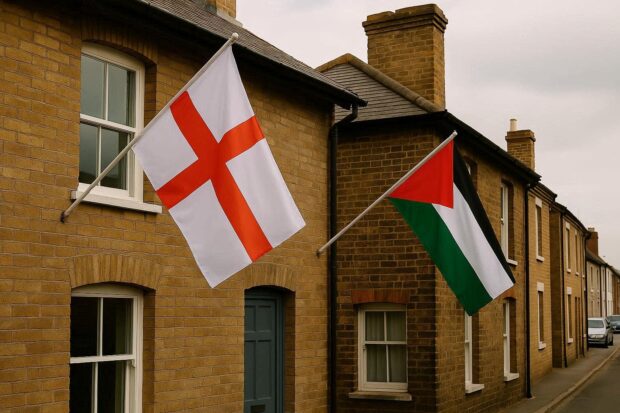
Drive through many English towns recently and you will see a rise in popularity of flags. St George’s crosses painted across roundabouts. Union Jacks tied to lampposts. Flags in windows, on cars, in gardens or draped over flyovers on the motorways. This acceleration of flag-flying in particular towns and regions has been linked to grassroots campaigns like Raise the Colours, which frame the flag as a symbol of neglected communities reasserting pride. Others note that it clusters in areas hit hardest by economic decline or debates about immigration. Surveys even suggest that while many view the St George’s cross as unifying, for others it is bound up with hostility and exclusion. Flags, in other words, are never neutral. They are contested signs: comfort for some, confrontation for others.

For some, these are signs of pride. For others, they feel like warnings. Whatever they mean, their very proliferation speaks of anxiety, a people uncertain of their place, grasping for symbols to say, we are still here.

This is not a new story. I have written before about the fragility of Englishness and how it shows itself most clearly in absence, in the fear of being overlooked. I have also noted how English identity is rarely named positively in intercultural conversations. Add to this the deep changes of the last forty years: deindustrialisation, globalisation, austerity. We begin to see why flags are multiplying. They are signs of a wound, the feeling of being forgotten, left behind, excluded from the story of your own land.

This wound has been seized upon by populist politics. In Britain, in Europe, in the United States, whole movements have been built on the claim that ordinary people no longer belong, that the system is rigged, that elites welcome others at your expense. Flags become rallying points not just for belonging but for blame.

And yet, this is not only one group’s story. Migrants and asylum seekers know a parallel pain. They arrive in places that promise welcome only to be met with suspicion, rejection, or conditional acceptance. Their flags are invisible. Their belonging is fragile.

The result is a crisis of belonging that touches everyone. A gnawing sense that no one belongs, that home itself is slipping away. Which raises the question: is there a place where both can belong without erasing their differences? Or are we doomed to live in parallel, separated by suspicion?


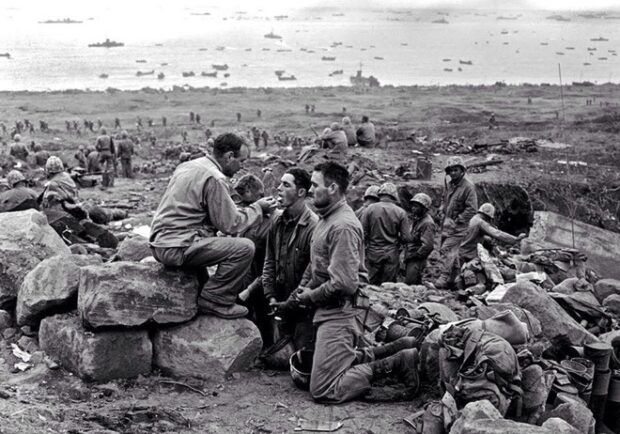
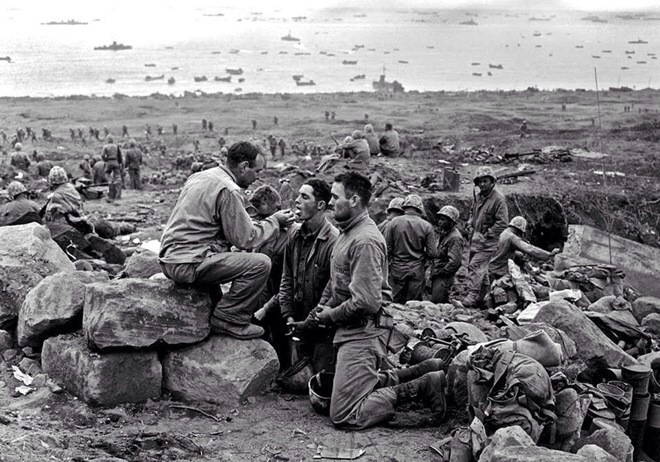
“No man’s land” once named the blasted ground between enemy lines, uninhabitable, unclaimed, deadly. It has become for me a fertile metaphor for intercultural practice. It describes the in-between, not one side or the other, not settled, not safe.

Anthropologist Victor Turner spoke of ‘liminality’, the threshold stage in a rite of passage where one is no longer what they were but not yet what they will be. In that space, the old identity has been stripped away but the new one is not yet given. Liminality is disorienting but necessary. Transformation cannot happen without it.

Hakim Bey’s ‘Temporary Autonomous Zones’ describe moments when established orders loosen. For a time, people can imagine and act differently, outside the control of dominant powers. They rarely last, but their fleeting nature is part of the gift. They show that another world is possible.

Homi Bhabha’s ‘third space’ describes the unpredictable zone where cultures collide. It is neither one nor the other, but something new, created in the negotiation of difference. Identity, in Bhabha’s view, is always hybrid, always contested.

Each of these thinkers invites us to reimagine no man’s land not as waste ground but as generative. It is unsettling and risky, yet full of possibility.

The Church has long known this ground. Augustine fought the Donatists’ dream of purity with his vision of the corpus permixtum, a mixed body of saints and sinners, insiders and outsiders, wheat and tares. The Church on earth is never pure, never settled, always provisional. Belonging is always contested, always mixed, always awaiting God’s final gift.

Paul Ricoeur adds a further insight. We only know ourselves in relation to others. Identity is never sealed off. It is always shaped in recognition of the one who stands different from me. Belonging is not possession but encounter. Not fortress, but relation.

So how do we inhabit no man’s land? My answer is improvisation. Improvisation is not chaos. It is the practiced art of responsiveness. It listens, adapts, takes risks, co-creates meaning in real time. It allows us to act boldly yet provisionally, to commit without total control. Improvisation is how we live with difference without demanding its erasure.

And this is what I call inclusive othering. We do not deny difference. Nor do we let it harden into hostility. We acknowledge it, honour it, and still choose unity. It is not assimilation, not purity, not separation. It is life together in tension, trusting that something new can emerge in the contested ground of no man’s land.

Britain itself, I think, is living in a cultural no man’s land.

For white working-class communities, the disorientation is real. Industries gone. Neighbourhood rituals fading. Economic insecurity biting. The feeling that the nation’s story is moving on without them. In former mill towns, pubs stand empty and terraces crumble. In coastal villages, young people leave because there is no work to stay for. Hence the flags: “we are still here.” They are not only signs of pride but pleas for recognition.

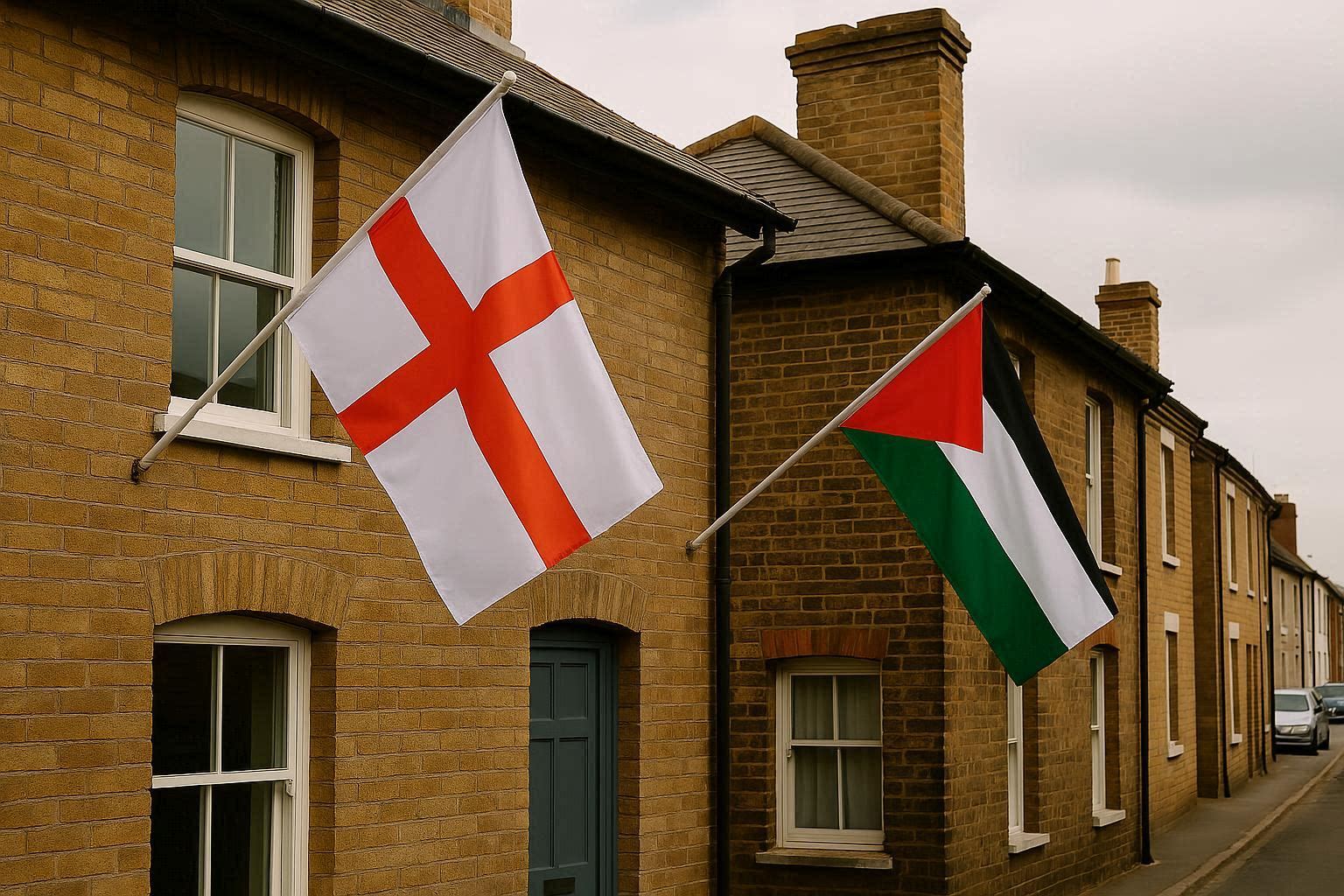
In cities like Bradford, another flag has appeared with growing frequency: the Palestinian flag. Draped from windows, waved at marches, painted onto walls, it signals solidarity with a people perceived as oppressed and stateless. For some, it is a banner of justice and compassion. For others, it is unsettling, even threatening. Like the English flag, it carries multiple meanings, and like the English flag, its presence is contested. Together, they show how the struggle for recognition is being fought out through symbols. Flags are becoming the visible language of belonging and exclusion.

For migrants and asylum seekers, the challenge is different but parallel. Hopes for safety and belonging meet suspicion and hostility. Hotels are filled with people whose cases drag on. Families are scattered by bureaucracy. Headlines reduce them to numbers. They too live in no man’s land, neither fully welcomed nor fully at home.

Here zero-sum logic takes hold. A zero-sum game is one where one side’s gain is another’s loss. If migrants are welcomed, are working-class communities displaced? If the English flag is flown, are newcomers excluded? If the Palestinian flag is raised, does it signal recognition or division? Populism thrives on this frame, belonging as scarce, a prize to be fought over.

We can see this logic in national debates. Housing shortages are blamed on migrants rather than decades of underinvestment. Hospitals are said to be strained by asylum seekers rather than chronic underfunding. “Taking back control” becomes less about empowerment and more about exclusion. In each case, the flag is enlisted as a marker of “us” against “them.”

But belonging is not zero-sum. It is not a limited commodity. It is relational, dynamic, capable of expanding. The problem is not that one group belongs and another does not, but that both feel they do not. As I wrote in Into Culture: Patronage, whose stories are told and supported matters. When whole communities feel invisible, belonging collapses. Populism grows in the gaps.

Where, then, can we model another way? Cathedrals have a unique vocation here.

Cathedrals are, by nature, no man’s lands. They sit at the crossroads of church, city, and nation. They belong to everyone and to no one. They are symbols of continuity, yet constantly pressed into new uses. They can be places where identities meet, unsettle, and reshape one another.

But there are blockages. Many cathedrals are perceived as elitist, grand buildings for “other people,” not for ordinary lives. Financial pressures push them to prioritise survival, hiring space, hosting events, protecting heritage, rather than risk inhabiting the raw edges of belonging. Governance often rewards caution rather than imagination. The tie to establishment power can blunt their ability to stand in contested ground.

Yet cathedrals, if they dare, could be laboratories of belonging. Spaces where multiple stories are heard without being collapsed into one. Places where worship is voiced in many accents, where art unsettles easy assumptions, where the overlooked find recognition. Not pure. Not settled. Not easy. But real.

For cathedrals to be a form of no man’s land is to risk the discomfort of contested space. It is to host conversation across suspicion, to embody recognition across difference. It is to resist populism’s fortress logic by opening space for belonging that is shared, provisional, larger than expected.

And so, the flags. The English flag, the Palestinian flag. They can be read as fortresses, lines drawn, territory claimed, belonging defended. Or they can be read as cries for recognition. “See us, do not forget us, we matter too.”

The challenge of our age is whether we will remain trapped in zero-sum suspicion, doomed to live in parallel, mistrusting neighbours across the street, or whether we will dare to step into no man’s land.

No man’s land is unsettling. It is unfinished. It strips away easy security. But it is also gift. It is the place where the deep work of belonging can be done. Where difference need not mean division. Where recognition can grow into relationship.

The health of our societies depends on this. Populism feeds on despair, on the sense that there is no shared home left to claim. If we cannot model a different kind of belonging, we leave the field open to fortress politics. Cathedrals, churches, communities; we all face the same choice.

So the question stands. Can we stop treating belonging as scarce? Can we risk inhabiting no man’s land, even when it hurts, in the hope that there we might find not the end of belonging but its renewal?

Into Culture: The Loom

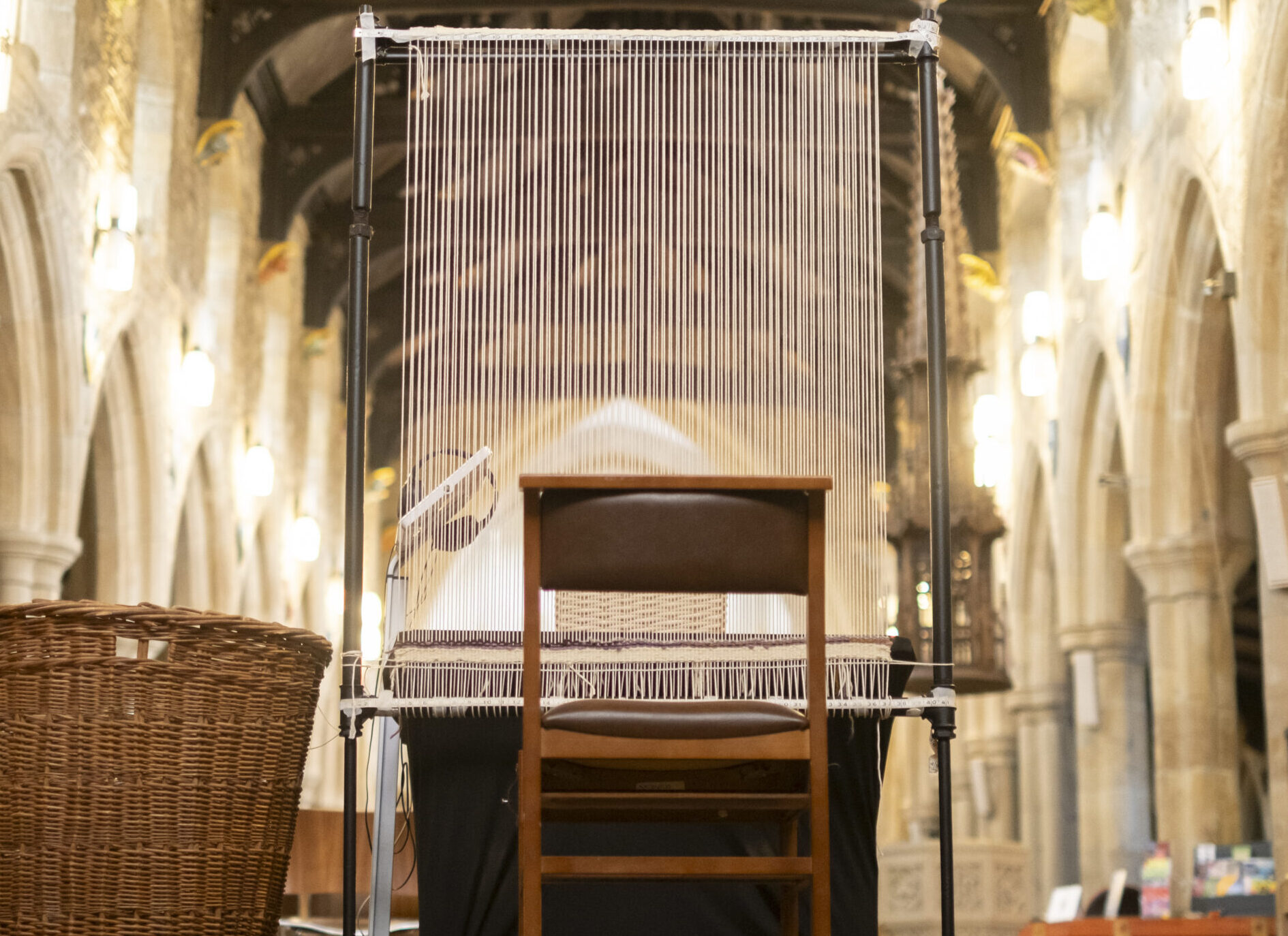
For the past four months, a loom has stood at the west end of Bradford Cathedral as part of a National Lottery Heritage Fund project we are running. We have invited members of the public to choose a thread of wool and weave it into a growing community tapestry. Children and elders, visitors and locals, those who come by chance and those who come with the single intent to weave; all have added their own strands.

It is strikingly simple, even meditative. The warp holds steady, the weft brings colour and movement, and each addition strengthens the whole. And yet, not everything has gone smoothly. Some people have misunderstood the instructions. Others have pulled too hard or left their threads loose. Quietly, those of us guiding the project have had to adjust, repair, and improvise to make sure the final piece still holds together. But none of that undoes the gift of participation. The tapestry only exists because so many hands risked adding their own imperfect thread.

And perhaps that is fitting, because Bradford itself is, in its very identity, a woven city. Its history is textile. Its present is intercultural. Its future is being worked out in the tension between tradition and innovation, roots and improvisation, scars and creativity. In recent weeks, as I have been part of conversations across the city, in civic forums, in the Cathedral, in cultural planning meetings, I have heard the same challenge surface again and again: how do we hold the threads together? I’ve found myself asking myself could this social weaving be the distinctive vocation of Cathedrals in the 21st century?


When I think back over the conversations I have been part of this month, I hear echoes of the loom in each of them. Different threads, different textures, yet all of them asking in their own way how we might weave this city’s life into something more than fragments.

With civic partners, the longing has been for more meaningful conversation than our public life currently allows. Too often dialogue becomes either polarised or polite, either combative or choreographed. But hospitality, one of our Cathedral values, is not about curating polite coexistence. It is about creating the conditions where people feel able to risk honesty, to sit with tension, and to trust that they will be held (you can read my reflections on this by reading last month’s post, ‘Into Cultire: Platform to Presence’) This, I believe, is part of what a Cathedral can uniquely offer: a hospitable loom, where threads that might otherwise fray or remain apart are drawn into a fabric that is stronger than the sum of its parts.

Within the Cathedral itself, my colleagues and I have been asking how our own vision document can be more than a paper statement. That too is a question of the warp and the weft. Rootedness, another of our values, reminds us that this community stands in more than a millennium of Christian witness and daily prayer. These are the warp threads, stretched tight across time, holding the structure. But without the weft, the innovative, intercultural, hospitable life that crosses them, the warp alone cannot make a fabric. To make our vision live we must keep weaving: to take the ancient story seriously enough to risk letting it meet the colours and textures of the present.

A third thread has come from our work on a Visitor Engagement Plan. We have been supported by consultants whose experience with other cathedrals is invaluable, yet the process has sharpened something for me: Bradford is not just any cathedral city. To describe it simply as intercultural misses what makes it distinctive. Bradford’s culture is forged in mills and markets, in migration and labour, in scars and solidarities. This is not a polished pluralism but a lived reality, raw and hopeful, shaped by both welcome and struggle. Any plan for engaging visitors here must reflect that uniqueness, not a generic template, but an experience that helps people encounter the texture of Bradford itself. That is what our value of interculturality really asks of us: not just to reflect diversity, but to interpret and host the distinctive, sometimes difficult, gift that this city carries.

And then there are the conversations about Bradford’s cultural future after 2025. When the spotlight of UK City of Culture fades, what will remain? Here the Cathedral’s value of innovation comes to the fore. Innovation is not about novelty for its own sake, but about courage: the willingness to improvise, to create new forms of beauty and dialogue that might not yet exist. Bradford has always produced outsider voices with global resonance, artists, writers, and leaders who have turned the tensions of this city into creativity. If we as a Cathedral can nurture that spirit, not showcasing diversity as finished performance but weaving it into new, surprising patterns, then perhaps we can help ensure that 2025 is not an endpoint but a beginning.

All these conversations, with civic partners, Cathedral colleagues, consultants, and cultural planners, are different threads. None of them by themselves make a fabric. But if the loom at the west end of the Cathedral has taught me anything, it is this: fabric only emerges when the threads are held in tension and patiently worked together, line by line.

On our loom there is no shuttle racing back and forth. The weaving happens slowly, by hand. That is significant; the tapestry only grows because people come, take hold of the yarn, and risk adding their part. Convening works the same way. A Cathedral cannot force unity or engineer neat patterns; what it can do is hold the frame steady, invite people forward, and create the conditions in which something larger than any one thread might take shape.

So what does this mean for the Cathedral’s future in Bradford? It means taking our vocation as loom seriously. It means curating conversations that do not stop at coexistence but risk honesty, vulnerability, and the possibility of change. It means rooting our life ever more deeply in prayer and worship so that the warp is strong enough to bear the tension. It means designing visitor experiences that reflect Bradford’s unique fabric, its scars as well as its solidarities, its particular story rather than a generic template. And it means using City of Culture 2025 as a beginning, not an endpoint, modelling intercultural creativity that continues long after the spotlight has moved on.

None of this will be straightforward. The tapestry will never be perfectly even; threads will be pulled too tightly or too loosely, and sometimes adjustments will be needed in the quiet. But perhaps that is the point. The work of weaving is never finished.

When the community tapestry on our physical loom is complete, it will hang as a piece of art. But its deeper value will not be the finished product; it will be the months of weaving, people meeting, hands moving, threads layered, mistakes amended, a fabric slowly emerging that no one could have made alone.

Too often our cathedrals are imagined in only two ways: either as monuments of the past, treasured for their heritage but disconnected from the present, or as venues for the present, hired out for franchised concerts and touring installations in order to keep the lights on. These roles may be necessary for survival, but they are not enough for vocation. If all we offer are relics or rentals, then we have missed the point.

What Bradford is beginning to show is that a Cathedral can be something else: not a museum, not a venue, but a loom. A place that holds tensions steady, invites difference into encounter, and patiently weaves new patterns of civic life. This is what our cities are crying out for; this is what our fractured societies desperately need.

The future of cathedrals will not be decided by balance sheets or by ticket sales, but by whether we dare to claim this vocation. We can continue as monuments and venues, but these will not last as long if we don’t primarily become looms for the future, weaving communities together, risk by risk, until something strong enough to hold begins to emerge.

Into Culture: From Platform to Presence

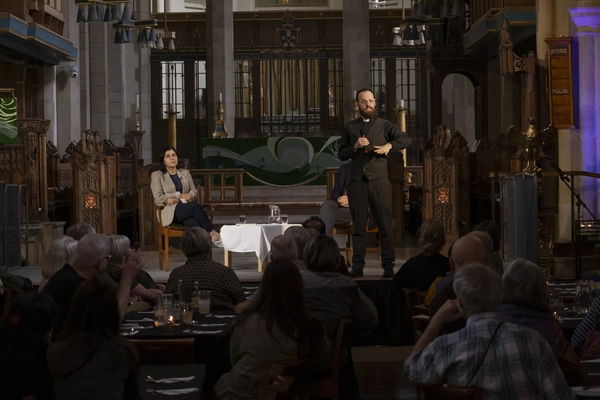
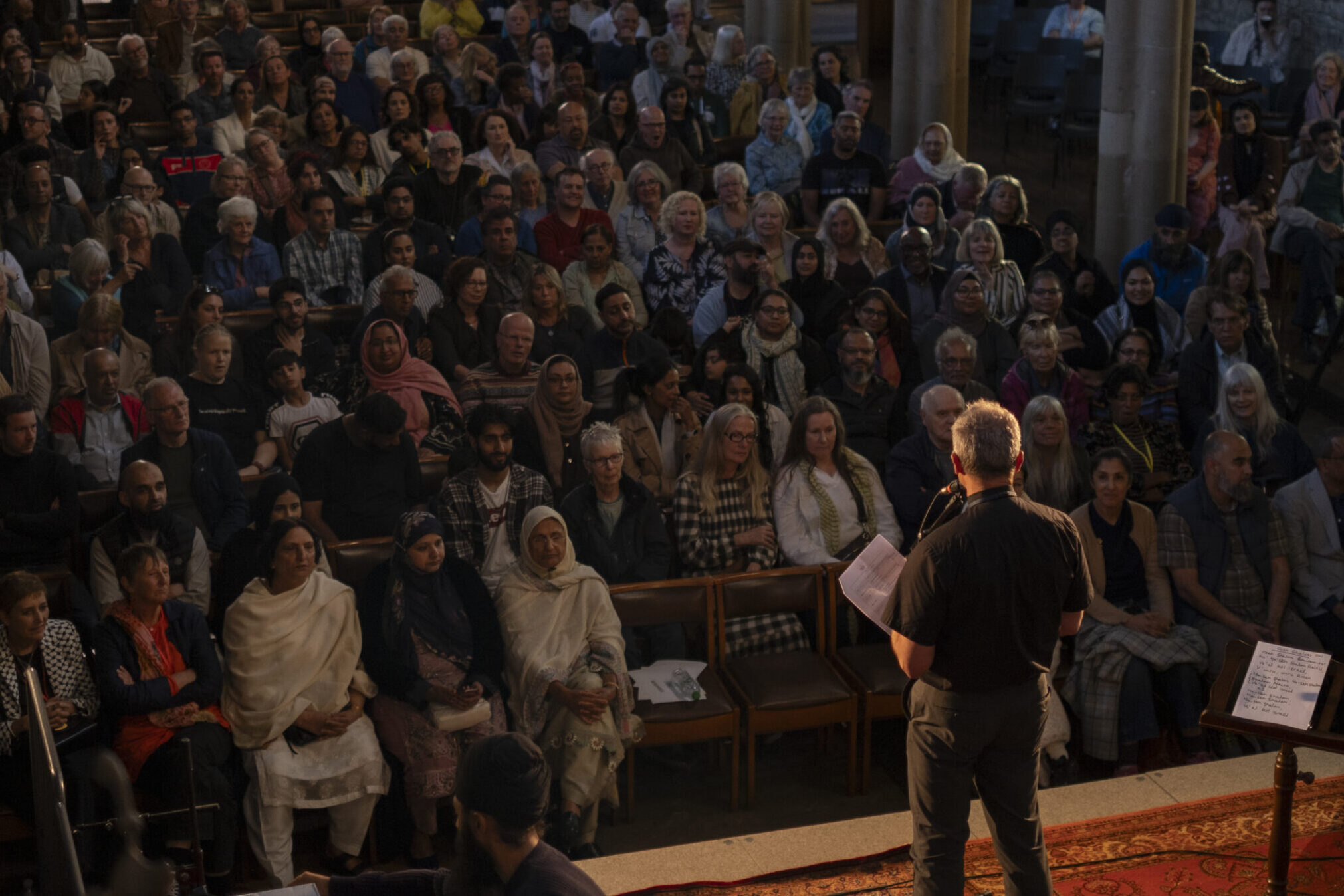
At the beginning of this month I stood on the same stage in the Cathedral for two different events both framed as a platform for interfaith encounter: one I was hosting the first public ‘Re:Imagine’ events looking at faith conversations with Baroness Sayeeda Warsi and Bishop Toby Howarth, the other, I was compering the annual ‘Sacred Music’ event for Bradford Literature Festival. Both events were billed as moments of dialogue, creativity, and shared spiritual insight: civic faith at its best.

Both events were curated with care. Both featured thoughtful, experienced voices. And yet, as the applause faded and the doors closed behind the final guests of that weekend, I felt a distinct and unsettling ache but not from hostility or controversy, but of absence: the absence of risk, the absence of surprise, the absence of the kind of uncomfortable, necessary tension that makes real conversation not only possible but transformative. Both had a sense that we were speaking around each other, not with each other. For all the talk of openness, diversity, and dialogue, what I experienced was not encounter but choreography.

Despite the warm words and generous presence of our contributors, neither evening managed to break the deadlock of public discourse. Neither truly modelled the innovative approach to intercultural engagement I had hoped for; something deeper than polite pluralism or liberal tolerance, something bolder than a curated diversity of views. What do we do when faith conversations, however well-intentioned, merely reinforce the safest, most performative version of themselves?

If Re:Imagine is to live up to its name, if sacred music is to do more than soothe, then we need more than curated coexistence. We need a new grammar for faith conversation, and public debate in general, that is something less about making space, and more about inhabiting tension. 

We must confront the following questions head-on: what needs to be unlearned in the way we currently gather across difference? And what might it take to birth something new; something not just novel, but necessary?


One of the things I’ve been reflecting on over the last few weeks is the inevitability of performance, especially when events take place on a stage. As soon as we put people in front of an audience, in a structured setting, particularly under the vaulted ceilings of a cathedral, we are not just enabling speech; we are framing it. Whether we realise it or not, we are inviting a performance.

This isn’t a criticism. It’s simply a sociological fact. In his seminal work The Presentation of Self in Everyday Life, Erving Goffman argued that social life is fundamentally theatrical. Each of us, he claimed, is always managing impressions; performing a version of ourselves that is shaped by context, audience, and expected norms. The ‘front stage’ is where roles are consciously curated; the ‘backstage’ is where we are less guarded, less polished, more uncertain. But Goffman’s point is that even our backstage is not fully free from performance; we are always somewhere on the spectrum of managing perception.

This framework helps explain why the platform changes things, even when the conversation is genuine. I tried to make Re:Imagine feel less like a panel discussion and more like an invitation to be present, unguarded, vulnerable. But the stage itself had its own logic. The lights, the audience, the publicity, all of it subtly nudged us into a mode of presentation. And once there, it was hard to improvise. When Baroness Warsi and Bishop Toby spoke, they were never really going to be able to simply share personal reflections. In hindsight, the temptation to enact identities was always going to be hard to resist. Warsi, a high-profile Muslim political figure, had to navigate all the projections, expectations, and contestations that come with that role. Bishop Toby, a Church of England bishop in a city like Bradford, was similarly constrained, not by lack of sincerity, but by the complexity of occupying an ecclesial role that is both spiritual and civic, pastoral and political. Both were, in a sense, ‘on stage’ before they even opened their mouths.

And yet I do not believe performance is always false. In fact, I’ve long thought that performance can be deeply true; perhaps even sacred but only when it moves beyond control into vulnerability. My background in theatre taught me that risk is the currency of authentic performance. It is not about getting it right but about stepping into the unknown with others. That kind of improvisational performance isn’t about projecting an image but revealing a self. For that to happen, the platform must allow for rupture and the inevitable mess to be held.

This is what I hoped Re:Imagine might enable. And while both our contributors gestured toward that vulnerability with grace and honesty, the structure around them hindered and blocked their improvisation. The conversation stayed within the boundaries of what the audience could already process. The performances were sincere. But they were still bounded.

What might it take to make a different kind of space?

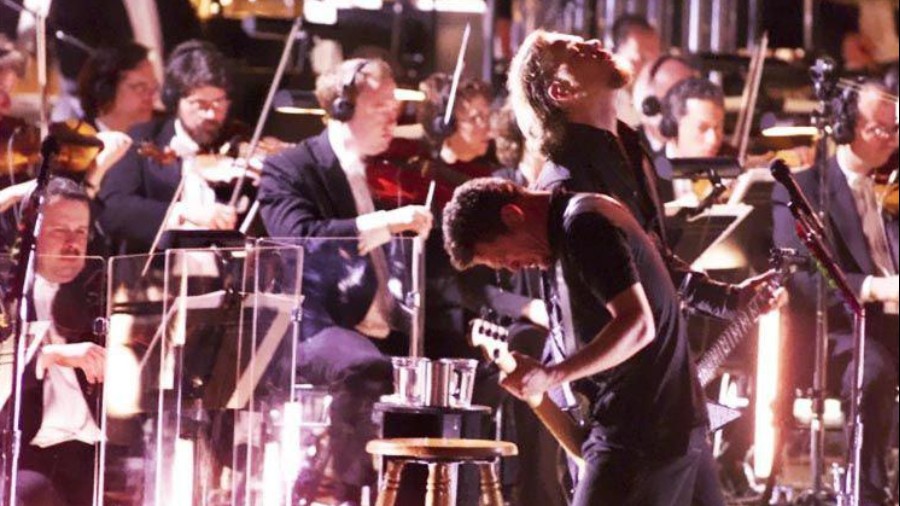
This question surfaced again the next evening. I had hoped to co-produce this year’s Sacred Music event with Bradford Literature Festival. I’d proposed a shift in format: rather than sequential performances by artists from different traditions, what if we invited musicians to improvise and collaborate to create something new in real time, across the boundaries of tradition? Faith in motion. Difference in dialogue.

The conversations were encouraging but, in the end, the final event returned to the familiar: artists from different faith backgrounds performing one after another in respectful sequence. Beautiful but ultimately predictable. We honoured coexistence, but did not risk co-creation.

And this is where I believe we are stuck.

In many public conversations about faith and other contested issues we find ourselves in one of two places. Either we veer toward conflict: oppositional voices debating from fixed positions. Or we avoid it altogether: showcasing diversity in a way that flattens its tension. The former breeds fatigue and defensiveness; the latter, polite stagnation. Both forms are governed by what I want to call curated coexistence. It’s the idea that if we simply gather different people in the same space, a deeper understanding will naturally emerge. But that’s not how real encounter works. Not in theology. Not in art. Not in life. Encounter requires not just proximity, but vulnerability. Not just expression, but interruption… and interruption is risky.

This is why I’ve been returning to my ongoing reflection on inclusive othering; a framework which seeks to hold deep difference not as a problem to be solved, but as a place to dwell. I have been drawn to the idea that genuine unity comes not through flattening difference, but by learning to desire the good of the other precisely as ‘other’, as different.

Inclusive othering is not about everyone feeling comfortable. In fact, it’s about learning to sit in that uncomfortable ‘no man’s land’ between views, identities, and traditions and allowing that space to shape us.

No Man’s Land by Magdalena Mudlaff

What, then, might this mean for the Re:Imagine series moving forward as a platform for reimagining all kinds of contentious and complex topics: global diplomacy, AI and ethics, environmental activism, migration?

Firstly, I believe we need to experiment with form. What if the structure of our events is not just a means of delivery, but a form of witness? Drawing from performance theory and social improvisation, I am increasingly convinced that our formats encode our assumptions. If our structure assumes performance, then transformation will remain secondary. If the structure of our encounter is built to invite surprise, co-dependence, and change, then our content may finally have room to breathe. This means, therefore, more than changing the seating arrangements. It means actively disrupting the expectation that ideas must be defended or performed. What would it look like to invite guests not to explain themselves, but to ask each other questions they have never dared ask? What if every event required a confession—of failure, of misunderstanding, of being surprised by the other? What if participants weren’t experts, but witnesses?

Secondly, I want to explore the role of embodied practices in public conversations; silence, lament, artistic improvisation, shared meals, symbolic gestures. These are not just aesthetic flourishes. They are facilitated interventions. They disarm the impulse to perform and invite a mode of engagement that speaks to the whole person—not just their views, but their lived and vulnerable selves.

Thirdly, we must reckon honestly with power and representation. One audience member felt, after the Re:Imagine event, discomfort that a powerful political figure, Sayeeda Warsi, was given an uncontested platform who could say things without a firm response. What I found most interesting about that expressed opinion was what it revealed about audience expectation: namely, that public spaces are understood as a kind of battleground. What if we reimagined and restructured it as a sanctuary for disarmed curiosity? What if our role as curators of public space is not to ensure balance, but to nurture trust in order to create containers where difference is neither erased nor exploited and tension is embraced as an uncomfortable but necessary catalyst to creativity. As Miroslav Volf suggests to embrace is to open one’s arms, wait, and then close them around the other; not to absorb, but to hold the other. Too often, our public events keep the arms open but never move toward that vulnerable embrace.

Finally, we must accept that not all fruitful conversations are public. I am still wrestling with whether these events should happen on stage at all. Yet I worry that if we retreat entirely into the private realm, we abandon the possibility of redeeming the public one. The challenge is this: how do we make public spaces more porous, more reflective of the quiet transformation we know happens in private? Risk, after all, needs aftercare. Surprise requires structure. Vulnerability must be held. To reimagine means not only saying new things, but saying them in new ways and allowing our forms to speak before our words ever do.

So what now?

I remain grateful to Baroness Warsi and Bishop Toby. They showed up. They offered themselves. They attempted to be vulnerable. My disappointment is not in them, but in the format that could not sustain the possibility of surprise. The same is true of the artists and the people at Bradford Literature Festival curating the Sacred Music event.

We do need new formats for public moments and encounters. We need creative risks. We need voices willing not just to speak, but to listen and then acknowledge the possibility of change. We need events where musicians and thinkers improvise across difference, where politicians weep, where migrants and fearful indigenous peoples meet each other, personally over a meal and share stories.

Because if faith, and public life, are to mean anything in this fractured age, they must do more than speak. They must listen. They must risk. They must dwell in the gaps.

That weekend in the cathedral did not go as I had hoped. But perhaps that’s the point. Hope is not about things going to plan. Hope is the refusal to give up on what could be, even when what was falls short.

It is time, once again, to reimagine.

Into Culture: A Self Apart

I was on retreat: a gathered community of leaders with disabilities and neurodivergence, drawn together to reflect, to rest, and to listen. During one of the sessions, ‘Leading From Who You Are’ the facilitator posed a deceptively simple question:

Who are you, apart from your team, your organisation, your context?

It was meant to help us excavate our identity, to reach below our roles and responsibilities to the self beneath. But I couldn’t answer it. In fact, I couldn’t even understand what was being asked.

What does it mean to imagine the self apart from the people, patterns, and places that shape it? I didn’t just struggle for an answer. I struggled to comprehend the very premise of the question. The rest of the room began to engage in conversation and I listened in to attempt to discern what I was missing. Others were talking about self; their understanding of who they felt they were but none were acknowledging how that self has come into being. It was as if they believed they ‘sprang from the mind of God’ (Peer Gynt, Act 5 Scene 3), fully formed. That’s a common assumption about the self, but I don’t think it’s true.

I was baffled, in part, because when I usually experience a dissonance between my own understanding and that of those around me, I instinctively blame my neurodiversity/autism. In this context, however, I felt restricted in doing that. For a fleeting moment, I feared there was something wrong with me beyond what I could safely attribute to autism.

I’ve come to see that what unsettled me on that retreat wasn’t a lack of self-awareness but a different way of being a self altogether.


At first, it might seem contradictory to say that autistic people experience selfhood as fundamentally relational. The stereotype is that autistic people struggle with social connection and interpersonal understanding. Surely, then, autistic people would feel themselves as more isolated, not less. This assumption collapses, however, when we explore how autistic relationality actually works. Autistic people often experience difficulty with certain social performances: small talk, fluid group dynamics, decoding unspoken social rules. This does not mean we are less relational; it just means we connect differently.

Autistic researcher Damian Milton challenges the typical narrative with his theory of the ‘double empathy problem’, which proposes that autistic social difficulties arise not from inherent deficits but from ‘mutual misattunement’ between autistic and neurotypical people. I am not less social; I simply socialise differently. Neurotypical society tends to privilege social ambiguity, implicit communication, and high-context interactions and these modes are exhausting or bewildering to us autistics. This doesn’t mean that we are not interested in relationships but we tend to find fulfilment in these connections through shared activities, clear structures, predictable rituals, and deep focused interests. We flourish in communal spaces that are stable, ordered, and trustworthy; places where the unspoken social rules are replaced by liturgies, patterns, and shared rhythms.

Beyond this, many autistic people experience a form of ‘ecological selfhood’ which is a sense of self that is intrinsically tied to our environment, sensory world, routines, and the people and objects that anchor us. The boundaries between self and context, therefore, are often blurred.

Naoki Higashida captures this in his remarkable book:

It’s as if my body belongs to someone else and I have zero control over it… I can’t just think about things in isolation—my thoughts are all linked to other things.

Naoki Higashida, The Reason I Jump: The Inner Voice of a Thirteen-Year-Old Boy with Autism, trans. KA Yoshida and David Mitchell (New York: Random House, 2013), 36.

I don’t perceive myself as something separable from my context. I experience selfhood as something that emerges within forms of social, as well as ecclesial liturgies, shared spaces, and communal belonging. When people ask me to strip that away to find some ‘pure self’ underneath I get lost, not because I am avoiding myself but because I have never known myself apart from the places and people around me.

Grant Macaskill, in his theological reflection on autism, puts it bluntly:

Autistic people often embody modes of relationality that resist the individualism of Western culture. Their difficulties are less about absence of sociality and more about divergence from normative expectations of social behaviour.

Grant Macaskill, Autism and the Church: Bible, Theology, and Community (Waco, TX: Baylor University Press, 2019), 73.

What I struggled with on that retreat was not self-awareness. I was struggling with the premise that my truest self could somehow be detached from my community. That model of selfhood just doesn’t fit, but more than that, I am beginning to wonder whether it doesn’t fit anyone.

Perhaps autistic relationality doesn’t simply offer an alternative way of connecting but offers the Church a prophetic reorientation. If the dominant leadership cultures centres on the autonomous, performative self, maybe it is those cultures, not autistic people, that are out of step with the Body of Christ. Perhaps autistic ways of being illuminate what our theology has always said but our practice has too often forgotten: that the self is made in relation, that difference is not a problem to be managed, but the very ground where communion takes root.

What if autistic relationality is not a deficit to be overcome but a gift to be received: a sign that we lead most faithfully not by extracting ourselves from others, but by remaining deeply, dependently, unmistakably embedded in the life of the community?

Richard Giblett, Mycelium Rhizome, 2006-2009

Our culture tells us that identity is something we must cultivate independently. The self is seen as a solitary project: find yourself, be yourself, lead from your authentic self. This story of selfhood assumes that the truest ‘you’ exists somewhere prior to or beneath your context.

This story of selfhood is deeply rooted in the modern, Western imagination, shaped by Enlightenment ideals of autonomy, rationality, and the self as an isolated, self-determining agent. This is not just a cultural whim; it is a historically located worldview that has shaped leadership, spirituality, and even Christian discipleship in the West, and I believe this modern ideal is a myth.

The Christian tradition, particularly through the voices of Augustine, Rowan Williams, and Yves Congar, calls this into question. The self, they suggest, is not a fortress. It is not a self-contained treasure waiting to be uncovered through introspection. Thomas Merton offers a sharper vision:

The true self is not a private, isolated self… It is found in the act of self-forgetfulness, in love.

Thomas Merton, New Seeds of Contemplation (New York: New Directions, 2007), 42.

Love, relation, community; these are not optional extensions of selfhood. They are the very ground of it.

My recent reading of Yves Congar and Henri de Lubac gave this instinct theological clarity. Both rejected the idea that the Church is simply a collection of individuals. They insisted the Church is a communion: a people bound together by the Spirit, by shared life, by mutual dependence.

The Church is not the sum of individuals. It is the common life of grace and truth, a communion in Christ through the Spirit.

Yves Congar, Lay People in the Church: A Study for a Theology of the Laity, trans. Donald Attwater (Westminster, MD: Newman Press, 1957), 16.

Congar’s vision resonates deeply with this idea of autistic relationality. You cannot understand the Church, or the self, by pulling it apart into isolated units. The Church is a living body, not a loose assembly of separate selves and, perhaps, autistic relationality teaches us this in its own particular, embodied way. It shows us what I am calling ‘inclusive othering’, where difference is seen, honoured, and held together in the unity of shared life. It refuses to collapse our distinctiveness into a bland sameness but insists that we are bound together precisely as different. Autistic relationality is not about dissolving difference to find connection, but about finding connection through difference.

It is not only Christian theology that challenges the Western fixation on the individual. Many cultures across the world understand the self as fundamentally communal. The Zulu concept of ubuntu (“I am because we are”) expresses this beautifully. In ubuntu thinking, your identity is not forged first and then added to community. Rather, “You are summoned into your identity by others.” (Rowan Williams, The Edge of Words: God and the Habits of Language (London: Bloomsbury, 2014), 105).

The self is not a solitary treasure to be excavated. It is a calling, a voice that is spoken into being by the community that loves, challenges, and shapes us. Perhaps, then, the question is not, “Who are you apart from your context?” Perhaps the more faithful question is, “Who are you within your context? What unique voice, gift, and way of leading do you offer precisely because you are embedded in your community?”

I do not lead from some self distilled and extracted from others. I lead from a self that is deeply, inescapably connected to the Church, to the Body, to the patterns that sustain me. Augustine, too, knew this:

Let your heart be more closely bound to the Church than to your own heartbeat.

Augustine, Sermon 265D, in Essential Sermons, ed. Boniface Ramsey, trans. Edmund Hill (Hyde Park, NY: New City Press, 2007), 326

When I return to the question of who I am, apart from my context, I realise I still have no answer… but perhaps that’s not a failing. Perhaps it’s a faithful refusal to sever what God has joined together.

Into Culture: The Shape of Sacrament

Two conversations in recent weeks have stayed with me.

The first was with a parent, curious and pastoral in their enquiry. One of their children, unexpectedly, had received Holy Communion during a service without the parent knowing, and before the older sibling had done so. There was no anger, just a gentle, open question: how do we handle such things? What does it mean?

The other was with a Hindu friend exploring the possibility of converting to Christianity. As we discussed belief, belonging, and the nature of commitment, they said something that struck me deeply:

Monotheism is like monogamy. It’s choosing one, even though you could choose many.

The metaphor wasn’t just theological: it was cultural. They come from a society shaped by the traditions of arranged marriage, where ‘dating’ doesn’t carry the same social weight as it does in the West. Love, for them, often follows promise, not the other way round. It was also a metaphor born out of difference. Hinduism, after all, is not merely polytheistic in number but in relationality. It holds a world thick with deities, each reflecting a particular facet of the divine. To consider monotheism as monogamous was not a rejection of plurality but a fascination with the Christian claim: one God, one covenant, one beloved. Fidelity, not variety, as the heart of the divine-human relationship.

And here, of course, is where Christ steps into the conversation, not simply as a name for God, but as the one through whom we know this fidelity. The incarnation of God’s self-giving love. The one who calls, commits, and receives.

These two encounters, one quietly domestic, the other vividly cross-cultural, have refused to let go of each other in my imagination. They have drawn me again into pondering the complex choreography of the sacraments: of belonging and believing, of who comes to the table and when, and of how the Church holds open space for grace without making it cheap.


Back when I was serving in Sheffield, I remember a situation where I discovered a few children had been regularly receiving communion before they had been baptised. Their parents did not want them to be baptised until they could make the decision themselves. In trying to explain the theological dissonance of that moment, I reached for an analogy: baptism, I suggested, is like marriage, a public act of covenantal commitment. Holy Communion, then, is the consummation of that covenant; the intimate, embodied sign of a life now shared. To take communion before baptism is to jump ahead in the story. It is, I said, like sex before marriage: a moment of intimacy without the promise that gives it shape.

I know that analogy isn’t perfect (none ever are) but it helped me to name something important: sacraments are not isolated rites; they exist in relationship. They interpret each other. The Eucharist matters because baptism matters, and the sequence, while not legalistic, carries meaning: it tells a story.

This is why I find myself returning often to John Henry Newman’s observation:

Baptism may be the hand of the giver, and Faith the hand of the receiver.

John Henry Newman, ‘Tract 90: Remarks on Certain Passages in the Thirty-Nine Articles‘ (London: J.G. & F. Rivington, 1841) section 7.

The sacraments are not mechanical rituals. They are gestures of grace, relational acts of giving and receiving. Baptism is not simply a declaration of belief: it is the moment we are named and known. The Eucharist is not merely food: it is the kiss of Christ, the deep intimacy of shared life with Jesus and his Body.

And yet, the analogy, in light of my conversation with my Hindu friend, also exposed something deeper: a tension between our cultural assumptions about merit and the Christian understanding of grace. We often delay baptism, particularly in adult or convert situations, until we can be confident of someone’s belief, clarity, or readiness. But is that confidence always necessary, or even faithful? The Christian life does not begin with our certainty, but with God’s initiative.

As John Lennox insightfully puts it, “A Christian is a person who enjoys now a real relationship with God through Christ through trusting him that he or she has not merited.” He goes on to describe how we project our performance-driven society onto God.

We think that we can merit God and a relationship with him… But just a minute, what about marriage?… You wouldn’t insult a fellow human being by telling them that your acceptance of them depends on their performance. But that’s exactly what you’re basing a relationship with God on.

John Lennox, Facing the Canon with J. John, YouTube, 2022, https://www.youtube.com/watch?v=JDQPvgi4HeQ

That’s what makes the baptism of infants so subversive and so revealing. A child cannot articulate trust or doctrinal clarity, and yet, this month I baptised my 4 1/2 month old son. Why? Because God’s promise comes first. Because grace precedes understanding. And that has reshaped how I reflect on conversations like the one with my Hindu friend. Was I, however gently, asking them to earn something that can only be received?

Lennox suggests our world defines religion as “…a path. You try and follow it. And you hope that when you get to the judgment, you’ll have done enough for God to accept you.” If this is true, then Lennox is right that Christianity is not a religion. Christianity is indeed a path but one not to somewhere (acceptance) but from somewhere (an encounter with the grace of the Risen Christ).

So what of the child who comes to the rail and stretches out their hands with innocent expectancy? The recent conversation reminded me how delicate and deeply human these moments are. I shared with the parent that there have been a few times (very few) when I have felt I should refuse communion at the rail. Each time, it left me aching, aware that in doing so, I opened myself to the charge of hypocrisy: who am I to decide? I don’t know everyone’s story. I don’t know what grace is doing beneath the surface.

And yet, I also know this: administering the sacraments is not about performing a perfect system. It’s about holding mystery with trembling hands. It’s about standing at the intersection of grace and form, of longing and limit. It’s about seeking to be faithful to the Christ who both institutes and inhabits these sacraments and who gives himself not only in bread and wine, but in the very act of our seeking.

What struck me in both conversations was not confusion but hunger; and beneath that, perhaps, the Church’s call to recover the fullness of its sacramental imagination. Communion is not simply about inclusion or exclusion. It is about meaning. It is a mystery into which we are drawn, a story into which we are written, a Person with whom we are united.

Yes, there are policies. Yes, there are pastoral accommodations. But more than that, there are people stretching out hands in wonder, asking in quiet tones what it means to commit, to be welcomed, to be known.

And this is the paradox at the heart of the sacraments: God’s grace always comes first. Its very freeness deepens our responsibility not to achieve them, but to honour them. Receiving what we do not merit asks of us a different kind of seriousness, not one based on performance, but on attentiveness, reverence, and response. To baptise is to welcome trust, not certify certainty. To receive communion is not to prove faith but to be formed by it, again and again. 

This is where the Church’s discernment matters; not to police the font and table, but to hold them as places where grace is costly because it is real. Sacraments are grace with weight. They cost us nothing, and they change everything. They are divine invitations, not human achievements.

Baptism initiates us into this grace-soaked life; Eucharist sustains us in it. Baptism comes first because the Church receives before it feeds. But when the order blurs, we do not panic: we discern. We ask not, “Have they earned this?” but, “What is grace doing here?” They do not work because we grasp them, but because Christ gives himself in them. That is not a contradiction to resolve, but a reality to live.

And so I find myself wanting to say, both to the child at the rail and to my Hindu friend, “this is the shape of grace: to come to Christ and to say yes, and that yes is not the end of the path but the beginning of it.” The sacraments are not prizes for the certain, nor performances for the worthy. They are where that path begins and continues; one in water, the other in bread, both in the gift of Christ himself who still says, “Come.”

Into Culture: Pursuing Mystery

It’s strange to feel the weight of a question before it is even asked. As I logged into the video call for my PhD interview, I knew what was coming first: they had helpfully told me the questions beforehand. Yet, despite that, the moment still had force.

What motivates you to study this topic?

It was not asked brusquely or with pressure. The tone was kind, the invitation sincere but I felt the air shift slightly. This was not just opening pleasantries for me: this was the moment when scholarship would meet selfhood, when the scaffolding of ideas would be tested for depth, for purpose, for real roots. I had wanted to answer the question ‘correctly’ but, as I looked at my notes in front of me, they merely offered the usual rationale: theological relevance, ecclesiological urgency, intellectual continuity with my MA. All of that was true but none of them quite hit the mark.

The truth is, my proposal (exploring unity in difference through Augustine and Hugh of St Victor and their respective understandings of the Triune God and the outworking of that into the Church) is not simply academic. It feels personal. It’s visceral. It is, in a real way, autobiographical.

I have come to realise that what really motivates me to return again and again to ‘unity in difference’ is paradox. I cannot escape a deep longing for unity, yet I experience the world as difference. I feel deeply connected to the Church, yet I am constantly aware of my divergence from its norms. I seek the coherence of truth, yet find that coherence not in simplicity but in complexity.

The inhabiting of paradox, more than any footnote or formal learning, is what has led me, and continues, again and again, to return me to the Trinity.


When I began to realise that I might be on the autistic spectrum as an adult, many things began to make more sense. I had always known that I saw and processed the world differently, but now I had a language for it. Patterns, structures, systems, these were not just useful to me; they were compelling. I do not let go of questions easily. I turn them over and over. I have a t-shirt that reads, ‘Hold on. Let me overthink this.’ I feel a gravitational pull towards that which seemingly cannot be resolved. If I encounter a paradox, I do not walk around it, accept it as mystery and brush it off: I live in it.

This cognitive style has been widely recognised in research as autistic reasoning. In one important study, Morsanyi et al. argue that individuals on the autistic spectrum are less inclined to accept intuitive, but logically misleading, responses. Instead, they show a strong preference for deliberative, analytical approaches. What appears to many as a tangle of contradiction becomes, for us, an invitation to go deeper. The study concludes that autistic people “may be less susceptible to intuitive but misleading reasoning responses and instead rely more on deliberative, logical approaches.” (Morsanyi, Kinga, et al. “Reasoning on the Autism Spectrum: A Dual Process Theory Account.” Journal of Autism and Developmental Disorders 46, no. 6 (2016): 2120. https://doi.org/10.1007/s10803-016-2742-2). We are wired for coherence, but we find it not by simplifying the data but by persisting with the difficult bits until a deeper pattern emerges.

This is echoed in visual perception studies, such as Sheppard et al.’s paper entitled, “Perceiving the Impossible: How Individuals with Autism Copy Paradoxical Figures.” on the reproduction of paradoxical figures. When presented with drawings that defied spatial logic named ‘impossible shapes’, autistic participants were not confused or blocked by them. They simply copied what was there, detail for detail, without needing to make it fit into a pre-existing spatial framework. The paradox did not need to be resolved before it could be engaged with. It was engaged with as it was.

This struck me, when I read the research, as a deeply theological posture.

The Christian faith is full of paradoxes. The incarnation, the cross, the Kingdom that is here and not yet and, most centrally and foundationally, the Trinity. One God but three Persons. Not modalism, not tritheism but a unity that holds difference within itself, eternally.

Many theologians acknowledge that the Trinity is not merely an intellectual puzzle but a revelation that resists flattening. To understand it is not to tame it. And yet, for me, that complexity is not a barrier to faith; it is a pathway. It draws me closer, because it reflects something I already know in my bones: that truth is not the absence of tension, but the holding of it.

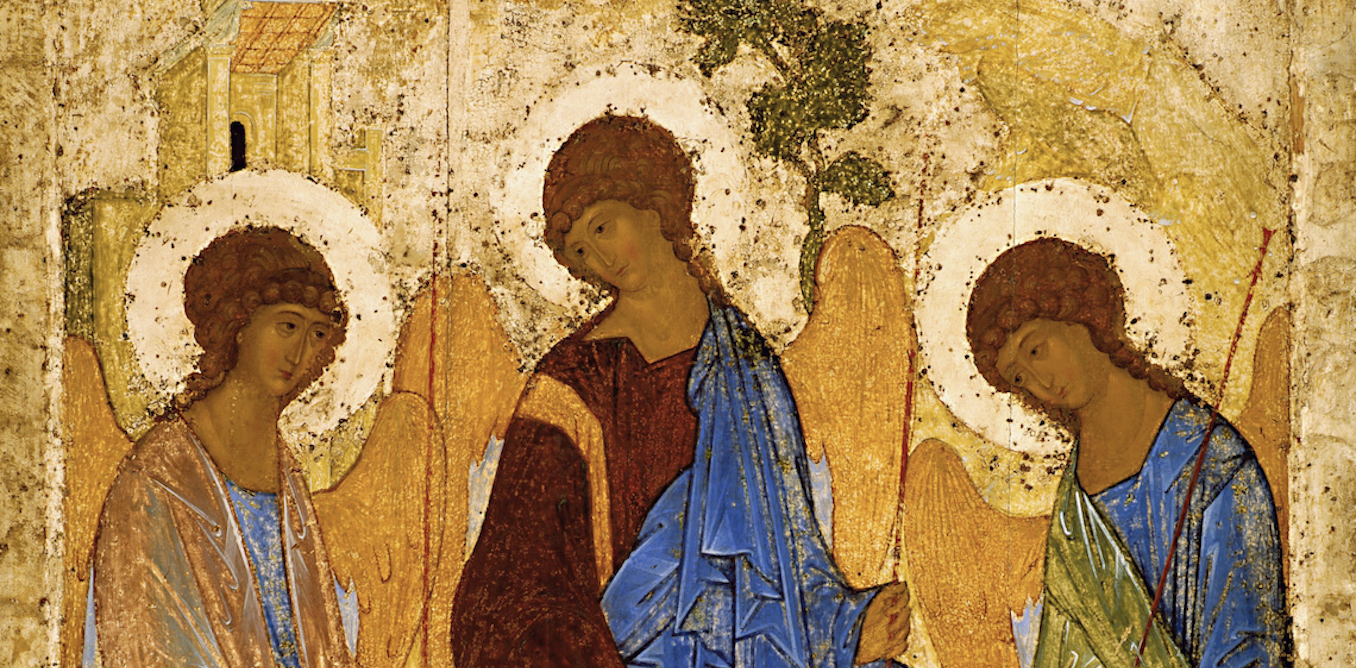
The Trinity, then, is not an object of my study but, in some way, it is an icon. It reveals and affirms a mode of existence that is deeply familiar to me but remains strangely unspeakable. It offers a way of thinking about unity that does not demand uniformity. And this is where the theology becomes not only personal, but ecclesial.

I have come to describe my approach to intercultural practice as one of ‘inclusive othering’. It is an attempt to name a way of holding difference within a framework of unity, without dissolving the importance of either. In the life of the Church, we often fall into one of two traps: either we preserve purity by excluding the ‘other’, or we flatten difference in the name of peace; but the Trinity models a different way. The Persons of the Trinity are not interchangeable. The Father is not the Son. The Spirit is not the Father. There is real distinction. But there is also real union. Not hierarchical, not conflicted, but harmonious and perichoretic.

Inclusive othering, then, is not about making everyone agree, or ignoring deep disagreement. It is about recognising that difference can be held within relationship, even if it is not resolved. This, I believe, is the ecclesial challenge of our age and it is also the gift that neurodivergent people can offer to the Church.

While autism often, in clinical terms, emphasises what it lacks, there is a growing recognition that it brings distinctive ways of seeing the world. One way is an ability to hold complexity, to pursue coherence without closure and to name inconsistencies others tolerate into silence. These traits, I believe, far from being flaws, are prophetic. They invite the Church to imagine a community not, primarily, as shared agreement, but as shared attention to the mystery of God and one another. Unity that can hold difference is not only a theological necessity but may also be a neurodivergent gift.

And if Augustine’s ecclesiology can be read as a struggle to hold grace and order together and if Hugh of St Victor offers a vision of community that cultivates both discipline and mutuality, then these are not merely historical artefacts; they are resources for the Church today. They resonate with the neurodivergent experience of needing structure, while longing for belonging.

So when I was asked what motivates me to study the topic of unity in difference, I could have said: “Because the Church is divided and needs healing,” or “Because doctrinal clarity matters,” or “Because I want to trace a theological thread from Augustine to Hugh that can inform contemporary ecclesiology.” All of that would be true.

But the deeper truth is this:

I study the Trinity because I need to believe that unity in difference is real, not as a concept, but as a lived possibility. I need to believe that my way of being is not a problem to be solved, but a perspective that can illuminate. I need to believe that the paradoxes I carry, between belonging and difference, between tradition and innovation, between fixed structures and fluid relationships, can find a home in God and the Church.

The philosopher Søren Kierkegaard, who also dwelled in paradox, argued that the most important decisions are not made through objective reasoning but through the leap of faith. That leap is not irrational, but it goes beyond calculation. It is the choice to act in the face of ambiguity, to commit to something that cannot be proved in advance.

In a way, my PhD project is such a leap. It is an act of trust that unity can be more than a word, that difference need not mean distance and that the Trinity is not only the object of our theology but the pattern of our life together.

What motivates me, then?

I have always felt slightly out of joint with the world. Not entirely apart, but never entirely at ease. It’s not just a matter of difference; it’s dissonance. I sense the world moving to a rhythm I can’t quite learn, speaking in a language I only half understand. The intensity of this disunity between me and others, between people and institutions, between ideals and actions, has never gone away. And yet, I have never lost the longing for communion. If anything, it only grows stronger.

This is not a purely intellectual dilemma. It is an existential ache. The question I live with is not just ‘how can we be united?’ but ‘where do I belong if unity is impossible?’

That question fuels my interest in the Trinity, not as a neat theological formula, but as a holy enigma that effects my own life. I don’t approach the doctrine of unity in difference with cool detachment. I approach it like someone trying to breathe underwater. The paradoxes of the Trinity are not obstacles for me to overcome; they are contours of a mystery I recognise in my bones. Here is a God who is one and three, eternally. Not in compromise, but in fullness. Not despite difference, but through it. If this is what God is like, then perhaps my longing for unity amid difference is not a flaw or a futile dream but, in fact, it is a call to dwell ever more deeply in the reality of God.

That doesn’t resolve the tensions I feel in the world. It doesn’t dissolve the pain of disunity or the sharp edges of misunderstanding that often meet neurodivergent people like me. I still experience difference as disruption. I still feel the pull between solitude and connection but, though the puzzle may never be resolved, it must still be tackled and pursued. It is in the process of trying to solve it that a different kind of solution emerges. Contemplating the Trinity teaches us that paradox is not a problem to be solved, but a mysterious invitation to be constantly received. That divine communion holds difference without annihilation and my discomfort with simplistic harmony is not a failure to integrate but a witness to something deeper: a call to truth that makes room for tension.

So where does that leave me?

Here, still yearning. Still wrestling. Still believing that the unsolvable puzzle of unity in difference is not a sign of failure, but a place where God is already waiting. And maybe, just maybe, it is the very shape of holiness.

Into Culture: Provisionality Defined

It has been a difficult month.

After months of planning, the intercultural conference I was organising was cancelled at the last minute due to a lack of funding. This wasn’t a minor event or distraction. I had invested a huge amount of energy and passion into it and had a great vision for it. It was meant to be a space where people from vastly different cultural backgrounds could come together to dream: a fragile but vital act in a world increasingly defined by division.

And yet, with a single email, the structure we had painstakingly built collapsed.

The cancellation wasn’t just an administrative setback; it felt like an indictment. Had I been naïve to believe this work mattered enough to secure funding? Was intercultural ministry just a well-meaning aspiration rather than a necessity? As I sat with the news, I felt the creeping temptation to retreat; to step back from the discomfort of advocating for something that, apparently, wasn’t a priority for everyone else.

But instead of stepping back, I found myself writing from the ruins.


With the conference gone, I turned to the academic journal article I had been meaning to write for months. What had previously felt like an abstract exercise, an attempt to articulate ideas that had been swirling in my mind, now became urgent. The cancellation forced me to confront the very questions I had been wrestling with: Why does intercultural ministry matter? Why does it so often feel like the latest fad? How do I articulate its significance, not as an optional endeavour but as a necessary gift to the Church of England?

Perhaps this was what I needed. The push to put into words what I had been struggling to articulate. The conference would have been an event, but writing would be an argument, a case that could not be as easily dismissed as a line in a budget.

And so, in the space where the conference should have been, I wrote.

Intercultural ministry inhabits no man’s land: the space between entrenched identities, where categories lose their certainty and encounter becomes possible. It is a place where cultural and theological boundaries are suspended just long enough for something new to emerge.

But it is not a comfortable space. The world prefers fortifications, fixed identities, clear allegiances, firm distinctions between inside and outside. Even within the Church, we too often treat diversity as a problem to be solved rather than a gift to be received.

Yet no man’s land is where transformation happens. It is where encounter moves beyond tolerance into something riskier: the possibility of being changed. It is a space that resists resolution, where we are required to remain, even when there are no clear answers.

Augustine’s corpus permixtum offers a theological vision of this space. The Church, he insists, is always mixed, unfinished, in pilgrimage, provisional until the eschaton. Against the Donatists, who sought a pure Church free from compromise, Augustine argued that any attempt to enforce purity before the final judgment was not just futile but theologically misguided. The wheat and tares must grow together. To be the Church is to inhabit that tension.

This is no man’s land as a theological reality. It is not an unfortunate byproduct of cultural difference but the very space where grace does its work. The impulse to resolve, to fix identity, to enforce certainty. These are the real dangers. Augustine understood that provisionality is not weakness but faithfulness: the refusal to collapse history into resolution, the willingness to dwell in the unfolding mystery of God’s work.

But if no man’s land is the necessary site of encounter, how do we remain there without being paralysed by uncertainty? How do we engage without defaulting to either avoidance or control?

Improvisation is what allows us to remain in no man land. It is not the absence of structure but the ability to shape meaning in real time. It is the posture of responsiveness, the refusal to impose a script onto an encounter before the other has had a chance to speak.

The instinct, in uncertain spaces, is either to withdraw or to dominate, to retreat to what we know or to force an outcome. But improvisation resists both. It assumes that truth unfolds in relationship, that we do not come to intercultural engagement with all the answers but discover them in the process.

Stanley Hauerwas speaks of Christian ethics as improvisation within a shared narrative. We do not act in a vacuum; we inherit a story but the story itself remains in motion. Kevin Vanhoozer extends this further, describing doctrine as improvisation in response to history as an ongoing engagement with God’s unfolding work in the world.

Improvisation allows us to stay in no man’s land when the temptation is to resolve the tension too quickly. It allows us to respond in the moment, to listen deeply, to shape meaning as we go. Improvisation without direction, however, can become either chaotic or manipulative. It requires an ethic as a way of ensuring that our engagement is neither passive nor coercive, but genuinely transformative.

If improvisation is the mode by which we remain in no man’s land, then inclusive othering is the ethic that ensures we do so faithfully.

Othering is often framed as exclusion, a way of defining oneself against another. Inclusive othering refuses this binary. It acknowledges difference without reducing it to opposition. It insists that engagement is possible without assimilation, that unity need not come at the cost of integrity.

Paul Ricoeur warns against two failures: the absolutisation of culture, where difference becomes impenetrable, and the erasure of culture, where distinctiveness is lost in the pursuit of sameness. Inclusive othering navigates between these extremes. It allows for mutual transformation without coercion.

This is not comfortable. It requires a commitment to remain in the tension of difference, to resist the easy exits of withdrawal or dominance. It asks us to trust that relationship itself is formative and that even when no agreement is reached, something vital is taking place.


And so, I return to the original question: Is intercultural ministry a necessity, or just a luxury?

Funding has not been secured, in part because the argument for intercultural ministry has not been persuasive. Writing forced me to clarify what I had already sensed: this work is not peripheral. It is the only viable way forward.

Without it, we entrench division. Without it, we mistake tolerance for engagement, proximity for relationship. Without it, the Church risks irrelevance, offering certainty when the world cries out for wisdom.

The Church of England finds itself caught between conflicting pressures: a fractured institution seeking coherence, a shifting society demanding relevance, a cultural landscape marked by division and distrust. It is tempting to respond to these crises with control, to seek definitive solutions, to shore up institutional identity in the face of decline.

What if the way forward is not resolution, but a deeper commitment to provisionality? What if, rather than retreating to entrenched positions, we learned to inhabit no man’s land? To lead not with fixed answers but with an openness to encounter? To rediscover the art of improvisation, responding to the Spirit’s movement in history rather than dictating the terms of engagement? To embrace inclusive othering, holding our convictions with integrity while remaining radically open to the transformation that only relationship can bring?

This is not weakness. It is faithfulness.

The Church is being called, once again, into the risk of relationship; not to dictate, but to dwell; not to dominate, but to discern.

Intercultural ministry is the work of inhabiting no man’s land, of improvising faithfully in the face of uncertainty, of othering in a way that does not exclude but transforms.

If the Church of England is serious about its future, it must learn to stand in this space. Not as a concession, but as a calling.

Improvisation remains. No man’s land remains. And that is precisely where we must learn to stand.

Into Culture: Cultural Fasting

This month, I preached a sermon about storms—the relentless, exhausting experience of being tossed about, crying out, and wondering when it will end. To introduce this theme, I shared a personal story about Billy the Goat, a small stuffed animal my son has adopted, but which was originally given to me as a reminder of a prophetic word spoken over me during a particularly difficult season of my life. A minister had prayed for me and saw a mountain goat perched high on a craggy landscape, while sheep grazed below in the lush valleys. The words he spoke to me were:

You were built for the crags.

It wasn’t the encouragement I wanted at the time, but over the years, I’ve come to recognise its truth. Maybe some of us are made to endure the harsh terrains of life, drawing sustenance from the challenges that others may not survive.

In my pastoral context, I rarely meet anyone who isn’t facing some storm—whether personal, political, or social. We are living in a moment marked by crisis, social upheaval, and overwhelming pressure. It’s exhausting. As I preached on the storm narrative from Luke 8:22-25, I was struck by the overwhelming question: When will it end? But I wonder: Is this the right question to ask?

In a culture increasingly driven by crisis—a culture obsessed with urgency, drama, and overstimulation—I’m beginning to suspect that the question we should ask is: What if we’re being trained to drown?

What if, instead of asking when the storm will cease, we asked how we can learn to navigate it? And so, this Lent, I’m contemplating a different kind of fast—not one from food, but from the culture that seems to be constantly generating storms. It’s not that I’m retreating from the world, but I want to explore what it would look like to fast from the ceaseless consumption of media and social distraction. To pause, take a step back, and learn to engage with life’s challenges in a deeper, more intentional way.


As we grapple with the constant storms in our lives, I’m reminded of Shakespeare’s Hamlet, specifically his famous soliloquy:

To be, or not to be, that is the question: Whether ’tis nobler in the mind to suffer the slings and arrows of outrageous fortune, or to take arms against a sea of troubles, and by opposing end them?

In these words, Hamlet wonders how one can endure the myriad injustices that shape life—from the most intimate betrayals to the systemic failures of society. His personal suffering is set against a backdrop of broader societal corruption. Hamlet asks whether he should passively endure these injustices or actively fight against them, though he seems uncertain about his ability to do either. The question he poses is not just philosophical, but existential; essentially asking, “Am I a passive victim, or do I have the agency to change my fate?”

This question resonates with our contemporary experience of crisis. We, too, live in a world that often feels overwhelming and out of control. The media thrives on urgency. Everything is unprecedented. Everything is a crisis. The sheer volume of information we consume is exhausting, pulling us from one catastrophe to the next, leaving us, like Hamlet, to ask:

Whether ’tis nobler in the mind to suffer the slings and arrows of outrageous fortune, Or to take arms against a sea of troubles, and by opposing end them?

The weight of crisis after crisis dulls our resistance, saps our strength, and leaves us in a state of near paralysis. It’s as if the constant bombardment of noise is designed to make us surrender, to give up on clarity, to numb us into compliance. The media, politics, and even the systems of power rely on this sensory overload. They know that when we are too tired to think clearly, too overstimulated to resist, we become easier to control. I see it in my newborn son. When he fights sleep, I sometimes flood him with sensation—rocking, shushing, bouncing—until he can’t resist any longer. The world does the same to us. It doesn’t want us awake; it wants us numb, exhausted, compliant.

We experience ‘the slings and arrows of life’ in various forms—personal struggles, societal injustices, and the constant barrage of media and political crises. In the face of this, it’s easy to feel powerless, overwhelmed, or even paralysed. Just as Hamlet contemplates his own powerlessness, we may wonder: Do we have agency to change our circumstances, or are we merely at the mercy of forces beyond our control?

This is where cultural fasting comes in—not as an avoidance, but as an intentional act of reclaiming agency. Hamlet’s existential crisis is a reminder that we must face our pain and our circumstances with clarity and resolve. In much the same way, we must reclaim agency in our response to the crises of today. This doesn’t mean we ignore the storm; it means we learn to act within it, with purpose and intention.

The storms of life may not subside anytime soon. The crises—personal, social, and political—will continue. But the question for us is whether we will let ourselves be overwhelmed by them or whether we can find ways to act meaningfully within them.

In Luke’s gospel, the disciples cry out in the storm:

Master, Master, we are perishing! (Luke 8:24)

They don’t ask for the storm to stop. They just cry out. And Jesus responds—not by explaining, not by offering an action plan, but by being present.

We often pray for circumstances to change, for the storm to end. But Jesus calls us to ask for the Holy Spirit—not escape, but presence.

Hamlet, caught in his own storm, wrestles with the temptation to escape:

To die—to sleep, No more; and by a sleep to say we end The heart-ache and the thousand natural shocks That flesh is heir to…

But the answer isn’t withdrawal or surrender. The answer is to learn to stand firm. To discern when and how to engage. To root ourselves in something deeper than the chaos of the moment.

Lent is often framed as a time of deprivation, of discipline. But I prefer to engage with the season as a time of reorientation. What if fasting from media and cultural noise isn’t about retreat, but about finding nourishment in the crags of that landscape; learning to be present in the storm rather than demanding it cease?

Again, this is where I believe cultural fasting can help us reclaim our agency. By stepping back from the noise, we could create space to think, to discern, and to act with purpose. We can choose how and when we consume information, and we can choose to engage with cultural texts and crises in a more reflective and meaningful way.

This could look like:

  • Setting specific times for news consumption and intentionally stepping away afterward to process it.
  • Practicing a form of lectio divina with cultural texts (films, books, articles) and news items instead of passively consuming them.

Instead of being bombarded by culture, this is about making room to see it more clearly. So:

  • Choosing one meaningful cultural artefact each week (a book, a play, a work of art) and intentionally engaging deeply with it rather than superficially.
  • Committing to discuss what’s encountered culturally with others rather than just absorbing it alone.
  • Reading against the grain—approaching media with discernment, asking: What is this shaping in me?

The storm is not going to end. But we are not powerless in the face of it. The armour of God, as described in Ephesians 6, is not just a metaphor; it’s a practical guide for standing firm in the face of life’s challenges. Truth, righteousness, faith—these are not abstract virtues but practical tools for resilience in the storms of life.

So, this Lent, I invite you to join me in fasting from the constant churn of cultural crisis. Rather than passively consuming media and information, let us actively choose how we engage with the world around us. Let us reclaim our agency by stepping back from the noise, reflecting on what truly matters, and choosing to act with purpose in the face of the storms.

The Lord is with us, even in the crags. And there is nourishment—if we know where and how to look.

Into Culture: Enter Hugo

It’s 3 o’clock in the morning, and I am sat in a maternity ward in Bradford Royal Infirmary. My son, Hugo, is 15 hours old. My wife is attempting to sleep in the single bed provided. I am sat in an uncomfortable chair, with Hugo next to me in a crib. I am prepared to not sleep tonight; I will be there to ensure that my family does.

We had no visitors at visiting time, as we didn’t know when we’d be arriving in the ward. We are self-contained, efficiently prepared for all eventualities, armed with information and research to help us navigate the first few days of parenthood. We have systems in place, with contingencies on contingencies, to ensure that we keep calm and carry on. In the reality of it, however, both Mumma and Papa are out of our depth.

We share this ward with three other families. I know intimate details of their lives, not by choice, but by proximity. Speakerphones and raised voices mean I have been drawn into their anxieties, their frustrations, their joys. After eight hours, we have become a strange kind of community of voices; segregated by curtains, yet woven together by the night’s sounds and struggles. I only glimpse them in stolen moments: as I fetch water for nappy changes, as I step into the corridor for air, as I pass the midwives at their station.

This is a microcosm of Bradford on the second day of its year as UK City of Culture.


One mother, from a working-class estate, is accompanied by her own mother. The father of her baby is wanted by the police for assault, and the grandmother has no hesitation in making her contempt for him known. There is no peace between them—only frustration, which they take out on each other, the baby caught in the crossfire of their exhausted exasperation. They are both scared, though neither would admit it.

It breaks my heart to see how cycles continue, how patterns of survival become cultural norms passed down through generations. The stories of their pasts are being written into this child’s future before he even knows what it means to have a name. The choices they have made—some freely, many not—have been shaped by conditioning, by the limits placed on them before they even had a chance to dream of escape.

This is working-class Bradford. It is raw, resilient, often overlooked. There is a dignity in this community, but also a deep wariness of institutions, including, at times, the Church. Estate ministry is a particular calling and the Church of England struggles to do it despite our ontological commitment to stability in place through the parish system. The working class remains the most underrepresented group in the pews and in leadership, despite louder conversations about race and gender.

What does the gospel mean to this mother, to this grandmother? Does it sound like another well-meaning social programme, a new initiative that will run its course and leave them where they started? What words would Christ speak to them, if not from a pulpit, then from a hospital chair at 3 a.m.?

Next to them is another mother, one who speaks no English. Urdu fills the air between her and the man beside her—husband, father, I cannot tell. He is significantly older and serves as her translator, though not always faithfully. The midwives, patient yet perplexed, struggle to understand why she is not urinating, why the baby is dehydrated. She cries only when she thinks no one is watching.

How long has she lived in Bradford? Why does she not have a basic grasp of the language? How vulnerable she must feel, relying entirely on the men in her life to interpret her most fragile moments. I voice my concern to a midwife, who assures me they are monitoring the situation. I trust they will do right by her; but will she know? But will this mother even know if she is being cared for? Will she trust their help?

The gospel calls us to welcome the stranger, but what happens when the stranger has no means to hear the welcome? I have spent the last two years thinking about intercultural mission, about the tension between preserving identity and embracing community. But here, in this maternity ward, the theory is stripped bare. It is not about initiatives or theories; it’s about whether this woman, right now, has someone who can truly see her, listen to her, advocate for her.

Next to us, another South Asian family. A young mother, exhausted and afraid, a husband who does not seem to understand, or perhaps does not care. She speaks English; he does not. The divide between them is both linguistic and emotional. She sends him away, then calls him back, then sends him away again. A sister arrives, bringing advice that is unwelcome. Everyone is tense.

There is a forcefulness in their interactions, a refusal to yield that I have seen before. It is a strength, a survival instinct that allows people to carve out their space in a world that would rather not make room for them. I, in my tiredness, in my innate Englishness, have found myself silently pushing back—physically, as their space encroaches on ours, and emotionally, as their volume and presence overwhelm my senses. Colonialism emerging from ancestral depths!

Each of us, in this microcosm of Bradford, are vulnerable in different ways and it seems that we’re forced, therefore, into survival mode exhibiting certain defence mechanisms and unconscious traits we have little control over. I imagine what interpretation our temporary neighbours make of this essential middle class, professional white couple. I imagine what these families are like in less oppressive environments.

I feel my own edges harden. I am already emotionally and sensorially overwhelmed and the heat, noise and smell has an increase intensity due to my already established sleep deprivation. I feel the instinct to retreat into my own bubble, to shut it all out and attempt to regulate. The fatigue amplifies the differences, and I catch myself falling into the same tribal impulses that I spend my life trying to deconstruct.

And then I look at Hugo.

Here he is, in his crib, fresh and unshaped by the world ex uteri. His lungs, his eyes, his tiny hands—all of them unburdened, not yet tethered to the weight of culture, class, language, or expectation.

But he will be.

He will grow up in Bradford, in a city of shifting cultures, of inevitable clashes, of unspoken assumptions about who belongs where. He will learn from us, his parents, how to navigate it all—how to hold his identity with grace, how to make space for others without losing himself. He will learn, I hope, that borders can be places of meeting as well as division.

What will his inheritance be?

I think of Jesus, entering into the mess of the world—not from a distance, but from within. I think of his refusal to let culture, class, or law dictate whom he should love. I think of the stable, the vulnerability, the very human struggle of his earliest days.

And I think, perhaps, that is the answer.

Not to separate, not to retreat, but to step deeper into the tension. To be fully present in the complexity, to listen before speaking, to offer himself without condition.

Hugo shifts in his crib, his tiny face peaceful. I place my hand gently on his chest and whisper a prayer—not just for him, but for the mother across from me, for the woman crying behind the curtain, for the families fighting through their fear, for this city of birth and rebirth.

We are all newborns in some way, all learning how to live in a world that does not always make sense.

And maybe, just maybe, we can learn together.