
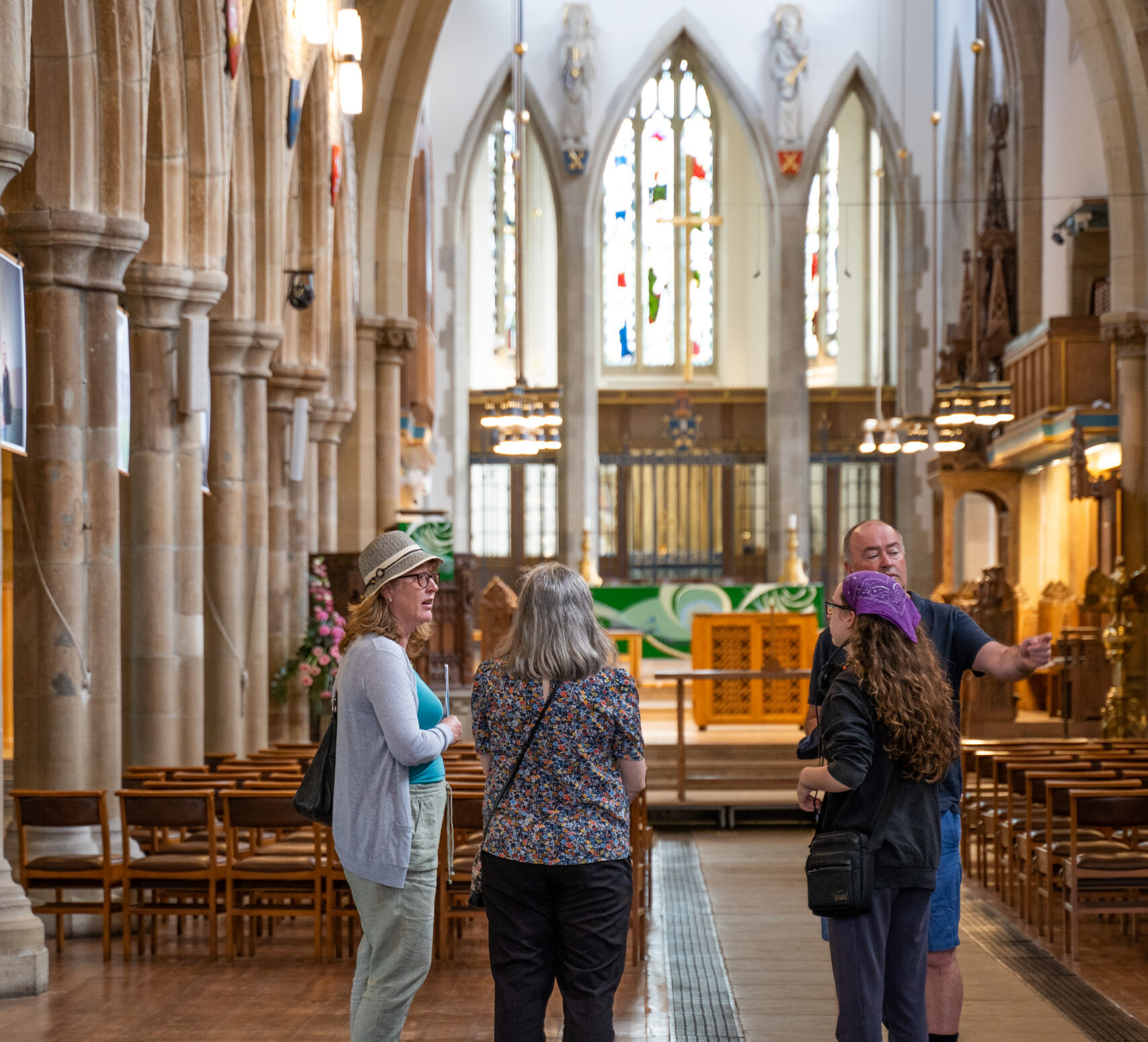
Last month I attended the National Cathedrals’ Conference in Bristol. I mentioned a particular panel at the conference in last month’s post but the wider conference was helping us to reflect on a report, produced by Theos in partnership with the Association of English Cathedrals, called ‘Living Stones’. The report is encouraging reading because it articulates, forcefully, the remarkable contribution cathedrals continue to make to life in England with the millions of visits each year contributing to, amongst other things, local economies. As well as this, cathedrals preserve heritage, support wellbeing, nurture musical excellence, provide educational opportunities and convene civic spaces. At a time when the conversation in the Church remains dominated by a narrative of decline, this report was evidence that cathedrals buck a trend and still matter.
The report seemed to be answering lots of the usual questions that are asked within the cathedral ‘sector’. It demonstrated that cathedrals create value, that we produce definable outcomes and we generate measurable benefits for individuals and communities. Yet as the discussions at the conference unfolded I became increasingly aware of a question lurking beneath the conversation; a question I was not convinced the report was helping us to answer. The question, if it isn’t answered, would suggest that all the data in the world would mean nothing. It is a question our culture is increasingly asking every institution: why should you (we) continue to exist?
The distinction between the metrics and the deeper meaning matters more than it first appears. After all, many of the things we cathedrals do can be done elsewhere: music venues can hold concerts, museums can preserve heritage, community centres can provide gathering spaces, schools can educate and counselling services can support wellbeing.
The same observation can be made about many institutions: healthcare can be provided by private companies, television and radio can be produced by commercial broadcasters, learning can happen without universities, education can happen beyond schools. If institutions are simply collections of services, then the obvious question becomes: who can provide those services most effectively?
Yet most of us instinctively sense that something important is missing from that kind of analysis. People speak differently about the NHS than we do about a healthcare company. We speak differently about the BBC than we do about streaming platforms. We speak differently about a university than we do about other training providers.
The question is ‘why?’
I found myself listening to Angela Tilby reflecting on the distinction between organisations and institutions on the Re-Enchanting podcast whilst she promoted her new book on the Church of England. Her observation helped illuminate what I had been struggling to articulate.
I’ve always thought there was a big distinction to be made between an institution and an organisation. An organisation exists for a purpose: if you’re going to sell widgets, then you set it up to sell widgets in the most efficient and practical and profitable way you can.. but institutions aren’t quite like that, because they actually exist to propagate themselves and to carry something forward into the future that is of value in itself…They think about themselves as being there for future generations, and not just for now. So they have a rather different approach. It’s not just about widgets. It’s also about their impact on wider society as bodies.
Angela Tilby, interview by Justin Brierley and Belle Tindall-Riley, “Re-Enchanting… The Church of England,” Re-Enchanting, podcast audio, May 13, 2026
Organisations exist to achieve purposes. They solve problems, deliver services and produce outcomes. Their success is largely measured by whether they accomplish the task for which they were established.
Institutions certainly do these things, but they are not exhausted by them. One of the historic functions of institutions has been to help societies identify and sustain things that cannot be reduced to efficiency, profitability or immediate usefulness. Organisations help us to achieve goals; institutions help us to discern which goals are worth pursuing in the first place. The NHS, for example, is not simply a mechanism for delivering healthcare; it embodies a commitment that healthcare should be available according to need rather than wealth. The BBC is not simply a producer of content; it acts in the public interest to, amongst other things, ‘to reflect the United Kingdom, its culture and values to the world’.
Whether these institutions always live up to those commitments is another matter. In fact, justifiable, harsh criticism have arisen precisely because they sometimes fail to do so. Yet their failures are judged against an underlying purpose that extends beyond mere, organisational efficiency.
This led me to think about that underlying question about cathedrals and to broaden it out to other institutions. Perhaps the crisis we’re all facing is not simply that institutions are losing the public’s trust but that we increasingly describe ourselves primarily as organisations.
Consider how the NHS, say, justifies itself with waiting times, appointment numbers and efficiency targets. The BBC tells us about audience reach and engagement figures and, in cathedrals, we talk, both internally and externally, about visitor numbers, economic impact, volunteer hours or educational encounters.
None of these things are unimportant; they matter greatly. Public institutions should be accountable and transparent and should be able to demonstrate that entrusted resources are being used wisely. The difficulty comes, however, when these measurements cease to be servants and become masters so that cathedrals that primarily describe ourselves through visitor statistics, or economic impact begin to sound remarkably like just another heritage attraction, cultural venue or community hub.
The challenge facing institutions is not that we measure too much. The challenge is that we increasingly only remember what we are asked to and can measure. This is not entirely our fault: funders ask for outcomes and impacts and trustees ask for performance indicators. We are required to describe ourselves in organisational terms because organisational language is what the system rewards. The danger is that we eventually begin to believe that this language tells the whole story. So I am not denying that a cathedral should know how many visitors enter our doors but we should also always ask whether by entering our doors we have helped them to feel our local community can sustain trust across difference. The NHS should measure waiting times whilst never forgetting that they only matter if human dignity has been maintained in the interactions between patient and medical staff. The BBC should ensure people still tune into their content (across mediums) but only if facilitates a deeper experience of British values.
If an institution begins to explain and justify itself organisationally then we should not be surprised, therefore, that we are judged organisationally. The more the language of purpose is replaced by the language of performance the more an institution will know what it does but becomes less certain why it does it. At which point our identity and purpose becomes that of comparative, organisational performance. If healthcare is simply healthcare, why should we not choose whichever provider is most efficient? If broadcasting is simply content production, why not choose whichever platform is most entertaining? And if a cathedral is simply a venue, why not replace it with any other venue?
The institutional argument has already been conceded.
This, I think, helps to explain why so many institutions feel, simultaneously, anxious and defensive. We are trying to justify ourselves within a competition in which we can’t win without significant time and resources (which we don’t have) and we feel, whilst fighting the losing battle, unable to adequately account for what makes us truly distinctive.
The theologian Daniel Hardy observed, back in 2001,
…so many of the fundamental institutions of society struggle with their sense of purpose and with their role in the advancement of life; many are now beleaguered and fearful. The result can be one of two things. One is that the institutions become over-cautious and self-protective, thereby losing their capacity to move us forward to the good…
Daniel W. Hardy, ‘Finding the Church’ p.63
I have observed and, in weaker moments, participated in conversations where we in the cathedral are merely talking about protecting ourselves, our budgets, our relevance rather than how we continue to serve the ‘good’ that originally gave rise to us. The institution might survive but our horizon will have shrunk.
…The other is that they ‘go with the flow’, uncritically following wherever the prevailing pressures lead them.
Ibid.
When institutions lose a sense or confidence in our distinctive contribution and simply follow prevailing cultural currents, we adopt whatever language appears most persuasive, whatever priorities appear most fashionable and whatever measures appear most rewarded.
It seems that the binary options are: retreat into nostalgia or dissolve into ‘relevance’; become a fortress or become a weather vane. Neither inspires confidence because neither can clearly answer the question: what are we for?
This strikes me as a particularly important challenge for churches and cathedrals as there is a temptation to become defensive and to speak primarily about survival, finance and decline. There is, however, the equal temptation to become indistinguishable from every other civic or cultural organisation in the hope of remaining relevant.
The question should not be whether institutions survive; the question should be whether we continue to serve ‘goods’ worth preserving. By ‘goods, I mean those things society judges to be valuable in and of themselves rather than merely useful for achieving something else. They are the kinds of things that make common life possible and meaningful. Each generation must decide whether these ‘goods’ should be preserved, renewed and handed on. At which point another question emerges: who decides which goods are worth preserving and handing on?
Historically, institutions often assumed considerable authority in answering this question. Churches, universities and governments frequently believed they possessed the right to define the common good on behalf of the wider society. Modernity and postmodernity has changed that and, often, for good reason. Many institutions have proven themselves to have been blind to their own failures; excluding voices that deserved to be heard and confusing their own interests for the interests of the communities they claimed to serve.
The sceptic is therefore right to ask difficult questions: whose goods are being stewarded? who gets to define them? who benefits? who is excluded?There is, also, another difficulty emerging alongside this justifiable critique and that is that we are now confident in questioning inherited goods but we are less skilled at identifying any shared goods. We’re great at deconstruction but no one seems to be able to rebuild afterwards. Hence the rise of populism, characterised as clearly exposing problems but unclear in articulating what should endure and how.
The result is that public life increasingly becomes a contest between competing interests rather than a conversation about shared purposes. This is not simply a problem for institutions; it’s a problem for the whole of society itself. If fewer institutions are capable of naming shared goods, fewer spaces remain in which shared purposes can be imagined, debated and, potentially, renewed.
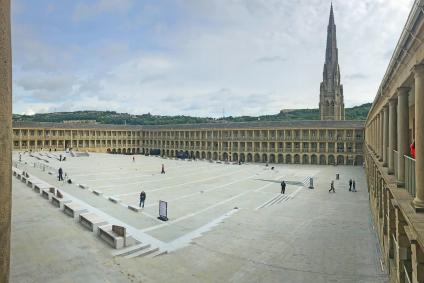
These ponderings around the decline of institutions and my wrestling with frustrations about how we, cathedrals are talking about ourselves, hit home locally when I was participating in a review of City of Culture and reflecting on the council shift from Labour to Reform in Bradford.
As Bradford celebrated being UK City of Culture during 2025 the year was filled with creativity, culture and diversity but as that was happening, political shifts continued to reveal anxieties around belonging, trust, identity and representation. Many would have been tempted to treat these as separate conversations but as I thought about it deeper I realised that they were connected. The underlying question I had during 2025 is whether a diverse city, like Bradford, could ever identify, again, goods worth pursuing together? This is not whether Bradford could agree: Bradford has never been a city defined by agreement. The question is whether a city marked by profound difference could still identify goods worth pursuing together. Could we remain distinct without becoming divided? Could we disagree without becoming enemies? Could diversity become more than coexistence and mature into a genuinely shared life?
At a time when unity is often mistakenly understood as synonymous with agreement, how would an ontologically diverse place like Bradford express a common life that is something more than mere coexistence? Such a thing requires shared commitments. What might they be? And is there a willingness to remain in relationship, however uncomfortably, across disagreement? What kind of goods are there, without which a city struggles to remain a city?
This is where institutions become important; not because we possess the answers or because we should dictate the common good, but because we might provide places where society could ask, together, what is worth preserving? what requires repentance? what deserves renewal? and what should be handed on? If institutions cease performing that role, it becomes increasingly unclear where such conversations now happen.

And so, as Bradford Cathedral approaches 1400 years of Christian presence on our site, I find myself wondering how we mark this anniversary so that it’s not just about what has been preserved but promoting what has been judged worthy of preservation over the centuries. This is where we could be distinct from other heritage organisations. Museums ask what should be remembered whereas an institution asks what should be handed on. Although those sound the same, the distinction matters. To hand something on requires discernment and judging what continues to serve life and the greater good and what no longer does.
That discernment can’t be done by markets, opinion polls or social media feeds, nor can it, however, be entrusted uncritically to institutions themselves. It requires ongoing conversation, argument, listening and reflection with all communities and that requires a structure or process capable of holding difficult questions about the future while remaining rooted in the past.
Throughout this reflection, however, I have assumed that we still know how to identify shared goods. Increasingly, I’m not sure we do.
I spoke earlier about how contemporary culture finds it easier to diagnose problems than to dream of solutions. We are very good at knowing what we fear but are less certain about what we hope for. As political movements regularly tell us what they want to dismantle, organisations explain what they are trying to achieve and institutions tell us what they are trying to protect, who is helping us imagine the future we are trying to build together?
A society that cannot imagine a shared future will inevitably struggle to identify goods worth handing on and a city that cannot articulate its hopes will find itself arguing endlessly about its fears. If institutions cannot describe the future towards which we point, we will eventually become either defensive, adrift or, more troubling, we forget why we emerged in the first place.
Institutions exist, essentially, because each successive generation eventually confronts the same question: what from our shared life is worth carrying forward? And perhaps our deepest purpose is not simply to preserve yesterday, nor merely to accommodate today, but to help us answer that question together before tomorrow arrives.
I think the crisis facing institutions, including cathedrals, isn’t ultimately a crisis of trust, funding or governance: it’s a crisis of imagination. We have become increasingly uncertain about what goods are worth stewarding because we have become increasingly uncertain about the future towards which those goods point. And as we do, society itself loses some of its capacity to imagine and pursue a common future.
This may explain why so much public life feels trapped between nostalgia and anger. We know what we fear losing and we know what we want to dismantle and change. What we are far less certain about is what we hope to build. So, maybe, the greatest danger then, is not that cathedrals, the NHS, the BBC or any other institution disappear but that we survive while continuing to forget to help society imagine a future worth inhabiting.
If that happens, what exactly are we handing on?