Tag Archives: Church of England

Chapter 56: the abbot’s table

cropped-color-calgary-header-3

The abbot will eat with guests and travelers.

What does it mean to have ‘a calling’?

I have spoken at length on my understanding of ordained ministers within the life of the whole people of God. The tension, it seems to me, is most obvious around questions of holiness. By holiness I mean ‘set apart-edness’ of the clergy from the laity. Some would say that ontologically, the very substance of the ordained is different from the non-ordained, while others see no division accept in the function of the clergy. It comes down to an opinion on whether the clergy are changed into something particular by God’s Holy Spirit, distinctive from the other members of the Body of Christ. Where you stand on that idea will mark out how you respond to the particular calling on certain people that differentiates them from others.

So what does it mean to have ‘a calling’?

The Bible is full of God singling out a particular person for a specific task. Some of these tasks are on a temporary basis (e.g. Moses leading the people out of Egypt to the Promise Land, Ananias welcoming Saul/Paul in Damascus) others are permanent (e.g. Abraham being the father of many generations, Peter to ‘feed [my] sheep’). God calls his people, as a collective, to particular tasks (to be holy, faithful, loving, etc.) but there are specific tasks to specific people.

It is clear from the Bible that God calls all people to himself to know and love him and to become his disciple. Once someone has responded to that call they are a disciple, allowing God to transform them, by his Holy spirit, into the likeness of his Son, Jesus Christ. After that God will call them to additional tasks or lifestyles to grow into alongside and in conjunction with the life’s work of discipleship.

What task, then, is given to those called to be ordained?

This is a contentious issue and it depends on who you ask. Some would say it is into a leadership role within the church, others would emphasise a pastoral, serving role, others will create a particular cocktail of various functions and characteristics which define ‘ordained ministry’ but there is no concrete definition because God calls many people to it from different backgrounds, upbringings, experience, personality types, etc. Ordained ministry will look unique to each person who tries to live it out.

The added complication comes when you distinguish, in the Anglican Church, between ordained deacons, ordained priests and ordained bishops. The Anglican Church ordains people into three forms of ministry and they have different functions, roles and some would argue, characters. We confuse it even further by ordaining one person as a deacon, a priest and (in some cases) a bishop, all of which are unique a separate callings but are held together. I am, for instance, both a deacon and a priest simultaneously.

God, it seems, calls us both into tasks (temporary and sometime repeatable) and into way of life (permanent and evolving). Trying to discern one of these is difficult enough but then distinguishing between the two becomes even more difficult. It is for this reason I struggle with the simplistic view of ordained ministry as synonymous with ‘leadership’. ‘Leadership’ is a task, a role. At some point you will cease to be able to function as the leader or you may find that in a particular context you are called to follow and not to lead. If you are ordained as a ‘leader’ then it means you must always lead or, otherwise, your status as ‘ordained’ must be able to be revoked when you don’t ‘lead’.

Take a hypothetical scenerio: you are ordained and you lead a church congregation. You go to a conference and are put in a group where you are being led by someone else. In this instance you are not ‘leading’ therefore are you ‘ordained’ if the definition of your status is ‘leadership’?

Ordained ministry for me is about a specific ‘way of life’. What that looks like needs to be clarified in general across the Church of England. We have fallen into a complicated situation of defining ordained ministry as so many different things that it is not any one thing; it’s subjective. The problem with it being subjective it can no longer be institutionalised and therefore anyone can say they are ordained. We have so many different forms of ordained ministry that I’m not surprised when people are dismayed when they are not selected to be ordained.

Throughout the Rule, St. Benedict distinguishes certain roles within the life of the community but establishes those roles within the way of life of the call to be a monk. The call is to be a monk and within that God may have a particular job, relatively temporary, to perform (e.g. dean, cellarer, infirmarian, etc.). The call of the abbot, however, seems to be different. In modern day Benedictine monasteries the abbot is clearly one of the monks with particular responsibilities and tasks to perform (outlined in the Rule). Here, in this chapter, it paints a picture of the abbot living a separate life to the community, welcoming guests in his own dining room.

Earlier in the Rule, St. Benedict indicated that the table was a symbolic place for communal life, it is around the table, as well as in the oratory, that the community grew. In separating the abbot from them at the dining table puts a division between the abbot and the other monks. I am glad to say that this chapter never really worked out and, in modern day monasteries it is not held to.

Reflection

It is easy to fall into the trap of setting the ordained ministers away from the people. They are to be set apart for their particular roles, which the non-ordained may not, for unspoken reasons, participate in. It is all too easy to settle for the ‘this is tradition’ argument for why only the ordained may preside at Holy Communion or why only the ordained may baptize.

Having walked the discernment process through with several people now, and having gone through it myself, I have discovered the process is far from uniform. Some are ordained for one reason which, seen in another person, is the reason they are not ordained. The deep questions of calling have become muddy to the point at which it is harder to discern the difference between ordained and non ordained ministry.

For what it’s worth, from this ordained minister, I feel a re-examination of the parish church to fit a model of monastic life may lead to a greater understanding of ordained ministry from the ministry of the people of God. The abbot is the symbol of ordained ministry and the callings and tasks of other officers in the church are valued with equal honour.

Father, I abandon myself into your hands.
Do with me whatever you will.
Whatever you may do I thank you.
I am ready for all, I accept all.
Let only your will be done in me and all your creatures.
I wish no more than this, O Lord.
Into your hands I commend my soul.
I offer it to you with all the love of my heart.
For I love you Lord and so need to give myself,
surrender myself into your hands without
reserve and with boundless confidence
for you are my Father.
Amen

Charles de Foucauld (1858–1916)

Come, Lord Jesus.

Chapter 55: clothing and shoes

cropped-color-calgary-header-3

Suitable clothing shall be given the monks…

Are you seriously going to wear that?

Well it was bound to happen, wasn’t it? Sooner or later the conversation would come up about…

Vestments.

I have run a session on Holy Communion for two of our church’s home groups. The first part of these sessions look at why clergy wear what they wear. I am always keen to point out that its probably the practices came before the theory but that doesn’t negate the importance of the theory; if it worked for the Trinity it works for anything!

I hope, dear reader, you won’t mind me skimming through the major aspects of Anglican vestments as I understand them. I also ask that you, hold off judgement on the legitimacy and missional pros and cons of such outfits until I am finished. Do you promise?
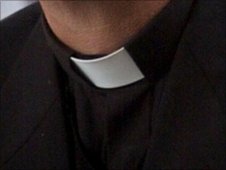
dogcollar

I will start with my ‘everyday wear’: the dog collar.

The dog collar is so called, in my mind anyway, because it is a symbol of being led and, simultaneously, leading a walk with my master: God. At the end of John’s gospel Jesus says to Peter,

“Very truly, I tell you, when you were younger, you used to fasten your own belt and to go wherever you wished. But when you grow old, you will stretch out your hands, and someone else will fasten a belt around you and take you where you do not wish to go.” (John 21:18)

When I made my vows and entered ‘Holy Orders’ I handed over my freedom to live as I wanted to live, to say what I wanted to say, to go where I wanted to go… well that was the idea. The problem arose when I failed to live up to that promise. In that way I allow God to lead me (and when I put my dog collar on I am reminding myself that God is in charge and will lead me to where I do not wish to go necessarily) but I also have a tendency, like a dog, to run on ahead and drag God to the lampposts and other dogs that take my fancy. There is, in the image of dog and owner, a beautiful give and take. The owner is in ultimate control but they allow the dog to explore but when they need to go somewhere particular the collar becomes tight and the owner drags the animal in a certain direction.

There are time in my life now where I know where God wants me to go and what he wants me to do but I resist. It is at these times the collar becomes tight and I want to throw it off. I always listen deeper at those times! To use a simple example: when I’m driving. Say another driver cuts me off or forces me to break the Highway Code and I want to swear at them and let them know my anger but I’m wearing my dog collar; I tend to resist the temptation from expressing my anger and instead smile and pray blessing on them. Or say I am walking down the street in my dog collar and I see a homeless person begging for money… That usual dilemma of how to respond, knowing that money is not necessarily what they need but a meaningful encounter with another human being who will listen to them and their situation and care for them, is multiplied for me. There are times when I’m rushing to get to a meeting and pass several homeless people on my way; without the dog collar there is less guilt (because I’m a broken and fallen person!) than when I pass them in a dog collar. The dog collar at those times becomes so tight that I know of other clergy who don’t wear dog collars in the centre of cities. I find myself stopping for each one and being late for meetings… In this way the dog collar helps me.

There are two camps in the Church: those who do wear them and those who don’t. Dog collars divide the clergy. Some feel they are a barrier to genuine relationship with strangers whilst others feel they invite relationship with strangers where otherwise there would not have been. The problem is that it’s a bit of both; sometimes the dog collar puts people off talking or opening up to you, the wearer, while other time it starts conversation. I don’t think there is a stand out winner for which it is more: it just depends.

For me, personally, I find it more helpful than I do a hindrance. I have had my fair share of abuse thrown at me because of the dog collar (or at least I think it was the dog collar). I have even had a can of coke thrown at me by a stranger but the conversations that the dog collar has encouraged far out way the negatives. I was on a bus in Leeds wearing my dog collar and a complete stranger started sharing about his wife who was suffering through chemotherapy and he didn’t know how to support her. I listened and tried to encouraged him. He asked if I would walk him to the ward as it was close to my destination anyway which I happily did. I prayed with him before he went to see his wife before parting company. I know that wouldn’t have happened if I wasn’t wearing a dog collar.

Some clergy feel the dog collar asserts authority onto conversation which may seem oppressive. I can see how that might be the case but that’s where the character of the wearer must be challenged. If that is the motivation behind wearing it then you should probably pray through that and challenge yourself. The dog collar does set you apart from other people, other Christians as well but that’s the point. Philip Lawrence astutely tells us,

Today many monks want a clerical wardrobe, a monastic wardrobe and a lay wardrobe so that “they will not stand out” when they are with various people. This seems clearly against the thinking of Saint Benedict. We monks should always look like monks. We have only one identity and that identity is being a monk. (Philip Lawrence, “Chapter 55: The Clothing and Footwear of the Brothers”, Benedictine Abbey of Christ in the Desert, March 1 2015, http://christdesert.org/Detailed/926.html)

There is a theory that clergy should be just like other Christians and I agree, in the most part, with that sentiment. There is, however, a distinction between clergy and laity but I don’t think it is where most people think it is.

Yes, we are ‘a priesthood of all believers’. Yes, we are ‘a company of saints’. Yes, I believe the hierarchy in the established Church hinders change and can be restrictive and it is here that we must rethink the distinction. Being ordained is not about raising a person ‘up the ladder’ but separating them for a particular task. Being ordained, for me, was about being set apart as a public example of discipleship. Yes, all should be public examples of discipleship, but we aren’t and we need people to be disciplined to do it so we can all be encouraged.

It’s the same with marriage. Yes, we should all love others intimately and with complete selfless, faithful and unbridled desire for the flourishing of them and their transformation into the likeness of Christ, but we don’t. In order to protect that ideal, some are called to commit themselves to the discipline of chastity to another and work out how to be faithful through the chains of marriage and part of marriage is about this type of ‘slavery’ but it is through this we discover true freedom.

For the Christian to be perfectly free means to be perfectly obedient. True freedom is perfect service. (Stanley Hauerwas, A Community of Character: toward a constructive christian social ethic (Notre Dame: University of Notre Dame Press, 1981) p.131)

The dog collar is a reminder for me that I no longer have the freedom to shirk my discipleship. The dog collar is more for me than for others, to remind me that I am to learn what it means to be holy, set apart from the world.

I know that my view of ordination is monastic in character for this very reason and I’m still on a journey with this understanding.

Most of the other vestments, for me, stem from this basic understanding of ordination.

So a quick run down of what is what and why it is used. Bear in mind that people have different understandings of the symbolism behind vestments and this where the conflict in what they say to observers occurs. I will also only speak on vestments that I am asked to wear as a ‘low church anglican’.

cassock albCassock Alb: Is a white garment that goes over clothes. This symbolises a clothing of the wearer in heavenly glory. This is about identifying the role of the leader of worship and not the person wearing it. The leader of worship is an expression of the character of the whole company of worshippers; they are to be the spokesperson of the collective voice of the congregation. By draping them in white it is a draping of all the people in that resurrection glory.

cinctureCincture (girdle or fascia): Is either a strip of material that goes round the body above the waist (girdle) or a rope with tassels that is worn around the waist (fascia). This is meant to symbolise, like the dog collar, the being lead by God from John 21:18. I wear the fascia because it reminds me of my Roman Catholic heritage and has a monastic quality about it which I find helpful to remind me of my particular calling to ordained priesthood.
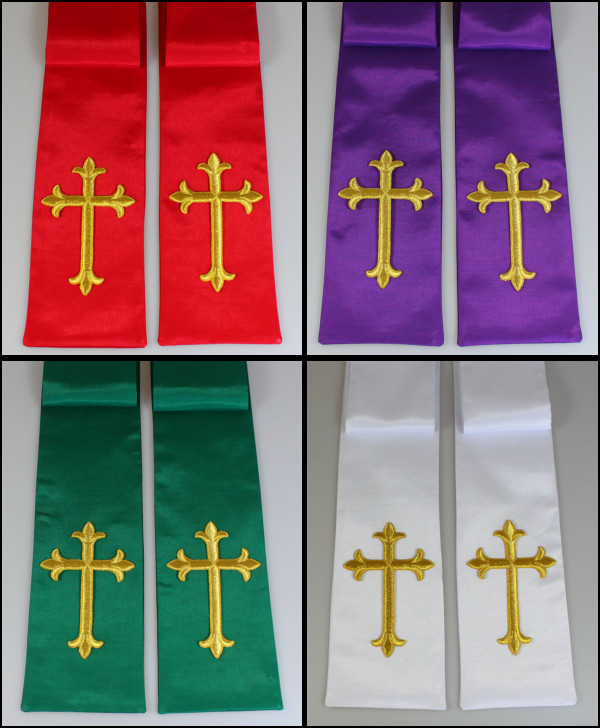
stolesStoles: Are the scarfs that get draped over the shoulders, for deacons in the ‘Miss World style’ and for the priests in the ‘Football Supporter style’. This sybolises the yoke of Christ being laid upon the shoulders of the ordained person. It originated in the Roman society as a symbol of ofice and responsibility and there’s still that element in the symbol today. We, who wear it bear the responsibility of leading the people in worship and voicing the communities prayers and concerns to God. You will find that these come in four or five different colours: white for times when we celebrate resurrection or the coming of God’s Kingdom into the present (Christmas/Epiphany/Easter/Trinity, baptisms, funerals (sometimes) and weddings), purple for times of preparation and penitence (Advent/Lent) (sometimes blue is used in Advent as the penitence is seen as different and it is more of a Marian focus but I use purple to see Lent and Advent in similar contexts) (there is also Lent Array which is unbleached linen), red for times where we remember the Holy Spirit or martyrs (Pentecost/Feast Days) and green for ‘ordinary time’ where we settle into the rhythm of the world and it is our natural position to counterpoint the points of celebration or preparation.

cassockCassock: Is a black garment similar to that of the Cassock Alb. At the reformation the Cassock Alb was seen as a symbolism of the abuses of clericalism where the clergy and those ordained were seen as being elevated beyond the reach of the laity. The reformers were keen to bring the work of the Church to the people and so they removed the symbolism. This reformation was focussed on the words used in the Church, hence the translation of the Bible into the common tongue. The reformation replaced the priest with the scholar, those who could read and interpret the Scriptures and the Cassock hints at the origins of being like the university gowns or the preaching monks (of which Calvin and Luther were).

surplice

Surplice: Is the thin white ‘dress’ which goes over the Cassock for the same reaon the Cassock Alb is white.

preaching scarf

Preaching Scarf: Is a black scarf that is worn with Cassock and Surplice and is a reformation alternative to the Stole which symbolises the office and learning of the wearer.

When do I wear what?

I tend to wear Cassock Alb, Cincture and Stole for any sacramental activity (Holy Communion and Baptism). I am on a journey here too as to my honest understanding of ‘sacrament’ so this is not fixed at the moment in my mind. I ask myself,

Is my role to be placed in a ‘between’ time/space, an altar moment where heaven will kiss earth? Where we, the people of God will have a foretaste of God’s Kingdom on earth?

If the answer is “yes” then I wear Cassock Alb et al.

If the answer is “no” but I still need to be identified as ‘ordained’ then I will wear a Cassock, Surplice and either Preaching Scarf or Stole (usually Preaching Scarf). This tends to be in civic services and funerals.

Weddings are up for grabs at the moment!

Reflection

There is often much discussion and personal opinions around the conversation of a ‘uniform’ for ordained ministers and I think it betrays are lack of agreed understanding as to our language around ordination and vocation. We are all uncertain as to how leadership, ministry and vocation works because there are so many theories and schools of thought around the subject. All the different denominations pick and choose their own view of ordained/ lay ministry and it creates a big tension. I agree that it is a secondary issue but, like most secondary issues, this is highly emotive and people get confused as to why we feel so strongly about it. For what its worth I feel it’s about the personal response to distinction in vocation, history of who represents different ministries and how we have viewed it as an outsider. If you have been painfully hurt by the actions of an ordained person then that will tarnish your view of other clergy (understandably).

There is a complex cocktail of personal character and uniformed role going on with ordained ministry and therefore vestments articulate this tension within congregations. It is hard to hide from the confusion and different opinions when it is there for all to see. We can either get rid of the vestments and forget that different views are held or we can grab the nettle in our hands and patiently talk about what and why we think what we think.

There is an important conversation to be had about what it means to be ordained and what the alternative calls are on the life of a disciple. Maybe a more monastic view of ordination is worth revisiting and encouraging a distinction between church leadership and that of service through the priesthood and diaconate.

Lord, you call us all to be disciples, to lay down our lives and will to go where you want us to go. For some of us that will be a specific call to live out our discipleship in radical forms of obedience and to be an encouragement to others to pursue that holy life, set apart from the world but still loving and serving it. For others the discipleship will look very different and the role will be very specific in a particular area or to a particular people. Whilst we live in this complicated and fallen world may we hold out the hope that in the end we will all be transformed into the likeness of your Son and will worship together in Spirit and Truth at your heavenly throne.

Come, Lord Jesus.

Chapter 39: food apportionment

cropped-color-calgary-header-3

…care must be taken against excessive eating.

Why do we struggle so much to share?

There are statistics lining the internet about wealth distribution and figures which highlight the disparity between the wealthier parts of society and the poorer. Economic inequality has been a curse of humanity ever since man discovered the concept of possession.

Why do we struggle so much to share?

We have, built within us, a survival instinct which grows from experiences of lack. We experience hunger (for however long or short a time) and we remember that, at one point, we were unable, for whatever reason, to access basic sustenance. This sensation remains with us and we teach ourselves and our offspring that the world is ultimately a place of scarcity and we must fight for the resources available to us to stay alive.

Despite developed political systems and economic theories the thing the world is really scarce in is a system or idea which encourages a healthy and sustainable mutual sharing of resources. Our current politic, neoliberalism, is based on the premise that we, as citizens, must compete. Without market and competition our economy breaks. This political ideology forces us citizens to view ourselves as individual units who must interact with others through a ‘healthy’ exchange of goods and services within a competitive market place. This in turn forces politics to become synonymous with matters of money and wealth, which means that all conversations about how we should live together revolves around discussions about how to generate income and how to spend that income.

Politics began as the varying practices of rulers and kings in their control of their subjects. When governance became more complex at the dawning of empires, these practices began to be studied by those powerful people who were delegated power by the emperor and advised him/her on decisions relating to maintaining control of the kingdom. Aristotle’s exploration on the subject, outlines 6 main tasks for a state to concern itself: food supply, manufacture of tools, weapons and defence, creation of wealth/trade, ‘and of primary importance the supervision of religious matters, which is called the priesthood’ and finally, ‘the most necessary of all, judgement about what is beneficial and what is just in their relations with one another.’

In Aristotle’s outlining of ‘good’ politic, wealth was a minor issue. Indeed Aristotle’s understanding of economics, which we all immediately think is about finance, was actually more to do with the general ‘art of household management’ (the original root of the word oikonomikos: economics) of which money is mentioned as a mere tool to be used within the art of managing a household.

It is clear that household management [economics] is not the same as wealth acquisition, since the former uses resources, while the latter provides them (Aristotle, CDC Reeve (trans.), Politics (Indianapolis: Hackett Publishing Company, 1998)p. 13)

Aristotle suggests that a symptom of a sick or distorted politic or economy is one which overly focuses on wealth acquisition. He even goes as far as to say,

Hence usury is very justifiably detested, since it gets wealth from money itself, rather than from the very thing money was devised to facilitate. For money was introduced to facilitate exchange, but interest makes money itself grow bigger. (That is how it gets its name; for offspring resemble their parents, and interest is money that comes from money.) Hence of all the kinds of wealth acquisition this one is the most unnatural.(ibid., p.19)

Of course, Aristotle is just one person who has outlined a political theory and there are many others who disagree with some or all of his ideas. Aristotle’s book however, along with Plato’s ‘Republic’, is considered the first systematic framework for political thought and one which, in my opinion, is so thorough that all books after it can be considered as footnotes or developments.

With this in mind, I find it interesting that the father of political philosophy should diagnose an economy based on interest rates and discussions on wealth acquisition as ‘most unnatural’. It is also of interest to note the biblical view of economics and, particularly discussions on money. The Old Testament has strong things to say about ‘usury’,

 If he has a son who is violent, a shedder of blood, who does any of these things (though his father does none of them), who eats upon the mountains, defiles his neighbour’s wife, oppresses the poor and needy, commits robbery, does not restore the pledge, lifts up his eyes to the idols, commits abomination, takes advance or accrued interest; shall he then live? He shall not. He has done all these abominable things; he shall surely die; his blood shall be upon himself. (Ezekiel 18:10-13) (my emphasis)

Jesus, repeatedly talks about money, not as something to ‘store up’, but something to be used to bless others. There is an interesting parable which seems to suggest that Jesus is stating that accruing interest is a godly thing,

As they were listening to this, he went on to tell a parable, because he was near Jerusalem, and because they supposed that the kingdom of God was to appear immediately. So he said, “A nobleman went to a distant country to get royal power for himself and then return. He summoned ten of his slaves, and gave them ten pounds, and said to them, ‘Do business with these until I come back.’ But the citizens of his country hated him and sent a delegation after him, saying, ‘We do not want this man to rule over us.’ When he returned, having received royal power, he ordered these slaves, to whom he had given the money, to be summoned so that he might find out what they had gained by trading. The first came forward and said, ‘Lord, your pound has made ten more pounds.’ He said to him, ‘Well done, good slave! Because you have been trustworthy in a very small thing, take charge of ten cities.’ Then the second came, saying, ‘Lord, your pound has made five pounds.’ He said to him, ‘And you, rule over five cities.’ Then the other came, saying, ‘Lord, here is your pound. I wrapped it up in a piece of cloth, for I was afraid of you, because you are a harsh man; you take what you did not deposit, and reap what you did not sow.’ He said to him, ‘I will judge you by your own words, you wicked slave! You knew, did you, that I was a harsh man, taking what I did not deposit and reaping what I did not sow? Why then did you not put my money into the bank? Then when I returned, I could have collected it with interest.’ He said to the bystanders, ‘Take the pound from him and give it to the one who has ten pounds.’ (And they said to him, ‘Lord, he has ten pounds!’) ‘I tell you, to all those who have, more will be given; but from those who have nothing, even what they have will be taken away. But as for these enemies of mine who did not want me to be king over them—bring them here and slaughter them in my presence.’” (Luke 19:11-27)

It is Walter Wink who famously challenges our traditional interpretation of this passage and, although I don’t follow his argument through to his conclusion exactly, I do agree with the questions he raises with the reading which is promoted in many Christian congregations. Wink’s argument begins by drawing out some verses which do not naturally ‘add up’. In the traditional interpretation of this passage the ‘nobleman’ is seen as the God-figure; if this is true then where is his ‘country’ of which the citizens ‘hated him’? Heaven or earth? If Heaven then the citizens are the angels and why are they described as hating God? If earth then where is the distant country of which also the citizens do not want him to rule over them?

This God-figure then becomes more sinister as we observe his interactions with the third slave: he is seen as a ‘harsh man, taking what I did not deposit and reaping what I did not sow’ then he gives to those that have more and those that have nothing (the poor) even more will be taken away. How do we square this God with the God of the poor? His response to the failure of this slave to produce interest on an investment is not to send him away to a place with gnashing teeth (the usual punishment in parables) but to have him brought back and slaughtered in his presence!

If we understand Jesus as being the proclaimer of ‘good news to the poor’ then how might we read this parable through the eyes of the poor? The nobleman becomes Caesar, or worldly rulers, who want to seize power, who want to reap where they have not sown, to make money without working (usury). The poor in the nobleman’s country rightfully hate him and those who he goes a conquers do not want to be oppressed likewise. When he comes back the third slave, instead of being a symbol of failure, becomes instead a protestor to the misuse of money, economics and politics. Jesus sides, in this interpretation as being on the side of the third slave and his punishment will be like that of the slave in the story; to be slaughtered in the presence of his accusers.

Jesus tells this cautionary tale on his way into Jerusalem where he will defy those who have the power of life and death over him, standing before Herod, Pilate and others who ‘reap what they do not sow’.(Chris Howson, A Just Church: 21st century Liberation Theology in Action (London: Continuum, 2011) p.39)

This interpretation then fits within a theology which denies the use of usury and unhealthy reliance on investment, which brings money back into a position of tool rather than possession. The Kingdom is described by Jesus’ words and actions as having a different economy and politic to that offered by the empires of this world. God’s economy is securely based on a view that the world is full of abundant gift not scarcity.

There is the promise throughout Scripture that God has created an economy in which there is enough, that God has not created a world of scarcity with too many people or too little stuff. As Gandhi said, “There’s enough for everyone’s need but not everyone’s greed.” We are to pray this day for our daily bread – nothing more and nothing less. (Shane Claiborne, Jonathan Wilson Hartgrove and Enuma Okoro, Common Prayer: a liturgy for Ordinary Radicals (Michigan: Zondervan, 2010) p.88)

Here, in the Rule of St. Benedict, we have the establishing of a practice which is based on a different economy to them one we are used to in the world. In this economy everyone is given enough; nothing more and nothing less. For the elderly, the young and the sick there is more given but the basic rule is that all will be fed. This economy relies on trust that God will provide our daily bread but also that we are to curb our desire for excess.

Reflection

The Kingdom of God has a distinct politic and economic system, one which challenges the world’s. It is easy to work within the Church (the embodiment of the Kingdom) using the theories and practices of the world when it comes to money and politics. We are called, however, to live God’s way in God’s economy but what a sign of God’s power and sovereignty if we lived in a world of abundance rather than scarcity.

Our reliance on interest, on savings and reserves is not only not ideal, it is actually contrary to the Kingdom of God. This view of money is one which is distorted by fear; fear of not having enough. Sure, there are congregations which struggle to make ends meet, with buildings requiring upkeep and heating to be maintained but the solution is not to seek more money but to ask what it is that God is giving you and to use that. What I mean is the focus of conversation is not looking at what’s missing but discerning what God has provided. This will require some challenging questions about the need for a large building, or on what the money is currently being spent on; maybe God wants you to redistribute the resources to other things and to stop us spending excessive amounts on particular projects.

The moment our conversations are solely about that which we don’t have the large the temptation to create it ‘unnaturally’. The problem of the austerity measures our current government (both the Coalition and parts of the Opposition) are promoting is not the practical outworkings but rather the basis altogether. It is far easier for us to change things to increase income than to ask the question of where are we being excessive? The disparity between the rich and the poor is solely rooted in the greed of our hearts and the system set up to encourage competition and private ownership.

We as the Church can preach the gospel by offering an alternative economy and politic and I for one want it to go beyond the Church; this, however, means we need to start living it in the Church.

Abundant God, you created the world teeming with life and called us to be stewards of its resources. You taught us the way to have enough for all and we’re truly sorry for the lack of care we have shown and our failure to fully grasp our shared responsibility over the world’s fruit. Grant us your wisdom to manage the many gifts you give us to build up the Body of Christ and to bring about your Kingdom in the world.

Come, Lord Jesus

Chapter 38: the weekly reader

cropped-color-calgary-header-3

No whispering or noise is to be heard, only the sound of the reader.

Why silence?

It is a sign of God’s grace and goodness that in a week which began with a blessed retreat with close confidantes as means of recovering from mental illness but before I can fully say I’m back to fitness, He grants that I have a relatively straight forward passage from the Rule of St. Benedict. Whilst on retreat I was able to apply my mind to theological study and reading and have made much needed headway on my writing project (which has been on the back burner for some months now!)

This week’s chapter outlines St. Benedict’s vision for meal times: silent and prayerful. This flies in the face of our culture’s understanding of meal times. It is a current trend within the life of the Church to have food and fellowship (they always go together!) In our church, the youth work is centred around a shared meal where we chat and find out about each other. I’d feel pretty insulted if someone judged what we did at these times of eating as ‘idle chatter’ because the work of relationship is multi layered and complex with use of various means of communication; ‘chatter’ being just one of them.

Having said that, there is a need in the specific example of our youth group and in the general point of meal times for more awareness of listening. Where, in our culture, do we encourage one another to be silent with others?

On my retreat with close friends we spent several times in silence. They were not long but they were rich. I treasured the times when we fell into silence together. Of course it wasn’t pure silence for we were all clearly communicating with God in prayer but it was a wonderful moment to have sat next to people where words did not need to be expressed.

Some of the most beautiful moments I have spent with my wife have been silent (this is not to say that I get bored of the sound of her voice or of what she has to say!) The time that comes to mind is last summer in her hospital room when she was lying staring into space and I sat looking at her. She was very ill and we’d run out of words to express frustration, anger at God, sadness of the situation and ultimately, a way to explain what the future held. Silence was the most appropriate sound and we sang it together beautifully.

As part of my recovery programme, I have embarked, with a counsellor, on Mindfulness Based Cognitive Therapy. I have looked at mindfulness before but in the context of contemplative prayer exercises. For me, mindfulness is a form of contemplation; contemplation on the present moment and where it is being punctuated by God’s grace and mercy. I’m reminded of Thomas Merton’s description of contemplative prayer,

Contemplative prayer is, in a way, simply the preference for the desert, for emptiness, for poverty… Contemplation is essentially a listening in silence, an expectancy. (Thomas Merton, Contemplative Prayer (London: Darton, Longman and Todd, 2005)p. 111-112)

One of the exercises for this week is to be intentionally conscious of the process of eating; to eat a meal and be aware of the texture of the food, the sensation of the need to swallow and the echoes of taste on the tongue. It is in this exercise that I am aware of the power and need for silence at meal times.

We must be careful, however, to remove the Rule of St. Benedict from its context. If we are to truly reflect on how the Rule may be utilised in a current, un-cloistered culture then we must ask some important questions. For this particular part of the Rule it would foolish to blindly take the guidance without asking whether there is any worthy benefit of encouraging conversation at meal times.

To go back to the specific example of our youth group: it may be an interesting experiment to try one meal time in silence but the reason we gather round the table is to engage in relationship. We remove all mobile devices and encourage them to connect with others over the very tangible and present reality of food. We have established, after much reflection, prayer and consultation that it is important for our young people (some more than others) to have a place, each week, to sit and have a family meal where they are encouraged to listen and to be heard with no distractions and no where to rush off to. ‘Idle chatter’ at the table is counter cultural for some of them where silence fills their meal times but a silence poor in listening due to the distraction of technology and relationships being fostered remotely.

cropped-color-calgary-header-3

The Reader

A brief note on the requirement of quality in public reading:

Coming from an arts background I have often been asked by colleagues and church readers for practical advice and training in how to read effectively. We’ve all been in services or groups where someone goes to read (Scripture particularly) and puts on this strange voice which makes the reading sound as dull as dishwater! They have no passion for what they are reading and/or they have no sense of what the words are saying. The opposite is often just as bad; someone, wanting to make it sound interesting, puts such emphasis on the reading that it becomes comic and (to use a theatrical term) ‘hammy’.

There is a comfortable middle way which is achieved by knowing what it is you’re reading; knowing the specific words and what they mean, knowing the context it was written and the context into which you are reading, to know the genre and general point of the piece. This takes preparation and then certain skills and experience to translate all that knowledge into your voice to communicate beyond words the meaning of the words.

With these skills, developed through experience and training, words are open to having life breathed into them and are then able to change people’s lives. It is these trained or experienced people, who have gone thorough a process of reflecting on their practice, who should be encouraged to stand up in public and read for it is in their ‘ministry’ that people will be invited to hear and respond to what is being read for the building up of their souls.

Reflection

Part of my theological study whilst on retreat was to bring together my years of thinking around the need for a new form ecclesiology for the Church of England; one that would encourage and grow discipleship amongst our people. Part of the solution, I believe, can be found in the discoveries of the New Monastic movement. It was Alan Roxburgh who wrote,

Discipleship emerges out of prayer, study, dialogue and worship by a community learning to ask the questions of obedience, as they are engaged directly in mission. (Alan Roxburgh, Missionary Congregation, Leadership and Liminality (Harrisburg: Trinity Press, 1997) p.66)

I love that vision for the church: to be a place of ‘prayer, study, dialogue and worship’. Often the church, I find, devalues study; individuals palm their responsibility off to academics and the local congregation is starved of intellectual rigour as it gets trapped in the academy. I’m reminded of Dietrich Bonhoeffer’s observations of the monastic movement before the Reformation,

Monasticism was represented as an individual achievement which the mass of the laity could not be expected to emulate. By thus limiting the application of the commandments of Jesus to a restricted group of specialists, the Church evolved the fatal conception of the double standard – a maximum and a minimum standard of Christian obedience. (Dietrich Bonhoeffer, The Cost of Discipleship (New York: Touchstone, 1995) p.47)

Although Bonhoeffer is discussing the complete task of discipleship I see a distinct lack of study within modern congregations. Not only do they resist participating in it but they belittle its worth to justify their lack of desire for it. There is a common thought that you don’t need to study to grow in discipleship, there is no need to wrestle with difficult questions or, if you do need to, it is to be done by understanding how you feel rather than learning how to think. This develops into teaching which is authorised solely by emotional feeling rather than intellectual truths.

There needs to be a place where a community learns to sit in silence and listen to teaching and to listen with their hearts as well as their ears; to receive teaching and the wisdom of the Church, to be challenged to grow and to be inspired to study the words and works of God. This study needs to be shaped and directed so that we do not fall into heresy and worldly wisdom.

Yes, there is a place for discussion and dialogue but where are the times of silent study, together, as a community?

Teacher, you taught us that there is no other teacher but you and so we commit to sitting at your feet and receiving bread from heaven, every word that comes from your mouth. We want to learn how to be expectant to hear from you, to answer your invitation to enter the desert, to be emptied, to become poor in order to meet with you, to be filled by your Spirit and to be rich in knowledge and love of you.

Come, Lord Jesus.

Chapter 36: sick brothers

cropped-color-calgary-header-3

Before others and above all, special care must be taken of the ill so they may be looked after, as Christ.

What is an infirmarian to do with my sickness?

It was ironic that, on the week I was reflecting on how a community cares for the sick, I got sick. My sickness was not a commonly accepted sickness and many people question whether we should classify what I am still suffering with as a ‘sickness’ but for me there were physical symptoms which hindered me from functioning as well as I can and therefore it is a sickness like any other. My sickness was stress related and was a mental sickness: depression.

I am prone to this sickness like some are to colds and flus, to migraines and back problems. I am aware that I can be ‘crippled’ by this sickness if not kept in check. The symptoms for me (as I am aware people suffer with this in different ways) are an overwhelming sense of apathy, weariness, chest pains, inability to sleep, stomach cramps and unexpected waves of sadness and weeping. I am often loathed to name this sickness ‘depression’ because of the various versions of it and reasons for it: some are biological and hormonal others are circumstantial and based on the interaction between personality and environment/culture. Mine is not majorly biological but rather the way I function doesn’t, pre heavenly state of being, lend itself to easily coping with certain situations. Trying to manage these symptoms and counter them is difficult and is made more difficult when trying to function normally.

I am not one for hiding problems but this illness has a stigma particularly if you are a leader and teacher. This illness is deemed as a weakness and a failure in greater and lesser degrees. People judge you as the cause of the sickness and when you fail to function like normal you are blamed for not being able to control yourself and your body. Outside of the sickness I can see how this response comes about and there is a certain regime one should develop to live with mental health sickness. When you are overwhelmed by the darkness and despair it is so easy to fall into blaming yourself for your relapse but that makes things worse.

The problem I have found with this current bout of sickness is how it is, for me, externally triggered but that doesn’t mean that the trigger is the sole blame for it. It is the mixture with many other factors including my personal state of mind and, yes, body. If I am tired (like everyone gets sometimes) then I’m more vulnerable. Here again the sickness is like the common cold for me: if I am low on energy to fight the virus then I will knocked by it so, in order to not catch colds, I need to keep my energy up. Also, like the common cold, there is an external trigger, someone gives you a cold, but the solution to that is to not be around anyone. This is stupid and unrealistic so there’s always a danger of contracting it but I need to look after myself.

Despite it being a sickness there is not a simple cure for it (aside from medication which I have issues with, personally). Each person and each triggered relapse requires different ‘cures’ or strategies. I find preventative measures much more helpful than reactionary diagnosis and aid. I’d rather find better ways to protect myself from falling ill rather than to keep falling ill and having to wait for things to ease. It is easier, in my mind, to learn how to manage the external triggers rather than to be blind to them and be surprised every time to begin to suffer.

The complication for me comes when my ministry requires me to live so close to so many potential triggers. My personality/spirituality/theology are based largely on being vulnerable, committing to deep relationship with others and to engaging in a very real battle between darkness and light. This means that I find myself placed in situations which I am called to stand with people in brokenness, burden and the darknesses of this world. For someone who is easily tempted to despair this is not a great place to be for long periods of time but I do not feel it is God’s will for me to avoid such situations; in fact, I am witness to the powerful way in which God is redeeming this approach to life and discipleship in powerful ways for people. I’m not just talking about a basic understanding for people in a situation but actually of taking off the other their burden and sharing the weight, feeling the pain of loss and the void of hopelessness. I do that with the full knowledge and faith in Christ the Light of the world.

Being in these situations I know my own complete dependance on God to sustain me and to uphold me. I genuinely cry out for both myself and the person who’s burden I am sharing. I know that, if I don’t turn to God, I will fall and I will suffer. This does mean, however, that when I suffer with despair it is so easy for me to think,

I clearly was not with God nor dependant on him.

This makes me feel as though I have failed and beat myself further into a miry pit.

Having people around me concerned for my wellbeing is nice, to a point, but how am I to be taken care of? What is an infirmarian to do with my sickness?

This is a question I am still wrestling with and it is made more acute when I look at the Church of England and the structures in place for its leaders (lay and ordained). What support and healing is available and realistic? Who is the Diocesan Infirmarian and how might healing work within the pressures of full-time ministry?

Without dismissing anyone who is ‘weak’ enough to suffer from this inability to cope with the pressures of ministry and who can’t divorce their own lives from others to protect themselves from deep, gut-wrenching compassion what is the Church of England to do? Is there a way that people like me can be surrounded and supported, like Moses was with Hur and Aaron (Exodus 17), to be used by God in this ministry of vulnerability and compassion?

Most ministers I know either suffer in silence or develop divorcing techniques from the cause of the problem. Neither really changes the situation; both are avoiding the deeper issues. If you just ‘cope’ and accept reality as unchangeable (or at best ‘long term and complicated’) then you lose any hope of your situation changing; you’re trapped and must change to deal with it or succumb to a kind of death. If you develop divorcing techniques such as, refusing to enter fully into the emotion of conflict and/or other’s painful experience, distraction from reflecting too much on complex landscape of the mess of the world or just repeating over and over, ‘it’s all fine really’ then you ignore the problem and it is only a matter of time before you can ignore it no more.

So what are my conclusions? What are the answers to my questions? I’m afraid I don’t know entirely but here is my best stab in the dark (and it really feels dark at times)…

The isolation model of most parish ministers is unhealthy for the kind of work that we are called to engage with. I would be surprised if many parish priests would not admit to feeling lonely at some point. Fortunately many full-time ministers (lay and ordain) gather round them teams of people but, because of the responsibility and the oversight role they hold it is difficult to be open and honest at certain times. There might be more fruit in sharing the full responsibility and pressures of leadership in peer groups, with the overall care of the team of peers being placed with the abbot (bishop) and deans together.

When one of the ministers falls sick then the others come around and fulfil the work. An infirmarian is called in and the sick minister is taken to a place to heal knowing that the work continues in the way that it was started.

Unfortunately, due to the centralisation of power that tends to be executed in the Church of England the powers to act and support are so far removed from the parish that it can feel like you are neglected. It takes so long to get hold of the busy bishop or arch-deacon.

I am aware that in some cases this works well but the system is a strained model which needs looking at.

Reflection

As I still struggle with my illness, without an effective infirmarian or ‘cure’, I am acutely aware of how my approach to ministry and how God has shaped and continues to use me doesn’t work within the Church of England generally. I am aware that my theology and particular call is not the liberal, at times cynical and altogether ‘pragmatic’ approach of the majority of the Church of England and that what I desire is an intentional community of discipleship who share life together: prayer together, study together and mission together. To put it simply I am monastic and the Church of England is not.

There is something, I feel, to be had if we were to ask the question of the larger system and institution of the Church of England. That question is this:

What if every parish church was either a) a monastery with the powers devolved to enable it to function or b)the parish is seen as one equal but distinct part of a wider monastic community of a deanery in prayer, study and mission together?

As I struggle to see a way out of the forest of my current plethora of external triggers to my sickness, I am forced to reflect on the role of a curacy. This is a much bigger topic than can be dealt with here but I want to voice a hunch that if we see the role of college training as a powerhouse of discipleship and preparation why is there a big disconnect between it and parish training? Is there any scope in developing a training programme which continues on that process of a placing curates (and maybe all full time ministers) into a community that live together, praying, studying and engaging in mission? As we welcome new people in other employment we develop and grow that community which is fed from the local centre of monastic rhythm.

Lots of thoughts on that: anyone willing to talk to me and dream with me on that?

Loving Father, you know my prayers, the silent sighs and groans tune in with your Spirit who intercedes for us, “Abba Father”. That is a prayer not just as a cry from a nightmare to be embraced and brought close to you but also as a statement of refuge and strength.

Come, Lord Jesus

Parish Monasticism: a review

cropped-color-calgary-header-3

Suscipe me, Domine, secundum eloquium tuum, et vivam; 
et non confundas me ab expectatione mea.

Receive me, O Lord, according to your word, and I shall live:
 and let me not be ashamed of my hope.

I am keen to pause before reflecting on the next chapter to note that I have fallen behind in writing my reflections one chapter each week; life just gets in the way sometimes! I will get on to specifics in a moment. Before I do I want to say I remain prayerfully engaged with The Rule of St. Benedict and continue to read and reflect on each chapter in order. What I mean is I am not jumping ahead and planning future weeks. I’m writing as I read. This means that sometimes I misunderstand portions of the text. I have been keen that these reflections are a documentation of learning. I hope that they are helpful to you (please do encourage me with what God has been saying to you as you have read the Rule and shared parts of my own journey).

The part of life that has got in the way over recent months is the ongoing process of discernment as to God’s call on my life. I have returned to a deep sense of vocation to some form of ‘monastic’ life and what that might look like for my wife and I. Clearly being married means that I cannot enter into traditional vows in an established monastic house. I have chosen to take the exclusive vows of marriage (for which I’m grateful) and this means that I can’t also take the vows of monastic orders. I am also committed to the Church of England and feel a call to minister as a priest in it*. This is why I chose, at the beginning of this year, to set aside time to reflect on my unique set of callings that make up my vocation as a disciple of Jesus Christ. This exercise has been a great blessing.

It is clear to me, after much prayer, study and dialogue that Sarah (my wife) and my future lies in the New Monastic movement of the Church. We see that this does not conflict with our sense of calling to the Church of England and to married/family life. In fact it is the call to ‘family’ life that strengthens our sense of calling to the monastic way of life.

Due to Sarah’s health we are unable to have children and it has proven difficult (if not impossible) at this time to go through the official channels of adoption. How do we understand our marriage without the ability to bear children? I am sensing that our call to raising children through extended family ensures an integrity to our marriage as a ‘social office’. We are deeply blessed by the children we have had the honour of walking with for seasons in our roles as uncle/aunt and as ‘godparents’. We love to be an active part in the raising of children, even though we have not been blessed with ones that share our own genetics.

Through my reflections I have become increasingly aware that, although the parish church should be more monastic, it currently is not and nor is it understood as such in any practical way. During the establishment of the Church of England, however, there was a desire for this to be so.

…the reforming vision for parish churches at the time of the dissolution of the monasteries saw the local church as the new accessible local monastery, as the locus for monastic prayers and worship. (Ian Mobsby and Mark Berry, A New Monastic Handbook: from vision to practice (Norwich: Canterbury Press, 2014) p.14)

In my current position as Assistant Curate I am in no position to move forward in exploring the potential for a parish church to be a form of monastery. I also struggle to see how possible it would be to explore this vision within the context of a ‘normal’ parish. This call to a form of monastic life, I feel, fits, more realistically, in a para-parish ministry, separate from but connected to the parish system. I think there are large opportunities within the Deanery in which I serve to explore the possibility of such a New Monastic community being established which would deeply strengthen the ministry of the Church in the city. This would require a creative re-imagining of what is possible and beneficial within the current structures of the Church of England but I feel there is strong precedent by pioneers who have taken this journey before us. I think particularly of my brother and sister in Christ, Rev. Ian Mobsby and Rev. Sam Foster.

I have taken a great deal of time in prayer and sort the counsel of elders and friends and feel that the Lord is calling Sarah and I, in the near future, to move on our calling. This will need the blessing of those in authority over me and I will be seeking their wisdom on this matter. I am very aware of timing and there is a danger that I am motivated, in part, by youthful impatience. I have considered this at great length and remain convinced that the time is now for York to begin a process of exploration into this and I’d be interested in being involved.

Please pray for me and Sarah and those who have gathered around us with a similar sense of calling at this time. Please listen to God for His will for us and I encourage you to share words of wisdom with us.

*I am aware also of my vows to the Office of Deacon and this is encompassed into my priestly functions whilst remaining distinct.

Reconciliation Is Not Sitting On The Fence

I rarely write a script for my sermons but due to the contentious issues raised during this one I felt I needed to. Many people have asked to see a copy and so I publish it here in full.

The reading for the day was Matthew 13:24-30, 36-43
(It also is inspired by the epistle as well: Romans 8:12-25)


This week has seen several momentous debates take place. It started with the Church of England’s General Synod discussing the issue of allowing women to become bishops and finished with the House of Lord’s debating the controversial ‘Assisted Dying Bill’. It has been a week of heated opinions and difficult conflict. To add to these there’s also been renewed conversation around the Israel/Palestine conflict to manoeuvre. All in all it could have left many of us feeling overwhelmed and confused.

Which side do I stand on?

How do I know what is right and wrong?

Who can I trust?

I wouldn’t blame anyone for just keeping your head down and not engaging because it’s tiring, isn’t it?

PrintWhen I was at school we often staged debates on moral and ethical issues. These debates were put on to help us to develop our persuasive writing technique and for this reason I was always quite good. You see, to succeed in a debate you must defeat your opponent’s argument and not, necessarily, with facts. Most of the time they were won by playing with language. If you can bring into question the use of a word you can subtle destabilise any argument.

The truth is language is complicated and the english language is so steeped in history that it is one of the hardest to fully grasp and therefore easiest to manipulate. The meaning of words have been adapted so many times through the centuries that the original meaning doesn’t usually match its common usage. Debates end up being caught in details over language (or semantics). The game in debates is to attack weakness of understanding of words until you judge the right time to play the ‘simplify’ card. A debater will suddenly grab the confused and tired mood of the crowd and state the thought now running through most listeners heads:

“We can spend all day discussing semantics but at the end of the day this is all about people and all people need is…compassion. Compassion is not allowing suffering, therefore, assisted dying is the right thing to do”

No one will have the energy to argue the definition of compassion and it sounds plausible enough and, let’s be honest, we don’t have time to debate this anymore… To no one’s surprise, therefore, these staged debates always ended in a stalemate.

To be honest many of us don’t care as much about somethings as other people and so debates are often won by the most energetic arguers. To persuade others is more of a marathon of campaigning, slowly wearing opponents out. As victims of these campaigns it’s easy to tire and to give in rather than try and stand and engage.

Take the issue over Israel and Palestine for a moment:

israel-palestine-gaza-390x285Who has the right to the land of Gaza and the West Bank? We could start by going into all the history and legalities over this issue. The use of words such as ownership can then be brought into question. Historical facts could then be muddied by interpretation of events and phrasings and then there’s the insurmountable obstacle of personal stories and the tangled web of historical violence from both sides.
Who started it? What were the real motives behind each attack? Who are the secret players behind the scenes, the hidden investors? We could easily end up just throwing your hands in the air and saying,

“I don’t know.”

It’s in this tired, apathetic position that you are a prime target for lobbyists with an agenda to come alongside you and gently and nicely persuade you to just subtly ‘understand’ their point of view. They say,

“I know, it’s complicated, right. All you need to know is… Israel are seeking complete control of their ‘Promised Land’”

or

“You just need to realise that… there was never a state of Palestine in the first place.”

The work of reconciliation, of bringing people into true understanding and real peace, is hard. In fact, I’d go as far as to say, it is humanly impossible.

In those school room debates the problem was that the point of the exercise was not to discover the truth but to win an argument at any cost. Success was judged not by the right outcome being found but a majority of people agreeing with you at the end. You didn’t have to be right; you just needed to be popular. I was always good at standing up, observing the room, and re-phrasing the emotions; twisting them and manoeuvring them to sound very similar to my motion and, therefore, encourage them to feel like I was speaking for them; I was a born politician. This, I soon realised, was a very useful tool in life. I could get what I wanted!

I discovered, however, that getting what I want isn’t always the best thing. I could manipulate anything except the truth. I didn’t know what was good for me, I still don’t. I don’t always know what is right. I had intelligence but not wisdom. The poverty of wisdom was always my (and I suspect all of our) undoing and I soon realised that building my life on intelligent manipulation of facts was like building a house on sand and it soon began to crumble and harm me. I had made decisions based on what I wanted. I had made my bed and now I slept in it. It was then, I was convicted of my lack of wisdom and found my need for God, the source of real wisdom.

The problem is I still have to wrestle with how much I argue about anything, particularly issues of faith, knowing that I have the ability and the sinful desire to ‘win’ at any cost. I am acutely aware of my own personal need for wisdom over and above intelligence and rhetoric.

Whilst on holiday I was enticed into a debate with a fellow traveller on the coach tour. The issues being debated were wide and various; the existence of God, matters of ethics, political discourse. It was tiring. I landed a few fine tuned points which won ground but ultimately it was a thoroughly unsatisfying encounter. Why? Because in the end both parties, him and me, were unwilling to listen. We didn’t seek wisdom, we sought success.

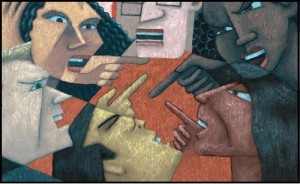
295_Conflict_4Winning arguments is easy if you can just wear down your opponent and the easiest way to do that is keep moving the goal posts; re-define the terms of the argument until it gets too complicated and they get confused and worn out. You don’t need truth to do this; all you need is stamina and intelligence.
It is easy to look at the world with all the complicated issues brought out by relationships and be overwhelmed and confused. The instinctive position at this point is to succumb to the ‘live and let live’ view or the “there is no ‘right’ answer”. This is problematic when it comes to creating laws, governance and guidance as to how we live together. This approach only ends with lots of people doing what they like trying not to hurt others which ultimately won’t happen as we need to interact with each other; our personal desires will always conflict with someone else’s. The only way we can all be happy and not upset others is by not living together.

So how then do we live together?

Wisdom.

And how do we gain wisdom?

I want to suggest it’s ‘time’ and despite what many in our culture and society believe, we know we have time. God is a god of eternity. He is timeless, far above our concept of it. He holds all things in his everlasting existence. We proclaim that His kingdom will have no end. This means we have time; time to stop, time to listen, time to pray and invite God to work, time to wait for God to emerge and reveal Himself the source of wisdom.

Impatience and urgency are dangerous when making decisions. Yes, there’s a need for pragmatic decisiveness but should only be done in God’s timing.

Here’s where the General Synod has succeeded this week and where the House of Lord’s failed.

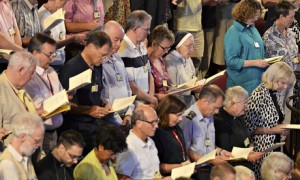
Members of the Church of England's Synod join in morning prayersIn November 2012 General Synod’s motion to vote female bishops failed, only just but enough. What was clear back then was that the debate had been established on the principle that there was an ‘us’ vs. ‘them’. The aim was not to discover wisdom but to ‘win’ at any cost. Both parties on the extremes didn’t seem to care how they would win just as long as they did. This week, however, the tone of the debate was not on winning points and persuasion but a genuine, heartfelt desire to seek wisdom and to trust one another. The debate stopped being about party politics but more about seeking genuine peace and wisdom only found in the Spirit of God.
At Friargate Theatre back in May there was an evening entitled ‘The Stones Cry Out’ where two men from the Holy Land came and shared their stories. One was a Palestinian the other Israeli. Both men had lost daughters in the conflict and now they were travelling around together witnessing to the power of their relationship across the great divide.

The Palestinian father suggested the true route to peace is not to be pro-Israel or pro-Palestine but to be pro-peace. In order for real reconciliation and peace one must hold both parties in critical tension. To commit to both in equality and to be pro both and, at the same time, pro neither. This is not sitting on the fence! The problem with sitting on the fence is that the fence still exists. Real reconciliation is destroying the fence and stretching across to both sides.

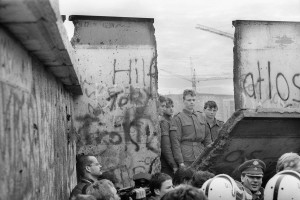
berlin19-1To dismantle such a fence of division takes time, building trust and relationship something sadly lacking in our politics in this country. My very public critique of the Same Sex Marriage Bill was not based on some personal, moral judgement on homosexuality but on the way a decision was being sought. It was rushed. The lobbyists pressured opponents with the supposed lack of time and bullied people into making a response; to choose a side of the fence. Rather than taking the fences down they were happy to keep them there. People were forced off the fence onto one side or the other and it was all done by the manipulation of language. The same is being done with The Assisted Dying Bill.

When Lord Falconer was asked to give people time to engage and for a thorough exploration and facilitated discussion to take place he said there was no time. We need to make the decision now.

Why? Because he is afraid. He is afraid to wait. He is afraid of the suffering. He is afraid of what he might find when he stops and listens to the secrets of his heart. I sympathise with those who can see no hope in the future and want to take control of the confusion that surrounds them but the correct Christian response is to witness to our trust in the miraculous hope of God to bring peace and comfort. When all you have to look forward to is meaningless abyss then suicide may well feel like the best option; why wait?

We wait because, through the lens of Christ’s gospel we have lots to wait for.

Our gospel reading today calls us to deliberately and intentionally challenge our instinctive desire to act decisively ‘now’ to separate and divide; to judge ‘now’. God has time and so do we. God’s Kingdom will outlive every other lobbying group, political ideology and revolution. We are to look to Him for our wisdom not some human campaigner. This will mean we must exist in the painful complications of difference but it is in this field we call life that we grow. We live in peace when we accept God’s rhythm, God’s timing. Seeking relationships over and above position and power.

Peace is only achievable when we stop and let God work. To wait, often uncomfortably, in hope. This will often feel as if nothing will ever change, how it is is how it always will be but God waits for us to invite Him in and we should wait for Him to work. So let’s pray in God’s eternity for His hope and wait for His peace to rule.


Chapter 26: those who meet with the excommunicated without leave of the abbot

cropped-color-calgary-header-3

If a brother dares speak with or meet with the excommunicated brother, without the express permission of the abbot, he shall undergo the same penalty of excommunication.

Why can’t I speak with them?

A short chapter this week on the role of authority; a topic that is increasingly contentious in our culture. I have written on the subject before and have reflected at length on it from a personal point of view. I encourage you to search on this site for previous posts on the topic (you’ll find a few!)

The post I thought of first was this one from February which quoted from an article by Anna Mussmann called, ‘Millennials Think Authority Figures Are Untrustworthy Idiots, And Modern Culture Is To Blame’ In this article Mussmann argues that popular fiction is both commenting on the shift in attitudes to authority and wisdom as well as encouraging a particular culture amongst the younger generation.

I continue to reflect on the popularity of changing rules and traditions. There has been, in my opinion, a rise in challenge to long held traditional views and the bending to popularism. Popular media is being used cleverly to move goal posts to argue for a rethink on any moral or ethical standpoint. The way it has been done is similar in approach each time:

A lobbying group begins by publicising the story of a bullied minority who are discriminated against and face daily injustices. Once the public see and hear of this plight of the opposed they have good will and (if we’re honest) feel suitably guilty for making another person feel that way and, being British with colonial guilt now ingrained, do all they can to elevate their oppression. Once this good will is felt and vocalised and people are emotionally invested the lobbying group then proclaim that they are a majority voice and begin approaching politicians who love to say yes to majority voices. With the politicians on side they then move to change legalisation and, therefore, the character of the society.

All this happens with clever use of media, persuasive rhetoric and stubborn campaigning. None of these things are wrong, in fact I am glad that people are able to speak freely and protest against injustices. My issue is that at times the bias is skewed and a balanced debate cannot be had because of unfair game playing by political crusaders. The approach relies heavily on two things: subtle shifts in the use of language and a high reliance on emotive stories to cover up exaggerations and twists of logic.

There is one other thing which is involved in this and why, I think, there’s been an increase in major moral debates in government in recent years; no one understands or respects authority outside of subjective individualism.

I’ve said it before and I’ll continue to say it: our culture is sick. The disease is individualism. The symptoms are isolation, violence in action and language, increase in suicide, imbalance in wealth distribution and the subtle crumbling of social institutions and groupings. The cause: an increasing bias towards unchallenged liberalism.

Of course what I am arguing here is simplistic and overly generalised which, if I were to face up to opposition would need to go into more detail but for now my observations stand as a starting statement. What is clear is the breakdown of trust in authorities leads to no stable ground on which to build a commonality in society. It is right to hold authorities to account but where does it stop?

The Assisted Dying Bill has been widely discussed and, I am glad to say, faced great opposition. My concern is that if the Bill passes the arbitrary six months will be challenged, the ‘terminal illness’ will be challenged and, in our ‘legal precedent’ culture the floodgates will be opened. My use of floodgates will already prickle some of the more liberal of my readers and I stand again in the position of oppressed by the popular, liberal agenda.

Our society wants free will unrestrained. I don’t blame society that but when the Church sides with them and blesses their freedom of choice and calls all their choices ‘Christian’, Christ-like I have a problem. To be a Christian is to be under authority. To be ordained is to be under authority. To act in disobedience to that authority must be challenged (in love) and done to bring you back to the authority given by Christ himself to His Church. The Right Reverend Dr. Alan Wilson, Bishop of Buckingham, an outspoken liberal bishop has been very public in his challenges to authority on the issue of Same Sex Marriage along with many other ordained brothers and sisters. It was Rev. Rachel Mann’s, poet in residence at Manchester Cathedral, article on the recent issue of Rev. Jeremy Pemberton’s denial of licence to minister by his bishop, Rt Rev’d Richard Inwood, because of Pemberton’s marriage to his now husband Laurence Cunnington that made me reflect the most.

In the article Mann writes that the only thing Jeremy Pemberton has done wrong is got married. This is not true. Jeremy has broken Canon Law by refusing the authority of the church in to which he was ordained; authority held by his bishops. In acting against the wishes of this authority he has opened up the need for disciplinary action. He has sworn an oath of canonical allegiance to that authority and that authority must be allowed to act in the manner set out in accepted documents. In order of those documents to be changed there needs to be a thorough debate and discussion. Within that discussion there must be sacrifice on both sides and for reconciliation and peace to be achieved we must allow our selves to be challenged by God through the painful process of community.

Discipline in a Christian setting is about shaping someone into the likeness of Christ, who, himself was under authority. It is not a natural thing for us to reject obedience and we fight against it at every corner (Adam and Eve’s instinct still beats within us!). We don’t understand discipline and it always seems ‘unfair’ but that is what changes us. I repeat my assertion from before; authority must be held accountable and hence why I have promoted before the need for multiple authorities to be held in balance but it is important that we know what the rules are. The problem with the continual erosion of authority is that it encourages repetition. The great prophets and revolutionaries of human history are the ones who know and appreciate authority; who act under it and are humbled by it.

Reflection

Discipline is always a difficult subject and neither party ‘enjoys’ giving or receiving it but it is necessary. To be transformed is to be changed and change is painful and difficult. To live in community is to accept life under an authority; an authority of a Rule and that of an abbot. In parish life there is less explicit authority as anyone who doesn’t like a particular community leaves.

How do we exercise authority in a parish church? What does this look like? How do we accept the admonitions of others and how do we encourage each other to be accountable?

Heavenly Father, you sent your son Jesus to be an example of life under authority and you gave unto him all authority in heaven and earth. He then gave it to His disciples. He gave it so they could proclaim the gospel and to bring your people into a relationship with you. Help us to know how to wield and receive authority.

Come, Lord Jesus

Chapter 23: excommunication for faults

cropped-color-calgary-header-3

If a brother is found to be stubborn, disobedient, proud or a murmurer…

When is enough enough?

As we head towards the middle of the year and, having prayed through the Rule of St. Benedict for 24 weeks, I have begun to ask:

What happens when someone fails to live in accord with others?

We all hold some ideals of behaviour and moral decisions, however loose they are. We are all soon aware, after spending any time with other people, that we all fall short of our own expectations and the expectations of others. It is easy to beat ourselves up over our repetitive failures and disappointments and easy also to point out the faults of others. Even if the ‘law’ does not exist in concrete terms there are always guidelines or expectations within a group of correct ways to behave and when those expectations are not met there is a cry for justice or a lesson to be learnt.

Having reflected a lot on discipline over the last two weeks and how I respond to different forms of it being exercised on me personally, I have found that I appreciate it when people package criticism or complaint within a reminder of deep and real relationship. I wrote two weeks ago about the need to be known; to be in a long term trusting relationship, where character formation can happen. Our deep changes in character cannot be done in a vacuum or in some distant, business-like environment but in deep and loving relationships. I respond to people who have committed to me before they tell me my faults.

It is important not to automatically jump over the first stage of St. Benedict’s guidance to admonition. The Bible suggests if one hurts or causes conflict within the Body of Christ then they should be told, privately, on two occasions. This is harder than many of us are willing to give credit for. To go and tell someone directly and in love, in case of falling into reproof ourselves, is tough and vulnerable. It is easier to gossip and moan behind their back and then gang up with others and expel them… I sadly speak from experience.

The ‘failings’ of a fellow Christian is easier to speak about when the matter is small but we put it off and imagine it will be a one off. Rarely, if at all, are the large indiscretions not preceded by smaller minor offences. There is always that first sign of trouble. Take the story of Cain as an example.

After Cain and Abel take their offering to God and God prefers Abel’s to Cain’s, Cain’s ‘countenance fell’ (Genesis 4:5); he gave up. It was that small thing that shows he had allowed envy and jealousy into his heart. It was this small moment when he gave in to that voice in his head which said,

God loves Abel more than you because you’re… and he’s… It’s not fair.

That small paranoid voice that demands more attention or interprets others actions wrongly is a small seed which can fester and grow. It can quickly escalate into bitterness and anger and then to murder.

The question is when do you say something? When is enough enough?

In my family I was taught it was easier to talk about a small, relatively isolated issue before it embeds within someone’s character/personality and before it gets tightly woven into multiple and varying examples of actions and choices; before everything gets complicated and muddied. I was also taught it was easier to apologies at this stage rather than having to go back over many incidents. If you can acknowledge a problem early on it is easier to manage/‘master’ (Gen 4:7) It’s as God says to Cain,

If you do not do well, sin is lurking at the door; its desire is for you, but you must master it.

Resisting selfish instincts is hard work and to keep watch over them is a full time occupation that is why we are put in communities, into families. The correction, however, must be done with love, which is patient and kind, not envious or boastful, etc. (1 Corinthians 13:4-7) To face wrongly expressed ‘truths’ is often painful and unhelpful in developing in character. What is needed is both grace and truth.

So when is enough enough? I’d say when it is easier to say something gently and patiently rather than when it is out of control and ingrained.

cropped-color-calgary-header-3

Ministry of Reconciliation

After a year of being an ordained priest I have already had my share of conflict and need for reconciliation. This aspect of priestly ministry has been important in my personal understanding of vocation. The ordinal states,

Formed by the word, they [priests] are to call their hearers to repentance and to declare in Christ’s name the absolution and forgiveness of their sins. (The Ordination of Priests, Common Worship: Ordination Services, The Archbishops’ Council of the Church of England: The Prayer Book as Proposed in 1928; The Alternative Service Book 1980; both of which are copyright © The Archbishops’ Council of the Church of England)

To reconcile warring parties is to stand between them and hold them together in peace. This position means that you can become enemy to all sides as you try to mediate between them. Reconciliation is painful but it is to follow Christ in His ultimate work on the cross. Paul writes in Colossians,

For in him [Jesus] all the fullness of God was pleased to dwell, and through him God was pleased to reconcile to himself all things, whether on earth or in heaven, by making peace through the blood of his cross. (Colossians 1:19-20)

Over the next six weeks we will be reflecting on judgement, punishment and forgiveness but I want to begin by saying that the severity of punishment of excommunication must be understood and exercised within the complete mercy and grace of God who has reconciled all things in Christ. What that means is that all things are held in their correct place and relationship by Christ. Without this acceptance that God is working out that reconciliation, that bringing together of all things into harmony and right relationship with one another, then excommunication is a further severing of relationship.

Reflection

Conflict is hard and gut-wrenchingly painful. I have sat through break downs of relationship in churches, in marriages, in families and in businesses. I have been divided within myself as I see two friends or groups that I care for turn their backs on one another and vow never to speak again. I have tried to sit between people and encourage dialogue and peace and I have failed on many occasions. For me, peace and reconciliation can only occur when relationships are deep; deeper than the superficial exchanges we now label ‘relationship’. We, as a society, now settle for second rate relationships and miss out on sustaining and life-giving intimacy because we are afraid of the risk that it takes to enter such a commitment.

Loving Father, Prince of Peace, thank you for being the source of peace. Thank you for the blessed Trinity, community of love and commitment, our epitome of relationship. We are sorry for the times we cut ourselves off from others by our attitude, actions and words. Forgive us and bring us back to your love where we are held and transformed.

Come, Lord Jesus.

Chapter 22: how the monks are to sleep

cropped-color-calgary-header-3

All the monks shall sleep in separate beds.

Why are you making this more complicated than it needs to be?

When I first read this chapter I was struck by how context is important when reading this document.

What is being described by St. Benedict in this chapter seems very odd to my modern brain and to enforce this on modern day monks would be a bigger deal than St. Benedict seems to be giving it credit.

If possible they should all sleep in one room.

They will sleep in their robes, belted but with no knives.

The younger brothers should not be next to each other. Rather their beds should be interspersed with those of their elders.

Each suggestion brings with it big questions:

Why do you need to even mention that monks sleep in separate beds or even that they not take knives to bed?

Why sleep in one room? Surely then you’d not need to be concerned about elders interspersing younger monks; I’m guessing they are likely to talk into the night!

So here is some context that has helped me to feel settled and to hear what God is saying through St. Benedict.

In Europe in those days it was uncommon for average people to have their own bedrooms. Families slept in one room. It was a luxury even for parents to have their own private room. Monasteries were a spiritual family and did pretty much the same thing… By our modern standards nothing was terribly private in Benedict’s cenobitical monasteries…They also slept fully clothed. This was to keep them ready to rise to meet Jesus in prayer at vigils around two or three o’clock in the morning…Few people actually had nightclothes in those days. The average person slept in regular clothes and used his cloak as a cover. The monks were no different. (John Michael Talbot, Blessings of St. Benedict (Minnesota: Order of Saint Benedict, 2011) p.23)

In those days sleeping arrangements were different and therefore the view of bedrooms was different. Today we see a bedroom as a private space, one that, generally speaking, is considered deeply intimate and personal. Teenagers become possessive over this space, demanding privacy and solitude. The clutter and mess is allowed in that space because they have authority and ownership over it.

None of these issues of privacy and solitude would be raised in a monastery at the time of St. Benedict but other concerns were being addressed. These seem so alien to us and from our different culture/context it seems the solution would be to change in line with our modern approach. Indeed that is what modern monasteries have done. The issues being raised here, I think, are the probability of younger, un-disciplined monks talking together late at night and then not being able to get up to pray. Also the issue of unity and familial understanding of the monastery; the fact that this chapter follows the chapter on the appointment of deans with its implicit sense of hierarchy beyond Abbot and monk is telling, I think.

cropped-color-calgary-header-3

The Family not The Business

I am more convinced that the major issue with the Church of England at the moment is that we are discovering the cost of treating the Body of Christ like a business/institution. I have explored this distinction between organism and organisation before and continue to see how this conversation needs to be had and acted on. The monastery, in the Rule of St. Benedict, is seen more in terms of organic and familial. This does not mean that there is not structure or guidelines but these are more flexible and therefore useful.

If we treat a church in the terms of business then hierarchy rules and is the structure in which we exist. This brings with it questions of power and authority and people’s roles define them rather than their character and relationships with others. Someone is treated a certain way because of what they do rather than how they are known and they invest in relationship. Leaders then become figures treated with suspicion and thus are forced to assert authority or earn trust and respect. From this sense of needing to justify their position we get the whole culture of models of leadership that are systematised and objective.

I find the thought of hierarchy and the way authority is expressed within it difficult and, at worst, abusive. I baulk at its imposition upon me and obedience is not easy. Obedience in the familial settings seems more understandable to me and I wonder if others in my generation feel the same. I wonder if this is at the heart of why ‘millenials’ (or whatever you want to call people my age) struggle with the church (see ‘Chapter 5: obedience‘ post). I wonder if it is not the content of our worship or the beliefs we explore and journey with but the way we structure ourselves that put them off. What if they were invited to be a part of a community akin to a large family? There would be the authority figures within that community which were not enforced but emerged like any family. There would be those that were elected to teach and those who were looked to to organise but all would be natural and organic.

It is natural, when entering a new community or family, to be tentative and inquisitive. It feels wrong to enter it and demand you are heard and that everything should change to fit you but equally there is an organic process that is usually assumed within families that new members are accommodated but there is a natural order to family life as to authority and power. This image of the church as family comes naturally to me but it has been abused by the church as we stress the ‘family of God’ image but live out a ‘business of God’ model.

I’ll finish with this short piece written by the Lindisfarne Community:

Leadership in monastic communities was traditionally by the Abbot or Abbess (in the desert tradition Abba and Amma), meaning father or mother. In other words, leadership was seen to be of a familial relationship rather than, say, the hierarchy of military order or, as we would have it today, the bureaucratic efficiency of the modern business corporation. Monastic community is more akin to an extended family with parental care and oversight.

Of course, in the ancient world obedience to parental authority was a primary requirement and in the ancient Rules were rigorously enforced. Modern sensibilities find those practices too strict, not to say psychologically damaging. Nonetheless, the notion of spiritual parenting remains valid if reinterpreted through the lens of our modern social construction of the parental task: unconditional love and care, setting an example, creating boundaries in which to exercise freedom, a wise and gentle correction when necessary.

Abbots and Abbesses in their turn, were in relationship with bishops who acted as spiritual advisers to the monastic community. This practice of mutual accountability is much needed as a counter to contemporary radical individualism.

Reflection

How do we recapture the organic understanding of the church? How does a parish church become, for those without a family environment to flourish within, ‘home’, with all its instinctive distribution of authority and participation? How do we re-structure or re-imagine the church to release these natural gifts of God as He portray in Scripture? I would suggest it starts with those who currently sit in authority.

For those who find themselves higher on the hierarchical ladder to step down and take the bold move of following Christ who did not consider equality with God something to be grasped. It takes someone who is perceived by others to hold power to relinquish and hand it over, to surrender it and live out, radically, vulnerability and intimacy in relationship. This is highly costly but I get the sense that it is what God wants of His church for today.

Loving Father, you welcome us into your family as heirs of your Kingdom and as adopted children. You encourage us to take our place and to participate in the working of this family. You hold us and teach us as we grow and learn. We are sorry for what we’ve made your church. Help us, particularly those of us who perpetuate the hierarchical divisions that have seemed necessary, to risk relationship above position and to live out the organic and familial images that you spoke through your Son Jesus Christ, who said the Kingdom of God is like a Father who had two sons…

Come, Lord Jesus.