Tag Archives: Rule

Chapter 55: clothing and shoes

cropped-color-calgary-header-3

Suitable clothing shall be given the monks…

Are you seriously going to wear that?

Well it was bound to happen, wasn’t it? Sooner or later the conversation would come up about…

Vestments.

I have run a session on Holy Communion for two of our church’s home groups. The first part of these sessions look at why clergy wear what they wear. I am always keen to point out that its probably the practices came before the theory but that doesn’t negate the importance of the theory; if it worked for the Trinity it works for anything!

I hope, dear reader, you won’t mind me skimming through the major aspects of Anglican vestments as I understand them. I also ask that you, hold off judgement on the legitimacy and missional pros and cons of such outfits until I am finished. Do you promise?

dogcollar

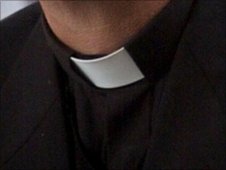
I will start with my ‘everyday wear’: the dog collar.

The dog collar is so called, in my mind anyway, because it is a symbol of being led and, simultaneously, leading a walk with my master: God. At the end of John’s gospel Jesus says to Peter,

“Very truly, I tell you, when you were younger, you used to fasten your own belt and to go wherever you wished. But when you grow old, you will stretch out your hands, and someone else will fasten a belt around you and take you where you do not wish to go.” (John 21:18)

When I made my vows and entered ‘Holy Orders’ I handed over my freedom to live as I wanted to live, to say what I wanted to say, to go where I wanted to go… well that was the idea. The problem arose when I failed to live up to that promise. In that way I allow God to lead me (and when I put my dog collar on I am reminding myself that God is in charge and will lead me to where I do not wish to go necessarily) but I also have a tendency, like a dog, to run on ahead and drag God to the lampposts and other dogs that take my fancy. There is, in the image of dog and owner, a beautiful give and take. The owner is in ultimate control but they allow the dog to explore but when they need to go somewhere particular the collar becomes tight and the owner drags the animal in a certain direction.

There are time in my life now where I know where God wants me to go and what he wants me to do but I resist. It is at these times the collar becomes tight and I want to throw it off. I always listen deeper at those times! To use a simple example: when I’m driving. Say another driver cuts me off or forces me to break the Highway Code and I want to swear at them and let them know my anger but I’m wearing my dog collar; I tend to resist the temptation from expressing my anger and instead smile and pray blessing on them. Or say I am walking down the street in my dog collar and I see a homeless person begging for money… That usual dilemma of how to respond, knowing that money is not necessarily what they need but a meaningful encounter with another human being who will listen to them and their situation and care for them, is multiplied for me. There are times when I’m rushing to get to a meeting and pass several homeless people on my way; without the dog collar there is less guilt (because I’m a broken and fallen person!) than when I pass them in a dog collar. The dog collar at those times becomes so tight that I know of other clergy who don’t wear dog collars in the centre of cities. I find myself stopping for each one and being late for meetings… In this way the dog collar helps me.

There are two camps in the Church: those who do wear them and those who don’t. Dog collars divide the clergy. Some feel they are a barrier to genuine relationship with strangers whilst others feel they invite relationship with strangers where otherwise there would not have been. The problem is that it’s a bit of both; sometimes the dog collar puts people off talking or opening up to you, the wearer, while other time it starts conversation. I don’t think there is a stand out winner for which it is more: it just depends.

For me, personally, I find it more helpful than I do a hindrance. I have had my fair share of abuse thrown at me because of the dog collar (or at least I think it was the dog collar). I have even had a can of coke thrown at me by a stranger but the conversations that the dog collar has encouraged far out way the negatives. I was on a bus in Leeds wearing my dog collar and a complete stranger started sharing about his wife who was suffering through chemotherapy and he didn’t know how to support her. I listened and tried to encouraged him. He asked if I would walk him to the ward as it was close to my destination anyway which I happily did. I prayed with him before he went to see his wife before parting company. I know that wouldn’t have happened if I wasn’t wearing a dog collar.

Some clergy feel the dog collar asserts authority onto conversation which may seem oppressive. I can see how that might be the case but that’s where the character of the wearer must be challenged. If that is the motivation behind wearing it then you should probably pray through that and challenge yourself. The dog collar does set you apart from other people, other Christians as well but that’s the point. Philip Lawrence astutely tells us,

Today many monks want a clerical wardrobe, a monastic wardrobe and a lay wardrobe so that “they will not stand out” when they are with various people. This seems clearly against the thinking of Saint Benedict. We monks should always look like monks. We have only one identity and that identity is being a monk. (Philip Lawrence, “Chapter 55: The Clothing and Footwear of the Brothers”, Benedictine Abbey of Christ in the Desert, March 1 2015, http://christdesert.org/Detailed/926.html)

There is a theory that clergy should be just like other Christians and I agree, in the most part, with that sentiment. There is, however, a distinction between clergy and laity but I don’t think it is where most people think it is.

Yes, we are ‘a priesthood of all believers’. Yes, we are ‘a company of saints’. Yes, I believe the hierarchy in the established Church hinders change and can be restrictive and it is here that we must rethink the distinction. Being ordained is not about raising a person ‘up the ladder’ but separating them for a particular task. Being ordained, for me, was about being set apart as a public example of discipleship. Yes, all should be public examples of discipleship, but we aren’t and we need people to be disciplined to do it so we can all be encouraged.

It’s the same with marriage. Yes, we should all love others intimately and with complete selfless, faithful and unbridled desire for the flourishing of them and their transformation into the likeness of Christ, but we don’t. In order to protect that ideal, some are called to commit themselves to the discipline of chastity to another and work out how to be faithful through the chains of marriage and part of marriage is about this type of ‘slavery’ but it is through this we discover true freedom.

For the Christian to be perfectly free means to be perfectly obedient. True freedom is perfect service. (Stanley Hauerwas, A Community of Character: toward a constructive christian social ethic (Notre Dame: University of Notre Dame Press, 1981) p.131)

The dog collar is a reminder for me that I no longer have the freedom to shirk my discipleship. The dog collar is more for me than for others, to remind me that I am to learn what it means to be holy, set apart from the world.

I know that my view of ordination is monastic in character for this very reason and I’m still on a journey with this understanding.

Most of the other vestments, for me, stem from this basic understanding of ordination.

So a quick run down of what is what and why it is used. Bear in mind that people have different understandings of the symbolism behind vestments and this where the conflict in what they say to observers occurs. I will also only speak on vestments that I am asked to wear as a ‘low church anglican’.

cassock albCassock Alb: Is a white garment that goes over clothes. This symbolises a clothing of the wearer in heavenly glory. This is about identifying the role of the leader of worship and not the person wearing it. The leader of worship is an expression of the character of the whole company of worshippers; they are to be the spokesperson of the collective voice of the congregation. By draping them in white it is a draping of all the people in that resurrection glory.

cinctureCincture (girdle or fascia): Is either a strip of material that goes round the body above the waist (girdle) or a rope with tassels that is worn around the waist (fascia). This is meant to symbolise, like the dog collar, the being lead by God from John 21:18. I wear the fascia because it reminds me of my Roman Catholic heritage and has a monastic quality about it which I find helpful to remind me of my particular calling to ordained priesthood.

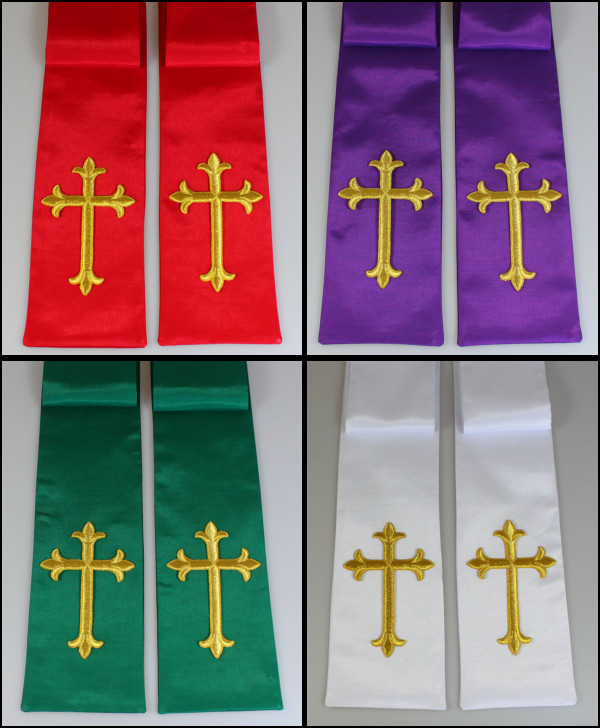
stolesStoles: Are the scarfs that get draped over the shoulders, for deacons in the ‘Miss World style’ and for the priests in the ‘Football Supporter style’. This sybolises the yoke of Christ being laid upon the shoulders of the ordained person. It originated in the Roman society as a symbol of ofice and responsibility and there’s still that element in the symbol today. We, who wear it bear the responsibility of leading the people in worship and voicing the communities prayers and concerns to God. You will find that these come in four or five different colours: white for times when we celebrate resurrection or the coming of God’s Kingdom into the present (Christmas/Epiphany/Easter/Trinity, baptisms, funerals (sometimes) and weddings), purple for times of preparation and penitence (Advent/Lent) (sometimes blue is used in Advent as the penitence is seen as different and it is more of a Marian focus but I use purple to see Lent and Advent in similar contexts) (there is also Lent Array which is unbleached linen), red for times where we remember the Holy Spirit or martyrs (Pentecost/Feast Days) and green for ‘ordinary time’ where we settle into the rhythm of the world and it is our natural position to counterpoint the points of celebration or preparation.

cassockCassock: Is a black garment similar to that of the Cassock Alb. At the reformation the Cassock Alb was seen as a symbolism of the abuses of clericalism where the clergy and those ordained were seen as being elevated beyond the reach of the laity. The reformers were keen to bring the work of the Church to the people and so they removed the symbolism. This reformation was focussed on the words used in the Church, hence the translation of the Bible into the common tongue. The reformation replaced the priest with the scholar, those who could read and interpret the Scriptures and the Cassock hints at the origins of being like the university gowns or the preaching monks (of which Calvin and Luther were).

surplice

Surplice: Is the thin white ‘dress’ which goes over the Cassock for the same reaon the Cassock Alb is white.

preaching scarf

Preaching Scarf: Is a black scarf that is worn with Cassock and Surplice and is a reformation alternative to the Stole which symbolises the office and learning of the wearer.

When do I wear what?

I tend to wear Cassock Alb, Cincture and Stole for any sacramental activity (Holy Communion and Baptism). I am on a journey here too as to my honest understanding of ‘sacrament’ so this is not fixed at the moment in my mind. I ask myself,

Is my role to be placed in a ‘between’ time/space, an altar moment where heaven will kiss earth? Where we, the people of God will have a foretaste of God’s Kingdom on earth?

If the answer is “yes” then I wear Cassock Alb et al.

If the answer is “no” but I still need to be identified as ‘ordained’ then I will wear a Cassock, Surplice and either Preaching Scarf or Stole (usually Preaching Scarf). This tends to be in civic services and funerals.

Weddings are up for grabs at the moment!

Reflection

There is often much discussion and personal opinions around the conversation of a ‘uniform’ for ordained ministers and I think it betrays are lack of agreed understanding as to our language around ordination and vocation. We are all uncertain as to how leadership, ministry and vocation works because there are so many theories and schools of thought around the subject. All the different denominations pick and choose their own view of ordained/ lay ministry and it creates a big tension. I agree that it is a secondary issue but, like most secondary issues, this is highly emotive and people get confused as to why we feel so strongly about it. For what its worth I feel it’s about the personal response to distinction in vocation, history of who represents different ministries and how we have viewed it as an outsider. If you have been painfully hurt by the actions of an ordained person then that will tarnish your view of other clergy (understandably).

There is a complex cocktail of personal character and uniformed role going on with ordained ministry and therefore vestments articulate this tension within congregations. It is hard to hide from the confusion and different opinions when it is there for all to see. We can either get rid of the vestments and forget that different views are held or we can grab the nettle in our hands and patiently talk about what and why we think what we think.

There is an important conversation to be had about what it means to be ordained and what the alternative calls are on the life of a disciple. Maybe a more monastic view of ordination is worth revisiting and encouraging a distinction between church leadership and that of service through the priesthood and diaconate.

Lord, you call us all to be disciples, to lay down our lives and will to go where you want us to go. For some of us that will be a specific call to live out our discipleship in radical forms of obedience and to be an encouragement to others to pursue that holy life, set apart from the world but still loving and serving it. For others the discipleship will look very different and the role will be very specific in a particular area or to a particular people. Whilst we live in this complicated and fallen world may we hold out the hope that in the end we will all be transformed into the likeness of your Son and will worship together in Spirit and Truth at your heavenly throne.

Come, Lord Jesus.

Chapter 54: the receipt of letters and presents.

cropped-color-calgary-header-3

Without the abbot’s permission a monk may not receive from or give to anyone…

What is community?

For Ash Wednesday this year I was away on holiday with some of my dearest friends. We go away for February half term to the Lake District each year and this year it happened to coincide with the start of Lent.

I love Ash Wednesday. My theology and spirituality begins with the central premise that we are dust and not gods. God is God and He, by His grace gives us life and His Spirit. Each day of my discipleship I remind myself of that basic truth of what I am made of, not in some twisted attempt of self-flagellation but so that I can appreciate, in fuller measure, the overwhelming reality of the grace of God upon me.

Discipleship without starting from this humility is going to de-rail somewhere down the line.

Ash Wednesday is all about humility. Humility, says the writer of Proverbs, is the fear of the Lord (Proverbs 22:4) and the fear of the Lord is the beginning of wisdom (Proverbs 1:7; 9:10). Humility is about knowing who you are. Charles Spurgeon once wrote,

True humility will lead you to think right about yourselves, to think the truth about yourselves. (Charles Spurgeon, The Soul-Winner (Tennessee: Lightning Source, 2001) p.15)

If our anthropology (our understanding of humanity) begins anywhere other than as creatures of the earth, coming from the same primordial ooze as everything else then we have begun in the wrong place. If we imagine, for even one moment, that we are born special, set apart from the rest of creation, that we are in some way born of the same substance as God then we are not being truthful.

But we must also remember that God has lifted us up from the dust and, in his gentle hands, formed us and shaped us into His beloveds.

Humble yourselves before the Lord, and he will lift you up. (James 4:10 NIV)

It starts in dust but it moves away from that into the hands of our Father who shapes us and moulds us into His people. We always remain dust, flesh, finite and fallible but, if we turn to God He will lift us up and redeem us.

That is why, for this Ash Wednesday, I created a liturgical space for my friends and I to reflect on the ash cross that we mark on our heads each year but also the cross of water some use at baptism. Ash Wednesday points forward to our redemption where we enter into the life of Christ who took on flesh that we may become one with God. Through the water of baptism we are renewed and we clothe ourselves in Christ, who did not reject flesh and dust but redeemed it by His life, death and resurrection.

But the story doesn’t end there.

Once we enter into the Body of Christ the symbol of flesh and God united we seal it with mark of oil for commissioning, being set apart for a task. We are called to be used by God’s Spirit who breathes through us and makes us living beings.

The service was called ‘Ash Water Oil’ and at each stage we discussed a word that has spoken to me through the Rule of St. Benedict which resonated with the theology behind each symbolic cross on our foreheads. For ash, we discussed ‘humility’, for the reasons expressed above. For water we discussed ‘obedience’; how we as disciples must turn to God and obey his hands as they shape us and redeem us. We follow in the footsteps of Christ as he obediently committed his body to death in order to be raised again. We reflected on these two quotes,

…faith exists only in obedience, is never without obedience. Faith is only faith in deeds of obedience. (Dietrich Bonhoeffer, Discipleship (Minneapolis: Fortress Press, 2001) p.64)

For the Christian to be perfectly free means to be perfectly obedient. True freedom is perfect service. (Stanley Hauerwas, A Community of Character: toward a constructive christian social ethic (Notre Dame: University of Notre Dame Press, 1981) p.131)

Finally, for oil we discussed ‘community’; how, through humility and obedience we are led, by God, into the community of believers and the community of the Trinity. The characteristics of Christina community should be marked by humility, rooted in flesh but filled with the Spirit, and obedience to the will of the Father through the example of Christ.

It was this final discussion on what we understood about community that sparked the most conversation. Community as a word is hard to pin down because it’s use is so varied and conflicting. We all think we know what it means and what it looks like and feels like but it shifts endlessly, it’s definition is always, it seems, just out of reach. We hear just an echo of its definitive state.

As I heard my friends struggle to find words for what this thing they are passionate about I was reminded of how we describe the Trinity. There’s a quote (which I can’t source) which says,

The Trinity is not a formula to be understood but a community to be experienced.

Why am I telling you all this?

When reflecting on seemingly cruel and strict chapter in the Rule of St. Benedict, it strikes me that the reason this and other chapters challenge is because it is cutting deep within that which makes us fallen beings. At the times of uncomfortableness, I can often find where I am finite and fallible. In this particular case with this strict removal of a monk from the ties to the outside world I am challenged by my need to be identified with material possessions and relationships with other people however well meaning I think they are. How many relationships must I lose before I realise I only need God? I think we judge too soon the answer to that question.

I can hear the protests and the reasons why we don’t need to sacrifice that much to know that we need God but I know for myself that I only want to say that because if I were to live it out I would find it too painful. The cost to this call is too much and so we don’t bother trying. To comfort ourselves we judge those who do that insane, unnecessarily severe but I look at the monks I know who have risked it and found great spiritual treasure from the discipline.

This of course doesn’t make it any easier to contemplate how much I am willing to cut myself off in order to discover the life of total dependence on God!

Reflection

I have been thinking a lot recently about where God is calling Sarah and I next. I keep returning to this call to monastic life and how it might look alongside other aspects of our calling. The call to humility, obedience and community fills me with delight even when it becomes slightly more uncomfortable than I’d like. Chapters like this one, where an abbot is given charge over letters and parcels, strangely make sense to me and in that sensation I am aware of how counter cultural that is.

I find myself thinking,

Maybe the Church should be living out a completely different culture to the one around it. Maybe we have completely lost sight of what true discipleship looks like.

I think of that quote from Dietrich Bonhoeffer,

Is the price that we are paying today with the collapse of the organized churches anything else but an inevitable consequence of grace acquired too cheaply?… We poured out rivers of grace without end, but the call to rigorously follow Christ was seldom heard. What happened to the insights of the ancient church, which in the baptismal teaching watched so carefully over the boundary between the church and the world, over costly grace? (Dietrich Bonhoeffer, Discipleship, p. 53-54)

I fall into humble silence before my God and ask for Him to lift me up out of the miry dust and form me into the likeness of His Son, to redeem me into His life and to fill me with His Spirit.

Come, Lord Jesus.

Chapter 53: the reception of guests

cropped-color-calgary-header-3

All guests to the monastery should be welcomed as Christ…

Where is this all leading to?

After 59 weeks of praying and working through the Rule of St. Benedict, we come to the reception of guests. We have spoken about hospitality before but it has been practice for the main event; receiving strangers into our home.

It is said that hospitality is a Benedictine practice (having been on the receiving end of it I can confirm they do it like no other!) The opening maxim of the chapter to see all guests/strangers as Christ and to welcome him thus is a strongly Biblical idea. In Genesis we have the story of Abraham and Sarah welcoming the strangers at Mamre and discovering that they are either angels or the God Himself (depending on your reading of the text.) Jesus tells of the analogy of the sheep and goats with the central idea being,

Truly I tell you, just as you did it to one of the least of these who are members of my family, you did it to me. (Matthew 25:40b)

We also have the story of the disciples walking to Emmaus and offering hospitality to the stranger who joins them on the road only to discover it was the risen Christ all along.

Sarah and I have a quote from the letter to the Hebrews on our dining room wall which is located at the front of our house,

Do not forget to show hospitality to strangers, for by so doing some have entertained angels without knowing it. (Hebrews 13:2)

Our guests often comment on it. Once a guest laughed and turned to us saying,

That’s a bit dangerous, isn’t it? What if complete strangers in the street see it and take you up on it?

That’s kind of the point!

I have yet to welcome in a complete stranger and fed them, clothed them, washed them, etc. It’s hard to know whether I’d be totally obedient to that radical hospitality or not. I suspect I would fail and back out of the opportunity. I suspect I’d justify my decision by saying how dangerous it is and our home is not set up for housing strangers. I have, however, shown hospitality to strangers and welcomed them in for an hour or two, listened to them and given them refreshments (in the form of a beverage!) This form of hospitality, though, is limited and I have always sent them on their way and never invited them to stay for a meal.

Maybe that’s enough sometimes. I have been struck by Esther de Waal’s comment on this chapter,

He has prepared me to welcome all, regardless of rank, and yet to treat each according to need, so that there is no uniformity but consideration for weakness or infirmity. (Esther de Waal, A Life Giving Way: a commentary on the rule of St Benedict (London: Continuum, 1995) p.155)

It was this quote from de Waal that has given me pause for thought.

…each according to need…

Hospitality has the same root as hospital. The latin word, ‘hospes’ means ‘guest’ or ‘stranger’ and hospital means ‘guest house’. There is the well known socialist phrase which many use when talking about the NHS,

From each according to his ability, to each according to his need

It seems to me, however, that this socialist phrase has been used to bring about uniformity. If we are to live out the socialist maxim of ‘to each according to his need’ then we are required to look at the individual and serve the person in front of us. It causes us to not ‘process’ the patient but to meet the person. The principle requires we connect with the stranger.

One of the issues with the NHS and the welfare system is that it has been treated, for a number of years, as an organisation and not as a service. The sheer size of the operation (excuse the pun) cries out to be treated as a machine which needs to be increasingly efficient and ‘successful’. Successive governments, in my limited opinion, have fallen for this temptation and have brought in increasing measures to streamline and improve.

There was a fantastic article on the NHS recently which articulated the point well. At times the NHS is clumsy and waiting times in Accident and Emergency are at breaking point but the solution, for me, is not to set targets and put pressure on the workers, it’s to do the complete opposite. The opposite, to encourage the medical professionals with fair wages and dedicated support would cost money but would also increase the uptake of people choosing the profession, then giving medical staff sustainable working hours and saving money on the administration of stress related issues, etc.

I’m no expert in the inner workings of the NHS nor of other welfare services but I know enough to say the main complaint from us users is that the welfare system is becoming more and more faceless and we feel ‘processed’ not known.

I volunteer at a local foodbank and I meet with all sorts of people in crisis. Many are recipients of benefits and only a few do I seriously question the legitimacy of their claim (I’d say one or two in the last two years!) I am surprised by that experience purely because, if all the experiences of the system by the users are true then I’d have thought the figure of abuses should be more. Those receiving benefits generally feel abused by an uncaring system who process them on numbers and finance and not on personal stories. This is not due to the lack of desire on behalf of those working for DWP but by their lack of ability to engage with those in need due to pressures put on them by management.

It is time we challenge the way we all use the welfare system and that includes how we see it being managed. The reason the church is stepping in on this issue and why the two Archbishops have spoken out about it, is because we have over a thousand years of experience in how to show care for the needy and hospitality to the stranger. We, as Christians, have a intrinsic maxim to how to do ‘hospitals’, ‘according to need’. This cuts out abusers of the system who would seek to take that which is needed elsewhere for themselves.

A quick personal story to finish:

Sarah is a major beneficiary of the NHS and so is her brother. Without this service in place, they’d both be dead! As a family they have a lot to be thankful for the NHS but they are proud supporters of the service because they see on a regular basis the work of those serving within it.

We sat down this week to discuss a major operation for Sarah with all the staff on their specialist CF ward. Each of the six professionals around the table knew Sarah, not her numbers and statistics but her personality, they cared for her. They know her life, her passions, her weaknesses and they know what would be good for her. In short they know her abilities and her needs and care for her accordingly. For those six people and for the hundred workers in that ward and for the thousands of workers throughout the NHS, from me, “THANK YOU!”

Reflection

Hospitality to the stranger should be at the top of all parish churches mission statement; it is that simple!

Welcome in the practical way outlined by St. Benedict protects us against those cringey, heavy-handed welcomes that make you feel slightly stalked through worship and the opposite danger of feeling overlooked and unworthy of attention. It is not just about welcome on a Sunday, though. Hospitality should be extended to all according to their needs. This will mean we serve those in greater need first and more often than those without but at all time we look to meet the person not process the number.

Hospitalable God, you welcomed us into your family and called us your children. Teach us to welcome others into our lives and serve them with the same love and grace that Christ showed to his people.

Come, Lord Jesus

Chapter 51: brothers who do not go far

cropped-color-calgary-header-3

A brother sent on an errand who expects to return to the monastery the same day is not to dine outside the monastery.

Why stay?

I have to admit, I’ve struggled with this chapter of the Rule. I’ve studied different commentaries and feel deeply unsatisfied with the general acceptance of a strict use of excommunication for accepting hospitality of others. In this instance I must humbly accept the wisdom of experience from Benedictine’s who live under the Rule and their view.

Over the last year I have deeply valued the reflections of Philip Lawrence OSB, Abbot of Christ in the Desert. He writes, on this particular chapter,

For monks from our monastery, it is necessary to eat outside and yet at times we spend too much on eating and look forward to our town trips simply as escapes from the discipline of monastic life. It should be the other way around–although we must admit that even for Saint Benedict’s monks it seems that they must have liked eating outside, since Saint Benedict has to tell them not to do it!! (Philip Lawrence, “Chapter 51: Brothers on a Short Journey”, Benedictine Abbey of Christ in the Desert, January 27 2015, http://christdesert.org/Detailed/922.html)

Lawrence points out earlier in his reflection the emphasis to remain part of a community particularly during this time of ‘incredible individualism’. It is the discipline of community that he speaks of that again strikes me. It is easy to speak of community, it is something altogether different to live out.

I am part of a small group that tries to live out small aspects of ‘community’ in our lives. We do not go far in this exploration but their is an intention at least. I have found myself, over the last few weeks, failing to live out anything of the virtues of community with particular members of the group. I have confessed to them my faults and have sought forgiveness. The particular failing was around the issue of shared meals. One member has struggled privately recently and, although I have prayed with them and tried to make myself available to them and offer them an open invite to come and share any meal with my wife and I, they have not come and I have not chased. I have allowed, slowly over time, for them to be left off my priorities until we meet in person again.

Community must happen even when it is not convenient. It must be a daily activity which we do both deliberately and naturally; deliberately when it is tough and naturally over time.

It is on this issue of eating together that a shared daily rhythm of life is important.

My wife and I currently have a guest living with us. I have yet to sit down and share a meal with her and my wife. Our diaries haven’t naturally synced and I doubt they will without us forcing them. It is easy, without deliberately trying to counter it, to become two ships that pass in the night. Sharing space but not lives. Community takes intentional strategic systems in place to ensure its flourishing. For Benedict, as we have seen over the last year, the key moments are in prayer and around the table. St. Benedict sees these two parts of life as of central importance.

Reflection

I hope that most parishes aspire to some ideal of community even if they don’t achieve it nor strive too hard to attain any semblance of it. Which parish church would not wish for people to feel like they belonged to a church? Some will encourage people to be part of small groups that meet during the week for discipleship and add to that a Sunday service and one planning meeting or two and… that’ll do. These are all potentially good things and chances for people to meet are great but how is it fostering the discipline of community?

The discipline of community challenges our self-autonomous desires to be in control. We want to make choices that work for us but here’s the rub: community doesn’t always work for us.

With my group I have discovered that it’s great when it fits into my pattern of living but when there is expectations that I should be inconvenienced by another, well, no one is forcing me to! Seeing the situation from another’s point of view was deeply upsetting. God, during a particular prayer time, showed me what my lack of discipline in community said to the person in need of fellowship. They needed someone to share the burden of the pain day in, day out, and I had neglected to truly know that, to see it in their face and the silence. It had worked for me not to work out an evening to share a meal with them. If they had turned up I would have welcomed them in but it had to be on their terms when, community is about sharing the terms of relationship.

Loving Father, you bring us into community, not because it’s easy and feels good but because it is where we are formed into people who love others as you love us. Lead us by your example out of our incredible individualism into radical community of grace and mercy.

Come, Lord Jesus.

Chapter 50: brothers who work at a distance from the oratory or are traveling

cropped-color-calgary-header-3

Brothers who cannot come to the oratory at the appointed hours – because of their distance labor – should say the Divine Office where they are, kneeling in fear of God.

Who do I pray with?

Part of my personal reflections as I read the Rule of St. Benedict has been on my place within the Northumbria Community. My noviciate process has been stalled for two years now and recently I have been revisiting my future of the journey with them. I called a stop to the noviciate process due to my difficulties with the dispersed nature of the community. Despite having local groups that meet to encourage living out the Rule of Life and to have fellowship with, I have never found a group local enough. As a parish minister I feel a strong connection with my geographical location, serving and praying for the people in the area I live and work. I feel I would benefit from a community who walk the Rule of Life in that location asking the question, ‘How then shall we live… here?’

I still find the Rule of Life for the Northumbria Community enriching and challenging and I find myself returning to it and wrestling with its questions. I still say the Daily Office regularly and have settled into a sustained rhythm embedded over five years. I have made annual retreats to the Mother House over the years and contribute a relational tithe to them each month. I still feel a deep connection with the Northumbria Community and value their friendship and prayers but is the season changing now?

Part of my reflections on my relationship with the dispersed community has been the question of prayer and how it connects me into the community. Each morning, lunchtime and evening when I sit down to pray the Daily Office I feel a connection with the community, mainly those praying at the Mother House in Northumberland. I think of them often, sitting in Nether Springs, preparing meals, cleaning rooms for guests, leading workshops, pausing to say those shared words that I too am saying several miles south in my parish. It is the rhythm of prayer that connects me most; connects me into the established relationship with specific people and, in a smaller way to unknown members of the community across the world.

Over time, however, I find that I think of them less as my mind turns to my more immediate community in the parish. I now consider those who sit with me in situ regularly praying the Daily Office with me. My prayer ‘home’ is no longer up in Northumberland but here in York.

I have moved.

This is significant when considering what rhythm you pray to. I am feeling less and less of a relational connection with the people in Nether Springs (the Mother House of Northumbria Community) not because I love them any less or that I don’t desire to be with them more but because my rhythm of life has had to change. The Rule still stands as root for me to return to but the Daily Office has become less of that connection than it did. I don’t pray at the same time as my fellow journeyers up in Nether Springs due to the different work days that we have. I no longer pray for the same people as I focus my prayers on the local area with the prayers of the people around me.

Where does this leave me in my relationship with the Northumbria Community?

Many would say it doesn’t matter where you are, you engage with the community when and where you like; that’s what it means to be a dispersed community.

You’re expecting too much. It is too idealistic.

Maybe that’s true but I still have a deep call to be part of an intentional community which is rooted in the monastic tradition and part of that call, for me, is about location.

Another question I have is about the alternatives. I have yet to see God leading me to start an intentional community where I am at this point in time. I will soon be moving on from current role and it would be foolish and impractical to start anything now. I have, however, sensed there is a group of people orbiting the idea of this form of community discipleship in York and there is the potential bubbling up. What that looks like, how it would work and what Sarah and my role in that is has yet to be discerned. As my mind thinks over this possibility I think less of the Northumbria Community and more about the people who seem to share a call to intentional community in York.

Having prayed for over a year now around this subject all I can say is that I feel called to be a part of a group of disciples who live and work close to one another, who live out a life of prayer, study, dialogue and worship with one another, who have a passion for reconciliation, healing and creativity. I want to explore this with people who live close to me who can share my life as I share theirs and we share the life of Christ with the world.

Reflection

Parish life lends itself to a community at prayer in and for a specific location. Each morning and each evening I pray for my geographical area, I lift their needs and questions to God on their behalf and I am privileged to share that task with a small group of others who sit with me and support me. When I am unable to meet with them I still pray, wherever I am or they are and I do not feel alone… Of course I am not alone in prayer as thousands (if not millions) of others are praying with me at the same time, they’re just not in that room with me physically and that is where my reflections return.

Where is my physical community at prayer? Where is the community who not only say prayers with me but live out the prayers with me, who know me, know my heart, challenge me, pray for me and speak God’s word into my life?

Father, you are with me and by your Spirit you pray through me. You have called me to this place with a particular vocation and ministry. Keep me faithful to your timing and rhythm. Lead me in the way of Christ and gather round me the Body of Christ that I may play my part in it.

Come, Lord Jesus.

Chapter 49: observance of lent

cropped-color-calgary-header-3

A monk’s life should always be like a Lenten observance.

Why wait?

This week I have mainly been… Writing lent material for our church family.

In May this year we celebrate the fiftieth year of the church of St. Aidan in Acomb and to help us mark this occasion we have decided to spend some time reflecting on the patron saint of our church to see if there is anything we can learn from his life and work (spoiler alert: we can!)

Writing this material has been an exciting and challenging task. It is exciting because there’s such potential that this time reflecting together, through sermons and small group material, will change us as people of God; grow us as disciples of Jesus. It is challenging because that potential is reliant, in a small way, on how I construct and frame the material to encourage that growth.

Lent is a great chance to focus our attention on one aspect of our Christian life. It’s like an annual MOT for our discipleship, a fine tuning of certain places where we ‘fall short of the glory of God’. Although we must remind ourselves that it is God who grows and transforms us into the likeness of his Son, there is a small part we must play in this work. We must allow our wills to be in line with God’s. The season of preparation before the great feast of the resurrection is an intentional focussing of our attention on our obedience to God’s will.

Lent is not the excuse for not doing this kind of spiritual work throughout the year but is merely an annual focus on it. Like an MOT we shouldn’t treat this annual checkup as an excuse not to look after a car, not fill it with oil or petrol. My wife has gone through times when she doesn’t take her medicine or do her necessary exercise and then just before a doctor’s appointment has tried to catch up with herself. It is equally unhealthy to store up developing and growing in our discipleship for the forty days of Lent.

A monk’s life should always be like a Lenten observance.

During Lent, St. Benedict suggests the community,

…devote ourselves to tearful prayer, reading, contrition and abstinence.

I wonder whether ‘tearful’ is solely describing the kind of prayer we do or whether we are also to do tearful reading, tearful contrition and tearful abstinence. I don’t think it really matters but there is a sense that when we dedicate ourselves to intentional focussing on our failings it should make us tearful in all aspects of our life. I wonder if this is why we are unable to maintain a Lenten observance all year round.

The Lent material I have been writing is looking at how St. Aidan went about evangelism and mission. His approach seemed to be about establishing and sustaining a intentional community of disciples from which mission will happen. Mission, for St. Aidan, is a natural outworking of true discipleship. If a community is not engaged in mission then their discipleship is faulty; mission is the fruit of the tree of discipleship. There is no point in just forcing a community to ‘do mission’ and expect it to work. It would be better to go back to the basics of discipleship, correcting that and the fruit of mission will grow. You judge discipleship by the mission.

I have continued to be struck by the Alan Roxburgh quote about discipleship which I have used before here.

Discipleship emerges out of prayer, study, dialogue and worship by a community learning to ask the questions of obedience, as they are engaged directly in mission. (Alan Roxburgh, Missionary Congregation, Leadership and Liminality (Harrisburg: Trinity Press, 1997) p.66)

Here Roxburgh argues that discipleship comes out of mission but I would argue that mission comes out of discipleship as well; the one feeds the other and vice versa. This community ‘learning to ask questions of obedience’ should engage in ‘prayer, study, dialogue and worship’. These four things all lead disciples within community to engage in mission. Prayer must involve listening to the will of God and having our hearts tune into his heart and his heart is for people. Study must involve reading the Scriptures which clearly describe a God who is mission, sending his people to the world to proclaim his good news. Dialogue must involve us speaking to others as people of God about our life, lived out in relationship with God. Worship is any activity done with the intentional purpose of laying down control of our lives and allowing God to use us.

With this in mind I was struck when St. Benedict suggested that Lenten observances should be ‘tearful prayer, reading, contrition and abstinence.’ The first two clearly have a direct correlation with Roxburgh’s ethos (prayer and study). The second two actions (contrition and abstinence) may be less direct but I still see a connection with (dialogue and worship).

Contrition comes from the latin words ‘terere’ (to rub) and ‘com’ (together). Contrition is what occurs when two or more things are rubbed together. I see a connection with dialogue which requires two or more things to come together and impact each other. I’d guess that what St. Benedict had in mind, from a Roman Catholic perspective, is an engagement in the sacrament of confession where a person must face his sin with true sorrow and desire to repent. I see great worth in confessing sins in the presence of another and this form of dialogue leads me to acting out the amendments required for repentance.

Abstinence is the withholding from something, usually a great temptation for us. This is famously worked out during the season of Lent as many people give up chocolate or something that they enjoy which may be taking a focal point in their life rather than God. A disciple is encouraged to abstain from those things which are not God to move God back to the centre of our decision making. One could say that we can often worship something instead of God, idols such as money, sex, power, other humans. What we mean when we worship idols is we look to them to make decisions for us. Take a celebrity; if a person worships, say, Lady Gaga, we mean that someone allows Lady Gaga to be the model for how they live their life. If they want to make a decision as to how to act, dress, live, they must ask, “What would Lady Gaga do?”. If we say someone worships money then we mean that they’re end goal is to have more money, their thoughts are consumed with the being close to or attaining money. Abstaining from those things is a discipline because it must be an intentional rejection of a un-conscious behaviour. Abstinence is a deliberate denial of an inner desire to act in a certain way. Worship of God is always a form of abstinence because it is a deliberate action to place God at the centre of our lives and not another thing or concept.

Reflection

Any Christian community must be a centre of intentional discipleship. From this life of discipleship comes a heart for mission. The focus is not how to do mission better but how to do discipleship better. We can tell people about Jesus until the cows come home but it won’t mean anything unless we do it all in complete obedience to God under his guidance by the Holy Spirit stemming from a life of prayer and study. We must be rooted in a life solely focussed on God.

Mission has often failed because people have sought to talk about God when they have not yet talked enough to him. It must be seen that they enjoy the presence and the love of God. They must show God is real, to be met and to be enjoyed. (David Adam, ‘Aidan, Bede, Cuthbert: three inspirational saints’ (London: SPCK 2006) p.33)

In a world of binging I see some of our approaches to Lent as a spiritual binging/purging. We live the other three hundred and twenty-five days of the year living life with no deliberate focus on the work of growing as disciples and then for forty days we sprint the race. Our whole lives should be intentionally aimed at allowing God to grow us by his Holy Spirit.

Loving Father, Create in us new and contrite hearts, open to receive from you mercy and grace. Bind us together, Lord, to be lovers of your tender guidance and teaching and by the power of your Spirit complete the heavenly work of our rebirth through Jesus Christ our Lord.

Come, Lord Jesus

Chapter 48: daily manual labour

cropped-color-calgary-header-3

…the brothers should be occupied according to schedule in either manual labour or holy reading.

What is work?

Why is it that after time off from ‘work’, feeling refreshed and think clearer, you begin work and almost immediately feel exhausted? The phrase ‘back to the grindstone’ is so apt at these times. I am just starting back at work after a week of relaxation and rest and for some reason find myself asking,

Why can’t I find the peace of rest during my working week?

It is not sustainable nor logical, I think we can all agree, to work until you’re exhausted and empty and then recoup the lost energy only to spend it all until the next break. The constant emptying and filling puts our nerves on edge as we live at extremes. In this narrative work becomes draining and rest becomes fulfilling. We immediately start to talk about work/life balance as if work and life are separate. We see work as a means to afford to live; life happens after work.

E.F. Schumacher, in his wonderful book ‘Small is Beautiful’, describes the West’s fundamental understanding of work.

There is a universal agreement that a fundamental source of wealth is human labour. Now, the modern economist has been brought up to consider ‘labour’ or work as little more than necessary evil. From the point of view of the employer, it is in any case simply an item of cost, to be reduced to a minimum if it cannot be eliminated altogether, say, by automation. From the point of view of the workman, it is a ‘disutility’; to work is to make a sacrifice of one’s leisure and comfort, and wages are a kind of compensation for the sacrifice. Hence the ideal from the point of view of the employer is to have output without employees, and the ideal from the point of view of the employee is to have income without employment. (E.F.Schumacher, ‘Small is beautiful:a study of economics as if people mattered’ (London: Abacus, 1988) p.44-45)

I remember when I first read this section of Schumacher’s book and having an intellectual light switched on. I looked at the economic problems facing the UK at the time (and which have not gone away but got worse!) and it made sense: The government, both then and more so now, in trying to balance the books, needs more money coming in than going out and so they want to increase exports whilst cutting costs. What is the greatest cost? Wages. That is why, when money is tight people get laid off or made redundant. People are just a cost, a necessary burden. If we could work without having to pay them then we’d make more money or if we can get one person to do three people’s job then we’d make a massive saving.

Why do we need more money? So we can pay to not work?

Work is seen by the workman, i.e. those who work, as task to be done in order to be able to pay for leisure. The shared vision of work/labour is to earn money to be spent on leisure pursuits outside of work. In the current economic climate, however, people are fearful for their jobs and so, to avoid redundancy and still be able to pay top price for mortgages, cars, leisure activities which are going to make you feel that slaving away was worth it, you work harder and longer hours to show your bosses that you are willing to sacrifice more than others and therefore you have no time for leisure. Work is sacrifice! Those who sacrifice more, appease the economic ‘gods’ and so are safe for another season but the ‘gods’ are never appeased… I digress!

Schumacher goes on to suggest,

If the ideal with regard to work is to get rid of it, every method that ‘reduces the work load’ is a good thing. The most potent method, short of automation, is the so-called ‘division of labour’ and the classical example is the pin factory eulogised in Adam Smith’s Wealth of Nations. Here it is not a matter of ordinary specialisation, which mankind has practised from time immemorial, but of dividing up every complete process of production into minute parts, so that the final product can be produced at great speed without anyone having had to contribute more than a totally insignificant and, in most cases, unskilled movement of his limbs. (Schumacher, ‘Small is Beautiful’, p.45)

Here is where I have a major problem with the current governments approach to the welfare problem: it is based on this notion that we can continue to see work in the way outlined above and yet force people also to do it more and for less money. People who don’t work cost the government money and don’t pay any money into the bank. To create money and balance the books we must cut the number of people we give money away to and encourage them to give more to us. If they worked, then they’d earn money and pay tax, they’d also not need money from us to live off. Why don’t they work? Why would they work if they get the money anyway? The mantra, therefore, ‘making it pay to work’, is employed.

This is nonsense, however, when jobs are being cut and the jobs being created are so unskilled that no takes pride in what they do. People aren’t at work because they’ve been made redundant or they’ve not been trained with a skill that is valued. We cut the pay of teachers and they feel unvalued and so struggle to commit to their vocation of training our children to achieve. We cut the pay of nurses and they feel unvalued and so can feel unenthusiastic to work beyond the bare minimum (thankfully many fight this urge!)

I sit each week volunteering at a Food Bank and I hear the same stories again and again. People who are trained in one trade/skill, who have worked for years find themselves laid off because money was tight or they’re pay has been cut or is static against the raising prices and are unable to pay the essentials to live. Cheaper labour can be found and so we become wary of foreigners coming in and being willing to work for less because they’re just happy to work but we don’t want to work because work is about earning enough to enjoy life outside of work.

The other thing wrong with the mantra ‘making it pay to work’ is that it still sits within the understanding that to get someone to work the incentive is money. Money is the system of value, in other words, we judge our value in the world by how much we get paid; this is why the celebrity culture is so big, we look at them and how much money they have and we subconsciously or consciously judge them to be valued more in society. Our teenagers all want the jobs that pay more money and be famous because they are desperate to feel valued by others. When they are completely starved of that sense of value they ‘settle’ for ‘menial’ jobs and accept that they are not valued by society so why bother contributing to it. In fact, why bother even working? They say to themselves,

I will never amount to anything of value (being paid money) so I can take that value (money) without working.

I think there needs to be a change in language around work. The culture needs to change to see work as something you do to connect with other people and to develop as a human being. The major difficulty with this is that a new vision of work requires the death of the major shackle we have to the capitalist materialist view of labour: consumption.

I was not accurate when I said that we find value in how much money we have; to be more precise we find value in how much we consume and in order to consume we must pay. Advertising is driven by the need to increase consumption so that people give more money so that others can consume more so that others can consume more, etc. This is another area of our society where we are lost and broken. Is there any hope?

Grace!

This is the message of grace: Forget the system of sacrifice and trust in God who provides. God grows the plants in the field and has created food to sustain us. He gives us what we need for free in order that we might enjoy the world and life with him. In this world of grace work is another opportunity to be with God. We are called to be co-labourers with God in his world; from the very beginning we are to work alongside God not because He couldn’t do it on his own but because work is more about relationship and process than the end product. We feel fulfilled when we enjoy good relationships with others. Work within the understanding of grace is to be celebrated and enjoyed as a complimentary part of life with God and others. It is to fit equally beside prayer/worship, rest and play.

cropped-color-calgary-header-3

Reading and study

There’s so much to say about work that I’ve neglected to even talk about what most of this chapter in the Rule of St. Benedict spoke on; reading!

Here study and reading is as much part of the day as prayer, work and eating. As an avid reader my heart jumps for joy to know that reading/study is marked into the day as a task that is expected to be done, so much so that someone will come round and make sure I’m doing it! The pressure I feel when I’m not ‘working’, fulfilling the expectation of those who pay me money, should equally be felt if I fail to read a book and study.

I often feel guilty when I sit down and read or study. I even feel guilty writing this blog because it is technically not part of any job description I have, but then my job description doesn’t really exist because, again that is not part of the world of grace…

Why do I feel so much pressure to be seen to be doing something? It’s because I want to know that I am valued. Our society values someone by what they do and contribute and so I must do or contribute something. This is not grace…

I feel I am indebted to others whose money goes to ‘pay my bills’ and to I am then shackled to them as a slave. What will reading and study do for them. I feel that if they pay me then I should perform my duties to them. This is not grace…

Some might say,

Other people can’t afford to not work and to spend their days reading and studying. What gives you the right to be given money by others to sit about and be lazy?

I’d challenge that. There is always time for reading and studying if you prioritise it. There is also an assumption that reading and studying has no value because not many people would pay you money to read and study. If we need to earn the right to stop generating income and ‘waste time’ participating in a task which cannot be valued then we are slaves to a world outside of grace…

Reflection

I feel guilty about my life as full-time minister. I feel the judgement of others as they look at me, in my free house, with my stipend,

Am I worth it?

Or

What differentiates me from those who don’t get this?

The problem begins when we talk of what I do as ‘work’ in the sense of what it is widely understood to be. I don’t do what I do in order to pay for leisure; I do what I do because I feel God is growing me in the tasks of this ministry. My ministry is my life not a means to a life. Every disciple should be able to say that. My worth, in the world of grace, comes not from what I do or achieve or ‘earn’ but by the unending love of God. I work not to earn value or worth but as a vehicle to experience value and worth. I work because I am blessed because it is part of the gift of life.

Take my wife as an example. She doesn’t get paid by a pay check for anything she does. In the eyes of the current society is is a sponging, work-shy slacker. She costs money to stay alive, with her food, heating, shelter and (in my wife’s case) medicine (lots of it!) What does she contribute to society? A lot. Does she generate income? No. Nothing she does adds money into the bank. She is of little value to society in this sense.

But…

She does contribute to society. She spends her days caring for others, encouraging others, giving people value outside of the purely materialistic understanding of existence. She is able to do that because she herself has received that same love and value from God as a gift in His pure grace. Without people like Sarah, the world would be a poorer place. She is my partner in ministry; it’s my name on the pay-check but it’s our money. If Sarah didn’t do what she does in the way she does it I wouldn’t be able to be the person God wants me to be in the place where he wants me.

I contemplate my life without Sarah a lot and I’m genuinely scared. How will I function without her beside me? I know, however, that what my life with her has taught me that life is a gift of grace from God that is meant to be shared with others. We must begin any understanding or study of life with the understanding of ‘grace’. God provides out of love for us and we’re called to participate in its delivery in order to draw close to him. The money I receive is not a deserved outcome of a sacrifice I have made, it is a gift to ensure I am able to live the life God has called me to. The gift comes first, the rest is a response.

Sarah lives by grace. I want to too.

The Christian community should be a place where all resources are shared, not out of duty but out of love. This means to have an attitude to all things as gift and to and to eradicate discussions of earning, sacrificing, etc. In this community reading and studying is another activity that is done; it has no less value than the creation of goods which can be sold to purchase other goods. In this community prayer is not a luxury which must be done after you have earned enough money to stop working.

I am fortunate to live the life I lead but it is a life that I invite others to live too, not because I don’t work but because work is another way I get to be with God. I am free to choose to follow God in everything I do. I share all I have with anyone who needs it. My house has been used to house others so they don’t feel the need to sacrifice life to just survive.
I share my table to help people who have none. The money that comes into my bank account each month is a generous gift from others which I pass on to others, through charity, relational gifts and blessing.

If you live in York and would be interested in living a life of grace why not get in touch and join Sarah and I in trying to work out what that looks like for us. We want to structure our lives around ‘prayer, study, dialogue and worship’ (Alan Roxburgh, Missionary Congregation, Leadership and Liminality (Harrisburg: Trinity Press, 1997) p.66).

Prayer is a life shaped around times in the presence of God establishing identity in his grace. By study I mean exploring and seeking out the truth of God where it may be found. By dialogue I mean real and deep, committed relationship with others that leads to wholeness, healing and reconciliation and by worship I mean activities which honour God, using our body and skills to communicate our love and acceptance of his grace.

Gracious Father, Thank you. Thank you for all your gifts to us. Thank you for your acceptance of us and desire to see us grow in maturity of faith. Thank you that everything in heaven and on earth is yours and of your own do we give you.

Come, Lord Jesus
Chapter 47: sounding the Hours of the Divine Office

cropped-color-calgary-header-3

For all things ought to be done at the designated hours.

When do things happen?

There is an organisational tool that I have found useful in creating spaces for creative conversations called ‘Open Space Technology’. I have described this many times over the last few years and have been exploring its uses in different practical contexts in my ministry. Within the world of Open Space there are some principles which guide people into more creative thinking; a narrative framework, if you will. One of those principles suggests:

Whenever it starts is the right time. The real impact of this principle is to serve important notice about the nature of creativity and spirit. Both are essential, and neither pays much attention to the clock. (Harrison Owen, Open Space Technology: a user’s guide (3rd edition),(San Francisco: Berrett-Koehler Publishers, 2008) p.93-94)

In the creative context this principles is true. If you say you’re going to begin a rehearsal at 3pm that doesn’t mean that the work begins at 3pm, you can’t switch it on like that. Creativity has its own time.

In this way the Divine Office is not a creative exercise. It is more about obedience to God than about creating some profound experience. We cannot put God on the clock but we can put our clocks on God, by which, I mean, we can give up our time for God and turn up whether he chooses to speak to us or not. A monk goes to prayers because he has given up his life to serve God in prayer to build his life around his times in prayer not the other way round. This life choice is so alien to us because we want to be in control of our lives, we think we know what’s best for us and we don’t like being told what to do, we don’t like being beholden to someone else. Obedience challenges us.

It has been interesting to witness how the above principle of Open Space comes undone when working with a specific group of people, namely in a community. I wanted to use Open Space Technology with a group on a weekend away to encourage a creative conversation about what lay ahead for us as a group. Several people were late for the start and so, as the leader, I had to decide when to start the introduction and explanation to the format and principles of Open Space. There were some who were keen to start without half the group but it fell to me to decide whether I prioritised another principle of Open Space Technology (‘whoever comes is the right people’) over the principle of starting, i.e. do we allow latecomers to control when things happen or do we set a rhythm which they chose to enter into or not?

I have heard the same conundrum occurring in creative communities such as a theatre company who uses Open Space in their process. If you are expected to be present at a rehearsal and you’re being paid to be there how far do you stretch this particular principle? One of the company suggested an amendment for occasions like the one described. They explain the principles as being ‘true’ within the world of Open Space, i.e. the normal world does not run on the principles stated in Open Space Technology. Once the community/company is gathered then the principles begin, outside of that context the principles are not lived by. There is something here about entering into the spirit of a different world.

The reality is, for life with others there needs to be agreed upon rules and regulations; why? It is because there are some instincts of our human nature which need to be disciplined and controlled. Obedience is a foundation to life together because it shapes our character to be one which looks beyond our own wants and desires. Open Space, I find, works best when the participants are committed to the wellbeing of the others. This is not to say it Open Space can’t work without this but it takes more time to see the benefits of Open Space without them. The principles shape the character of people but it helps speed up the process if the character is modelled. If used by an unbridled individualistic spirit then Open Space can quickly become ineffectual. All the principles require, I think, I genuine humility and commitment to the common good to work most effectively.

As I said when I spoke of latecomers, time-keeping is about ensuring no one controls his/her brother/sister by turning up when they feel like it. Lateness creates power play and it is unhelpful when sharing life with others. One must always be looking to prioritise the desire of others above one’s own. The time of another should be more precious then mine and if I waste it then I am not treating that gift with due reverence.

Reflection

Within the life of a community there are some set times for certain activities, activities that everyone needs to be at. Setting the times for these activities can be impossible to ensure everyone can be there. As I continually wrestle with arranging gathering times for people I have come to realise that sometimes a time must be set and people choose to prioritise it or not. If they don’t then that tells you a lot about their commitment. This is not to say that some people have genuine reasons why they cannot be present but that there is often a sad realisation when people would rather be somewhere else and do not share your interest in the activity.

In the Benedictine community, prayer is an absolute must. If you do to turn up to it you are failing to see the centrality of prayer and are denying your vows of obedience to God. In any community there needs to be an articulation of the activities which are central and those which are more optional. To decide on which activities are central a community must ask itself; what is going to shape us into the kind of character we want to be (in Christian contexts this should read ‘the character God wants us to be’, to which the answer is always Jesus!)

In the busy-ness of life outside the cloister walls, community rhythms and times together are tricky to police. How many times must someone miss out on gathering together before it becomes difficult to be genuine community? What are non-negotiable activities and what are up to the free-will of the community members? How far does the abbot figure ‘force’ community members to participate for the training in obedience and character? Where is the role rebuking and challenging fit within a community?

Within parish churches, the Sunday services remain an open house event where anyone, whether they are an active member of the church community or not, can turn up and be present. I feel there needs to be another space which is for those who have expressed a desire to be more committed. This seems very clique-y and the establishing of a different class of membership but, through the experience of many monastic and new-monastic communities, the presence of overt and public statements of commitment is helpful in the transformation of a person. Baptism should be this action but, for many reasons, this is no longer the case in most Anglican churches. The point of these public commitments is the placing of one’s desires and wills under the authority of God, and therefore His Body, the Church. The community then is the place where you are discipled into the character of that community: Christ.

Loving Father, you call us to obedience within your family, the Church. Help us all to hand over our time and priorities to our brothers and sisters. May we learn through obedience to so shape our lives that we may be used by you as you see fit.

Come, Lord Jesus.

Chapter 46: offences in other matters

cropped-color-calgary-header-3

If the cause of the sin is secret (hidden in the soul), the monk should confess to the abbot or one of the spiritual fathers.

Who can I tell?

When the Lord comes,
he will bring to light the things now hidden in darkness,
and will disclose the purposes of the heart.
Therefore in the light of Christ let us confess our sins.

This is a seasonal provision in Common Worship for an invitation to confession from the First Sunday of Advent until Christmas Eve. I’ve been saying this for four weeks as I’ve led services in different contexts. The wording is from 1 Corinthians 4:5 and is a great image of bringing everything into the light.

Darkness, after the initial shock, can be quite comforting. No one can see what you’re doing and so no one can judge your behaviour. You are alone with your thoughts and those probing eyes of others are gone; you can do whatever you like. You’re free. Darkness brings this sense of privacy where you feel in control, released from judgement.

Darkness is also scary, isolating and lonely. With no sense of sight your other senses are heightened and, those of us who are reliant on our eyes most of the time, struggle to interpret the sounds, smells and other sensations that we are now aware of.

I’ve been involved in many a party game where someone is blindfolded and asked to feel an object and guess what it is. Part of the thrill or anxiety that is created is the unknown, the unseen. What if the worst thing imaginable is placed into our hands? Not knowing what the object is means you cannot prepare yourself for the possible movement of the object or the danger that it might be. There’s a great wave of relief when you see, even if you don’t like it, what the object was. When it comes into the light there’s a fuller understanding of what it is you were dealing with.

St. Benedict has returned to discussing issues of mistakes, faults and offences in community life. We all make them, they all have an impact beyond ourselves and we should all be prepared to admit them and try and make amends. In this chapter St. Benedict reminds us again that there is no difference between what happens in the ‘sacred’ to what happens in the ‘mundane’; we are to behave in the kitchen, cellar, garden, bakery, refectory, etc. as we do in the chapel/oratory. If we make a mistake or offend God or neighbour then we should treat it as if we did it in a ‘sacred’ space such as a church building. We are to go and make a public admission in front of abbot and the community so that no one is left in the dark over such matters.

Like the previous chapter, we are encouraged to admit quickly before the issue becomes larger by deceit and covering over the fault. It is easy to try and keep mistakes private out of fear of being seen to have failed and stumbled but greater is the shame if you are found to be using the darkness to cover such mistakes. The darkness is easy to use as a tool to select what others see of you and to build the false image of yourself but this creates a kind of division within yourself of that which others know about and that which you’d rather hide from them out of fear you will be judged.

In our culture we demand that no one judges another but we do it all the time and judgement is a necessary part of growing and developing. Imagine education without anyone telling you when you get an answer right or wrong, the same is true of the development of character and behaviour. If you want to be a part of a society then you must act within the framework and worldview of that society, if you do not then you are not united in behaviour and outlook with those around you and the bonds are broken. Judgement helps us to connect with others and to learn how to live and behave with those around us.

The problem arises when mistakes and ‘failures’ are seen to be feared and resisted. This view leads to the inevitable hiding of faults and a desperate and futile attempt at being perfect in the eyes of others. Judgement, in this culture, becomes a devastating rejection of a person into the abyss of eternal damnation. The community portrayed within the Rule of St. Benedict, however, is one rooted and established on grace and a desire to be humbled (‘humiliated’ in the truest sense of the word.) With grace, mistakes and faults are to be expected and open to redemption by God who, when invited to, can cleanse us from all faults and make us perfect by his Spirit. Judgement, in this culture of grace, is seen as a diagnosis of a problem that is curable by the great Healer. The rejection of judgement is the resisting of full force of grace and healing within the Body of Christ.

In the issues of mistakes in the ‘mundane’ parts of communal life, St. Benedict is essentially saying in this chapter,

See above.

Although there is one difference in this chapter which has not been said in previous chapters,

If the cause of the sin is secret (hidden in the soul), the monk should confess to the abbot or one of the spiritual fathers. (my emphasis)

Throughout the Rule so far, the advice is to take confession to the abbot and he shall make judgement on the form and severity of correction. Here, however, there is the option of not going to the abbot but ‘one of the spiritual fathers’. When the fault is internal, i.e. not a tangible, which does not impact the community in a practical way, then the monk can go and admit it to another with authority granted to them by the abbot. This must be done, as with other sins, quickly before it becomes habitual or longer lasting.

This is characteristically practical of St. Benedict. I know that I have thoughts and temptations each day which pass, unseen by others, through my mind which effect my behaviour and attitude towards others. I can keep them private out of fear of being judged for thinking or feeling such things and no one would be any the wiser, their opinion of me would still be good and I wouldn’t upset or hurt them and thus cause them to reject me in some way. I justify the hiding of these mistakes by saying I don’t want to upset my brothers or sisters and cause them to act out of anger but it’s not the full truth.

In the Apprentice this year, one candidate made a mistake which cost the team dearly in the task. He was obviously ashamed of his failure and, instead of admitting it to the others, he ‘made a business decision’ and ‘for the morale of the team’ to not tell them: he lied. In the boardroom the truth came out and he continued to persuade the others, Lord Sugar and himself that it was solely for the morale of the team. I was surprised to hear, after he was ‘fired’, that others said this was a reasonable thing to do and was an established ‘technique’ in business. It was hiding in the darkness out of fear of the idol of himself he had made would crumble and he would be humbled.

Going to another and confessing the thoughts or inner sins stops us from building the idols of ourselves whilst, at the same time, protecting those who may not yet have the grace to forgive and pray for our healing from the mistake. The hearer of the confession may feel that the wisest thing to do in order to be healed is to go to others who may be affected by the inner mistake and admit it to them without involving others in the community. That other person may be the abbot and so it would be wise to time that admission for the danger is, the abbot still being human and able to fall themselves, might respond rashly out of anger or fear.
cropped-color-calgary-header-3

Sacred/Mundane

I had a good conversation with someone this week about the frustrations of church and they were keen to express their disappointment and anger at the irrelevance of church services to the majority of the population of this country. They had no problem with the Church, the people who make up the Body of Christ, but the worship services were a waste of time. I wonder whether the division between these two things is the problem here. What I mean is, if you don’t engage in the worship services of the Church then how do you engage with the other aspects of the Church’s life? You should have the same attitude when you go to a Sunday service (if your church meets on a Sunday) as you do when you meet together for social times because worship encompasses both activity/tasks and the devotion of time in the presence of God. God should be involved in all that we do, no matter where we are as individual disciples or with other Christians. We know this, so why is it that we say in one instance,

This particular group is my church.

and in another,

I don’t get that group of believers or how they express their faith (if indeed they have one)

The Church is the Church. It is, at it’s most basic level, a gathering of disciples of Jesus Christ. When we meet together we remind ourselves of the Body of Christ and we re-member Christ amongst us by his Holy Spirit. In this posture we humble ourselves before him and lay down our wills in favour of his and we worship, either by enacting his commands or proclaiming his greatness and majesty to position ourselves firmly beneath his will and command.

This should happen whenever we are with other followers of Jesus. Everything we say and do therefore should be worship in these two sense: reminding ourselves and each other of who we serve and to be humbled before him and also doing Christ’s work on earth/building his kingdom and not our own. The kitchen, cellar, garden, etc. then become places of worship because where ever we are we worship God.

If everywhere is sacred does this mean we no longer need specific places of worship? I would say that if we didn’t meet in one place we’d meet in another space and it would become sacred, therefore, we will always have specific sacred sites which we congregate in to intentionally praise and re-member Christ amongst us and receive from him. If we close our church buildings we’d need to find other buildings in which to meet for worship and if we moved we’d lose the connection with the two thousand year history and tradition of our faith and re-member with those ‘saints’ which have gone before.

Indeed, the whole of the worship service as passed down from generation to generation is a tool to connect with the saints throughout the ages to have relationship with the past, the present and the future. It is the mysterious work of God’s Spirit to bring us into the communion of Saints who will all stand, one day, in glory to sing God’s praises. Our worship services are, whether we feel it or not, a foretaste of this heavenly reality. We want to hold onto tradition, not because we are fearful of change, but because we want to honour our brothers and sisters before us and worship with them. It is a lesson we must heed in our time, to lay down our own preferences and choose to honour others before ourselves. This is painful and difficult thing to do because sometimes it feels like a one way street but we enter, in part, to Christ’s approach to us that when we were still sinners he came to meet us. He chose grace and became in the form of a servant and was obedient… to the point of death on the cross.

When we don’t appreciate the sacred in the mundane there is the danger that we will make the sacred, mundane. We stumble into our times of worship together and informality leads us to laziness and blindness. Samuel Beckett writes in his play ‘Waiting for Godot’,

But habit is a great deadener.(Samuel Beckett, Waiting for Godot (London: Faber and Faber, 2000) p.83)

We all find it easier to differentiate between ‘work’ and ‘life’; we talk of achieving the work/life balance but in the life of faith everything is work and everything is life. When you head into the office, the school or wherever you ‘work’ you do not leave your discipleship at the door. You’re going to that place with the mission of Christ ringing in your ear. The priority for disciples, over and above the job description, is to build God’s Kingdom here on earth, to make disciples, to be light in the world. In this mindset we approach worship as a duty that we feel forced to do in our ‘spare time’, there is then the pressure of making it beneficial and for us to feel something. When the service doesn’t live up to that expectation we reject it and complain and grumble. If we were to approach it with the knowledge that we should always be worshipping and encouraging one another as disciples then whenever we meet it is a joining in of what is going on in all of our hearts. Worship then is not the shop window of the community but the factory, the powerhouse at the centre. We return to this place of communal re-membering of Christ to be fed and to be sent out. Inviting people into the community is through the thresholds of the community and via the waters of baptism.

Reflection

This chapter is a bridge between two important points. We are moving from the discussion on the need for swift admission of faults and mistakes, firmly establishing an attitude towards judgement within the framework of grace and humility. We are moving to a discussion on the erasing of a sacred/mundane divide which protects us from the demands of discipleship. The establishing of a distinction between sacred and mundane is done for the same reason we find we want to maintain both light and darkness. In one we can do what we like and behave without judgement and shame whilst still being able to enter into the other controlling what others see and what they don’t.

Those who argue that darkness must exist in order to appreciate the light are trying to justify the maintaining of that small corner of our lives that is useful to feel comfortable and in control. The problem is, without the light reaching those parts we cannot appreciate the full force of grace which transforms and heals us to be the fully resurrected people of God. The Refiner’s fire must burn into every aspect of our lives and change us. This is a painful experience but until we go through it we cannot know the full brilliance of our God who we invite to lead us to holiness and peace.

Our communities must be rooted and established in grace. In this we intentionally seek to be humbled and then to see judgement in the right way as a means to be in the right position before our God who we worship in every aspect of our lives. This means to be actively seeking to be in right relationship with other Christians and trusting in the vehicle of grace: God’s Body, the Church.

If we are not channels of grace then we have no right to call ourselves church… The body of Christ the ultimate vehicle of grace. (John Barclay, a lecture on the wisdom of the cross in 1 Corinthians, Tuesday 4th June 2013, Diocese of York Clergy Conference)

Gracious and healing God, bring into light those things we long to keep hidden in the darkness. We invite your judgement onto us knowing that you are tender and loving towards those that fear you and you have come, in the person Jesus, to heal sinners like me. May our communities be places where mistakes and faults are dealt with quickly so we can experience more fully your grace and love for us.

Come, Lord Jesus.

Chapter 44: how the excommunicated are to make satisfaction

cropped-color-calgary-header-3

He who has been excommunicated from oratory and the community table is to prostrate himself in front of the oratory door when the Divine Office is concluding.

Do we need penance?

It all sounds very severe and humiliating to literally lie face down for an extended period of time in front of others. Two things to quickly note: one, to prostrate yourself has similar roots to the word ‘worship’ we prostrate ourselves before God, is this also ‘humiliating’? The second point is about the role of humiliation.

Humiliation means ‘to be humbled’ or ‘to be brought to a lowly position’. Prostrating oneself is going to the lowest one can go physically. What a wonderful enacting of a metaphysical positioning of the heart; we make visible that which is invisible, like a sacrament,

A Sacrament is a visible sign of an invisible grace, instituted for our justification (Cathech. Trident. II. i. 4)

Many commentators point out how alien this concept of physical manifestations of repentance is to our modern day sensibilities and it made me wonder, “why?”

Firstly there is a historical aspect to the thought of penance in this way. When we think of repentance we think of saying “sorry” but as my Mum used to say,

It’s no good just saying sorry, you have to mean it.

I’m afraid, Elton John, you might be wrong: ‘sorry’ isn’t the hardest word to say!

Repentance, in the Bible seems to require some physical acting out of the inward turning back, ultimately to God. John came to proclaim a baptism of repentance. To be baptised, therefore, is to physically and publicly enact your turning towards God with the symbolic burying (in the water) and the rising to new life (out of the water). As baptism cannot be repeated in fear of denying God’s eternal adoption of us into His Kingdom, the Early Church, and still in the Roman Catholic Church (amongst others), the role of penance became that symbol of re-turning after some sin or grievance had been made. Often these were a set of prayers or a pilgrimage to a particular holy site or relic.

During the time of the Crusades, however, the Church began to develop an idea of ‘indulgences’, a form of tax on repentance; one would pay for forgiveness/pardon from the Church as a form of penance. This was very lucrative and paid for the war against the Turks and the Ottoman Empire. Later, Pope Leo X needed funds to complete the building of St Peter’s Basilica in Rome and so encouraged official pardoners to ‘cash in’ to cover the costs of the building project. These abuses were one of the primary causes of Martin Luther’s Wittenberg protest which officially started the Reformation.

We, in the protestant West, feel uncomfortable with St. Benedict’s use of ‘satisfaction’ for grievances because it flies too close to penance and indulgences. We want to reject that and proclaim freedom from such arcane understandings but we can’t fully believe this freedom to be true. We still have, in post-reformation religion, the language of penal substitution. Penal Substitution is the idea that Christ, by his freely chosen and perfect sacrifice on the cross, was penalised for sins we, ourselves should suffer for. Christ satisfies the demands of justice and pays the price of sin; death. The language of this theory is so transactional: payment of debts, satisfying an angry God who demands we repay Him for grievances against Him. It is too karmic for me and not enough of the power grace.

Luther was protesting against a system which had abused this ‘transactional’ approach to forgiveness and so used the language understood by the people to say,

Christ has paid off your debts. You don’t need to pay money or do anything except accept the forgiveness. If you need to feel that the indulgence or penance is completed then think of it as Christ doing it for you.

This is correct; we don’t need to pay someone to earn forgiveness from God, it is freely given by His grace. The problem, however, is we have not fully grasped the reality of the end of the transactional view of God’s justice. Grace, in my reading of Scripture, doesn’t say Christ participated in a real transaction with a wrathful God who is waiting for us all to balance our books. Grace speaks of Christ belittling and revealing the weakness of such an approach altogether. God was not separate from the cross, He was on the cross. God wasn’t receiving payment for sins, He was entering into the stupidity of that sacrificial system to end it, making it obsolete.

I don’t think Christ was paying God for my sins because I don’t think God is needs something to balance out my bad deeds before he forgives; he surely isn’t that petty. God does not withhold his mercy, that’s the wonderful truth about grace.

This notion of substitution centres in on Paul’s words in Romans 6:23,

For the wages of sin is death…

Correct me if I’m wrong but I don’t see where this literal idea comes from. I read these words as meaning that if we sin, i.e. we turn away from God, reject God, deny Him, we die. This makes sense if God is the giver and sustainer of life. God offers us, in relationship with Him, life and if we move away from the source of life we will die. Where did we get this notion that if we sin God will actively cut us off as a punishment?

To put it in another way, we don’t need to pay God for our sins because He isn’t asking for payment. The wages aren’t coming from God. We will receive death, not from God but as a natural consequence of refusing the payment of life. As Paul goes on to say in Romans 6:23,

…but the free gift of God is eternal life in Christ Jesus our Lord.

We want to live under the stick and know punishment. God wants us to live in true freedom and to know His free gift of eternal life in Christ Jesus our Lord, the source of abundant life.

Try reading Matthew 25:31-46, the image of the sheep and the goats, without the concept of karma (we need to have more good deeds by our name than bad) or balance books or any form of transactional justice. We naturally want to see this view of judgement as God, sat on His throne in heaven, with a list seeing who’s been naughty and nice. God is not Santa so let’s start believing that fact! The wonderful truth about God’s grace is that He’s not counting. He offers us the free gift of life which we can receive with joy or opt out of.

St. Benedict’s proposed ‘satisfication’ may strike us as too petty and humiliating but some of us still hold too much to a similar view when we preach the cross as ‘satisfaction’ of an angry God.

cropped-color-calgary-header-3

The Liberalism Delusion

The second aspect to why our modern sensibilities think this concept of physical manifestations of repentance is alien is cultural.

This Christmas there’s one book that I would really like (no pressure!) and that’s John Marsh’s book, ‘The Liberalism Delusion’. Regular readers of my blog will know my blatant disagreements with the form of liberalism prevalent in British culture today. John Marsh, in his synopsis of his book, sums up my questions concisely. He suggests that the flaws in liberalism are: ‘human nature is good and rational’, ‘the more freedom the better’, ‘morality is unnecessary’, ‘the individual is of overriding importance’, ‘greater equality is always beneficial’, ‘science is certain and benign’, ‘religion is untrue and harmful’, ‘history and tradition are unimportant’, ‘universalism and multiculturalism are beneficial’ and ‘we are shaped by our experiences not by our genes’.

I might, if I get hold of the book, write a full review of the book but for now it would be worth taking three of these ‘flaws’/‘delusions’ and outlining his proposition in our current discussion on penance and repentance.

Firstly, ‘human nature is good and rational’.

At the heart of liberalism – and of its forerunner the Enlightenment – is the rejection of the Judeo-Christian belief that human nature is flawed, believing instead that we are born good and wise; although later warped and corrupted by parents and society. These ideas became popular in the 1960s, especially in areas like education, which became child-centred. This led to the decline of discipline and undermined parental authority. However recent scientific discoveries in genetics – including the Human Genome Project – and in psychology have shown that human nature is indeed flawed. In religious jargon we are sinners; and science has proved it. (John Marsh, “‘The Liberal Delusion’ by John Marsh – synopsis”, Anglican Mainstream, December 2 2014, http://anglicanmainstream.org/the-liberal-delusion-by-john-marsh-synopsis/)

With this view of human nature, sin becomes an unnecessary and dirty, guilt inducing lie to keep us trapped, unable to flourish, rather than the fact of our own brokenness and need for healing. If human’s are essentially good then we are innocent until proven guilty. The problem, however, is that liberalism also promotes the idea that ‘morality is unnecessary’.

If we are good we do not need morality, restraints, regulations or religion. Many liberals regard moral rules as unproven, unscientific and having a traditional or religious basis; they maintain children should be free to make up their own minds on morals, without the influence of parents or schools. So undermining morality is consistent with liberal principles; the outcome is a society that is non-judgemental, value-free and amoral. (John Marsh, “‘The Liberal Delusion’ by John Marsh – synopsis”)

If we desire a society which is value-free and non-judgemental then the sort of penance that St. Benedict is proposing is bound to be out-dated and alien; this is religion at its most harmful! The wisdom of the Christian tradition, however, witnesses to our deep need to enact, embody and manifest that which is internal. We are symbolic creatures who benefit from ‘making visible that which is invisible’. This tradition of physicalising repentance is much more than proving to one another the truth and completeness of a transformation or ‘rebirth’, it is also about proving it to ourselves. We mark in history, physically, the momentous occasion of a decision; we sign a document, we submerge and re-emerge from water we gather witnesses to testify to a declaration of belief and change of heart/mind.

Our liberal culture would refuse this, however, because ‘history and tradition are unimportant’.

Many liberals regard the past as an era of ignorance, superstition and darkness best forgotten, and strive to free people from history and tradition. So in liberal societies there is a tendency for the past to be forgotten, and for history to be downgraded as a subject in schools. However history is necessary for our self-understanding and identity.

In my mind there is a more dangerous characteristic of our liberal society and it, ironically, shares this with other fanatical ideologies such as fascism and communism and that’s not only the forgetting of the past but the re-writing or re-interpreting of the past.

I have already outlined my discomfort of the projecting onto of the story of St Aelred of Rievaulx, reframing his ideas and ministry as overtly pro-homosexuality. Some have even gone as far as proclaiming St Aelred as ‘gay’. It’s wrong. Imagine, if I were in fifty years time, to promote the idea that Alan Turing was straight and he the way he lived his life was not what he truly wanted, there would be uproar and rightly so. If we view our travel through time as one of pure progress culturally, always becoming more and more enlightened then we will always feel the need to correct the stupid, narrow-minded ancestors and re-interpret them saying to ourselves,

What they meant to say was…

We cannot tell what they were thinking or seeing. We cannot teach them how to look at the world because they were different to us, not worse, different. We cannot colonise the past with our culture.

Indeed, when you explore monasticism as just one example, you discover that our fore-fathers and mothers made discoveries and solved problems we are struggling with today. There is a well-spring of wisdom we’d do well to draw from the past. We shoot ourselves in the foot when we reject the past as uninformed and bigoted; maybe it is us who have stepped back in our understanding of the world and ourselves as humanity.

Reflection

Making amends is a natural desire of human beings. We want people to show us that they regret their actions or words against us. Before we forgive we want to know that we can trust them again. In this way, the ‘satisfaction’ St. Benedict is proposing is legitimate and understandable. The problem comes when we project that onto God in His dealings with us.

God does not require us to prove to Him our repentance for He knows our hearts and knows when we are truly turning to Him or not. Penance is for each other not God. In this way the ‘satisfaction’ is about reconciling the community together and not about the earning the reality of God’s mercy upon the sinner. The prostrating is not about earning forgiveness but about rebuilding trust and re-bonding the division made by the transgression.

In our churches there are times when we divide ourselves and others off from one another. We say something, or do something which hurts, disappoints and upsets a brother or sister. Saying “sorry” doesn’t rebuild trust, it may help, but it doesn’t complete it. Physicalising regret communicates a genuine change of heart and mind to the other and rebuilds relationship. If someone is unable to suffer public humiliation they will never achieve humility, which, as we are continually reminded of in the Rule of St. Benedict, is the very heart of healthy communities and the very centre of the Kingdom of God.
Merciful Father, we confess our sinfulness and praise you for your unending love, grace and forgiveness of us. We thank you that you are the source of life and we are invited to drink from that well. We thank you for the perfect revelation of your love through Jesus Christ on the cross. We thank you for suffering in that way to show us your character and desire for relationship with us.

Come, Lord Jesus.