Tag Archives: Bradford Cathedral

Into Culture: Borrowed Portfolios

For the past nine months, amongst other things, I have been holding the traditional Canon Precentor’s portfolio; overseeing the liturgical logistics and the quiet choreography that, together, go into creating the invisible landscape that leads people into worship. As I sat, therefore, in a gathering of Canon Precentors from all the Cathedrals in England and Wales, I felt entirely capable of following the conversation, I could track the discussion, I could contribute and I could even anticipate where some of the pressure points would surface.

It had been a privilege to be invited to join my colleagues and friends. The invitation, in my current situation, however, carried a certain ambiguity, however, because during the introductions the Chair referred to me, kindly and casually, as “our non-Precentor canon.” It landed with a double sensation: recognition and dislocation arriving at the same time. For a moment, if I am honest, it felt faintly like an insult, but I know it wasn’t intended as such. I realised later, reflecting on that repeated sensation throughout the day, that competence and belonging are not always the same thing. I can learn the patterns of a role, I can carry its weight for a season, I can even begin to speak the language with some fluency, but that doesn’t mean the same thing as vocation.

What I felt in that moment was not exclusion. It was something more subtle and, if I am honest, more theologically interesting. I was both inside the conversation and slightly adjacent to it. Trusted to contribute but named as other. Which, as it turns out, is not a bad place from which to begin thinking about a larger question that has been quietly gathering weight over the past year for me at Bradford Cathedral: what happens when your ministry becomes defined by the things you are temporarily holding together? Or, perhaps more precisely, how do you remember what you feel called to when the institution quite genuinely needs you to be several other things first?


To understand the question properly, you should know something more of the current context I’m inhabiting at Bradford Cathedral.

This has been, by any reasonable measure, a stretched season: the inevitable frustrations as organisational cultural and strategic change is further embedded, staffing transitions and, on top of that, UK City of Culture year. All of this is the ordinary, unspectacular fragility that institutions can carry more visibly in some years than in others. Aside for the City of Culture, all of these pressures and strains are not unique to us and many cathedrals will recognise the pattern with perhaps more intense financial challenges than we have.

In the space of change, roles begin to behave differently. Over recent months I have found myself covering various significant aspects of leadership in the Cathedral. In addition to inhabiting much of the operational and liturgical responsibility of the Canon Precentor, I have been supporting parts of the events management space, working closely alongside vergers and operations to keep the daily life of the cathedral moving with some degree of grace, and in the last month or so, covering aspects of the Dean’s portfolio.

None of this has felt inappropriate. Still less has it felt unwelcome. There is something deeply proper about stepping into the gaps that inevitably appear in any living institution. Cathedrals, perhaps more than most ecclesial bodies, run on a kind of invisible elasticity. People stretch. Roles flex. Goodwill does a remarkable amount of heavy lifting. If you have spent any time in cathedral life, you will know this instinctively. Job descriptions are worked from, not to and the reality is a web of relationships and responsive adjustments, but elasticity, if sustained indefinitely, begins to carry its own cost. The real danger, in times like this is vocational amnesia.

There comes a point (and it rarely announces itself loudly) when the necessary act of holding things together begins quietly to reshape how you are perceived, and eventually how you perceive yourself. What began as provisional cover starts to solidify into assumed identity.

I have become increasingly aware that the inherited model of residentiary canon roles presumes a level of boundary clarity that contemporary cathedral life does not always permit. The assumption is that it is possible to have distinct portfolios, relatively stable domains of responsibility and a certain institutional tidiness. I have found that it is much more porous than that and porous leadership is not, in itself, a problem. In fact, there is something ecclesiologically healthy about a clergy team that can flex, respond, and redistribute energy where it is most needed. The Body of Christ is always spoken of organically and not in mechanistic terms; it was never meant to operate as a set of sealed compartments.

But…

Porous must not become formless. Without some intentional attentiveness, flexibility can slide into diffusion and responsiveness can become reactive drift. Individuals who are temperamentally inclined to say “yes”  (and I include myself in that category) can wake up to discover that their ministry has slowly reorganised itself around institutional necessity rather than a vocational centre.
Augustine, who has become a regular companion in my own thinking, is helpfully perceptive at precisely this point. One of his most enduring contributions to Christian moral theology is the idea often summarised as the ordo amoris (the ordering of loves). He developed this idea most clearly in his De Doctrina Christiana and within his vast argument of The City of God. The idea is deceptively simple. The problem with human beings, he suggests, is not usually that we love bad things outright. It is that we love good things in the wrong order, with the wrong weight and/or with an urgency that quietly displaces what should properly come first.

For Augustine, wisdom is not primarily about intensity of devotion but about proportion. We are created to love God above all and to love our neighbour rightly. Created goods are to be received gratefully, but not allowed to occupy the centre of our attention. Disorder creeps in not only through obvious vice but through subtle misalignment of what we prioritise.

It is disarmingly searching when I apply it to what I have been doing over the past nine months. Supporting colleagues, sustaining worship, ensuring the cathedral’s daily life continues to function with integrity; there is nothing here that Augustine would want to rebuke. In fact, much of it is, in itself, unquestionably good and yet the Augustinian question presses gently but persistently: what happens when everything becomes equally urgent, every portfolio feels temporarily necessary and when the immediate institutional need begins to flatten the hierarchy of attention?

Borrowed responsibility, if we are not careful, can begin subtly to dis-order calling. Not dramatically, and not through any obvious failure of faithfulness, but through a slow recalibration of where energy, imagination and identity are most consistently invested.

There is another layer here which intersects with what I have elsewhere called inclusive othering. In that moment in the Precentors’ Conference, I was inhabiting a curious vocational liminality. I was fully engaged in the work but not fully located within the identity being named around the table. I was both participant and, gently, an outsider. The temptation at such moments is usually to resolve the tension too quickly. Either to insist on full belonging or to withdraw into defensive distance. Neither move feels particularly right to me.

Cathedral life, it seems to me, increasingly requires the capacity to remain present within such tensions. Many of us residentiary canons are operating in spaces that are neither entirely ours nor entirely alien. The institutional map no longer corresponds neatly to the portfolio shaped assumption of previous generations. Which is where, again, provisionality becomes not just descriptive but theological.

Bradford, at present, is living through a genuinely provisional season (I have begun to argue that we will always be doing so). Decisions are being made with partial information and structures are being held lightly enough to adapt. There is, if we are honest, a fair amount of holy improvisation taking place, which, for me, is great. Improvisation, however, still requires a key signature.

The Church, at it’s best, has always known how to live provisionally. The danger comes when the provisional quietly hardens into the assumed, or when the temporary becomes so extended that we forget it was ever meant to be temporary at all.
It would be easier, at this point, to resolve the tension neatly. To say either, “this is simply the season we are in; get on with it,” or, “this drift must be corrected immediately; redraw the lines.” The truth, as usual, is less obligingly tidy.

I am deeply grateful for the trust that has been extended to me over this past year. There has been real joy in some of the work. Real satisfaction in helping to steady parts of the cathedral’s life during a time of transition. I have learned things I would not otherwise have learned. Seen the institution from angles that have sharpened rather than diminished my affection for it. None of that is to be forgotten or remain unsaid. Yet, alongside the gratitude there is a slowly growing awareness, not quite resentment but of gravitational drift. There is a quiet sense that the centre of my ministerial energy has shifted, almost imperceptibly over time, and will continue to do so if it is not occasionally re-examined.

The truth is, I can do many things, but competence is not vocation.

I have found myself recently returning to an idea from Jostein Gaarder’s The Christmas Mystery. He suggests ‘there are two ways of becoming wise.’

One way is to travel out into the world and to see as much as possible of God’s creation. The other is to put down roots in one spot and to study everything that happens there in as much detail as you can. The trouble is that it’s impossible to do both at the same time.

Jostein Gaarder, The Christmas Mystery (London: Phoenix, 2004) p.55

I suspect part of what I have been feeling at Bradford is not simply the pressure of workload but the quiet pull between these two wisdoms. Over the past nine months my ministry has necessarily leaned toward the second mode: staying, tending, stabilising, noticing the fine grain of how the cathedral’s daily life actually holds together. There is real grace in that work but, if I am honest, much of the energy that has historically animated my priesthood lives closer to Gaarder’s first path. I am most alive when I’m learning something new, finding new connections between ideas, mining different disciplines of thought for ‘the theory of everything’. Which is another way of saying: I can inhabit the rooted work for a season. I am less convinced I am called to live there indefinitely.

What has been slowly surfacing for me over these months is not the discovery of a new vocation but the reappearance of a very old one. Every few months it seems to return, usually when institutional life has required me to settle more fully into maintenance mode than I instinctively inhabit. At first it comes as a mild restlessness, then as a question I cannot quite silence and eventually, if I am paying attention, as a recognition.

I have been here before.

Over the years I have reached for different images to name that vocational nudge, each one catching part of the truth but never quite exhausting it. Sometimes it has felt like standing on the walls as a watchman, scanning the horizon not because danger is certain but because someone needs to pay attention to what is coming into view. This is the language of the prophet, not in any grand or dramatic sense, but in a quieter, more uncomfortable calling to notice what others might prefer to step around.

At other times the image is less dignified and more like a mountain goat picking its way across harsh and uncertain terrain while, somewhere below, the sheep graze contentedly in the lush fields. It is not that the fields are wrong, still less that the sheep are foolish. It’s only that I seem constitutionally drawn to the challenging environments where the air is thinner and the footing less secure.

Then there remains in my imagination something of the pioneer, repeatedly finding myself drawn toward spaces where something new is trying to emerge and where the path, if there is one, is not yet clearly marked. If that particular image risks sounding like a love affair with novelty, then that needs correcting. My instinct has never been toward the new simply because it is new. Nor am I interested in dismantling what is old in order to feel prophetic. The tension I experience is not between stability and adventure but between different forms of fidelity.

I find myself returning, again and again, to the words of Oscar Romero, who warned that unconditional attachment to what is old can hamper the Church’s progress and restrict its catholicity, while an unbounded spirit of novelty becomes an impudent exploration of what is uncertain and a betrayal of the Church’s rich inheritance. His conclusion was neither reactionary nor reckless: “think with the Church.”

That phrase has always mattered to me. To think with the Church is not to freeze it in time, nor drag it impatiently into whatever appears fashionable. It means to love it enough to help it renew itself from within. Which means that the watchman image is not about abandoning the city but guarding it. The mountain goat is not scorning the lush field below but navigating terrain the flock will one day need to cross. The pioneer, if that word is to be used at all, is not founding a rival settlement but clearing space so that the old settlement can breathe again.

This is why the tension in this season feels more complex than a simple pull towards adventure in opposition to staying put. My passion for the intellectual and strategic exploration has always been inseparable from a desire for institutional reformation and detailed correction.

It is not accidental that many of the Church’s reforming figures that I have been drawn to lived precisely at this intersection. Augustine did not set out to invent a new Christianity; he wrestled to recalibrate inherited faith in a moment of crisis. Martin Luther did not begin by founding a new ecclesial body; he began by calling the existing one to account. In different centuries and under very different pressures, both stood uncomfortably close to the centre while also refusing to ignore what they saw on the horizon. Reform is rarely born from detachment or abandonment but emerges from those who love the institution enough to risk standing at its fault lines.
If these reflections were simply about my personal internal bandwidth or external capacity it would not be worth a whole blog post. What I suspect may resonate beyond my own ministerial balance is the larger ecclesial as well as the nuanced vocational questions that sit underneath my current lived experience.

What if residentiary roles in cathedrals were shaped more explicitly around charism rather than merely function? What if cathedral chapters became more intentional about naming when elasticity is a short-term grace and when it is quietly becoming a long-term distortion?

None of this requires a retreat into rigid role protection. That would be neither realistic nor particularly faithful to the collaborative instincts of cathedral life at its best. It might, however, require a more deliberate attentiveness to the difference between the roles we can faithfully cover and the vocations we are actually called to inhabit over time.

The question before me, at least, is not whether I am called to the edge or to the centre, but how to inhabit the edge in order to serve the centre faithfully.

Bradford, for all its current pressures, has often shown a willingness to experiment in this kind of space. There is room here, I think, for some careful, hopeful reimagining of what residentiary life might look like in a more fluid ecclesial landscape. Perhaps something more consciously aligned with the particular gifts that each canon brings into the shared life of the cathedral.

I find myself returning, as I close, to that conference room moment and the phrase that has lingered longer than I expected: “our non-Precentor canon.” There was no need to resist the description; in a straightforward sense, it was true, but the more interesting question is not whether I am or am not a Precentor. It is whether, in this stretched and searching moment, we might learn again how to recognise the difference between the responsibilities we faithfully hold for a time and the vocations we are actually being called to remember.

Some priesthoods are shaped primarily in the centre of the field. Mine, it seems, keeps being led back to the edges of the hill not to abandon the flock, but to help the whole landscape breathe again.


Into Culture: Between Humours

On Christmas morning I stood in the Cathedral and read the Gospel. I did not simply read it aloud; I ‘performed’ it. I moved between voices, I was an angel, I had a small rod puppet shepherd, and then there was the holy family. I was conscious that this story is not an abstract text but a narrative meant to be heard and inhabited.

There was a moment, brief and intentional, where the oddness of the scene was acknowledged: I, a bearded man, had to embody a pregnant Mary. The biblical text stated it, twice. Rather than pretending otherwise, I named it. People laughed, gently. The laughter was not the point; what followed was. The room relaxed. The congregation listened. In that moment something unspoken was shared: a trust that we were listening together, not auditioning one another for ideological purity.

For many in the room and, indeed, some familial viewers at home, my reading was a highlight; a focal point around which the rest of the service hung. I had worked with the BBC to ensure that it was the gateway to the liturgy, the sermon and the music.

Later that morning, on my phone, I encountered a different reception of the same moment.

On social media, particularly on X, the Gospel reading was redescribed in language I barely recognised. It became “prancing”. It became “a man pretending to be pregnant”, as though I were making a pro-trans statement. It became evidence that the Church had “lost its way”. One comment suggested that people like me were “mentally ill” and should not be given a platform on Christmas morning. Others contrasted the service with a more solemn broadcast elsewhere, as though Christianity were a consumer choice between aesthetic packages.

I was not especially hurt by this (maybe a little!). What struck me more was how quickly the moment was absorbed into a wider narrative that had already decided what it was seeing.

Why did this particular reading of the Gospel become a flashpoint? Why was humour interpreted as mockery rather than hospitality? And why did Christmas, once again, become the moment when Christianity was enlisted into cultural battle lines that long pre-dated the service itself?


I want to be clear about my intention here. I want to avoid simply justifying myself, but because intention and reception are now so rarely allowed to meet, I want instead to explore how our culture, shaped by the speed and incentives of social media, has become so individualised that any sense of sociality is quietly eroding. Grace, space, and curiosity are skipped over in favour of statement and performed certainty.

The humour in that Gospel reading was not there to provoke or to undermine reverence. It was there because I know how people listen. I know how easily attention can become trapped by surface strangeness, by the question of why this is happening rather than what is being said. By naming the oddness up front, I was trying to release the congregation from it. The humour functioned as a pastoral gesture; it said: you do not need to fixate on this, you can stay with the story.

In the room, that is what happened.

Online, the gesture was read very differently, either deliberately or through a lack of imaginative practice. What had been an attempt to open space became, in some accounts, evidence of contempt. The humour was not simply missed; it was reinterpreted as threat.

This is where social media culture becomes significant. Humour depends on trust, shared presence, and a willingness to be vulnerable together; it assumes a mutual commitment not to rush to the most hostile possible reading. These are precisely the things platforms are least able to sustain. Online, context collapses, intention is flattened, and the most suspicious interpretation is often the most rewarded.

It would be easy to attribute this simply to bad faith or a lack of imagination. But something more structural is at work. We are increasingly shaped by environments that discourage curiosity and train us to interpret quickly, defensively, and alone.

The reaction to the Bradford service did not occur in a vacuum. It came amid an ongoing argument about Christianity, nationalism, and belonging, sharpened recently by the controversy surrounding a carol service associated with Tommy Robinson.

Some Church of England clergy were quick to condemn that service, framing it as a distortion of Christianity and a capitulation to racism or extremism. In response, others accused the Church of despising the working class, of sneering at Reform voters, of aligning itself with a liberal elite that no longer understands national loyalty or cultural loss.

What struck me was how quickly both sides reached for caricature.

On one side, supporters of Robinson were reduced to racists or reactionaries, their fears dismissed as morally illegitimate. On the other, clergy and institutions were portrayed as decadent, faithless, and contemptuous of “ordinary people”. In both cases, the same move was made: complex human motivations were collapsed into moral shorthand, and with that collapse came the withdrawal of any obligation to listen.

This is where I find myself increasingly unable to stand comfortably with either camp.

I have no interest in baptising nationalism, nor in pretending that Christianity belongs naturally to any ethnic or political identity. But neither am I convinced that the Church serves the Gospel well when it treats national feeling, cultural grief, or anger at social change as inherently suspect or morally inferior.

Both responses are animated by fear. Both seek clarity through exclusion. Both prefer the certainty of an enemy to the risk of uncomfortable understanding. In different ways, both sides step away from a shared responsibility to treat one another as participants in a common moral world, rather than as symbols to be managed or threats to be neutralised.

The tragedy is that each believes it is resisting precisely what it is mirroring.

Social media does not create these dynamics, but it dramatically intensifies them once they are fed into the system. Platforms reward certainty over curiosity. They reward speed over attentiveness. They reward moral performance over moral risk. Across ideological spaces the same pattern appears, though it wears different clothes. Progressive platforms reward denunciation dressed as justice. Conservative ones reward outrage framed as defence.

In both cases, distance is created quickly. People become avatars rather than neighbours. Disagreement becomes pathology. The language used against me, particularly the leap to mental illness, is not unique. It is a familiar tactic across ideological lines: to name something as sick is to absolve oneself of the obligation to listen.

What concerns me most is not the aggression itself, but how readily it is normalised, including by Christians. Well-meaning colleagues on the left, myself included at times, can assume that the right kind of moral clarity excuses a lack of charity. Those on the right, again including myself at times, can assume that defending tradition excuses a lack of self-examination. Social media offers both sides endless opportunities to reinforce their own virtue by refusing complexity.

It would be easy at this point to conclude that X is simply broken, that the loudest voices are marginal, and that nothing of value is being lost. But that conclusion feels too easy, and too costly.

The sadness is not that people were angry. It is that the informal agreements that make shared life possible, the habits of patience, generosity, and interpretive restraint, feel increasingly thin. To dismiss these exchanges as inevitable noise is to accept the erosion of a social contract we rarely name because it once felt so obvious: that we owe one another enough time, care, and attention for meaning to emerge at all. The loss is not merely of civility, but of a common life in which faith, disagreement, and imagination can still meet.

So where does this leave me?

It leaves me deliberately standing in a space that is uncomfortable and increasingly unpopular. A space between easy alliances. A space where difference is acknowledged without being weaponised, and unity is sought without pretending differences do not matter.

This is not neutrality. It is a commitment of a different kind.

It means refusing to dismiss those who reacted angrily to the service as simply bigoted or backward, while also refusing to allow anger and fear to define the boundaries of Christian faith. It means challenging colleagues on the ecclesial left when critique slips into contempt, just as it means challenging nationalist readings of Christianity that collapse the Gospel into cultural defence.

It also means continuing to take risks in worship, not as acts of provocation, but as acts of trust; small, embodied ways of repairing the fragile agreements that allow us to listen to one another at all. Trust that the Gospel can survive misunderstanding. Trust that the Church does not need to harden itself into a single cultural posture in order to remain faithful.

Christmas does not offer us control. It offers us presence.

Social media will continue to demand sides. It will continue to reward outrage and simplify complexity. But the Church still has choices to make: about how it speaks, how it listens, and where it is willing to remain when misunderstanding arises.

The Gospel suggests that God does not resolve conflict by choosing a faction, but by inhabiting the space between. Perhaps the task now is not to shout louder from one trench or another, nor to abandon the public square altogether, but to stay, patiently and vulnerably, in that difficult middle ground where listening is still possible, where shared responsibility has not yet been surrendered, and where incarnation, against all odds, continues to take place.

Into Culture: The Loom

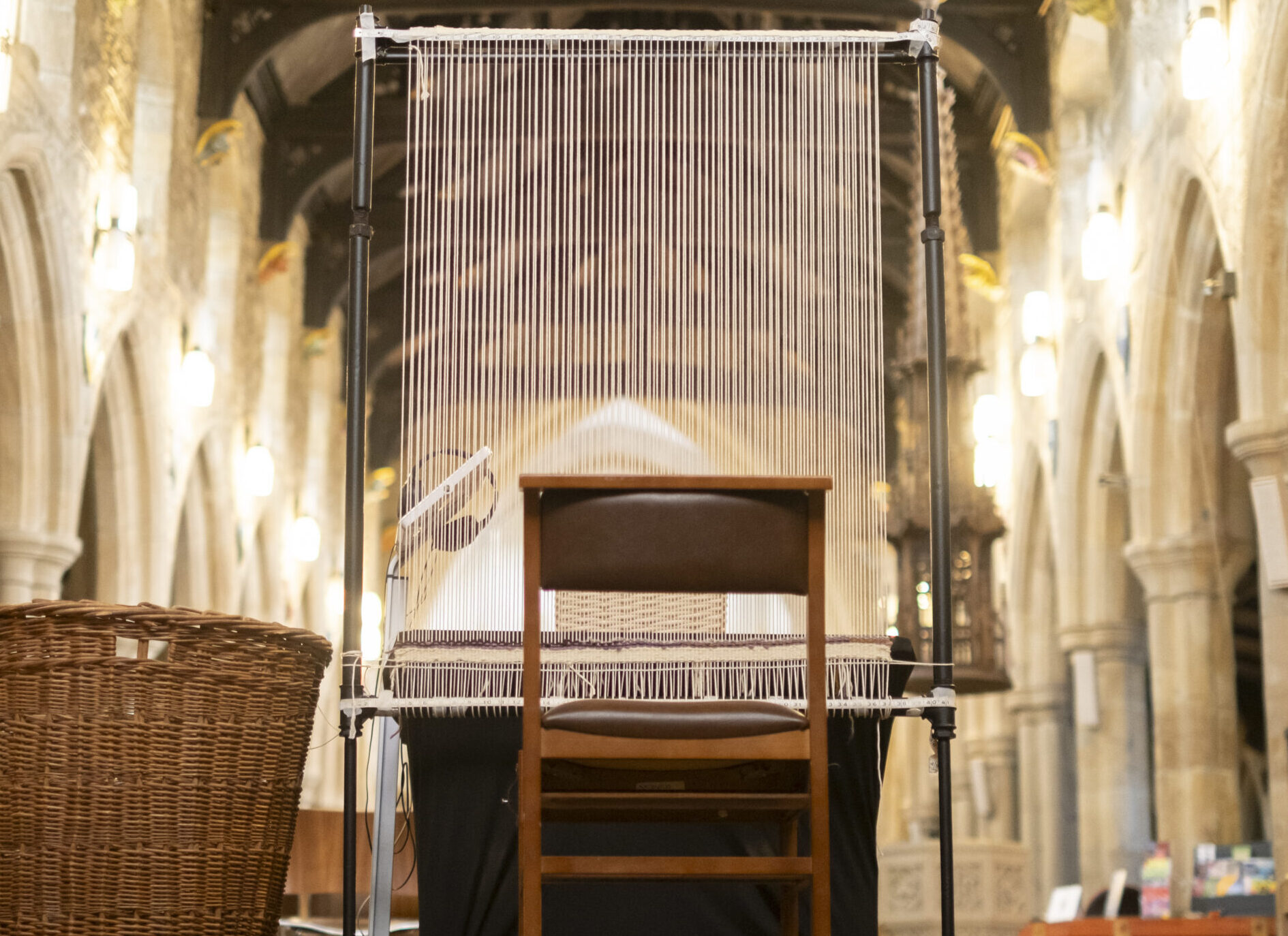
For the past four months, a loom has stood at the west end of Bradford Cathedral as part of a National Lottery Heritage Fund project we are running. We have invited members of the public to choose a thread of wool and weave it into a growing community tapestry. Children and elders, visitors and locals, those who come by chance and those who come with the single intent to weave; all have added their own strands.

It is strikingly simple, even meditative. The warp holds steady, the weft brings colour and movement, and each addition strengthens the whole. And yet, not everything has gone smoothly. Some people have misunderstood the instructions. Others have pulled too hard or left their threads loose. Quietly, those of us guiding the project have had to adjust, repair, and improvise to make sure the final piece still holds together. But none of that undoes the gift of participation. The tapestry only exists because so many hands risked adding their own imperfect thread.

And perhaps that is fitting, because Bradford itself is, in its very identity, a woven city. Its history is textile. Its present is intercultural. Its future is being worked out in the tension between tradition and innovation, roots and improvisation, scars and creativity. In recent weeks, as I have been part of conversations across the city, in civic forums, in the Cathedral, in cultural planning meetings, I have heard the same challenge surface again and again: how do we hold the threads together? I’ve found myself asking myself could this social weaving be the distinctive vocation of Cathedrals in the 21st century?


When I think back over the conversations I have been part of this month, I hear echoes of the loom in each of them. Different threads, different textures, yet all of them asking in their own way how we might weave this city’s life into something more than fragments.

With civic partners, the longing has been for more meaningful conversation than our public life currently allows. Too often dialogue becomes either polarised or polite, either combative or choreographed. But hospitality, one of our Cathedral values, is not about curating polite coexistence. It is about creating the conditions where people feel able to risk honesty, to sit with tension, and to trust that they will be held (you can read my reflections on this by reading last month’s post, ‘Into Cultire: Platform to Presence’) This, I believe, is part of what a Cathedral can uniquely offer: a hospitable loom, where threads that might otherwise fray or remain apart are drawn into a fabric that is stronger than the sum of its parts.

Within the Cathedral itself, my colleagues and I have been asking how our own vision document can be more than a paper statement. That too is a question of the warp and the weft. Rootedness, another of our values, reminds us that this community stands in more than a millennium of Christian witness and daily prayer. These are the warp threads, stretched tight across time, holding the structure. But without the weft, the innovative, intercultural, hospitable life that crosses them, the warp alone cannot make a fabric. To make our vision live we must keep weaving: to take the ancient story seriously enough to risk letting it meet the colours and textures of the present.

A third thread has come from our work on a Visitor Engagement Plan. We have been supported by consultants whose experience with other cathedrals is invaluable, yet the process has sharpened something for me: Bradford is not just any cathedral city. To describe it simply as intercultural misses what makes it distinctive. Bradford’s culture is forged in mills and markets, in migration and labour, in scars and solidarities. This is not a polished pluralism but a lived reality, raw and hopeful, shaped by both welcome and struggle. Any plan for engaging visitors here must reflect that uniqueness, not a generic template, but an experience that helps people encounter the texture of Bradford itself. That is what our value of interculturality really asks of us: not just to reflect diversity, but to interpret and host the distinctive, sometimes difficult, gift that this city carries.

And then there are the conversations about Bradford’s cultural future after 2025. When the spotlight of UK City of Culture fades, what will remain? Here the Cathedral’s value of innovation comes to the fore. Innovation is not about novelty for its own sake, but about courage: the willingness to improvise, to create new forms of beauty and dialogue that might not yet exist. Bradford has always produced outsider voices with global resonance, artists, writers, and leaders who have turned the tensions of this city into creativity. If we as a Cathedral can nurture that spirit, not showcasing diversity as finished performance but weaving it into new, surprising patterns, then perhaps we can help ensure that 2025 is not an endpoint but a beginning.

All these conversations, with civic partners, Cathedral colleagues, consultants, and cultural planners, are different threads. None of them by themselves make a fabric. But if the loom at the west end of the Cathedral has taught me anything, it is this: fabric only emerges when the threads are held in tension and patiently worked together, line by line.

On our loom there is no shuttle racing back and forth. The weaving happens slowly, by hand. That is significant; the tapestry only grows because people come, take hold of the yarn, and risk adding their part. Convening works the same way. A Cathedral cannot force unity or engineer neat patterns; what it can do is hold the frame steady, invite people forward, and create the conditions in which something larger than any one thread might take shape.

So what does this mean for the Cathedral’s future in Bradford? It means taking our vocation as loom seriously. It means curating conversations that do not stop at coexistence but risk honesty, vulnerability, and the possibility of change. It means rooting our life ever more deeply in prayer and worship so that the warp is strong enough to bear the tension. It means designing visitor experiences that reflect Bradford’s unique fabric, its scars as well as its solidarities, its particular story rather than a generic template. And it means using City of Culture 2025 as a beginning, not an endpoint, modelling intercultural creativity that continues long after the spotlight has moved on.

None of this will be straightforward. The tapestry will never be perfectly even; threads will be pulled too tightly or too loosely, and sometimes adjustments will be needed in the quiet. But perhaps that is the point. The work of weaving is never finished.

When the community tapestry on our physical loom is complete, it will hang as a piece of art. But its deeper value will not be the finished product; it will be the months of weaving, people meeting, hands moving, threads layered, mistakes amended, a fabric slowly emerging that no one could have made alone.

Too often our cathedrals are imagined in only two ways: either as monuments of the past, treasured for their heritage but disconnected from the present, or as venues for the present, hired out for franchised concerts and touring installations in order to keep the lights on. These roles may be necessary for survival, but they are not enough for vocation. If all we offer are relics or rentals, then we have missed the point.

What Bradford is beginning to show is that a Cathedral can be something else: not a museum, not a venue, but a loom. A place that holds tensions steady, invites difference into encounter, and patiently weaves new patterns of civic life. This is what our cities are crying out for; this is what our fractured societies desperately need.

The future of cathedrals will not be decided by balance sheets or by ticket sales, but by whether we dare to claim this vocation. We can continue as monuments and venues, but these will not last as long if we don’t primarily become looms for the future, weaving communities together, risk by risk, until something strong enough to hold begins to emerge.

Into Culture: From Platform to Presence

At the beginning of this month I stood on the same stage in the Cathedral for two different events both framed as a platform for interfaith encounter: one I was hosting the first public ‘Re:Imagine’ events looking at faith conversations with Baroness Sayeeda Warsi and Bishop Toby Howarth, the other, I was compering the annual ‘Sacred Music’ event for Bradford Literature Festival. Both events were billed as moments of dialogue, creativity, and shared spiritual insight: civic faith at its best.

Both events were curated with care. Both featured thoughtful, experienced voices. And yet, as the applause faded and the doors closed behind the final guests of that weekend, I felt a distinct and unsettling ache but not from hostility or controversy, but of absence: the absence of risk, the absence of surprise, the absence of the kind of uncomfortable, necessary tension that makes real conversation not only possible but transformative. Both had a sense that we were speaking around each other, not with each other. For all the talk of openness, diversity, and dialogue, what I experienced was not encounter but choreography.

Despite the warm words and generous presence of our contributors, neither evening managed to break the deadlock of public discourse. Neither truly modelled the innovative approach to intercultural engagement I had hoped for; something deeper than polite pluralism or liberal tolerance, something bolder than a curated diversity of views. What do we do when faith conversations, however well-intentioned, merely reinforce the safest, most performative version of themselves?

If Re:Imagine is to live up to its name, if sacred music is to do more than soothe, then we need more than curated coexistence. We need a new grammar for faith conversation, and public debate in general, that is something less about making space, and more about inhabiting tension. 

We must confront the following questions head-on: what needs to be unlearned in the way we currently gather across difference? And what might it take to birth something new; something not just novel, but necessary?


One of the things I’ve been reflecting on over the last few weeks is the inevitability of performance, especially when events take place on a stage. As soon as we put people in front of an audience, in a structured setting, particularly under the vaulted ceilings of a cathedral, we are not just enabling speech; we are framing it. Whether we realise it or not, we are inviting a performance.

This isn’t a criticism. It’s simply a sociological fact. In his seminal work The Presentation of Self in Everyday Life, Erving Goffman argued that social life is fundamentally theatrical. Each of us, he claimed, is always managing impressions; performing a version of ourselves that is shaped by context, audience, and expected norms. The ‘front stage’ is where roles are consciously curated; the ‘backstage’ is where we are less guarded, less polished, more uncertain. But Goffman’s point is that even our backstage is not fully free from performance; we are always somewhere on the spectrum of managing perception.

This framework helps explain why the platform changes things, even when the conversation is genuine. I tried to make Re:Imagine feel less like a panel discussion and more like an invitation to be present, unguarded, vulnerable. But the stage itself had its own logic. The lights, the audience, the publicity, all of it subtly nudged us into a mode of presentation. And once there, it was hard to improvise. When Baroness Warsi and Bishop Toby spoke, they were never really going to be able to simply share personal reflections. In hindsight, the temptation to enact identities was always going to be hard to resist. Warsi, a high-profile Muslim political figure, had to navigate all the projections, expectations, and contestations that come with that role. Bishop Toby, a Church of England bishop in a city like Bradford, was similarly constrained, not by lack of sincerity, but by the complexity of occupying an ecclesial role that is both spiritual and civic, pastoral and political. Both were, in a sense, ‘on stage’ before they even opened their mouths.

And yet I do not believe performance is always false. In fact, I’ve long thought that performance can be deeply true; perhaps even sacred but only when it moves beyond control into vulnerability. My background in theatre taught me that risk is the currency of authentic performance. It is not about getting it right but about stepping into the unknown with others. That kind of improvisational performance isn’t about projecting an image but revealing a self. For that to happen, the platform must allow for rupture and the inevitable mess to be held.

This is what I hoped Re:Imagine might enable. And while both our contributors gestured toward that vulnerability with grace and honesty, the structure around them hindered and blocked their improvisation. The conversation stayed within the boundaries of what the audience could already process. The performances were sincere. But they were still bounded.

What might it take to make a different kind of space?

This question surfaced again the next evening. I had hoped to co-produce this year’s Sacred Music event with Bradford Literature Festival. I’d proposed a shift in format: rather than sequential performances by artists from different traditions, what if we invited musicians to improvise and collaborate to create something new in real time, across the boundaries of tradition? Faith in motion. Difference in dialogue.

The conversations were encouraging but, in the end, the final event returned to the familiar: artists from different faith backgrounds performing one after another in respectful sequence. Beautiful but ultimately predictable. We honoured coexistence, but did not risk co-creation.

And this is where I believe we are stuck.

In many public conversations about faith and other contested issues we find ourselves in one of two places. Either we veer toward conflict: oppositional voices debating from fixed positions. Or we avoid it altogether: showcasing diversity in a way that flattens its tension. The former breeds fatigue and defensiveness; the latter, polite stagnation. Both forms are governed by what I want to call curated coexistence. It’s the idea that if we simply gather different people in the same space, a deeper understanding will naturally emerge. But that’s not how real encounter works. Not in theology. Not in art. Not in life. Encounter requires not just proximity, but vulnerability. Not just expression, but interruption… and interruption is risky.

This is why I’ve been returning to my ongoing reflection on inclusive othering; a framework which seeks to hold deep difference not as a problem to be solved, but as a place to dwell. I have been drawn to the idea that genuine unity comes not through flattening difference, but by learning to desire the good of the other precisely as ‘other’, as different.

Inclusive othering is not about everyone feeling comfortable. In fact, it’s about learning to sit in that uncomfortable ‘no man’s land’ between views, identities, and traditions and allowing that space to shape us.

No Man’s Land by Magdalena Mudlaff

What, then, might this mean for the Re:Imagine series moving forward as a platform for reimagining all kinds of contentious and complex topics: global diplomacy, AI and ethics, environmental activism, migration?

Firstly, I believe we need to experiment with form. What if the structure of our events is not just a means of delivery, but a form of witness? Drawing from performance theory and social improvisation, I am increasingly convinced that our formats encode our assumptions. If our structure assumes performance, then transformation will remain secondary. If the structure of our encounter is built to invite surprise, co-dependence, and change, then our content may finally have room to breathe. This means, therefore, more than changing the seating arrangements. It means actively disrupting the expectation that ideas must be defended or performed. What would it look like to invite guests not to explain themselves, but to ask each other questions they have never dared ask? What if every event required a confession—of failure, of misunderstanding, of being surprised by the other? What if participants weren’t experts, but witnesses?

Secondly, I want to explore the role of embodied practices in public conversations; silence, lament, artistic improvisation, shared meals, symbolic gestures. These are not just aesthetic flourishes. They are facilitated interventions. They disarm the impulse to perform and invite a mode of engagement that speaks to the whole person—not just their views, but their lived and vulnerable selves.

Thirdly, we must reckon honestly with power and representation. One audience member felt, after the Re:Imagine event, discomfort that a powerful political figure, Sayeeda Warsi, was given an uncontested platform who could say things without a firm response. What I found most interesting about that expressed opinion was what it revealed about audience expectation: namely, that public spaces are understood as a kind of battleground. What if we reimagined and restructured it as a sanctuary for disarmed curiosity? What if our role as curators of public space is not to ensure balance, but to nurture trust in order to create containers where difference is neither erased nor exploited and tension is embraced as an uncomfortable but necessary catalyst to creativity. As Miroslav Volf suggests to embrace is to open one’s arms, wait, and then close them around the other; not to absorb, but to hold the other. Too often, our public events keep the arms open but never move toward that vulnerable embrace.

Finally, we must accept that not all fruitful conversations are public. I am still wrestling with whether these events should happen on stage at all. Yet I worry that if we retreat entirely into the private realm, we abandon the possibility of redeeming the public one. The challenge is this: how do we make public spaces more porous, more reflective of the quiet transformation we know happens in private? Risk, after all, needs aftercare. Surprise requires structure. Vulnerability must be held. To reimagine means not only saying new things, but saying them in new ways and allowing our forms to speak before our words ever do.

So what now?

I remain grateful to Baroness Warsi and Bishop Toby. They showed up. They offered themselves. They attempted to be vulnerable. My disappointment is not in them, but in the format that could not sustain the possibility of surprise. The same is true of the artists and the people at Bradford Literature Festival curating the Sacred Music event.

We do need new formats for public moments and encounters. We need creative risks. We need voices willing not just to speak, but to listen and then acknowledge the possibility of change. We need events where musicians and thinkers improvise across difference, where politicians weep, where migrants and fearful indigenous peoples meet each other, personally over a meal and share stories.

Because if faith, and public life, are to mean anything in this fractured age, they must do more than speak. They must listen. They must risk. They must dwell in the gaps.

That weekend in the cathedral did not go as I had hoped. But perhaps that’s the point. Hope is not about things going to plan. Hope is the refusal to give up on what could be, even when what was falls short.

It is time, once again, to reimagine.

Into Culture: Improvisational Leadership

This month I have been blessed to perform twice in York; once with my wonderful long-form improvisation comedy troupe, Fool(ish), and the other as a regular at the monthly Right Here Right Now at Friargate Theatre. In preparation for the Fool(ish) show Not Gonna Lie at York Theatre Royal we had an intensive run of weekly rehearsals which meant I had to drive across to York from my home in Bradford. These creative outlets/escapes from everyday life and ministry are an absolute lifeline to my wellbeing and I love the community that exists with my fellow performers.

I have also been reading Tony Blair’s new book, On Leadership, and I have found myself drawn to his concept of a leader’s ‘hinterland’. Blair suggests that behind every great leader is a rich personal depth, a hinterland filled with passions, interests, and creative pursuits that feed their inner life. It’s a reminder that leadership isn’t just about what you do on the public stage; it’s about who you are behind the scenes, the broader life you cultivate outside the demands of your role. This interaction between the public performance and the private ‘rehearsal’ space has meant I have been reinvestigating my own leadership and drawing learning from my knowledge and experience of improvisation.


Improvisation, at its core, revolves around trust and generosity. On stage, without a script, the story is built through the free and generous exchange of offers—gifts between performers. This demands immense trust in your fellow actors to receive and build on what you offer, rather than rejecting or blocking it. In improvisation, accepting offers leads to a process of reimagination, where the unexpected becomes an opportunity to explore new narratives and ideas. Therefore, before going public on stage, groups must build that trust between performers. Without this the performances are stale and hard work. If you manage to build it, however, you experience the magic of co-creating ideas from nothing. In leadership, this same principle applies.

Generosity, in both performance and leadership, is about giving space to others; to let them contribute, fail, and grow. In Fool(ish) Improvisation, we practice a collaborative approach, not just in shows but also in how we run the company. Decisions about publicity, communication, and rehearsals are shared responsibilities. Although Paul Birch and I started Fool(ish), everyone’s contributions are equally valued, and we rely on each other to bring their best. Paul and I always hoped to build this culture of sacrificial generosity. We’re so glad to experience it and we know it is not easily built nor easily maintained, but it’s the heart of what we do.

At Bradford Cathedral, we are navigating a period of uncertainty and change, where trust can feel fragile. Financial pressures and organisational transitions have left people understandably cautious. In this context, rather than leaning into this improvisational spirit, embracing the unknown and trusting the process, I have found myself trying to control the narrative, inadvertently stifling the creativity and contributions of those around me. This instinct stems from a desire to ensure that everything runs smoothly, but it undermines the very principles of generosity and collaboration that I value. In my attempt to make a good public performance I have neglected the essential rehearsal process.

This has become a learning point for me. Blair’s hinterland concept challenges me to reconnect with my deeper self and rediscover my improvisational and ‘kenotic’ leadership style: one that embodies generosity and humility. Kenosis, the theological concept of self-emptying, invites me, as a leader, to prioritise the needs and voices of others, allowing space for their contributions to flourish. In the same way that kenosis calls for a letting go of one’s own control, improvisation requires a performer to relinquish their need to dictate the outcome. Instead, the focus shifts toward co-creating a shared experience, trusting others to contribute, fail, and grow.

In improvisation, the most powerful moments come when you step back, allowing others to take the spotlight, and trust that their offers will move the scene forward. This self-emptying, this kenotic release, is not passive but actively generous, making space for the unknown to emerge. In leadership, the same principle applies: a kenotic leader, much like an improviser, seeks not to dominate but to empower others. This mindset of releasing control, whether on stage or in community, fosters an environment where collective creativity can thrive.

In both improvisation and leadership, kenosis demands vulnerability. By prioritising the success of others over your own needs, you create the conditions for something greater to emerge, whether it’s a compelling improvisational scene or a thriving community. The leader, like the improviser, is called to a posture of generosity, making space for the voices around them to shape the collective narrative.

A hinterland is not just about reminding the leader that there is a life outside of their role; it also ensures they remain rooted in trusting relationships with people who interact with them out of role. A leader with these important, grounding, personal communities draws from their own reserves, giving to others who are hesitant the trust they have experienced in their hinterland. This requires patience and courage. It is not just about expecting people to meet us halfway; it’s about leading from a place of abundance. When we cultivate our own personal depth—our hinterland—through passions, creativity, and reflective practice, we can give without expecting immediate reciprocity.

In both theatre and ministry, trust and generosity are foundational to building a strong community. Theologically, these concepts are grounded in grace—leading with an open heart, offering yourself and your leadership freely without demanding anything in return. Christ’s leadership, rooted in self-giving love, provides a profound model for leading through times of uncertainty. Even when his disciples doubted and faltered, Christ trusted them, allowing space for them to grow.

However, in today’s political landscape, we are witnessing an increase of polarisation and a pervasive sense of mistrust and, just as individuals in the political sphere feel disillusioned, the same sense of disenchantment can emerge when trust is fragile within our own circles. The erosion of trust, whether in politics or community leadership, undermines the foundations of collaboration and shared purpose.

In improvisation, when trust breaks down, we return to the principles of generosity and collaboration to rebuild the creative process. This same return to first principles is essential in leadership, whether navigating smaller communities or a broader social context. When political discourse becomes transactional rather than relational, and when leadership focuses on control rather than trust, we risk losing the very bonds that hold communities together. In this sense, improvisational practices offer a model for rebuilding societal cohesion: just as a scene is co-created through shared trust on stage, so too must we foster collaboration and openness in leadership, both in our communities and beyond.

The creative space of theatre, like the one I find in Fool(ish) and Right Here Right Now, offers a counter-narrative to this political disillusionment. In our life together both the private rehearsals and the public performances, we seek to model a different way of being together; where ideas are shared generously, where vulnerability is celebrated, and where each person’s contribution is lovingly handled and grown. This stands in stark contrast to the often adversarial nature of contemporary political and social dialogue. By embodying these principles of trust and generosity, we not only enhance our performances but also create a microcosm of what is possible in the wider world.

An improvisational approach to leadership at Bradford Cathedral could significantly influence our communal life and contribute positively to our broader social context. By fostering an environment where creativity thrives and every voice, generously offered, is heard within a trusting community, we could encourage collaboration within our community. This will help us navigate the uncertainties we face, inviting others to take part in co-creating solutions rather than merely following directives.

This spirit of reimagination underpins a new series of events, Re:Imagine, at Bradford Cathedral. These events are designed to ignite our collective imagination and envision a different future for our community, drawing on the rich entrepreneurial spirit that has shaped our beautiful city. Each event will be unique, but they will share a commitment to fostering creativity, innovation, and collaboration—principles deeply rooted in the practices of improvisation.

By intentionally integrating improvisational principles into Re:Imagine, we aim to create a collaborative atmosphere where participants feel empowered to share their ideas freely, knowing that their contributions will be valued. Just as in improvisation, where every performer’s input shapes the narrative, these events will prioritize the process of co-creation, encouraging attendees to build upon one another’s contributions without the fear of rejection. Each session will begin with open-ended prompts that invite participants to explore topics from multiple perspectives, mirroring the improvisational practice of “yes, and…” a technique that fosters a culture of acceptance and expansion. In this way, we hope to cultivate an environment where trust can flourish, allowing diverse voices to be heard and new ideas to emerge organically. I have been experimenting with this improvisational approach since starting at the cathedral. You can read about it here and, in more explicitly ways in my published article, “Improvisation As Intercultural Practice

I’ve come to realise that the principles of trust, generosity, and collaboration are essential practices for me and can transform communities and society in general. Reflecting on my experiences in both improvisation and ministry, I recognise the importance of my hinterland, not just how it helps me to lead effectively but also how it roots me in a community that nurtures creativity and trust. I’m learning again to lean into my hinterland: a place of curiosity, joy and silliness where my people, foolish people, ground me, trust me and are abundantly generous to me. My visits to this place remind me of the person and leader I want to be. I hope to be a patient, trusting, and generous leader, believing that together, my community can co-create, out of nothing, something greater than any one of us could achieve alone. I want to encourage my colleagues to join me in cultivating an environment where every voice is heard and valued, where we can co-create a future filled with possibility. Though we face uncertainties, I am hopeful that by embracing an improvisational approach to leadership, we can navigate these challenges together and create a vibrant, trusting community. Ultimately, my commitment to embodying trust and generosity is not just about my role as a leader; it is about fostering a culture where creativity can flourish, and where together, we can craft narratives that reflect the richness of our shared experiences.

Into Culture: Tale of Two Cities

In my reading at the moment, I am currently inhabiting two vastly different worlds: one, the dark, Gothic corridors of ‘The Hunchback of Notre Dame’ by Victor Hugo, and the other, the contemplative and theological depths of ‘The City of God’ by St Augustine of Hippo. At first glance, these two texts seem to come from different places; one a romantic novel from 19th-century France, the other a theological treatise from 5th-century Rome. Yet, as I delve into the opening chapters of both works, I am struck by a common thread: the place of the arts in society and how they are used by seemingly competing visions of our world.

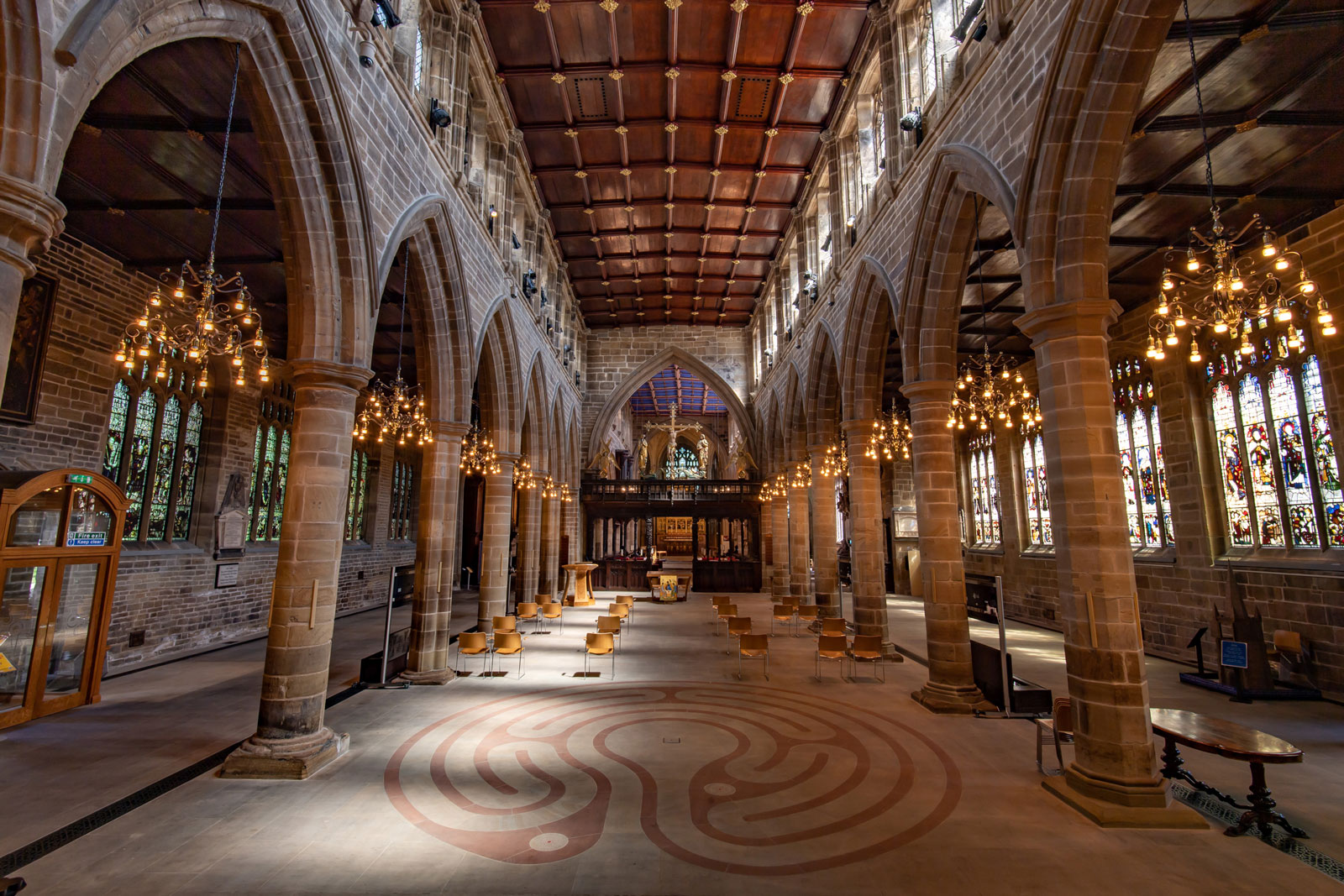
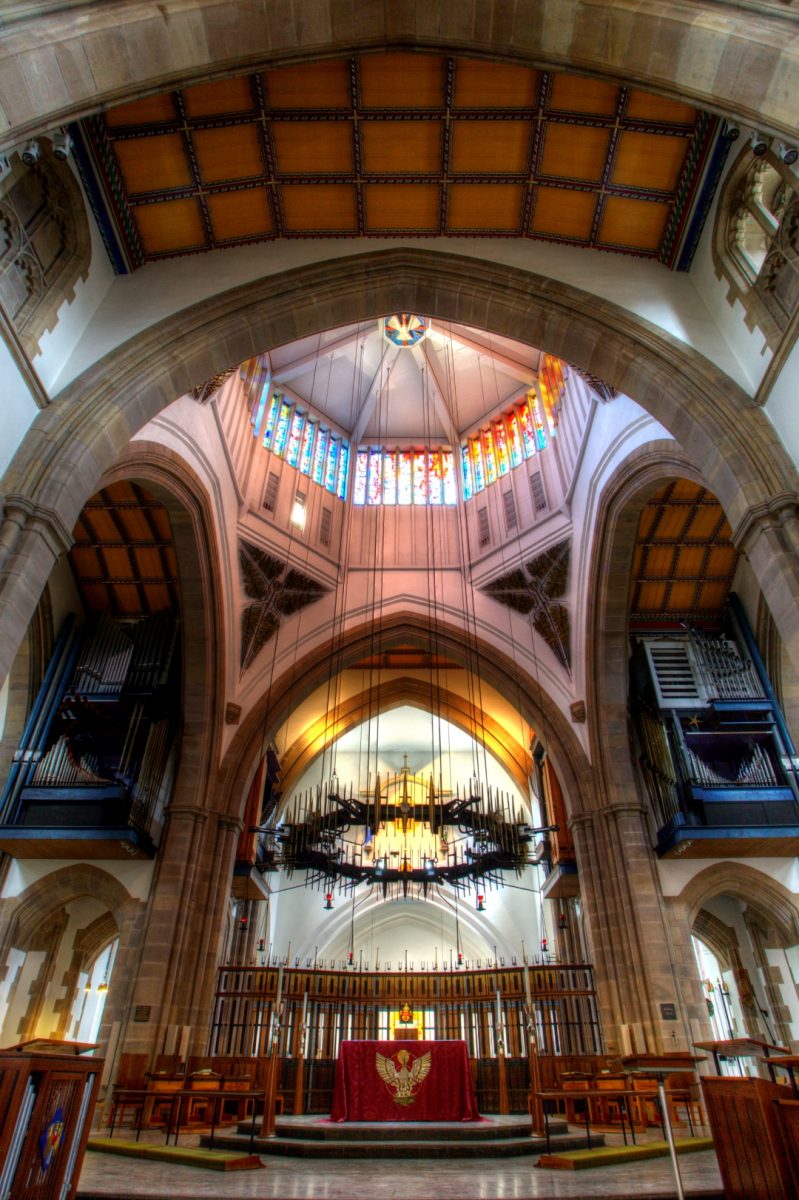
I have also been thinking again this month about the architectural design of Bradford Cathedral and how, I have been told, Edward Maufe, the architect who designed our East end, wanted to articulate a coming together of the mundane and the sacred. The West end was to be experienced and understood as a convening space for the whole of Bradford society. The East end would be the focus of sacred worship. Whether that is true or not I don’t know but there is a strong architectural difference between these two spaces in our Cathedral. 

The interplay between these two spaces is characterised by St Augustine as two cohabitating ‘cities’; the City of God symbolising the divine, eternal order and the City of the World symbolising human civilisation with all its flaws. I want to examine briefly the more nuanced interaction between these two ‘cities’ to see if there is something fruitful to be found for us at Bradford Cathedral to offer our city as we head into 2025, where Bradford will be UK City of Culture, as well as other Cathedrals as they wrestle with the stewardship of their own sacred/secular space.


Hugo begins his story, not with the titular hunchback, Quasimodo, but with a scene set in Paris’s grand cathedral, Notre Dame (arguably a major character in the book) during the Festival of Fools. In these opening pages, we are introduced to the clash between the religious order represented by the cathedral and the chaotic, almost carnivalesque atmosphere of the festival outside. Here, art is both sacred and profane, elevated and debased, reflecting the dual nature of humanity itself. 

Similarly, Augustine, in the opening books of ‘The City of God’, discusses the dichotomy of the two cities: the City of God and the City of the World. For Augustine, the City of the World is marked by its temporal, fleeting nature and its inclination towards sin and self-glorification. Yet, even within this human city, Augustine acknowledges the presence of art, culture, and human achievements, which, though marred by sin, still bear the potential to reflect divine truth. In the early chapters, he argues that the polytheistic worship and rituals of the Graeco-Roman world which heavily influenced and controlled the public performances and artistic artefacts is more to be blamed for the fall of that civilisation than the acceptance of Christianity into their cultural milieu.

Bradford Cathedral aspires to be a beacon of spiritual and artistic expression amidst the bustling life of our city. Its walls, filled with history, uniquely tell the story of the whole community and its faiths. Just as Hugo uses Notre Dame to symbolise the connection between the sacred and the secular, Bradford Cathedral serves as a constant reminder of the spiritual heritage and the rich cultural tapestry that defines the city of Bradford. It is a space where the divine meets the everyday, and where art, I aim to show, can serve as a bridge between the two. 

In reflecting on these two great works, it becomes clear that the arts have always occupied this central place in human society. They are a means through which we explore our relationship with the world around us, with each other, and with the divine. Whether in the grand architecture of a cathedral, the lively performance of a play, or the quiet contemplation of a painting, the arts offer us a glimpse into the deeper truths of existence.

Hugo and Augustine remind us that the arts are both a gift and a responsibility. They have the power to inspire and uplift, but also to distract and lead astray. As we engage with the arts, whether as creators or as audience members, we must do so with a sense of discernment and purpose. We must strive to see beyond the surface, to seek the truth that lies beneath, and to recognise the metaphysical fingerprints, whether good or bad, in the works of human hands.

In a world that often seems consumed by the immediate and the material, the arts call us to remember the eternal, to lift our eyes towards the heavens even as we walk the streets of our earthly city. They remind us that we are more than the sum of our parts, that we are creatures of both body and soul, and that in every brushstroke, every note, and every word, there is the potential to glimpse the divine.

The opening chapters of ‘The Hunchback of Notre Dame’ introduce us to Pierre Gringoire, a struggling playwright whose dramatic piece is set to be performed during the Festival of Fools. Gringoire embodies the romantic ideal of the artist: impoverished, passionate, and slightly out of touch with the mundane concerns of everyday life. His work, a Mystery play titled ‘The Good Judgment of Madame the Virgin Mary’, is meant to be a serious, thoughtful exploration of divine justice. Yet, it quickly becomes evident that Gringoire’s high-minded artistic vision is out of sync with the boisterous, irreverent mood of the crowd.

The Flemish visitor, Jacques Coppenole, crystallises this disconnect when he dismisses Gringoire’s Mystery as a waste of time, preferring the spontaneous entertainment of the festival over the playwright’s carefully crafted narrative. Coppenole’s comment is not just a critique of Gringoire’s play but a broader statement on the role of art in society. To Coppenole, the art that matters is the art that entertains, that is immediate and accessible. Gringoire’s highbrow ambitions are lost on a crowd that craves spectacle, not contemplation.

Hugo uses Gringoire’s predicament to illustrate the fragile place of the artist in society. Gringoire’s struggle to have his work appreciated reflects a larger struggle between different conceptions of art: art as a serious, almost sacred endeavour, and art as entertainment, something that should delight and distract. Hugo’s portrayal of Gringoire is sympathetic but tinged with irony; the artist is seen as a tragic figure, striving for an ideal that the world, in its indifference or ignorance, fails to recognise.

Augustine, too, is concerned with the role of art, but his focus is on the potential of art to lead people away from God. He acknowledges the beauty of the arts but warns against their capacity to distract and mislead. For Augustine, the highest purpose of art is to direct the soul towards the divine, not to entertain or merely please the senses. In this light, Gringoire’s predicament can be seen as emblematic of a deeper tension: the artist’s desire to convey truth and meaning versus the public’s desire for amusement.

I find myself caught in this tension. I, obviously, tend towards the Gringoire/Augustinian direction but we at Bradford Cathedral must constantly navigate the balance between art as sacred and art as entertainment. I return, again and again, to my reflections on the Empty Space and how we might make meaningful and prophetic contributions to the cultural narrative of our city whilst having to ensure such endeavours provide us with, understandably necessary, financial return. Like Gringoire, I must remember that there is no measurable point in expending time and money in creating a statement if no one is going to hear it or it leads to the closure of the means to share it.

Gringoire’s failure to connect with his audience is not just a personal failure but a reflection of society’s failure to appreciate the deeper value of art. The public’s preference for the rowdy, unrestrained entertainment of the Festival of Fools over Gringoire’s thoughtful play mirrors the City of the World’s inclination towards the immediate and the material. It is a reminder of how easily society can overlook the things of true, lasting value in favour of the fleeting pleasures of the moment.

Both Hugo and Augustine recognise the profound impact that artists have on society. For Hugo, the artist is a visionary, someone who can see beyond the mundane realities of daily life and capture the essence of what it means to be human. The artist is both a creator and a communicator, someone who bridges the gap between the sacred and the secular, the eternal and the temporal. Through their work, artists invite us to see the world anew, to recognise the beauty in the ordinary and the extraordinary in the everyday.

Augustine, while perhaps more circumspect, also acknowledges the power of the artist. He understands that artists have the ability to shape the minds and hearts of their audience, to lead them towards truth or away from it. Augustine calls for artists to use their gifts wisely, to create works that not only delight the senses but also elevate the soul. For Augustine, the ultimate purpose of art is not self-expression or entertainment, but the glorification of God.

In the end, both Hugo and Augustine challenge us to consider not just the place of the arts in society, but the place of society in the grand, divine tapestry of creation. Gringoire’s plight is a poignant reminder of the fragile position of the artist, caught between the demands of the world and the pursuit of a higher ideal. His failure is not just his own but a reflection of a society that has lost its way, that has forgotten the true purpose of art. Yet, even in this failure, there is hope. For as long as there are artists like Gringoire, striving to build, create, and imagine, we can participate in the ongoing story of the world, a story that began long before us and will continue long after we are gone. In this, the arts are not just a reflection of society—they are a bridge between heaven and earth, a testament to the enduring and transcendent nature of the human spirit…

… how can we translate that value to also be financial? Answers on a postcard and sent to Bradford Cathedral, please!

Into Culture: Patronage

When the Bishop of Bradford asked me back in 2022 to develop a strategy for the faith communities engagement with City of Culture I immediately researched previous examples to learn from them. I found a repeated experience of faith communities in the three previous City of Cultures (UK City of Culture is distinct and different from the European Capital of Culture, although many confuse the two). All the reports had seen faith communities feeling overlooked, disconnected and ‘done to’ for other people’s ends. They had attempted to engage through production and contributing artistic products or cultural artifices to the packed programme. Many committed significant resources to contributing to the programme with unique offerings but, when the year came, their offering was lost in the packed schedule and audiences did not connect with their work as much as they had hoped. This caused understandable disappointment and led to compounding a cynicism about the whole project. 

I was clear, therefore, as we looked ahead to Bradford being the UK City of Culture in 2025, that the faith communities would be clear, from the outset, what a feasible expectation of their involvement should be. I suggested that our strategy should be underpinned by the word ‘patronage’. I proposed we ‘patronise the arts without patronising the artists.’ What I meant by this was that we should seek to become patrons akin to the old medieval system whereby we support and encourage the artists to produce work of great value and to play our appropriate role in its production. In practice this meant: 

  1. to offer our resources to the arts and culture professionals for their use, e.g. space, stories, funding, etc. 
  2. to attend and promote the arts and cultural offers and engage with artists in discussing their work and finding points of connection with them.
  3. to volunteer and encourage others to volunteer to ensure the events go smoothly and more people feel the programme is for them.
  4. and to play our part in (re)shaping the cultural narrative.

The problem with this strategy was that the word ‘patronage’ has negative connotations due to its obvious linguistic links with ‘patriarchy’. Even saying we should ‘patronise’ the arts, although technically correctly, is more commonly associated with condescension. This cultural rejection or negating of the whole ‘patri-‘ cluster of words makes the activities that are best described by them difficult to recommend or enact.

During his recent visit my father-in-law became aware that the word ‘patronus’, from the Harry Potter world, is Latin for ‘protector’. Although I was aware of this etymological root I hadn’t quite connected it with my current pondering on the nature and concept of patronage. 


St George has been the official patron saint of England since Tudor times having been named the patron saint of the Order of the Garter by Edward III. George was of Cappadocian Greek descent, meaning he came from the region now known as Turkey. He, at no point, visited England and it is likely never knew of England. He was a Christian soldier in the Roman army but due to the persecution of Christianity he was martyred around the third century. He is now more famous for a legend that arose about him in the eleventh century. The story goes that George faced a fierce ‘dragon’ that was wreaking havoc in Libya and slaughtered it, thus saving the king’s daughter from being offered as a sacrifice. George’s bravery and rejection of monetary reward inspired the whole city to become Christian.

One can see why this story resonated with Edward III, who, though vastly outnumbered by the large French army still won several victories in battle. It is here, one could argue, that the English preference to the cultural narrative of ‘the underdog’ began. This particular social story echoes through to our time and continues to impact our collective decisions and instinctive responses, particular in times of conflict.

A patron saint historically was believed to be a saint who intercedes on behalf of a particular nation, craft, person, etc. They are elected by said nation, craft, person, etc. and looked to to protect and support their life and work. Although I understand the theological concept of the intercessions of dead saints and the wider concept of ‘the communion of saints’, I am not convinced by the rationale given and so don’t engage in the promotion of the idea in its common usage. I do, however, appreciate the power such personalities can have on particular people and communities. I believe the benefit is not about the spiritual intercession of the saint but the narrative construct that can inspire the living body that elects it as a patron. I happily celebrate patronal feast days and engage in the stories of saints on their particular anniversaries to pray for those that seek to imitate certain noble characteristics or feel particular resonance with them.

An issue has arisen, however, when I understand the patronage of saints in the way outlined and then seek to define the patronage of the Church to the Arts. In trying to square the circle I have also been thinking about Bradford Cathedral’s patronage of several parishes elsewhere in the Diocese. These patronal relationships are common in all parish churches across England. The patron is not the same as the patron saint of which the particular church is named. The patron has a particular role, historically held, to present particular candidates into the role of parish priest. In the 20th century most diocese went about collecting up ‘patronages’ in order for the Diocesan Bishop to have freedom to appoint who they wish to ecclesiastical livings. Some churches remain within specific organisational patronages (CPAS, The Church Society, Simeon’s Trust).

The Dean of Bradford has rightly, in my mind, decided to redevelop the role of the patron beyond just the recruitment process. In our strategy we have specifically named our aspiration to support and resource our patronage churches. This patronage will look different for each of our churches depending on needs. Some of our patronage churches are growing, lively places of faith with enough resources to sustain their important mission and ministry, whilst others are struggling in different ways. The immediate decision, to enact our strategy, was to offer our resource of clergy time to help maintain worship in all of the places by taking Eucharistic services when there is a vacancy. It has also meant that we have engaged with some in offering advice and consultation to assist in their own growth and development. The Dean also meets regularly with incumbents and encourages them personally.

If patronage is primarily about protection but also, in some way, narrative shaping, what might this mean both for the patronage relationship between the Cathedral and other churches and for the Church and the Arts?

Returning to the topic of patron saints, for a moment. Back in 2021, The Rest is History podcast did an episode on St Cuthbert. Tom Holland, historian and co-host of the podcast, was proposing to adopt St Cuthbert as the patron saint of England. He has developed this idea elsewhere and I am favourable to this suggestion due to the form the cult of St George can evolve into. The problem, I would argue, is that the story of St George shapes those who take it for their own collective story in a particular way: value is placed on defeating enemies with physical strength. That particular myth connects with some darker impulses of human beings and explains, for me, the way in which St George’s cross can now be adopted. Who we’ve chosen to ‘represent us’ in the world says something and gives, in my mind, an unhelpful foundation to the story we project outwards. Does St George focus others’ attention on particular characteristics of ‘English’ and not on other repeated behaviours and actions that we may want to be known for?

If St Cuthbert, on the other hand, were to be the patron saint of England how might it resonate with other parts of our national character?

St Cuthbert is described by Bede as ‘a very pleasant and affable man’ often citing his patience and forbearance as major characteristics. He is depicted, primarily, as a teacher, travelling to places ‘which others feared to visit and whose barbarity and squalor daunted other teachers.’ This brings out a different quality to our painful colonial past. I’m not suggesting that it justifies all, or even most, of the horrific, historical actions by our country on others’ but it does offer a little balance, suggesting that some of our explorations and ‘missions’ may have been done for other, more noble intentions. I am also not suggesting that the language used by Bede in the quote above is language that I would use to describe the many English people who have gone to other places and helped alleviate poverty and health crises.

St Cuthbert was also a reluctant public figure. This may be a personal resonance and not something that is shared widely by my fellow citizens but I get the sense that St Cuthbert was a home bird. He liked being in his own place and being called to go elsewhere was a cost to him. Now, it is true that the English are famous for our desire for home ownership. The data shows that we place a higher value on this than other nations. 

The Englishman’s house is his castle.

Last month I mentioned Jeremy Paxman’s book, ‘The English: A Portrait of A People’. In it he explores the English character in its glory and its deep problems. He comes to a summation that I think is an interesting image of what it means to be English, as opposed to British.

Yet, for all claims that the country is ‘finished’, the attitudes of mind that made the English culture what it is – individualism, pragmatism, love of words and, above all, that glorious, fundamental cussedness – are unchanged.

Jeremy Paxman, ‘The English: A Portrait of a People’ (London: Penguin, 1999) p.264

This patronage would frame our sense of ourselves differently from the legend of St George. My impression is that the story of St George no longer resonates enough with us as a people (except during sporting competitions and military conflicts). The use of this dragon-fighting legend to frame and interpret the ‘Blitz spirit’ has been used to justify reckless political endeavours as we pose as miraculous underdogs. One can view the coming together, the forbearance and patience seen during the war through a different qualitative lens if we see it as following the St Cuthbert way. The motivation is different as is the character in which we move forward.

So what of patronage?

The role of a patron, I want to suggest, is to give shape to a person or communities’ cultural narrative. It is to direct them towards that which they want to express to others. To give them a narrative protection and to support them in their exploration and articulation of themselves into the world.

We might want to explore this at Bradford Cathedral as we interact with the churches to which we hold a patronage. This might be that our vision, values and narrative is shared with them. The protection we could offer these churches is in advocacy, particularly those who feel vulnerable to closure by bringing to them our charisms of hospitality, rootedness, interculturality and innovation. We don’t want this patronage relationship to be imposed but want it, like the election of patronal saints, to be desired for the benefit of the patronised (not condescended!)

The Church will need to be more confident in its own story, vision and values if it wants to position itself as a patron of the Arts. Like the relationship between the patronage churches and the Cathedral, ‘the Arts’ has not chosen or elected the Church as their patrons. How might each (potential) patron so inspire their (potential) patronage to look to them to help shape their own articulations of themselves to others? What might the offer of patronage look like in the 21st century where most artists turn to the patronal Arts Council, National Lottery or other trusts who all desire them to fulfil set strategic criteria that fit particular cultural values?

Into Culture: Curated Silence

Conversations are broken

So begins the blurb on the back of Nihal Arthanayake’s new book ‘Let’s Talk: how to have better conversations’. I picked up Arthanayake’s book whilst on holiday and devoured it within a few days. It was a timely read for me as I continue to imagine what is being shaped at Bradford Cathedral in the run up to City of Culture. We have articulated aims at the Cathedral to “be a place where challenging issues facing the world can be discussed and debated openly and safely” as well as being recognised “as the safe place for gathering when local or global events require a spiritual response or an honest conversation.”

So what makes for good conversation? Why is the art of disagreement such a popular idea at the moment? From ‘The Rest is Politics’ podcast’s stated aim “to disagree agreeably” to the Church of England’s repeated mantra to learn to “disagree well”; lots of people are trying to recapture the skills to debate safely in an increasingly polarised world. Public discourse has lost a sense of maturity, calmness and creativity. We can point fingers towards the rise in social media (or, should we call it unsocial media?) or the cuts to education which disproportionally impact the humanities and thus our ability to learn the empathetic imagination required to converse with people of difference. There are, however, many other factors that have led to the erosion of social cohesion and community integration. The Covid 19 pandemic didn’t cause this conversational decay but it has undoubtedly accelerated the degradation of all the skills required to interact with others.

This month we have held 3 events at Bradford Cathedral that I have helped to produce, all aimed, in different ways, to position us as an organisation to fulfil the aims stated above. Each of these spaces, in different ways, used the arts to inspire and/or hold difficult, contested views in the hope of discovering, with people of difference, a new way forward together.


‘Journeys of Hope’ was an exhibition that told the stories of both the Ugandan Asian diaspora, who travelled to Britain in 1972 after being expelled from their homeland by Idi Amin, and ‘the Windrush generation’, who arrived from the 1940s seeking to fill labour shortages after World War II. As part of our engagement in ‘Black History Month’ we wanted to hear different black histories alongside one another to discern the universal experience as well as the nuanced and distinct narratives from different ‘black communities’. The banners that made up the exhibition depicted, in word and pictures, the journeys made by these different migrant communities. The public were invited to engage in the dialogue between the two different narratives.

The launch event amplified the voices from these two particular communities of Bradford. Individuals talked about their experience of having multiple ‘homes’ e.g. both the Caribbean or Uganda and Britain. The contributors began to explore together what they understood by ‘identity’ the painful memories that have shaped them as well as the joyful realisations they have discovered. I chose to give space for those stories, particularly the painful parts to just hang in the air. The silence inviting us to face the uncertainty without the pressing need to respond immediately; to ‘befriend’ the emotions that were stirred.

In the press coverage surrounding the exhibition the media were most interested in the deliberate shift we are making in Bradford from talking about multiculturalism to interculturalism. Multiculturalism carries connotations of a kind of deceptive ‘tolerance’; a meagre allowance of another’s existence. It rarely inspires any creative interaction and, indeed, I would, in some small way, agree that “multiculturalism is dead”. I do not see how this acceptance of the other in my periphery as doing anything beneficial and will, with little encouragement, fall into ghettoisation and conflict. Interculturalism, on the other hand, invites ‘inter’action between cultures. It means, as one local, Bradfordian broadcaster said at a recent Religion Media Conference hosted in our city, “getting up in each other’s business.” 

Secularists would have us all believe that the public realm is a naturally neutral space. This is not true. There is no such neutrality because it is always curated by a particular worldview, most often a secularist’s. A healthy and honest public space that encourages healthy, creative conversation around shared political and social goals is hard built and even harder to sustain. Intercultural practice, as opposed to multiculturalism, requires particular skills which are not obvious or easily learnt. One principle is deep, empathetic and imaginative listening. I explore this and a complimentary principle of ‘overaccepting’ in an article soon to be published in the Oxford Journal of Intercultural Mission, entitled, ‘Improvisation as Intercultural Practice’. Essentially I argue that the skills that make improvisatory drama work are the same that make public discourse work: curiosity and mutual trust. This is what is lacking so often in our interactions with others.

We were also invited, by the Council, to host an ‘interfaith service’ to begin Hate Crime Awareness Week. This year’s theme was tackling religiously motivated hate crime. Because interfaith worship/prayers are more complicated than many understand, I decided to invite friends from different faiths an opportunity to share, from a personal perspective, what their particular faith teaches them about relating well across religious difference. This kind of sharing can easily descend into a kind of Faith Battle as individuals feel they must ‘represent’ and defend their position. It was specifically to counteract that temptation that I encouraged contributors to speak only from their personal view and followed it with silence, reflection and, if the congregation wished, to pray privately. This approach disarmed the pressure we put upon ourselves when we talk publicly about a deeply held, identity shaping thing such as faith. It encouraged people to simply accept the offer being made with no need to respond either affirmatively or negatively.

The event was held on 16th October, just 9 days after the atrocities seen in Israel and the subsequent heartache across the region as Israel and Gaza fell again into bloody conflict. This event was naturally overshadowed by the pain, confusion and anger felt by many in our community in Bradford and across the world. Fortunately I had already devised a creative way that we could stand together as people of different faiths in a meaningful way without using words that can regularly, particularly at such times of heightened hostilities, get taken out of context, misheard/misunderstood. We simply lit a single candle from individual candles representing our different faith traditions. We held silence together and allowed one another to lament and be baffled together without requiring a verbal response.

Sometimes the skill of conversation is knowing when not to speak.

Finally we hosted a delegation from one of our Diocesan links. Bradford has partnered with the Church District of Erfurt in Germany for over 30 years. We have regularly engaged in an exchange programme: us visiting them and they us. This year it was their turn to come over to us. As we devised an event at the Cathedral we discovered it had been 90 years since Dietrich Bonhoeffer visited Bradford and made, what became known as the Bradford Declaration. It was the start of the work that culminated in the much wider known Barmen Declaration which spoke against the Nazi regime and led, ultimately, to Bonhoeffer’s arrest and death in 1945.

In honour of this anniversary we decided to host an event that helped us to reflect on the role of faith in politics and politics in faith. We had three speakers: Dr Matthias Rein who is a Lutheran pastor in Germany who gave us a good background to Bonhoeffer and his ongoing legacy in Germany in 21st century, Revd Dr Noel Irwin, a Methodist Minister who teaches community development and organising, political and public theology who spoke about the impact of Bonhoeffer’s thoughts on violence/non-violence during the Trouble in Northern Ireland and Rt Revd Nick Baines, bishop of Leeds who talked from his experience of being a bishop in the House of Lords. Tough questions were raised and some complex ideas began to be unpacked.

Again, in the media interviews I engaged with they focussed on the common request that people make to ‘keep faith out of politics’ or ‘keep politics out of faith’. In the light of the Israel/Gaza situation and the overwhelming complexities involved in that historic, multifaceted issue, such requests are, in my mind, naive and reckless. Whether you ascribe to a particular shared religious doctrine or are not part of an organised expression of belief we all believe in something. This is either a spiritual, political or psychological idea or, most likely, some mixture of all three. There is some set of values which coalesce into some form. This is your faith. This shapes your decisions and choices. Those choices direct your actions and engagement in the social world. This is politics. It is, therefore, dishonest, to suggest that anyone can separate their faith/beliefs from their political choices.

The event was held within the context of a bilingual choral evensong. I had thought that many would only turn up for the intellectual part of the evening but in fact we had all 80 or so audience members from various backgrounds come and experience the sung liturgy which included prayers of Dietrich Bonhoeffer. The music, I felt, played a significant part in settling people into our time together and expressed in the hauntingly beautiful harmonies the complexities Bonhoeffer faced in his time. In our own time, as demands are made on us to make choices and to pick sides, I listened to the quartet of voices sing words of trust often creating deliberate dissonance in the melody. I was reminded of a contemporary of Bonhoeffers, Karl Barth, who once wrote,

And he who is now concerned with truth must boldly acknowledge that he cannot be simple. In every direction human life is difficult and complicated… Men will not be grateful to us if we provide them with short-lived pseudo-simplifications.

Karl Barth, The Epistle to the Romans (Oxford: Oxford Univeristy Press, 1968) p.5

Arthanayake, referring to words spoken by Professor Tanya Byron earlier in his book, concludes by saying, 

…we must make sure that our education system encourages rather than diminishes curiosity. The curious may well dive into the online world to find answers to questions they have, but they will also wish to discuss those answers, refine them and even have them changed by new advice or evidence. The curious will have their ears open to empathise with the experiences of others or to process and push back on opinions they do not agree with. The curious will talk to strangers.

Nihal Arthanayake, Let’s Talk: how to have better conversations (London: Trapeze, 2022) p.266

That curiosity should be directed towards deliberately shaped silences in the world around us in order that we can engage better with to the daunting silence we find within. The arts should curate public spaces of silence to invite us, to woo us, into the uncomfortable conflicts that lie within us all so we can hold firm in the conflicts outside. When people declare our silence as deafening or that non-words are hurtful I weep. It’s because they cannot feel the gift that shared silence can be.

Into Culture: City of Travellers

I have become fascinated with a particular phrase that I hear quite a lot: “But we want to make it Bradford.” What does it mean to be ‘Bradford’? My colleague the Dean praises certain things by the adulation of, “We made that Bradford.” I was in a discussion about the creation of an Artists’ Charter to be proposed for the City of Bradford. As part of the consultation we were asked “how we would make this distinctly Bradford?” This singular cultural concept rooted in a local place is interesting to me in a city which is so global in its population.

Before moving to Bradford last year I began to be interested in a similar philosophical question but on a slightly larger level: “What does it mean to be British?” or, at times, “What does it mean to be English?” Do such conceptual categories exist? The term is used enough that we all seem to accept it and to bestow upon it meaning but is that meaning shared? I have witnessed it being used in contradictory ways and yet I still feel a truth lying at the heart of the sentiment; or, maybe, I long for it to mean something even if it does not.

A friend of mine often says that stereotypes, however insulting, are rooted in some truth. The issue is the removal of nuance and dimension from the object we’re stereotyping so they become caricatures without dignity and a deeply mysterious depth. Indeed, to stereotype is the start of the de-humanising of a person, but my friend is right in that these broad and basic categories have an element of truth: they’re just isolated from the plethora of other factors that make up a person or nation. Take Germany for example. There is a broad truth that there is, within the German culture, a valuing of efficiency and order. This is also seen in the wider category of germanic cultures outside of the current national identity of ‘Germany’. The question should be asked, therefore, are the people of germanic countries culturally conditioned or is the culture shaped by the people?


As we at Bradford Cathedral go through a vision and value setting process looking ahead to further strategic development, I am aware of the balance of listening and receiving a culture as well as shaping and making a culture. As part of our listening and consultation process we studied our history and probed it for cultural markers and definition. There are certainly some cultural artifices that repeat over the centuries of the community that worshipped on the site of the Cathedral; we have articulated this as ‘a story of change and ambition, of hard work and dedication, of failures and yet trust and hope in a God who changes lives and transforms communities.’ 

We hear the story of the civil war and how the people of Bradford were outnumbered by Royalists. They were besieged many times and cannons opened fire on the parish church (the future Cathedral that stands today). At the final battle, the Earl of Newcastle ordered the whole of Bradford to be killed. This order was rescinded after he had a visitation from a girl in white who famously said, “Pity poor Bradford.” Whether the people of Bradford like that story or not it is part of the history and it tells us several things that can still be felt and experienced in Bradford today. 

Firstly there is a history of being small, outnumbered underdogs who punch above their weight and, with daring do, manage to survive against all odds.

Then there is a sense of being people of protest. Bradford is protestant not just religiously but politically as well. We are the birth place of the Independent Labour Party don’t forget and there is still an alternative or contrary spirit in Bradford but there’s also something radical about our protest. What I mean by that is, like our Puritan ancestors, our protest is about reforming traditions rather than making up new ones. It’s hard to express this cultural nuance in detail but it is a particular Yorkshire trait of being both stubborn and proud of our heritage as well as being radically fresh and innovative. There’s a strange cultural importance, I feel, to the fact that Dietrich Bonhoeffer made his de-nazification speech in Bradford (now called the Bradford Declaration). This was a protest against the Nazi regime and how it had infiltrated all cultural institutions in Germany. This was not a progressive vision but rather a radical demand to return to some previous, lost tradition.

These two aspects could, I suggest, play a major part in what makes ‘Bradford’, but it equally, I think, makes it ‘Yorkshire’. Does it also just make it English? British?

My interest in Englishness was first raised after lockdown as I reconnected with my love of Tolkien. Tolkien had a particular interest in England, as separate from Scotland, Ireland and Wales. He believed that England lacks a cultural myth, whereas the other peoples of Great Britain have such myths. It is this mythological foundation that shapes culture. So what, Tolkien asked, is England’s mythological foundation? This question led him to write the sagas of ‘Middle Earth’ and to formulate a pre-Danish, pre-Beowulf mythology of England.

When people ask me, “Where are you from?” I say I am from Kent. It is where I was born and brought up. It is where my maternal family hold strong roots (my paternal family are mongrels from all over!) I don’t say Tunbridge Wells, although it is more factually accurate, because I do not associate myself with that town, despite being shaped there. When I say, “Kent” I have a mythological concept of green wolds, softened sea breeze, apples and woodlands. I feel comfortable with that imagery and have a nostalgia for that place. It is, I have come to realise, my subconscious attempt at identifying with the Shire and the world of Tolkien’s hobbits. The hobbits, more than any race in Middle Earth, are the English people. 

I want to be a hobbit. That is my cultural archetype.

So what of Bradford and it’s cultural shape?

As well as the underdog fighting against all odds against the ruling class and the radical protest for ancient principles there is one historic cultural expression that repeats itself in Bradford: we are ‘a city of travellers’. This phrase appears in J.B. Priestley’s ‘English Journey’. Priestley, a Bradfordian himself, returned to his hometown in 1933 as part of his grand tour of England. He wrote the following,

Bradford was always a city of travellers. Some of its citizens went regularly to other side of the globe to buy wool… They returned to Market Street, the same sturdy Bradfordians, from the ends of the earth… When they returned they did not give themselves cosmopolitan airs; it was very dangerous in Bradford to give yourself any airs, except those by tradition associated with solid wool men. And then there was this curious leaven of intelligent aliens, chiefly German-Jews and mostly affluent. They were so much a part of the place when I was a boy that it never occurred to me to ask why they were there. I… obscurely felt that they had always been with us and would always remain… Bradford was determinedly Yorkshire and provincial, yet some of its suburbs reached as far as Frankfurt and Leipzig. It was odd enough. But it worked.

J.B. Priestey, ‘English Journey’ (Manchester, Harper North, 2023) p.197-198

Although the German-Jews left during the 1920s, Bradford soon welcomed other migrants. First came those from Poland and Ukraine, then South Asians and Caribbeans and we are proud of our City of Sanctuary status. We are not naive in thinking that such welcomes were/are not hard, challenging and, at times, some may experience racism and hostility but we have a way of welcome and are happy to broaden out the category of ‘Bradford’ to encompass people who settle and make this place their home. 

It is this singular cultural value that we retell at Bradford Cathedral. The reason is this: we boast a history of Christian witness on the site of the Cathedral that stretches back 1,400 years. Back then there was no settlement, no village or town. A preaching cross was established and from all around people journeyed to hear the Christian faith proclaimed. Soon a market was established to cater for the travellers and then a small village, growing to a town and now a city. This legend says something about the heritage of this place but, as well, says something of a cultural narrative that might be. A unifying story in a multicultural society. We all bring with us a cultural narrative; mine of a Shire and the unassuming littleness of Tolkien’s England, others of family honour, generous gift giving, etc. We all value different things but, if we are to genuinely say something collectively then we need to do the work of exploring shared values and mythologies.

This is the challenge of City of Culture. When all eyes look at Bradford, what is it that we want them to see and to celebrate? What cultural narrative do we want to tell? How might Bradford stand up to the prevailing culture of division, polarisation, post-truth, etc. and protest for a better story? I think it starts by exploring this historic value of welcoming fellow travellers in a uniquely Bradfordian way, which is, in itself, a Yorkshire way of welcome, and, even an English/Hobbit welcome… for more on that read about Bilbo Baggins.

Into Culture: Post-Industrial Cathedrals

When I started as Interim Canon Missioner last year (before being invited to take on the full time role as Canon for Intercultural Mission and the Arts in January), I joined Rev. Canon Philip Hobday who had only recently been appointed as Canon Missioner at Wakefield Cathedral. I invited myself to go and have a look round Wakefield as one of our sister cathedrals in the Diocese of Leeds and to get to know him and see how we might work together. He had already been in contact with our counterpart in Ripon, Rev. Canon Matthew Pollard who started as Canon Chancellor at the same time, in the hope that we might support one another.

I greatly appreciated my time with Philip and our visit raised lots of questions around models of cathedral ministry, particularly, in our case, being one of three cathedrals in a diocese (unique in the Church of England) and also being in post-industrial towns/cities. My reflection, after my visit, was that I went too soon. Philip and I hadn’t gained enough experience or insights in our contexts. Our conversation was, therefore, much more about sharing aspirations. That was still beneficial but I now want to visit again and have deeper and more detailed conversations with him and, indeed, Matthew in Ripon; different as that context is to Bradford.

If three new Canon Generals (the common name for residentiary canons who are not precentors) starting in post at the same time was not interesting enough, in December, Rev. Canon James Lawrence began as Canon Missioner in Blackburn Cathedral. James and I have a very tenuous link through a mutual friend but I was very excited to hear that he was beginning in cathedral ministry with me. He was quickly adopted into the small, informal Canon Generals network. The group also extends to Rev. Canon Maggie McLean, Canon Missioner at York Minster who has been in post longer than us all and brings a wealth of experience.

Wakefield Cathedral

As I had reflected that my visit with Philip in Wakefield was too soon I gave James six months to settle in before asking if I could visit him in Blackburn. I was keen to visit Blackburn because, like Wakefield, it has a very similar history, foundation and population demographic to Bradford. Blackburn became a diocese in 1926 only seven years after Bradford. The cathedral was created from a large, central parish church and over the next decades (during the great financial challenges between the two world wars) expanded and redesigned the building. The design, therefore, in both, is 1950/60s in style. Around this time the British wool trade, which was a large industry in both Blackburn and Bradford, began to shrink as cheaper products were imported from elsewhere. Bradford Diocese was dissolved in 2014 and, in this way Blackburn and Bradford differ in status slightly. But there are great similarities still, in multi-faith dynamics and demographics as well as in economic indices. For all these reasons it was going to be useful to go and see how the team at Blackburn Cathedral were responding or reflecting on their own future.

I knew James and I had similar methodologies of reflection and research and was delighted when he not only agreed to welcome me but then produced a thorough tour with meetings with key members of staff. In advance he contacted his staff team and clearly outlined the purpose of my visit: to be an opportunity for mutual learning and reflection on our models of ministry and mission. I was not disappointed with my visit. Here are my two main takeaways.


Cathedrals, like Blackburn and Bradford, who are situated in small but ethnically and religiously diverse towns/cities must quickly acknowledge that faith is a cultural object. What I mean by that is, quite simply, for the global majority, faith is not relegated into the private realm and plays a significant role in public identity. This is because, as I was reflecting with James in Blackburn, other nationalities, ethnicities and cultures that we encounter day to day have a deep recognition and appreciation for how faith shapes and/or has shaped their native/historic cultures. Faith for most other peoples is still able to be proudly owned culturally. The secular West is an outlier in this respect and so, for those of us working amongst global majority heritage communities, we are faced with the challenge of what it means to be a confident Christian community in Britain today. The historic and classical liberal approach to Christian mission and civic engagement is no longer working when faced with people whose faith is central to their public identity and whose differing culture is also lauded by our secular society in Britain.

The cultural value in diversity and celebrating difference has a strange shape to it in its current form, in my mind. I continue to reflect on the selective way in which our current society goes out of its way to highlight and amplify different, often conflicting, faiths and cultural heritages. Mainly white, middle-class people who feel divorced or estranged from their own religio-cultural history seem to spend so much time promoting the faith and cultural heritage of others and express appreciation for their beauty and power. They stop short, however, of adopting it for themselves. Why is that? Is it a kind of faith tourism which demands nothing of them but where they feel virtuous for embracing it publicly. The same embracing does not happen with the public expressions of Christian faith and heritage. This is where cathedrals find themselves challenged. Gone are the days, or they are going as we speak, when we are cultural centres producing socially valued cultural expressions. For this reason we are driven to remain relevant by importing other cultural events (even if they are jarring) in order to attract people into our costly historic buildings. 21st century Britain does not flock to the Church as a connection to our shared past because modern Britain seems to want to cut itself off from its past.

Sure there are some painful and difficult things in our collective past but if we are not willing to be reconciled to it then we will continue to float adrift from any potential cultural narrative that could unite us. Without an historic story our identities will have no roots and will not survive the storms of our current age. It is this very problem that the smaller, more industrially shaped cathedrals must lead on if all cathedrals and, indeed, Christian communities are going to be renewed.

Blackburn Cathedral

Leading on from this, I was greatly encouraged that in both Philip in Wakefield and James in Blackburn I found young (ish) academics who are keen to think theologically about these very practical issues facing our cathedrals. Both of these partners were not embarrassed about asking challenging questions of the status quo of cathedral ministry. It has been even more encouraging because I have long felt called to cathedral ministry but have never seen someone like me doing it.

There is a type… If you know, you know.

I’m not dismissing them nor criticising these fellow cathedral ministers but there is a certain person who fits ‘cathedral ministry’ and if we don’t at the start, we somehow get shaped into it. I am not looking forward to my seemingly inevitable transformation! I don’t know if it is the highly public nature of the role that pushes us towards a more performative persona or the privileged positions associated with our work that give us an inflated sense of our own abilities. Somehow, at some point we fall for the temptations and traps of cathedral life which means we fixate on processional orders, protocols, historic traditions, etc. and our egos expand within the shrinking ecosystem that is our particular cathedral.

I feel it within myself already. It begins subtly with the sheer scale of financial pressures and, alongside that, cultural expectations. I have started explaining to my peers who are in parish ministry that being in a cathedral is like the parish but more so: all the challenges are scaled up but, thankfully, all the benefits and opportunities are too. The problem comes when you succumb to repeatedly dropping your guard and allowing things to happen without consideration or reflection. I get why! We don’t have the time or the energy but step by step, precedents are set and accidents become habits become practice become strategy.

It is in this time and resource poverty that the cultural pressures from other organisations and individuals with their own political and personal agendas just wear us down and we take the easy road of least resistance. Risks are not worth it. Optics are! And, again, I get it! This is what I was touched by meeting with James and speaking candidly with him about our hopes for our own futures but also the future potential of cathedral ministry, if only it could be re-framed: there is a new breed of ministers who are joining the ranks of the AEC. I am glad that I have someone who is young enough and still idealistic enough to keep me from slipping into the full pastiche of a cathedral dean of the 1970s!

Our country and society does not need cathedrals to ‘absolve an entire people, unquestioned and unconditionally’ (Dietrich Bonheoffer, Discipleship (Minneapolis: Fortress Press, 2003) p.53), nor to open our doors and meekly ask “if we could but beg a few moments of your time to ask that you might consider giving a few pence to our collection.” In the post-industrial areas like Blackburn and Bradford where families are struggling not with philosophical issues of identity but with practical things of unemployment and poverty, where popular culture is increasingly passing them by and has no relevance to them, it matters who the Church is seen to be blessing, partnering and dialoguing with and the language they are adopting. It is in this confusing and traumatic time that the Church needs to be robust in our proclamation and coherent in our offer of an alternative solution to the problems of our time. Seeking to agree with the often incoherent and conflicting cultural narratives in the public square will not bring Jesus Christ and his Kingdom into the places we are called to evangelise.

Bradford Cathedral

Interfaith work, as with intercultural work, is not about keeping silent or denying the very real and significant distinctions between our very different worldviews. If we pretend that we are all the same we undermine all of our beliefs and we are all poorer for that. Instead it is about being rooted in our heritage and being able to see it with all its strength and with its challenges. It’s about being clear as to what it is that is unique about your own faith and the faith of our friends and neighbours. It is about being hospitable in seeking our own healing, humbly accepting where we need to repent, and seeking the healing of those who we differ from.

I am grateful that I have colleagues who are ready to wrestle with the very keys of discipleship as a catalyst for mission in the very public life of cathedral ministry. I only pray that I will remain sharp and passionate about it myself.