…As the singer starts the Gloria, everyone will stand at once and all will bow their heads in honour of the Holy Trinity.
What’s so special about ordained ministry?
The fact that St. Benedict decides to give more than one chapter to this particular Divine Office seems to highlight an important point. I feel, having sat with it for a week in prayer, the point it makes is the cost of this particular monastic calling. If the Divine Office of Matins starts at midnight and the next Office (Lauds) is at daybreak then the question of when sleep happens is very pertinent.
Last week I decided to stay up and do prays starting at midnight. I did the Evening Prayer from Common Worship with all the Canticles and lectionary readings and psalms. I was finished at 12.35pm but I didn’t spend that long in intercessory prayer. To be truthful I was rushing the office. My meditation on the Psalms was minimal at best and the readings weren’t going in. This is all forgivable, I told myself, but what was interesting was that what I was asking myself to do was small in comparison to what is required of the Office of Matins in the Rule of St. Benedict.
If you just read the amount of Psalms alone it’s enough to make your head swim (and I love the Psalms!) This is clearly a long Office and is intended to be a real ‘vigil’. As monks you were being asked to, after a day of work and prayer to stay and watch with the Lord, like the disciples in Gethsemane. Before Matins some monks would have to have had a short nap in order to give full attention to the Office because I don’t think an abbot would be too pleased with snoring during an Antiphon!
This week, as part of the Northumbria Community’s set daily reflections, have been using quotes that have shaped the community’s narrative and identity. On March 2nd they quote Thomas Merton,
The monk is not defined by his task, his usefulness. In a certain sense he is supposed to be ‘useless’ because his mission is not to do this or that job but to be a man of God. (Thomas Merton, ‘Contemplation in a World of Action’ (New York: Doubleday, 1971) p.27)
A monk, unlike others called into ministry (lay and ordained), is to be dedicated to the work of prayer and watching. Increasingly I feel, within the conversation of ‘leadership’, that the forms of leadership of the laity and the clergy are so synonymous that it is hard, with any integrity, to distinguish the two unless we embrace a more monastic view of ordained leadership. This distinction would then release the model of leadership currently being proposed as ‘ordained ministry’ into the realm of the laity (as it already is in many instances) focussing on the life of ordained ministers to be the necessary centres of sacraments, prayer and watching.
This is not necessarily a passive, background ministry, although that may be one form it takes. Rather it allows for a spiritual leadership of a community distinguished from the functional, administrative and management that ties down many rectors, vicars, priests. To be the centre of sacraments is a more holistic ministry than the purely functional presidency of the Eucharistic life of the parish but extends to the ministry of reconciliation, bridging and being the focus of connection with a tradition both historically and globally. The ordained ministry, in all three forms (deacon, priest and bishop) would then be allowed to be a more spiritual oversight and guides to a community giving equal worth and value in the lay ministry of leadership akin to a Prior in the monastery compared with the abbot.
The work of keeping vigil is an important one but one that cannot be done by the same people who also have the pressures and strains of keeping and maintaining the practical work of a community going. The two must be connected and serve one another and so the organic image of the Body of Christ comes into focus.
In the missional community I am a part of, Burning Fences, there are many exercising leadership amongst us. What’s exciting about the group is the freedom for any member to take responsibility and direct us. There are clearly those who do this more naturally than others but there’s also those who do this leading in a more quiet way. As I reflect on my role within this particular community I am excited that I am free to be a priest amongst them; ordained in the Church of England to be that focus of tradition, a story-keeper of the Christian faith. This means that I can participate in discernment as to the direction we should take but not more so than anyone else. I bring a unique and important voice to discussions, yes, I speak on behalf of the Christian faith, with all the responsibilities that brings. I watch, with God, those who drift and dwell around the edges and try and warn against falling into an abyss that will hurt or harm. I am not the centre of power, however; far from it. Others make decisions. I am their to ensure the story continues to ring true in character and is connected into the larger story of God through Jesus Christ. If one decides to venture down a particular path and I have spoken warning, then I fall into silence and pray. I will, with God, walk down that path to search for them if they become lost and hold them until they come back to safety of His loving presence.
Reflection
This chapter in the Rule of St. Benedict challenges me on my vows as a priest,
With their Bishop and fellow ministers, they are to proclaim the word of the Lord and to watch for the signs of God’s new creation. They are to be messengers, watchmen and stewards of the Lord. (The Ordination of Priests, Common Worship: Ordination Services, The Archbishops’ Council of the Church of England: The Prayer Book as Proposed in 1928; The Alternative Service Book 1980; both of which are copyright © The Archbishops’ Council of the Church of England)
I do not see in my vows the terms of management, secular leadership, etc. which is pushed through some areas of the Church. Why not release this to the laity and encourage and empower them to do this and for those called to ordained ministry to be those who oversee the spiritual aspects of the worshipping community? I’m sure there is funding issues and logistical issues in relation to manpower and deployment but I feel there is conversation to be had on that.
The call into ordained ministry really centred on this watchman role, the one who is willing to keep a vigil for the Kingdom of God. I feel my priesthood is about being the person who watches a community, guards the vulnerable on the fringes and ensures they are reconciled to Christ as the centre. I am in a community to pull the community around Christ as the centre and to focus our mission into the work of the Church Universal through the Word and Sacraments.
Lord, make me useless in the eyes of others and strengthen me in my task of prayer, reconciliation and watching. Give me the heart to keep Your story being told through the lives of all who you put in my charge and may I lead them by my discipleship into Your loving presence each day.
Come, Lord Jesus.

 All artists are seeking that surprise because it is a divine moment; a meeting with a force unnameable, holy. It is un-manufacturable and many have tried to force it only to be left high and dry. The reason it can’t be rushed or made to happen is because if you’re focussing on creating a surprise it will no longer be a surprise.
 I have had the privilege of being welcomed into a community over the last year which has had an ongoing and deeply transformative impact on me and my vocation as an ordained priest. The community are mainly in their twenties and would, at a cursory glance, be classified as ‘arty’ intellectual types, although this is not entirely true; not that they are not either of those things but that which unites this group isn’t those two general categories. It is only in the last month or so that I have begun to grasp the ‘charism’, the ‘je ne sais qua’, of Burning Fences.
 Before I stumbled through the doors one cold December night, this community had been meeting, singing and telling stories for a year or more. They had produced a CD of songs which they had developed entitled ‘Of Anthem and Ashes’. The images that were resonating with them then and remain reverberating through our times together are phoenix like resurrections; songs sung in the rubble, new plants breaking through concrete. These images have always resonated with me and it’s why I know I am a ‘fence burner’.
 The times when Church is most frustrating, for me, is in the ‘necessary organization’. What irks me is the lack of convincing Biblical precedent. The Temple system failed and yet here we are in the 21st century rebuilding it. I get it, organic is messy and uncontrollable, unpredictable but it’s how the world functions. We human beings are devastating when we control and tinker with the organic creation. We’ve tried to organize the world and what we discover is we’re trapped in boxes which do not fit nor encourage us to flourish in the ways in which we should.

 Where he came from, neither of them knew. How he got past their captors; who could say? He was either a fraud, one of the warders provoking them for his own amusement; or their captors had fled leaving the cell unguarded; or it was a miracle. None of this mattered much as he walked over to them and spoke.
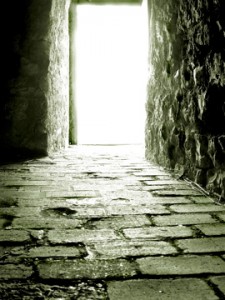 Through the doors they saw their guards sleeping soundly. It seemed so strange – no – illogical that they could slumber during a rescue mission in the jail they were meant to watch. The whole incident was feeling so mysterious and implausible; a dream with no reason. Yet this man kept leading them down the corridor towards a bright light; the final exit to freedom.