
At the beginning of this month I stood on the same stage in the Cathedral for two different events both framed as a platform for interfaith encounter: one I was hosting the first public ‘Re:Imagine’ events looking at faith conversations with Baroness Sayeeda Warsi and Bishop Toby Howarth, the other, I was compering the annual ‘Sacred Music’ event for Bradford Literature Festival. Both events were billed as moments of dialogue, creativity, and shared spiritual insight: civic faith at its best.
Both events were curated with care. Both featured thoughtful, experienced voices. And yet, as the applause faded and the doors closed behind the final guests of that weekend, I felt a distinct and unsettling ache but not from hostility or controversy, but of absence: the absence of risk, the absence of surprise, the absence of the kind of uncomfortable, necessary tension that makes real conversation not only possible but transformative. Both had a sense that we were speaking around each other, not with each other. For all the talk of openness, diversity, and dialogue, what I experienced was not encounter but choreography.
Despite the warm words and generous presence of our contributors, neither evening managed to break the deadlock of public discourse. Neither truly modelled the innovative approach to intercultural engagement I had hoped for; something deeper than polite pluralism or liberal tolerance, something bolder than a curated diversity of views. What do we do when faith conversations, however well-intentioned, merely reinforce the safest, most performative version of themselves?
If Re:Imagine is to live up to its name, if sacred music is to do more than soothe, then we need more than curated coexistence. We need a new grammar for faith conversation, and public debate in general, that is something less about making space, and more about inhabiting tension.
We must confront the following questions head-on: what needs to be unlearned in the way we currently gather across difference? And what might it take to birth something new; something not just novel, but necessary?
One of the things I’ve been reflecting on over the last few weeks is the inevitability of performance, especially when events take place on a stage. As soon as we put people in front of an audience, in a structured setting, particularly under the vaulted ceilings of a cathedral, we are not just enabling speech; we are framing it. Whether we realise it or not, we are inviting a performance.
This isn’t a criticism. It’s simply a sociological fact. In his seminal work The Presentation of Self in Everyday Life, Erving Goffman argued that social life is fundamentally theatrical. Each of us, he claimed, is always managing impressions; performing a version of ourselves that is shaped by context, audience, and expected norms. The ‘front stage’ is where roles are consciously curated; the ‘backstage’ is where we are less guarded, less polished, more uncertain. But Goffman’s point is that even our backstage is not fully free from performance; we are always somewhere on the spectrum of managing perception.
This framework helps explain why the platform changes things, even when the conversation is genuine. I tried to make Re:Imagine feel less like a panel discussion and more like an invitation to be present, unguarded, vulnerable. But the stage itself had its own logic. The lights, the audience, the publicity, all of it subtly nudged us into a mode of presentation. And once there, it was hard to improvise. When Baroness Warsi and Bishop Toby spoke, they were never really going to be able to simply share personal reflections. In hindsight, the temptation to enact identities was always going to be hard to resist. Warsi, a high-profile Muslim political figure, had to navigate all the projections, expectations, and contestations that come with that role. Bishop Toby, a Church of England bishop in a city like Bradford, was similarly constrained, not by lack of sincerity, but by the complexity of occupying an ecclesial role that is both spiritual and civic, pastoral and political. Both were, in a sense, ‘on stage’ before they even opened their mouths.
And yet I do not believe performance is always false. In fact, I’ve long thought that performance can be deeply true; perhaps even sacred but only when it moves beyond control into vulnerability. My background in theatre taught me that risk is the currency of authentic performance. It is not about getting it right but about stepping into the unknown with others. That kind of improvisational performance isn’t about projecting an image but revealing a self. For that to happen, the platform must allow for rupture and the inevitable mess to be held.
This is what I hoped Re:Imagine might enable. And while both our contributors gestured toward that vulnerability with grace and honesty, the structure around them hindered and blocked their improvisation. The conversation stayed within the boundaries of what the audience could already process. The performances were sincere. But they were still bounded.
What might it take to make a different kind of space?

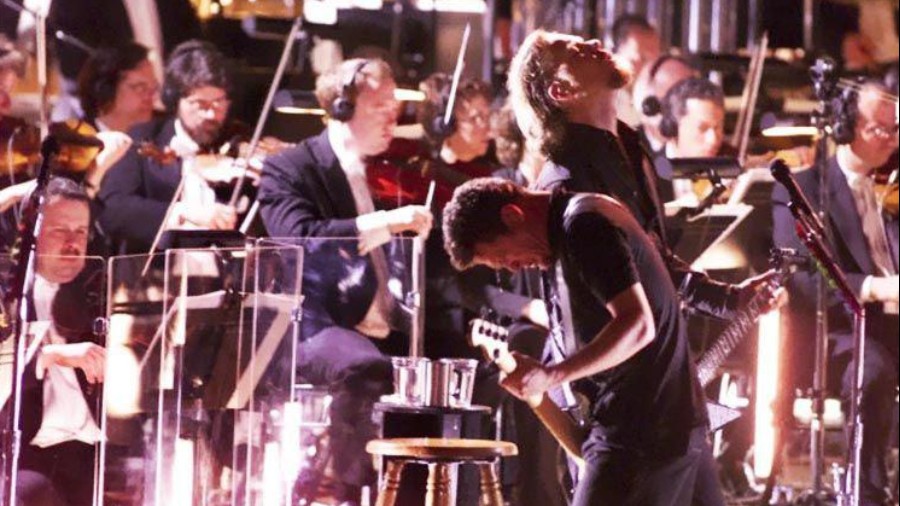
This question surfaced again the next evening. I had hoped to co-produce this year’s Sacred Music event with Bradford Literature Festival. I’d proposed a shift in format: rather than sequential performances by artists from different traditions, what if we invited musicians to improvise and collaborate to create something new in real time, across the boundaries of tradition? Faith in motion. Difference in dialogue.
The conversations were encouraging but, in the end, the final event returned to the familiar: artists from different faith backgrounds performing one after another in respectful sequence. Beautiful but ultimately predictable. We honoured coexistence, but did not risk co-creation.
And this is where I believe we are stuck.
In many public conversations about faith and other contested issues we find ourselves in one of two places. Either we veer toward conflict: oppositional voices debating from fixed positions. Or we avoid it altogether: showcasing diversity in a way that flattens its tension. The former breeds fatigue and defensiveness; the latter, polite stagnation. Both forms are governed by what I want to call curated coexistence. It’s the idea that if we simply gather different people in the same space, a deeper understanding will naturally emerge. But that’s not how real encounter works. Not in theology. Not in art. Not in life. Encounter requires not just proximity, but vulnerability. Not just expression, but interruption… and interruption is risky.
This is why I’ve been returning to my ongoing reflection on inclusive othering; a framework which seeks to hold deep difference not as a problem to be solved, but as a place to dwell. I have been drawn to the idea that genuine unity comes not through flattening difference, but by learning to desire the good of the other precisely as ‘other’, as different.
Inclusive othering is not about everyone feeling comfortable. In fact, it’s about learning to sit in that uncomfortable ‘no man’s land’ between views, identities, and traditions and allowing that space to shape us.
What, then, might this mean for the Re:Imagine series moving forward as a platform for reimagining all kinds of contentious and complex topics: global diplomacy, AI and ethics, environmental activism, migration?
Firstly, I believe we need to experiment with form. What if the structure of our events is not just a means of delivery, but a form of witness? Drawing from performance theory and social improvisation, I am increasingly convinced that our formats encode our assumptions. If our structure assumes performance, then transformation will remain secondary. If the structure of our encounter is built to invite surprise, co-dependence, and change, then our content may finally have room to breathe. This means, therefore, more than changing the seating arrangements. It means actively disrupting the expectation that ideas must be defended or performed. What would it look like to invite guests not to explain themselves, but to ask each other questions they have never dared ask? What if every event required a confession—of failure, of misunderstanding, of being surprised by the other? What if participants weren’t experts, but witnesses?
Secondly, I want to explore the role of embodied practices in public conversations; silence, lament, artistic improvisation, shared meals, symbolic gestures. These are not just aesthetic flourishes. They are facilitated interventions. They disarm the impulse to perform and invite a mode of engagement that speaks to the whole person—not just their views, but their lived and vulnerable selves.
Thirdly, we must reckon honestly with power and representation. One audience member felt, after the Re:Imagine event, discomfort that a powerful political figure, Sayeeda Warsi, was given an uncontested platform who could say things without a firm response. What I found most interesting about that expressed opinion was what it revealed about audience expectation: namely, that public spaces are understood as a kind of battleground. What if we reimagined and restructured it as a sanctuary for disarmed curiosity? What if our role as curators of public space is not to ensure balance, but to nurture trust in order to create containers where difference is neither erased nor exploited and tension is embraced as an uncomfortable but necessary catalyst to creativity. As Miroslav Volf suggests to embrace is to open one’s arms, wait, and then close them around the other; not to absorb, but to hold the other. Too often, our public events keep the arms open but never move toward that vulnerable embrace.
Finally, we must accept that not all fruitful conversations are public. I am still wrestling with whether these events should happen on stage at all. Yet I worry that if we retreat entirely into the private realm, we abandon the possibility of redeeming the public one. The challenge is this: how do we make public spaces more porous, more reflective of the quiet transformation we know happens in private? Risk, after all, needs aftercare. Surprise requires structure. Vulnerability must be held. To reimagine means not only saying new things, but saying them in new ways and allowing our forms to speak before our words ever do.
So what now?
I remain grateful to Baroness Warsi and Bishop Toby. They showed up. They offered themselves. They attempted to be vulnerable. My disappointment is not in them, but in the format that could not sustain the possibility of surprise. The same is true of the artists and the people at Bradford Literature Festival curating the Sacred Music event.
We do need new formats for public moments and encounters. We need creative risks. We need voices willing not just to speak, but to listen and then acknowledge the possibility of change. We need events where musicians and thinkers improvise across difference, where politicians weep, where migrants and fearful indigenous peoples meet each other, personally over a meal and share stories.
Because if faith, and public life, are to mean anything in this fractured age, they must do more than speak. They must listen. They must risk. They must dwell in the gaps.
That weekend in the cathedral did not go as I had hoped. But perhaps that’s the point. Hope is not about things going to plan. Hope is the refusal to give up on what could be, even when what was falls short.
It is time, once again, to reimagine.