Tag Archives: cathedrals

Into Culture: Borrowed Portfolios

For the past nine months, amongst other things, I have been holding the traditional Canon Precentor’s portfolio; overseeing the liturgical logistics and the quiet choreography that, together, go into creating the invisible landscape that leads people into worship. As I sat, therefore, in a gathering of Canon Precentors from all the Cathedrals in England and Wales, I felt entirely capable of following the conversation, I could track the discussion, I could contribute and I could even anticipate where some of the pressure points would surface.

It had been a privilege to be invited to join my colleagues and friends. The invitation, in my current situation, however, carried a certain ambiguity, however, because during the introductions the Chair referred to me, kindly and casually, as “our non-Precentor canon.” It landed with a double sensation: recognition and dislocation arriving at the same time. For a moment, if I am honest, it felt faintly like an insult, but I know it wasn’t intended as such. I realised later, reflecting on that repeated sensation throughout the day, that competence and belonging are not always the same thing. I can learn the patterns of a role, I can carry its weight for a season, I can even begin to speak the language with some fluency, but that doesn’t mean the same thing as vocation.

What I felt in that moment was not exclusion. It was something more subtle and, if I am honest, more theologically interesting. I was both inside the conversation and slightly adjacent to it. Trusted to contribute but named as other. Which, as it turns out, is not a bad place from which to begin thinking about a larger question that has been quietly gathering weight over the past year for me at Bradford Cathedral: what happens when your ministry becomes defined by the things you are temporarily holding together? Or, perhaps more precisely, how do you remember what you feel called to when the institution quite genuinely needs you to be several other things first?


To understand the question properly, you should know something more of the current context I’m inhabiting at Bradford Cathedral.

This has been, by any reasonable measure, a stretched season: the inevitable frustrations as organisational cultural and strategic change is further embedded, staffing transitions and, on top of that, UK City of Culture year. All of this is the ordinary, unspectacular fragility that institutions can carry more visibly in some years than in others. Aside for the City of Culture, all of these pressures and strains are not unique to us and many cathedrals will recognise the pattern with perhaps more intense financial challenges than we have.

In the space of change, roles begin to behave differently. Over recent months I have found myself covering various significant aspects of leadership in the Cathedral. In addition to inhabiting much of the operational and liturgical responsibility of the Canon Precentor, I have been supporting parts of the events management space, working closely alongside vergers and operations to keep the daily life of the cathedral moving with some degree of grace, and in the last month or so, covering aspects of the Dean’s portfolio.

None of this has felt inappropriate. Still less has it felt unwelcome. There is something deeply proper about stepping into the gaps that inevitably appear in any living institution. Cathedrals, perhaps more than most ecclesial bodies, run on a kind of invisible elasticity. People stretch. Roles flex. Goodwill does a remarkable amount of heavy lifting. If you have spent any time in cathedral life, you will know this instinctively. Job descriptions are worked from, not to and the reality is a web of relationships and responsive adjustments, but elasticity, if sustained indefinitely, begins to carry its own cost. The real danger, in times like this is vocational amnesia.

There comes a point (and it rarely announces itself loudly) when the necessary act of holding things together begins quietly to reshape how you are perceived, and eventually how you perceive yourself. What began as provisional cover starts to solidify into assumed identity.

I have become increasingly aware that the inherited model of residentiary canon roles presumes a level of boundary clarity that contemporary cathedral life does not always permit. The assumption is that it is possible to have distinct portfolios, relatively stable domains of responsibility and a certain institutional tidiness. I have found that it is much more porous than that and porous leadership is not, in itself, a problem. In fact, there is something ecclesiologically healthy about a clergy team that can flex, respond, and redistribute energy where it is most needed. The Body of Christ is always spoken of organically and not in mechanistic terms; it was never meant to operate as a set of sealed compartments.

But…

Porous must not become formless. Without some intentional attentiveness, flexibility can slide into diffusion and responsiveness can become reactive drift. Individuals who are temperamentally inclined to say “yes”  (and I include myself in that category) can wake up to discover that their ministry has slowly reorganised itself around institutional necessity rather than a vocational centre.
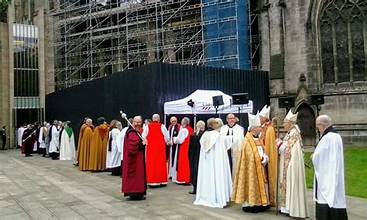
Augustine, who has become a regular companion in my own thinking, is helpfully perceptive at precisely this point. One of his most enduring contributions to Christian moral theology is the idea often summarised as the ordo amoris (the ordering of loves). He developed this idea most clearly in his De Doctrina Christiana and within his vast argument of The City of God. The idea is deceptively simple. The problem with human beings, he suggests, is not usually that we love bad things outright. It is that we love good things in the wrong order, with the wrong weight and/or with an urgency that quietly displaces what should properly come first.

For Augustine, wisdom is not primarily about intensity of devotion but about proportion. We are created to love God above all and to love our neighbour rightly. Created goods are to be received gratefully, but not allowed to occupy the centre of our attention. Disorder creeps in not only through obvious vice but through subtle misalignment of what we prioritise.

It is disarmingly searching when I apply it to what I have been doing over the past nine months. Supporting colleagues, sustaining worship, ensuring the cathedral’s daily life continues to function with integrity; there is nothing here that Augustine would want to rebuke. In fact, much of it is, in itself, unquestionably good and yet the Augustinian question presses gently but persistently: what happens when everything becomes equally urgent, every portfolio feels temporarily necessary and when the immediate institutional need begins to flatten the hierarchy of attention?

Borrowed responsibility, if we are not careful, can begin subtly to dis-order calling. Not dramatically, and not through any obvious failure of faithfulness, but through a slow recalibration of where energy, imagination and identity are most consistently invested.

There is another layer here which intersects with what I have elsewhere called inclusive othering. In that moment in the Precentors’ Conference, I was inhabiting a curious vocational liminality. I was fully engaged in the work but not fully located within the identity being named around the table. I was both participant and, gently, an outsider. The temptation at such moments is usually to resolve the tension too quickly. Either to insist on full belonging or to withdraw into defensive distance. Neither move feels particularly right to me.

Cathedral life, it seems to me, increasingly requires the capacity to remain present within such tensions. Many of us residentiary canons are operating in spaces that are neither entirely ours nor entirely alien. The institutional map no longer corresponds neatly to the portfolio shaped assumption of previous generations. Which is where, again, provisionality becomes not just descriptive but theological.

Bradford, at present, is living through a genuinely provisional season (I have begun to argue that we will always be doing so). Decisions are being made with partial information and structures are being held lightly enough to adapt. There is, if we are honest, a fair amount of holy improvisation taking place, which, for me, is great. Improvisation, however, still requires a key signature.

The Church, at it’s best, has always known how to live provisionally. The danger comes when the provisional quietly hardens into the assumed, or when the temporary becomes so extended that we forget it was ever meant to be temporary at all.
It would be easier, at this point, to resolve the tension neatly. To say either, “this is simply the season we are in; get on with it,” or, “this drift must be corrected immediately; redraw the lines.” The truth, as usual, is less obligingly tidy.

I am deeply grateful for the trust that has been extended to me over this past year. There has been real joy in some of the work. Real satisfaction in helping to steady parts of the cathedral’s life during a time of transition. I have learned things I would not otherwise have learned. Seen the institution from angles that have sharpened rather than diminished my affection for it. None of that is to be forgotten or remain unsaid. Yet, alongside the gratitude there is a slowly growing awareness, not quite resentment but of gravitational drift. There is a quiet sense that the centre of my ministerial energy has shifted, almost imperceptibly over time, and will continue to do so if it is not occasionally re-examined.

The truth is, I can do many things, but competence is not vocation.

I have found myself recently returning to an idea from Jostein Gaarder’s The Christmas Mystery. He suggests ‘there are two ways of becoming wise.’

One way is to travel out into the world and to see as much as possible of God’s creation. The other is to put down roots in one spot and to study everything that happens there in as much detail as you can. The trouble is that it’s impossible to do both at the same time.

Jostein Gaarder, The Christmas Mystery (London: Phoenix, 2004) p.55

I suspect part of what I have been feeling at Bradford is not simply the pressure of workload but the quiet pull between these two wisdoms. Over the past nine months my ministry has necessarily leaned toward the second mode: staying, tending, stabilising, noticing the fine grain of how the cathedral’s daily life actually holds together. There is real grace in that work but, if I am honest, much of the energy that has historically animated my priesthood lives closer to Gaarder’s first path. I am most alive when I’m learning something new, finding new connections between ideas, mining different disciplines of thought for ‘the theory of everything’. Which is another way of saying: I can inhabit the rooted work for a season. I am less convinced I am called to live there indefinitely.

What has been slowly surfacing for me over these months is not the discovery of a new vocation but the reappearance of a very old one. Every few months it seems to return, usually when institutional life has required me to settle more fully into maintenance mode than I instinctively inhabit. At first it comes as a mild restlessness, then as a question I cannot quite silence and eventually, if I am paying attention, as a recognition.

I have been here before.

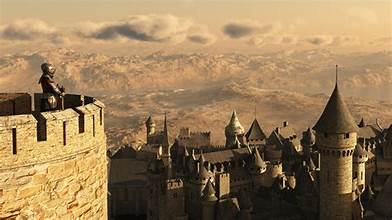
Over the years I have reached for different images to name that vocational nudge, each one catching part of the truth but never quite exhausting it. Sometimes it has felt like standing on the walls as a watchman, scanning the horizon not because danger is certain but because someone needs to pay attention to what is coming into view. This is the language of the prophet, not in any grand or dramatic sense, but in a quieter, more uncomfortable calling to notice what others might prefer to step around.

At other times the image is less dignified and more like a mountain goat picking its way across harsh and uncertain terrain while, somewhere below, the sheep graze contentedly in the lush fields. It is not that the fields are wrong, still less that the sheep are foolish. It’s only that I seem constitutionally drawn to the challenging environments where the air is thinner and the footing less secure.

Then there remains in my imagination something of the pioneer, repeatedly finding myself drawn toward spaces where something new is trying to emerge and where the path, if there is one, is not yet clearly marked. If that particular image risks sounding like a love affair with novelty, then that needs correcting. My instinct has never been toward the new simply because it is new. Nor am I interested in dismantling what is old in order to feel prophetic. The tension I experience is not between stability and adventure but between different forms of fidelity.

I find myself returning, again and again, to the words of Oscar Romero, who warned that unconditional attachment to what is old can hamper the Church’s progress and restrict its catholicity, while an unbounded spirit of novelty becomes an impudent exploration of what is uncertain and a betrayal of the Church’s rich inheritance. His conclusion was neither reactionary nor reckless: “think with the Church.”

That phrase has always mattered to me. To think with the Church is not to freeze it in time, nor drag it impatiently into whatever appears fashionable. It means to love it enough to help it renew itself from within. Which means that the watchman image is not about abandoning the city but guarding it. The mountain goat is not scorning the lush field below but navigating terrain the flock will one day need to cross. The pioneer, if that word is to be used at all, is not founding a rival settlement but clearing space so that the old settlement can breathe again.

This is why the tension in this season feels more complex than a simple pull towards adventure in opposition to staying put. My passion for the intellectual and strategic exploration has always been inseparable from a desire for institutional reformation and detailed correction.

It is not accidental that many of the Church’s reforming figures that I have been drawn to lived precisely at this intersection. Augustine did not set out to invent a new Christianity; he wrestled to recalibrate inherited faith in a moment of crisis. Martin Luther did not begin by founding a new ecclesial body; he began by calling the existing one to account. In different centuries and under very different pressures, both stood uncomfortably close to the centre while also refusing to ignore what they saw on the horizon. Reform is rarely born from detachment or abandonment but emerges from those who love the institution enough to risk standing at its fault lines.
If these reflections were simply about my personal internal bandwidth or external capacity it would not be worth a whole blog post. What I suspect may resonate beyond my own ministerial balance is the larger ecclesial as well as the nuanced vocational questions that sit underneath my current lived experience.

What if residentiary roles in cathedrals were shaped more explicitly around charism rather than merely function? What if cathedral chapters became more intentional about naming when elasticity is a short-term grace and when it is quietly becoming a long-term distortion?

None of this requires a retreat into rigid role protection. That would be neither realistic nor particularly faithful to the collaborative instincts of cathedral life at its best. It might, however, require a more deliberate attentiveness to the difference between the roles we can faithfully cover and the vocations we are actually called to inhabit over time.

The question before me, at least, is not whether I am called to the edge or to the centre, but how to inhabit the edge in order to serve the centre faithfully.

Bradford, for all its current pressures, has often shown a willingness to experiment in this kind of space. There is room here, I think, for some careful, hopeful reimagining of what residentiary life might look like in a more fluid ecclesial landscape. Perhaps something more consciously aligned with the particular gifts that each canon brings into the shared life of the cathedral.

I find myself returning, as I close, to that conference room moment and the phrase that has lingered longer than I expected: “our non-Precentor canon.” There was no need to resist the description; in a straightforward sense, it was true, but the more interesting question is not whether I am or am not a Precentor. It is whether, in this stretched and searching moment, we might learn again how to recognise the difference between the responsibilities we faithfully hold for a time and the vocations we are actually being called to remember.

Some priesthoods are shaped primarily in the centre of the field. Mine, it seems, keeps being led back to the edges of the hill not to abandon the flock, but to help the whole landscape breathe again.

Into Culture: The Loom

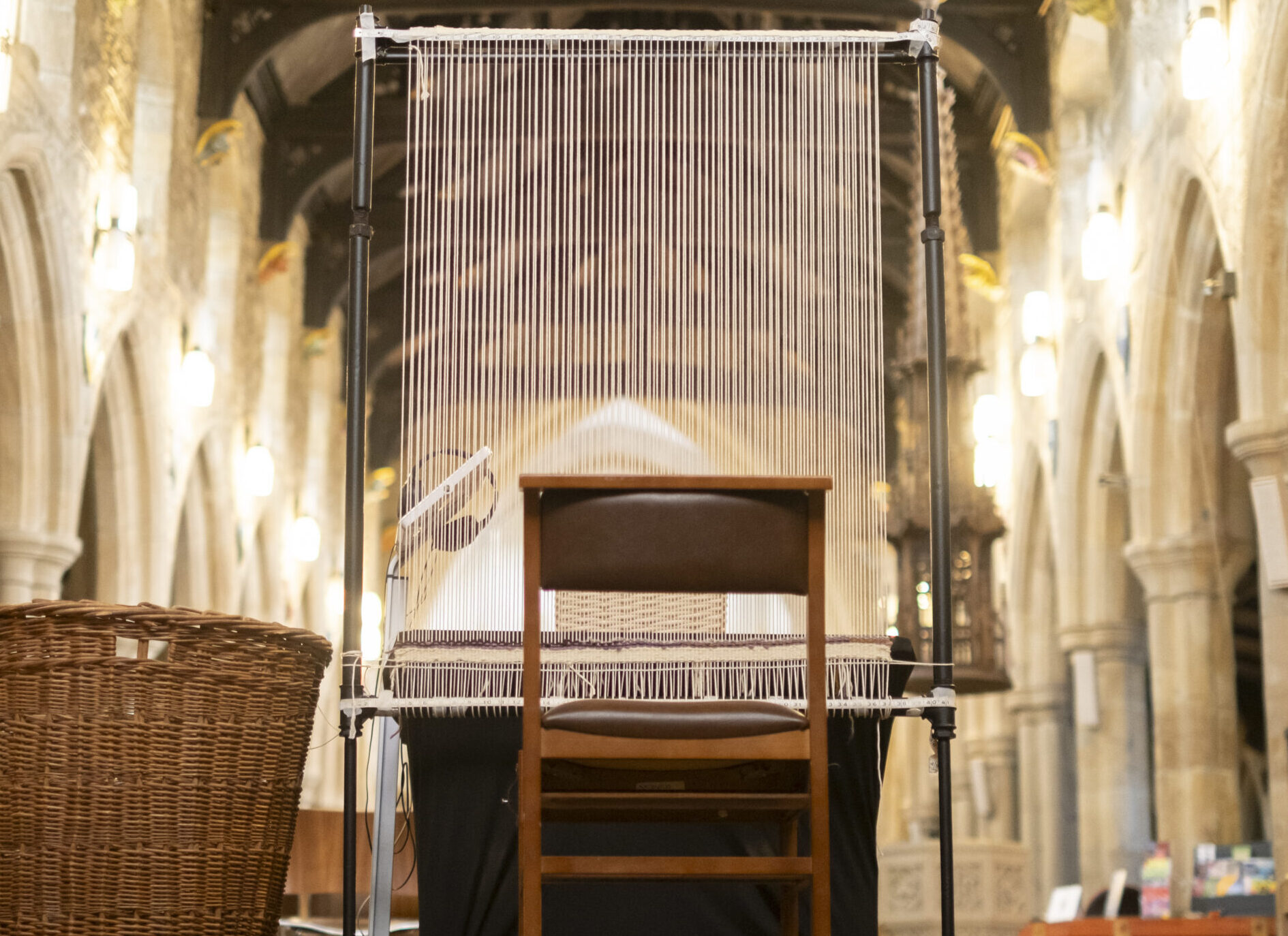
For the past four months, a loom has stood at the west end of Bradford Cathedral as part of a National Lottery Heritage Fund project we are running. We have invited members of the public to choose a thread of wool and weave it into a growing community tapestry. Children and elders, visitors and locals, those who come by chance and those who come with the single intent to weave; all have added their own strands.

It is strikingly simple, even meditative. The warp holds steady, the weft brings colour and movement, and each addition strengthens the whole. And yet, not everything has gone smoothly. Some people have misunderstood the instructions. Others have pulled too hard or left their threads loose. Quietly, those of us guiding the project have had to adjust, repair, and improvise to make sure the final piece still holds together. But none of that undoes the gift of participation. The tapestry only exists because so many hands risked adding their own imperfect thread.

And perhaps that is fitting, because Bradford itself is, in its very identity, a woven city. Its history is textile. Its present is intercultural. Its future is being worked out in the tension between tradition and innovation, roots and improvisation, scars and creativity. In recent weeks, as I have been part of conversations across the city, in civic forums, in the Cathedral, in cultural planning meetings, I have heard the same challenge surface again and again: how do we hold the threads together? I’ve found myself asking myself could this social weaving be the distinctive vocation of Cathedrals in the 21st century?


When I think back over the conversations I have been part of this month, I hear echoes of the loom in each of them. Different threads, different textures, yet all of them asking in their own way how we might weave this city’s life into something more than fragments.

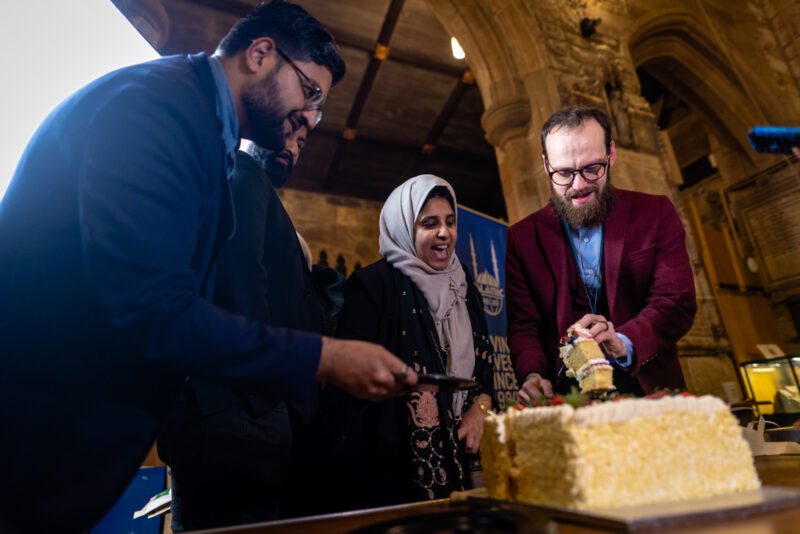
With civic partners, the longing has been for more meaningful conversation than our public life currently allows. Too often dialogue becomes either polarised or polite, either combative or choreographed. But hospitality, one of our Cathedral values, is not about curating polite coexistence. It is about creating the conditions where people feel able to risk honesty, to sit with tension, and to trust that they will be held (you can read my reflections on this by reading last month’s post, ‘Into Cultire: Platform to Presence’) This, I believe, is part of what a Cathedral can uniquely offer: a hospitable loom, where threads that might otherwise fray or remain apart are drawn into a fabric that is stronger than the sum of its parts.

Within the Cathedral itself, my colleagues and I have been asking how our own vision document can be more than a paper statement. That too is a question of the warp and the weft. Rootedness, another of our values, reminds us that this community stands in more than a millennium of Christian witness and daily prayer. These are the warp threads, stretched tight across time, holding the structure. But without the weft, the innovative, intercultural, hospitable life that crosses them, the warp alone cannot make a fabric. To make our vision live we must keep weaving: to take the ancient story seriously enough to risk letting it meet the colours and textures of the present.

A third thread has come from our work on a Visitor Engagement Plan. We have been supported by consultants whose experience with other cathedrals is invaluable, yet the process has sharpened something for me: Bradford is not just any cathedral city. To describe it simply as intercultural misses what makes it distinctive. Bradford’s culture is forged in mills and markets, in migration and labour, in scars and solidarities. This is not a polished pluralism but a lived reality, raw and hopeful, shaped by both welcome and struggle. Any plan for engaging visitors here must reflect that uniqueness, not a generic template, but an experience that helps people encounter the texture of Bradford itself. That is what our value of interculturality really asks of us: not just to reflect diversity, but to interpret and host the distinctive, sometimes difficult, gift that this city carries.

And then there are the conversations about Bradford’s cultural future after 2025. When the spotlight of UK City of Culture fades, what will remain? Here the Cathedral’s value of innovation comes to the fore. Innovation is not about novelty for its own sake, but about courage: the willingness to improvise, to create new forms of beauty and dialogue that might not yet exist. Bradford has always produced outsider voices with global resonance, artists, writers, and leaders who have turned the tensions of this city into creativity. If we as a Cathedral can nurture that spirit, not showcasing diversity as finished performance but weaving it into new, surprising patterns, then perhaps we can help ensure that 2025 is not an endpoint but a beginning.

All these conversations, with civic partners, Cathedral colleagues, consultants, and cultural planners, are different threads. None of them by themselves make a fabric. But if the loom at the west end of the Cathedral has taught me anything, it is this: fabric only emerges when the threads are held in tension and patiently worked together, line by line.

On our loom there is no shuttle racing back and forth. The weaving happens slowly, by hand. That is significant; the tapestry only grows because people come, take hold of the yarn, and risk adding their part. Convening works the same way. A Cathedral cannot force unity or engineer neat patterns; what it can do is hold the frame steady, invite people forward, and create the conditions in which something larger than any one thread might take shape.

So what does this mean for the Cathedral’s future in Bradford? It means taking our vocation as loom seriously. It means curating conversations that do not stop at coexistence but risk honesty, vulnerability, and the possibility of change. It means rooting our life ever more deeply in prayer and worship so that the warp is strong enough to bear the tension. It means designing visitor experiences that reflect Bradford’s unique fabric, its scars as well as its solidarities, its particular story rather than a generic template. And it means using City of Culture 2025 as a beginning, not an endpoint, modelling intercultural creativity that continues long after the spotlight has moved on.

None of this will be straightforward. The tapestry will never be perfectly even; threads will be pulled too tightly or too loosely, and sometimes adjustments will be needed in the quiet. But perhaps that is the point. The work of weaving is never finished.

When the community tapestry on our physical loom is complete, it will hang as a piece of art. But its deeper value will not be the finished product; it will be the months of weaving, people meeting, hands moving, threads layered, mistakes amended, a fabric slowly emerging that no one could have made alone.

Too often our cathedrals are imagined in only two ways: either as monuments of the past, treasured for their heritage but disconnected from the present, or as venues for the present, hired out for franchised concerts and touring installations in order to keep the lights on. These roles may be necessary for survival, but they are not enough for vocation. If all we offer are relics or rentals, then we have missed the point.

What Bradford is beginning to show is that a Cathedral can be something else: not a museum, not a venue, but a loom. A place that holds tensions steady, invites difference into encounter, and patiently weaves new patterns of civic life. This is what our cities are crying out for; this is what our fractured societies desperately need.

The future of cathedrals will not be decided by balance sheets or by ticket sales, but by whether we dare to claim this vocation. We can continue as monuments and venues, but these will not last as long if we don’t primarily become looms for the future, weaving communities together, risk by risk, until something strong enough to hold begins to emerge.

Into Culture: Tale of Two Cities

In my reading at the moment, I am currently inhabiting two vastly different worlds: one, the dark, Gothic corridors of ‘The Hunchback of Notre Dame’ by Victor Hugo, and the other, the contemplative and theological depths of ‘The City of God’ by St Augustine of Hippo. At first glance, these two texts seem to come from different places; one a romantic novel from 19th-century France, the other a theological treatise from 5th-century Rome. Yet, as I delve into the opening chapters of both works, I am struck by a common thread: the place of the arts in society and how they are used by seemingly competing visions of our world.

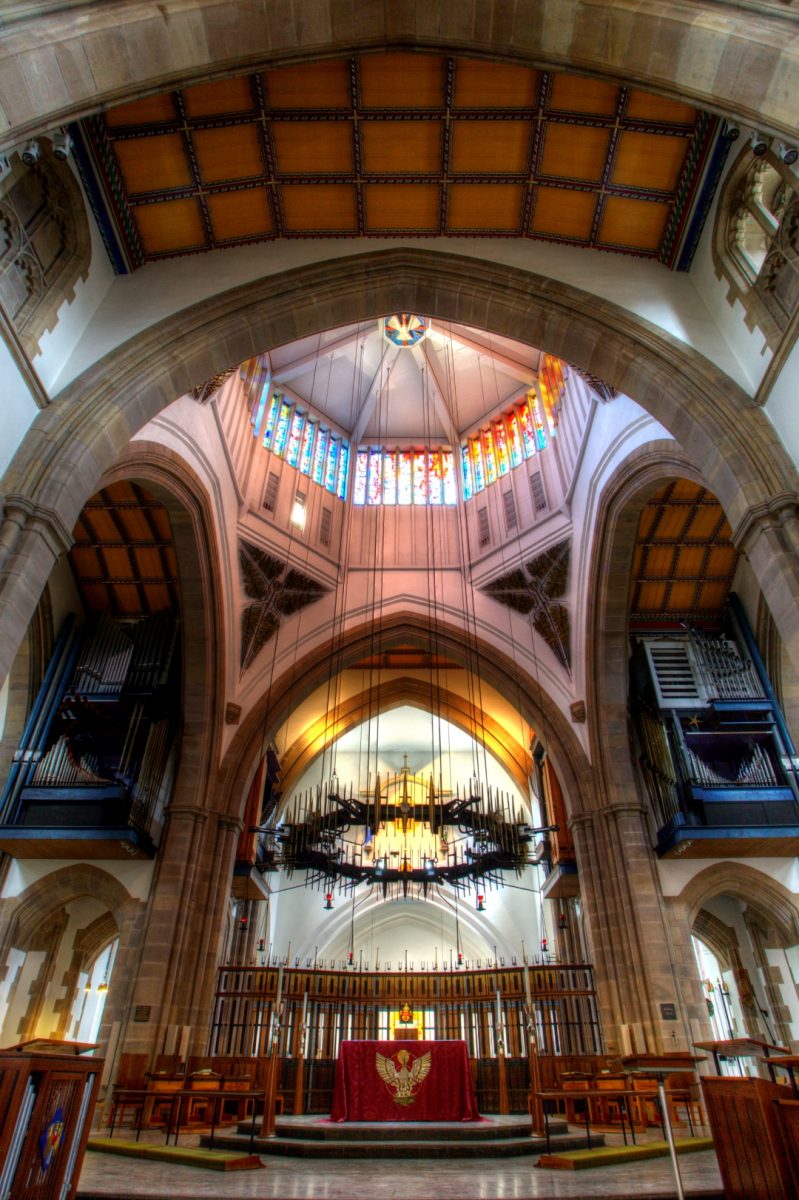
I have also been thinking again this month about the architectural design of Bradford Cathedral and how, I have been told, Edward Maufe, the architect who designed our East end, wanted to articulate a coming together of the mundane and the sacred. The West end was to be experienced and understood as a convening space for the whole of Bradford society. The East end would be the focus of sacred worship. Whether that is true or not I don’t know but there is a strong architectural difference between these two spaces in our Cathedral. 

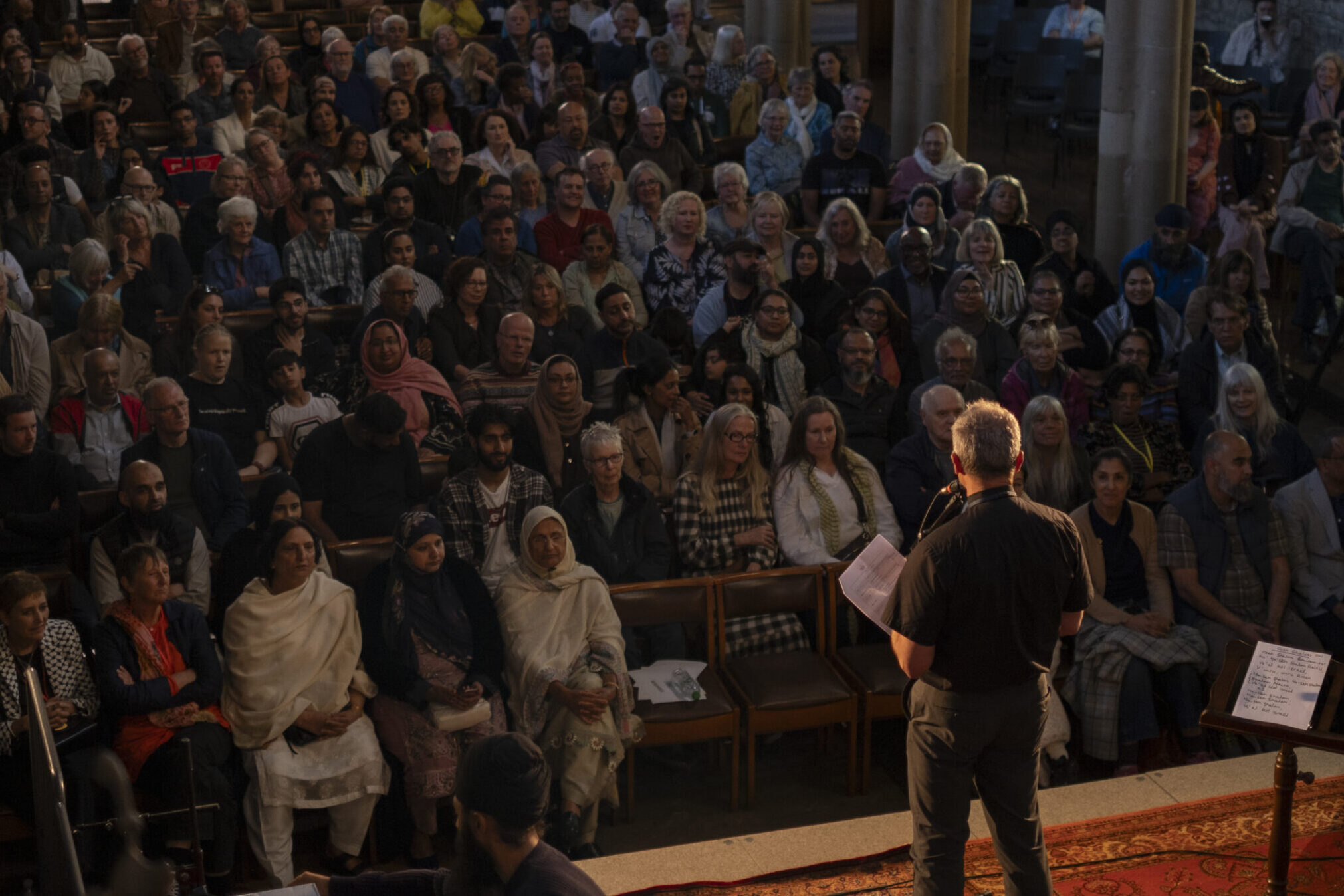
The interplay between these two spaces is characterised by St Augustine as two cohabitating ‘cities’; the City of God symbolising the divine, eternal order and the City of the World symbolising human civilisation with all its flaws. I want to examine briefly the more nuanced interaction between these two ‘cities’ to see if there is something fruitful to be found for us at Bradford Cathedral to offer our city as we head into 2025, where Bradford will be UK City of Culture, as well as other Cathedrals as they wrestle with the stewardship of their own sacred/secular space.


Hugo begins his story, not with the titular hunchback, Quasimodo, but with a scene set in Paris’s grand cathedral, Notre Dame (arguably a major character in the book) during the Festival of Fools. In these opening pages, we are introduced to the clash between the religious order represented by the cathedral and the chaotic, almost carnivalesque atmosphere of the festival outside. Here, art is both sacred and profane, elevated and debased, reflecting the dual nature of humanity itself. 

Similarly, Augustine, in the opening books of ‘The City of God’, discusses the dichotomy of the two cities: the City of God and the City of the World. For Augustine, the City of the World is marked by its temporal, fleeting nature and its inclination towards sin and self-glorification. Yet, even within this human city, Augustine acknowledges the presence of art, culture, and human achievements, which, though marred by sin, still bear the potential to reflect divine truth. In the early chapters, he argues that the polytheistic worship and rituals of the Graeco-Roman world which heavily influenced and controlled the public performances and artistic artefacts is more to be blamed for the fall of that civilisation than the acceptance of Christianity into their cultural milieu.

Bradford Cathedral aspires to be a beacon of spiritual and artistic expression amidst the bustling life of our city. Its walls, filled with history, uniquely tell the story of the whole community and its faiths. Just as Hugo uses Notre Dame to symbolise the connection between the sacred and the secular, Bradford Cathedral serves as a constant reminder of the spiritual heritage and the rich cultural tapestry that defines the city of Bradford. It is a space where the divine meets the everyday, and where art, I aim to show, can serve as a bridge between the two. 

In reflecting on these two great works, it becomes clear that the arts have always occupied this central place in human society. They are a means through which we explore our relationship with the world around us, with each other, and with the divine. Whether in the grand architecture of a cathedral, the lively performance of a play, or the quiet contemplation of a painting, the arts offer us a glimpse into the deeper truths of existence.

Hugo and Augustine remind us that the arts are both a gift and a responsibility. They have the power to inspire and uplift, but also to distract and lead astray. As we engage with the arts, whether as creators or as audience members, we must do so with a sense of discernment and purpose. We must strive to see beyond the surface, to seek the truth that lies beneath, and to recognise the metaphysical fingerprints, whether good or bad, in the works of human hands.

In a world that often seems consumed by the immediate and the material, the arts call us to remember the eternal, to lift our eyes towards the heavens even as we walk the streets of our earthly city. They remind us that we are more than the sum of our parts, that we are creatures of both body and soul, and that in every brushstroke, every note, and every word, there is the potential to glimpse the divine.

The opening chapters of ‘The Hunchback of Notre Dame’ introduce us to Pierre Gringoire, a struggling playwright whose dramatic piece is set to be performed during the Festival of Fools. Gringoire embodies the romantic ideal of the artist: impoverished, passionate, and slightly out of touch with the mundane concerns of everyday life. His work, a Mystery play titled ‘The Good Judgment of Madame the Virgin Mary’, is meant to be a serious, thoughtful exploration of divine justice. Yet, it quickly becomes evident that Gringoire’s high-minded artistic vision is out of sync with the boisterous, irreverent mood of the crowd.

The Flemish visitor, Jacques Coppenole, crystallises this disconnect when he dismisses Gringoire’s Mystery as a waste of time, preferring the spontaneous entertainment of the festival over the playwright’s carefully crafted narrative. Coppenole’s comment is not just a critique of Gringoire’s play but a broader statement on the role of art in society. To Coppenole, the art that matters is the art that entertains, that is immediate and accessible. Gringoire’s highbrow ambitions are lost on a crowd that craves spectacle, not contemplation.

Hugo uses Gringoire’s predicament to illustrate the fragile place of the artist in society. Gringoire’s struggle to have his work appreciated reflects a larger struggle between different conceptions of art: art as a serious, almost sacred endeavour, and art as entertainment, something that should delight and distract. Hugo’s portrayal of Gringoire is sympathetic but tinged with irony; the artist is seen as a tragic figure, striving for an ideal that the world, in its indifference or ignorance, fails to recognise.

Augustine, too, is concerned with the role of art, but his focus is on the potential of art to lead people away from God. He acknowledges the beauty of the arts but warns against their capacity to distract and mislead. For Augustine, the highest purpose of art is to direct the soul towards the divine, not to entertain or merely please the senses. In this light, Gringoire’s predicament can be seen as emblematic of a deeper tension: the artist’s desire to convey truth and meaning versus the public’s desire for amusement.

I find myself caught in this tension. I, obviously, tend towards the Gringoire/Augustinian direction but we at Bradford Cathedral must constantly navigate the balance between art as sacred and art as entertainment. I return, again and again, to my reflections on the Empty Space and how we might make meaningful and prophetic contributions to the cultural narrative of our city whilst having to ensure such endeavours provide us with, understandably necessary, financial return. Like Gringoire, I must remember that there is no measurable point in expending time and money in creating a statement if no one is going to hear it or it leads to the closure of the means to share it.

Gringoire’s failure to connect with his audience is not just a personal failure but a reflection of society’s failure to appreciate the deeper value of art. The public’s preference for the rowdy, unrestrained entertainment of the Festival of Fools over Gringoire’s thoughtful play mirrors the City of the World’s inclination towards the immediate and the material. It is a reminder of how easily society can overlook the things of true, lasting value in favour of the fleeting pleasures of the moment.

Both Hugo and Augustine recognise the profound impact that artists have on society. For Hugo, the artist is a visionary, someone who can see beyond the mundane realities of daily life and capture the essence of what it means to be human. The artist is both a creator and a communicator, someone who bridges the gap between the sacred and the secular, the eternal and the temporal. Through their work, artists invite us to see the world anew, to recognise the beauty in the ordinary and the extraordinary in the everyday.

Augustine, while perhaps more circumspect, also acknowledges the power of the artist. He understands that artists have the ability to shape the minds and hearts of their audience, to lead them towards truth or away from it. Augustine calls for artists to use their gifts wisely, to create works that not only delight the senses but also elevate the soul. For Augustine, the ultimate purpose of art is not self-expression or entertainment, but the glorification of God.

In the end, both Hugo and Augustine challenge us to consider not just the place of the arts in society, but the place of society in the grand, divine tapestry of creation. Gringoire’s plight is a poignant reminder of the fragile position of the artist, caught between the demands of the world and the pursuit of a higher ideal. His failure is not just his own but a reflection of a society that has lost its way, that has forgotten the true purpose of art. Yet, even in this failure, there is hope. For as long as there are artists like Gringoire, striving to build, create, and imagine, we can participate in the ongoing story of the world, a story that began long before us and will continue long after we are gone. In this, the arts are not just a reflection of society—they are a bridge between heaven and earth, a testament to the enduring and transcendent nature of the human spirit…

… how can we translate that value to also be financial? Answers on a postcard and sent to Bradford Cathedral, please!

Into Culture: Post-Industrial Cathedrals

When I started as Interim Canon Missioner last year (before being invited to take on the full time role as Canon for Intercultural Mission and the Arts in January), I joined Rev. Canon Philip Hobday who had only recently been appointed as Canon Missioner at Wakefield Cathedral. I invited myself to go and have a look round Wakefield as one of our sister cathedrals in the Diocese of Leeds and to get to know him and see how we might work together. He had already been in contact with our counterpart in Ripon, Rev. Canon Matthew Pollard who started as Canon Chancellor at the same time, in the hope that we might support one another.

I greatly appreciated my time with Philip and our visit raised lots of questions around models of cathedral ministry, particularly, in our case, being one of three cathedrals in a diocese (unique in the Church of England) and also being in post-industrial towns/cities. My reflection, after my visit, was that I went too soon. Philip and I hadn’t gained enough experience or insights in our contexts. Our conversation was, therefore, much more about sharing aspirations. That was still beneficial but I now want to visit again and have deeper and more detailed conversations with him and, indeed, Matthew in Ripon; different as that context is to Bradford.

If three new Canon Generals (the common name for residentiary canons who are not precentors) starting in post at the same time was not interesting enough, in December, Rev. Canon James Lawrence began as Canon Missioner in Blackburn Cathedral. James and I have a very tenuous link through a mutual friend but I was very excited to hear that he was beginning in cathedral ministry with me. He was quickly adopted into the small, informal Canon Generals network. The group also extends to Rev. Canon Maggie McLean, Canon Missioner at York Minster who has been in post longer than us all and brings a wealth of experience.

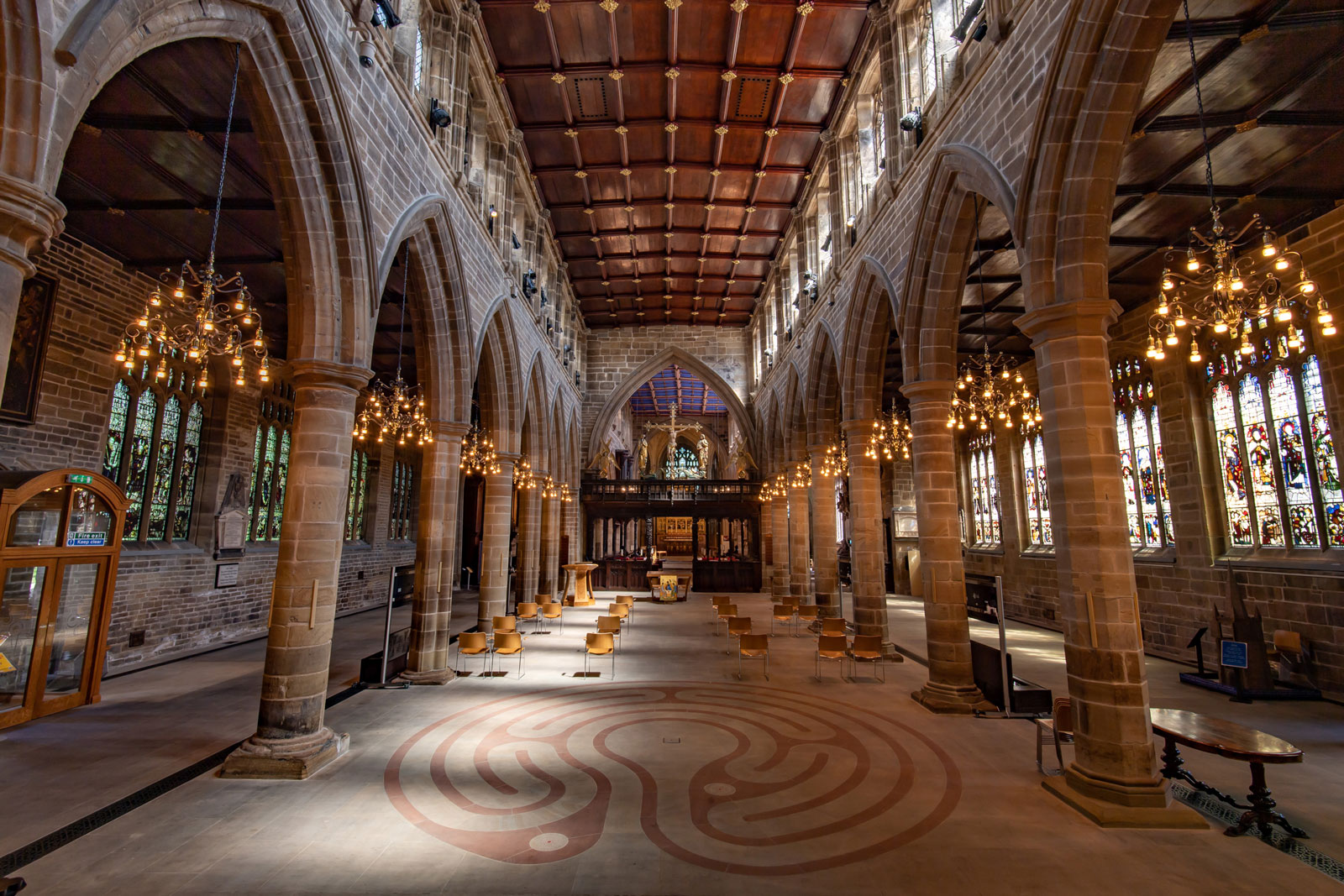
Wakefield Cathedral

As I had reflected that my visit with Philip in Wakefield was too soon I gave James six months to settle in before asking if I could visit him in Blackburn. I was keen to visit Blackburn because, like Wakefield, it has a very similar history, foundation and population demographic to Bradford. Blackburn became a diocese in 1926 only seven years after Bradford. The cathedral was created from a large, central parish church and over the next decades (during the great financial challenges between the two world wars) expanded and redesigned the building. The design, therefore, in both, is 1950/60s in style. Around this time the British wool trade, which was a large industry in both Blackburn and Bradford, began to shrink as cheaper products were imported from elsewhere. Bradford Diocese was dissolved in 2014 and, in this way Blackburn and Bradford differ in status slightly. But there are great similarities still, in multi-faith dynamics and demographics as well as in economic indices. For all these reasons it was going to be useful to go and see how the team at Blackburn Cathedral were responding or reflecting on their own future.

I knew James and I had similar methodologies of reflection and research and was delighted when he not only agreed to welcome me but then produced a thorough tour with meetings with key members of staff. In advance he contacted his staff team and clearly outlined the purpose of my visit: to be an opportunity for mutual learning and reflection on our models of ministry and mission. I was not disappointed with my visit. Here are my two main takeaways.


Cathedrals, like Blackburn and Bradford, who are situated in small but ethnically and religiously diverse towns/cities must quickly acknowledge that faith is a cultural object. What I mean by that is, quite simply, for the global majority, faith is not relegated into the private realm and plays a significant role in public identity. This is because, as I was reflecting with James in Blackburn, other nationalities, ethnicities and cultures that we encounter day to day have a deep recognition and appreciation for how faith shapes and/or has shaped their native/historic cultures. Faith for most other peoples is still able to be proudly owned culturally. The secular West is an outlier in this respect and so, for those of us working amongst global majority heritage communities, we are faced with the challenge of what it means to be a confident Christian community in Britain today. The historic and classical liberal approach to Christian mission and civic engagement is no longer working when faced with people whose faith is central to their public identity and whose differing culture is also lauded by our secular society in Britain.

The cultural value in diversity and celebrating difference has a strange shape to it in its current form, in my mind. I continue to reflect on the selective way in which our current society goes out of its way to highlight and amplify different, often conflicting, faiths and cultural heritages. Mainly white, middle-class people who feel divorced or estranged from their own religio-cultural history seem to spend so much time promoting the faith and cultural heritage of others and express appreciation for their beauty and power. They stop short, however, of adopting it for themselves. Why is that? Is it a kind of faith tourism which demands nothing of them but where they feel virtuous for embracing it publicly. The same embracing does not happen with the public expressions of Christian faith and heritage. This is where cathedrals find themselves challenged. Gone are the days, or they are going as we speak, when we are cultural centres producing socially valued cultural expressions. For this reason we are driven to remain relevant by importing other cultural events (even if they are jarring) in order to attract people into our costly historic buildings. 21st century Britain does not flock to the Church as a connection to our shared past because modern Britain seems to want to cut itself off from its past.

Sure there are some painful and difficult things in our collective past but if we are not willing to be reconciled to it then we will continue to float adrift from any potential cultural narrative that could unite us. Without an historic story our identities will have no roots and will not survive the storms of our current age. It is this very problem that the smaller, more industrially shaped cathedrals must lead on if all cathedrals and, indeed, Christian communities are going to be renewed.

Blackburn Cathedral

Leading on from this, I was greatly encouraged that in both Philip in Wakefield and James in Blackburn I found young (ish) academics who are keen to think theologically about these very practical issues facing our cathedrals. Both of these partners were not embarrassed about asking challenging questions of the status quo of cathedral ministry. It has been even more encouraging because I have long felt called to cathedral ministry but have never seen someone like me doing it.

There is a type… If you know, you know.

I’m not dismissing them nor criticising these fellow cathedral ministers but there is a certain person who fits ‘cathedral ministry’ and if we don’t at the start, we somehow get shaped into it. I am not looking forward to my seemingly inevitable transformation! I don’t know if it is the highly public nature of the role that pushes us towards a more performative persona or the privileged positions associated with our work that give us an inflated sense of our own abilities. Somehow, at some point we fall for the temptations and traps of cathedral life which means we fixate on processional orders, protocols, historic traditions, etc. and our egos expand within the shrinking ecosystem that is our particular cathedral.

I feel it within myself already. It begins subtly with the sheer scale of financial pressures and, alongside that, cultural expectations. I have started explaining to my peers who are in parish ministry that being in a cathedral is like the parish but more so: all the challenges are scaled up but, thankfully, all the benefits and opportunities are too. The problem comes when you succumb to repeatedly dropping your guard and allowing things to happen without consideration or reflection. I get why! We don’t have the time or the energy but step by step, precedents are set and accidents become habits become practice become strategy.

It is in this time and resource poverty that the cultural pressures from other organisations and individuals with their own political and personal agendas just wear us down and we take the easy road of least resistance. Risks are not worth it. Optics are! And, again, I get it! This is what I was touched by meeting with James and speaking candidly with him about our hopes for our own futures but also the future potential of cathedral ministry, if only it could be re-framed: there is a new breed of ministers who are joining the ranks of the AEC. I am glad that I have someone who is young enough and still idealistic enough to keep me from slipping into the full pastiche of a cathedral dean of the 1970s!

Our country and society does not need cathedrals to ‘absolve an entire people, unquestioned and unconditionally’ (Dietrich Bonheoffer, Discipleship (Minneapolis: Fortress Press, 2003) p.53), nor to open our doors and meekly ask “if we could but beg a few moments of your time to ask that you might consider giving a few pence to our collection.” In the post-industrial areas like Blackburn and Bradford where families are struggling not with philosophical issues of identity but with practical things of unemployment and poverty, where popular culture is increasingly passing them by and has no relevance to them, it matters who the Church is seen to be blessing, partnering and dialoguing with and the language they are adopting. It is in this confusing and traumatic time that the Church needs to be robust in our proclamation and coherent in our offer of an alternative solution to the problems of our time. Seeking to agree with the often incoherent and conflicting cultural narratives in the public square will not bring Jesus Christ and his Kingdom into the places we are called to evangelise.

Bradford Cathedral

Interfaith work, as with intercultural work, is not about keeping silent or denying the very real and significant distinctions between our very different worldviews. If we pretend that we are all the same we undermine all of our beliefs and we are all poorer for that. Instead it is about being rooted in our heritage and being able to see it with all its strength and with its challenges. It’s about being clear as to what it is that is unique about your own faith and the faith of our friends and neighbours. It is about being hospitable in seeking our own healing, humbly accepting where we need to repent, and seeking the healing of those who we differ from.

I am grateful that I have colleagues who are ready to wrestle with the very keys of discipleship as a catalyst for mission in the very public life of cathedral ministry. I only pray that I will remain sharp and passionate about it myself.