Tag Archives: autism

Into Culture: A Self Apart

I was on retreat: a gathered community of leaders with disabilities and neurodivergence, drawn together to reflect, to rest, and to listen. During one of the sessions, ‘Leading From Who You Are’ the facilitator posed a deceptively simple question:

Who are you, apart from your team, your organisation, your context?

It was meant to help us excavate our identity, to reach below our roles and responsibilities to the self beneath. But I couldn’t answer it. In fact, I couldn’t even understand what was being asked.

What does it mean to imagine the self apart from the people, patterns, and places that shape it? I didn’t just struggle for an answer. I struggled to comprehend the very premise of the question. The rest of the room began to engage in conversation and I listened in to attempt to discern what I was missing. Others were talking about self; their understanding of who they felt they were but none were acknowledging how that self has come into being. It was as if they believed they ‘sprang from the mind of God’ (Peer Gynt, Act 5 Scene 3), fully formed. That’s a common assumption about the self, but I don’t think it’s true.

I was baffled, in part, because when I usually experience a dissonance between my own understanding and that of those around me, I instinctively blame my neurodiversity/autism. In this context, however, I felt restricted in doing that. For a fleeting moment, I feared there was something wrong with me beyond what I could safely attribute to autism.

I’ve come to see that what unsettled me on that retreat wasn’t a lack of self-awareness but a different way of being a self altogether.


At first, it might seem contradictory to say that autistic people experience selfhood as fundamentally relational. The stereotype is that autistic people struggle with social connection and interpersonal understanding. Surely, then, autistic people would feel themselves as more isolated, not less. This assumption collapses, however, when we explore how autistic relationality actually works. Autistic people often experience difficulty with certain social performances: small talk, fluid group dynamics, decoding unspoken social rules. This does not mean we are less relational; it just means we connect differently.

Autistic researcher Damian Milton challenges the typical narrative with his theory of the ‘double empathy problem’, which proposes that autistic social difficulties arise not from inherent deficits but from ‘mutual misattunement’ between autistic and neurotypical people. I am not less social; I simply socialise differently. Neurotypical society tends to privilege social ambiguity, implicit communication, and high-context interactions and these modes are exhausting or bewildering to us autistics. This doesn’t mean that we are not interested in relationships but we tend to find fulfilment in these connections through shared activities, clear structures, predictable rituals, and deep focused interests. We flourish in communal spaces that are stable, ordered, and trustworthy; places where the unspoken social rules are replaced by liturgies, patterns, and shared rhythms.

Beyond this, many autistic people experience a form of ‘ecological selfhood’ which is a sense of self that is intrinsically tied to our environment, sensory world, routines, and the people and objects that anchor us. The boundaries between self and context, therefore, are often blurred.

Naoki Higashida captures this in his remarkable book:

It’s as if my body belongs to someone else and I have zero control over it… I can’t just think about things in isolation—my thoughts are all linked to other things.

Naoki Higashida, The Reason I Jump: The Inner Voice of a Thirteen-Year-Old Boy with Autism, trans. KA Yoshida and David Mitchell (New York: Random House, 2013), 36.

I don’t perceive myself as something separable from my context. I experience selfhood as something that emerges within forms of social, as well as ecclesial liturgies, shared spaces, and communal belonging. When people ask me to strip that away to find some ‘pure self’ underneath I get lost, not because I am avoiding myself but because I have never known myself apart from the places and people around me.

Grant Macaskill, in his theological reflection on autism, puts it bluntly:

Autistic people often embody modes of relationality that resist the individualism of Western culture. Their difficulties are less about absence of sociality and more about divergence from normative expectations of social behaviour.

Grant Macaskill, Autism and the Church: Bible, Theology, and Community (Waco, TX: Baylor University Press, 2019), 73.

What I struggled with on that retreat was not self-awareness. I was struggling with the premise that my truest self could somehow be detached from my community. That model of selfhood just doesn’t fit, but more than that, I am beginning to wonder whether it doesn’t fit anyone.

Perhaps autistic relationality doesn’t simply offer an alternative way of connecting but offers the Church a prophetic reorientation. If the dominant leadership cultures centres on the autonomous, performative self, maybe it is those cultures, not autistic people, that are out of step with the Body of Christ. Perhaps autistic ways of being illuminate what our theology has always said but our practice has too often forgotten: that the self is made in relation, that difference is not a problem to be managed, but the very ground where communion takes root.

What if autistic relationality is not a deficit to be overcome but a gift to be received: a sign that we lead most faithfully not by extracting ourselves from others, but by remaining deeply, dependently, unmistakably embedded in the life of the community?

Richard Giblett, Mycelium Rhizome, 2006-2009

Our culture tells us that identity is something we must cultivate independently. The self is seen as a solitary project: find yourself, be yourself, lead from your authentic self. This story of selfhood assumes that the truest ‘you’ exists somewhere prior to or beneath your context.

This story of selfhood is deeply rooted in the modern, Western imagination, shaped by Enlightenment ideals of autonomy, rationality, and the self as an isolated, self-determining agent. This is not just a cultural whim; it is a historically located worldview that has shaped leadership, spirituality, and even Christian discipleship in the West, and I believe this modern ideal is a myth.

The Christian tradition, particularly through the voices of Augustine, Rowan Williams, and Yves Congar, calls this into question. The self, they suggest, is not a fortress. It is not a self-contained treasure waiting to be uncovered through introspection. Thomas Merton offers a sharper vision:

The true self is not a private, isolated self… It is found in the act of self-forgetfulness, in love.

Thomas Merton, New Seeds of Contemplation (New York: New Directions, 2007), 42.

Love, relation, community; these are not optional extensions of selfhood. They are the very ground of it.

My recent reading of Yves Congar and Henri de Lubac gave this instinct theological clarity. Both rejected the idea that the Church is simply a collection of individuals. They insisted the Church is a communion: a people bound together by the Spirit, by shared life, by mutual dependence.

The Church is not the sum of individuals. It is the common life of grace and truth, a communion in Christ through the Spirit.

Yves Congar, Lay People in the Church: A Study for a Theology of the Laity, trans. Donald Attwater (Westminster, MD: Newman Press, 1957), 16.

Congar’s vision resonates deeply with this idea of autistic relationality. You cannot understand the Church, or the self, by pulling it apart into isolated units. The Church is a living body, not a loose assembly of separate selves and, perhaps, autistic relationality teaches us this in its own particular, embodied way. It shows us what I am calling ‘inclusive othering’, where difference is seen, honoured, and held together in the unity of shared life. It refuses to collapse our distinctiveness into a bland sameness but insists that we are bound together precisely as different. Autistic relationality is not about dissolving difference to find connection, but about finding connection through difference.

It is not only Christian theology that challenges the Western fixation on the individual. Many cultures across the world understand the self as fundamentally communal. The Zulu concept of ubuntu (“I am because we are”) expresses this beautifully. In ubuntu thinking, your identity is not forged first and then added to community. Rather, “You are summoned into your identity by others.” (Rowan Williams, The Edge of Words: God and the Habits of Language (London: Bloomsbury, 2014), 105).

The self is not a solitary treasure to be excavated. It is a calling, a voice that is spoken into being by the community that loves, challenges, and shapes us. Perhaps, then, the question is not, “Who are you apart from your context?” Perhaps the more faithful question is, “Who are you within your context? What unique voice, gift, and way of leading do you offer precisely because you are embedded in your community?”

I do not lead from some self distilled and extracted from others. I lead from a self that is deeply, inescapably connected to the Church, to the Body, to the patterns that sustain me. Augustine, too, knew this:

Let your heart be more closely bound to the Church than to your own heartbeat.

Augustine, Sermon 265D, in Essential Sermons, ed. Boniface Ramsey, trans. Edmund Hill (Hyde Park, NY: New City Press, 2007), 326

When I return to the question of who I am, apart from my context, I realise I still have no answer… but perhaps that’s not a failing. Perhaps it’s a faithful refusal to sever what God has joined together.
Into Culture: Pursuing Mystery

It’s strange to feel the weight of a question before it is even asked. As I logged into the video call for my PhD interview, I knew what was coming first: they had helpfully told me the questions beforehand. Yet, despite that, the moment still had force.

What motivates you to study this topic?

It was not asked brusquely or with pressure. The tone was kind, the invitation sincere but I felt the air shift slightly. This was not just opening pleasantries for me: this was the moment when scholarship would meet selfhood, when the scaffolding of ideas would be tested for depth, for purpose, for real roots. I had wanted to answer the question ‘correctly’ but, as I looked at my notes in front of me, they merely offered the usual rationale: theological relevance, ecclesiological urgency, intellectual continuity with my MA. All of that was true but none of them quite hit the mark.

The truth is, my proposal (exploring unity in difference through Augustine and Hugh of St Victor and their respective understandings of the Triune God and the outworking of that into the Church) is not simply academic. It feels personal. It’s visceral. It is, in a real way, autobiographical.

I have come to realise that what really motivates me to return again and again to ‘unity in difference’ is paradox. I cannot escape a deep longing for unity, yet I experience the world as difference. I feel deeply connected to the Church, yet I am constantly aware of my divergence from its norms. I seek the coherence of truth, yet find that coherence not in simplicity but in complexity.

The inhabiting of paradox, more than any footnote or formal learning, is what has led me, and continues, again and again, to return me to the Trinity.


When I began to realise that I might be on the autistic spectrum as an adult, many things began to make more sense. I had always known that I saw and processed the world differently, but now I had a language for it. Patterns, structures, systems, these were not just useful to me; they were compelling. I do not let go of questions easily. I turn them over and over. I have a t-shirt that reads, ‘Hold on. Let me overthink this.’ I feel a gravitational pull towards that which seemingly cannot be resolved. If I encounter a paradox, I do not walk around it, accept it as mystery and brush it off: I live in it.

This cognitive style has been widely recognised in research as autistic reasoning. In one important study, Morsanyi et al. argue that individuals on the autistic spectrum are less inclined to accept intuitive, but logically misleading, responses. Instead, they show a strong preference for deliberative, analytical approaches. What appears to many as a tangle of contradiction becomes, for us, an invitation to go deeper. The study concludes that autistic people “may be less susceptible to intuitive but misleading reasoning responses and instead rely more on deliberative, logical approaches.” (Morsanyi, Kinga, et al. “Reasoning on the Autism Spectrum: A Dual Process Theory Account.” Journal of Autism and Developmental Disorders 46, no. 6 (2016): 2120. https://doi.org/10.1007/s10803-016-2742-2). We are wired for coherence, but we find it not by simplifying the data but by persisting with the difficult bits until a deeper pattern emerges.

This is echoed in visual perception studies, such as Sheppard et al.’s paper entitled, “Perceiving the Impossible: How Individuals with Autism Copy Paradoxical Figures.” on the reproduction of paradoxical figures. When presented with drawings that defied spatial logic named ‘impossible shapes’, autistic participants were not confused or blocked by them. They simply copied what was there, detail for detail, without needing to make it fit into a pre-existing spatial framework. The paradox did not need to be resolved before it could be engaged with. It was engaged with as it was.

This struck me, when I read the research, as a deeply theological posture.

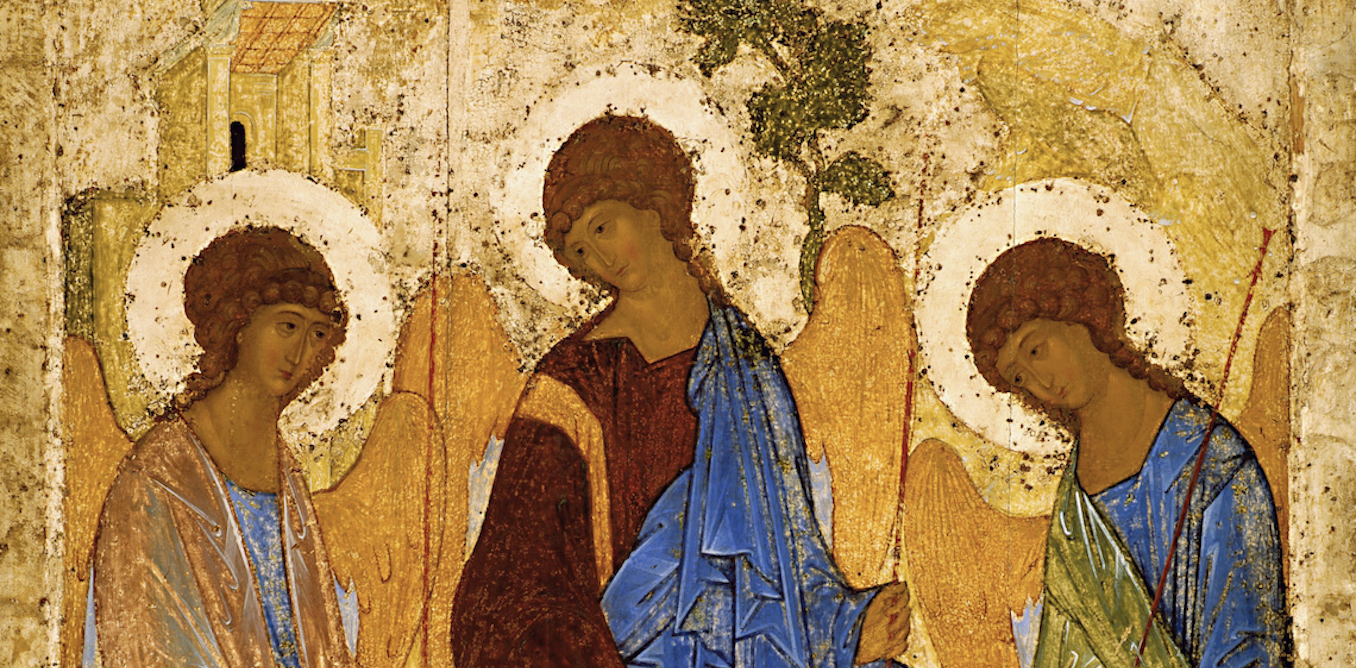
The Christian faith is full of paradoxes. The incarnation, the cross, the Kingdom that is here and not yet and, most centrally and foundationally, the Trinity. One God but three Persons. Not modalism, not tritheism but a unity that holds difference within itself, eternally.

Many theologians acknowledge that the Trinity is not merely an intellectual puzzle but a revelation that resists flattening. To understand it is not to tame it. And yet, for me, that complexity is not a barrier to faith; it is a pathway. It draws me closer, because it reflects something I already know in my bones: that truth is not the absence of tension, but the holding of it.

The Trinity, then, is not an object of my study but, in some way, it is an icon. It reveals and affirms a mode of existence that is deeply familiar to me but remains strangely unspeakable. It offers a way of thinking about unity that does not demand uniformity. And this is where the theology becomes not only personal, but ecclesial.

I have come to describe my approach to intercultural practice as one of ‘inclusive othering’. It is an attempt to name a way of holding difference within a framework of unity, without dissolving the importance of either. In the life of the Church, we often fall into one of two traps: either we preserve purity by excluding the ‘other’, or we flatten difference in the name of peace; but the Trinity models a different way. The Persons of the Trinity are not interchangeable. The Father is not the Son. The Spirit is not the Father. There is real distinction. But there is also real union. Not hierarchical, not conflicted, but harmonious and perichoretic.

Inclusive othering, then, is not about making everyone agree, or ignoring deep disagreement. It is about recognising that difference can be held within relationship, even if it is not resolved. This, I believe, is the ecclesial challenge of our age and it is also the gift that neurodivergent people can offer to the Church.

While autism often, in clinical terms, emphasises what it lacks, there is a growing recognition that it brings distinctive ways of seeing the world. One way is an ability to hold complexity, to pursue coherence without closure and to name inconsistencies others tolerate into silence. These traits, I believe, far from being flaws, are prophetic. They invite the Church to imagine a community not, primarily, as shared agreement, but as shared attention to the mystery of God and one another. Unity that can hold difference is not only a theological necessity but may also be a neurodivergent gift.

And if Augustine’s ecclesiology can be read as a struggle to hold grace and order together and if Hugh of St Victor offers a vision of community that cultivates both discipline and mutuality, then these are not merely historical artefacts; they are resources for the Church today. They resonate with the neurodivergent experience of needing structure, while longing for belonging.

So when I was asked what motivates me to study the topic of unity in difference, I could have said: “Because the Church is divided and needs healing,” or “Because doctrinal clarity matters,” or “Because I want to trace a theological thread from Augustine to Hugh that can inform contemporary ecclesiology.” All of that would be true.

But the deeper truth is this:

I study the Trinity because I need to believe that unity in difference is real, not as a concept, but as a lived possibility. I need to believe that my way of being is not a problem to be solved, but a perspective that can illuminate. I need to believe that the paradoxes I carry, between belonging and difference, between tradition and innovation, between fixed structures and fluid relationships, can find a home in God and the Church.

The philosopher Søren Kierkegaard, who also dwelled in paradox, argued that the most important decisions are not made through objective reasoning but through the leap of faith. That leap is not irrational, but it goes beyond calculation. It is the choice to act in the face of ambiguity, to commit to something that cannot be proved in advance.

In a way, my PhD project is such a leap. It is an act of trust that unity can be more than a word, that difference need not mean distance and that the Trinity is not only the object of our theology but the pattern of our life together.

What motivates me, then?

I have always felt slightly out of joint with the world. Not entirely apart, but never entirely at ease. It’s not just a matter of difference; it’s dissonance. I sense the world moving to a rhythm I can’t quite learn, speaking in a language I only half understand. The intensity of this disunity between me and others, between people and institutions, between ideals and actions, has never gone away. And yet, I have never lost the longing for communion. If anything, it only grows stronger.

This is not a purely intellectual dilemma. It is an existential ache. The question I live with is not just ‘how can we be united?’ but ‘where do I belong if unity is impossible?’

That question fuels my interest in the Trinity, not as a neat theological formula, but as a holy enigma that effects my own life. I don’t approach the doctrine of unity in difference with cool detachment. I approach it like someone trying to breathe underwater. The paradoxes of the Trinity are not obstacles for me to overcome; they are contours of a mystery I recognise in my bones. Here is a God who is one and three, eternally. Not in compromise, but in fullness. Not despite difference, but through it. If this is what God is like, then perhaps my longing for unity amid difference is not a flaw or a futile dream but, in fact, it is a call to dwell ever more deeply in the reality of God.

That doesn’t resolve the tensions I feel in the world. It doesn’t dissolve the pain of disunity or the sharp edges of misunderstanding that often meet neurodivergent people like me. I still experience difference as disruption. I still feel the pull between solitude and connection but, though the puzzle may never be resolved, it must still be tackled and pursued. It is in the process of trying to solve it that a different kind of solution emerges. Contemplating the Trinity teaches us that paradox is not a problem to be solved, but a mysterious invitation to be constantly received. That divine communion holds difference without annihilation and my discomfort with simplistic harmony is not a failure to integrate but a witness to something deeper: a call to truth that makes room for tension.

So where does that leave me?

Here, still yearning. Still wrestling. Still believing that the unsolvable puzzle of unity in difference is not a sign of failure, but a place where God is already waiting. And maybe, just maybe, it is the very shape of holiness.