Read Part I by clicking here.

“Welcome. Make yourself at home.”
I’m preaching a sermon at the main service on a Sunday. I have often reflected, in different contexts, on the cultural shape to hospitality and about the need to be intentional about internally naming the rules at play when we welcome someone. The opening phrase is a statement I impress upon every new volunteer welcomer when they start and one that every visitor to the Cathedral will hear, remember and feel is true.
“Welcome. Make yourself at home.” However, there is a rope that hangs at the threshold that leads to the flower room and education room that says, ‘No Public Access.’ There’s a sign at the stairs leading to the Chapter House which reads, ‘Private. Unless in an emergency.’ There are a series of doors that remain locked. There is a Listening Room that’s perpetually ‘In Use’ and a rope that drapes across the gallery to the main offices, the State Gate, Church Bank Gate and the Stott Hill Gate which at various times is locked much to the disappointment of some would be visitors.
“Welcome. Make yourself at home.” But there are the ropes that seem to block access to the sanctuaries here in the chancel and in our side chapels. So, are we welcome to make ourselves at home or not?
I hope that this list of things that could potentially be interpreted as barriers, might lead people to acknowledge the unconscious acceptance to the limit of ‘welcome’.
A Cathedral cannot simply be a building in which every door is permanently open.” I say, “Some things need protecting. Some spaces need to be kept secure and some boundaries exist in order that other spaces can remain open. And, before we judge too harshly, there are boundaries in our homes too. “You can make yourself at home… but perhaps not in my bedroom (that would be weird!), or the or in the cupboard where the good biscuits are kept.”
Every welcome has conditions. Every home has its customs, as do communities and usually we don’t even notice them until someone doesn’t know them.
A Cathedral, like all institutions, is accumulated rather designed. It carries the decisions of people who are long dead alongside the decisions of people who have only just arrived. There are things we do because they have been done for hundreds of years and things we do because someone had an idea last Tuesday and it’s often difficult to tell which is which.
I am sat in the office of our relatively new Safeguarding Officer. I look around and try and remember how it was a few months ago when it was the office of our old Chief Operating Officer. The decision to change offices was made swiftly and firmly; I like it. I am helping our Safeguarding Officer go through all our volunteers to ensure we are compliant with Safer Recruiting processes. She’s asking me because I am the only member of staff who knows all of the people and what various roles they inhabit. I know the complicated reasons why certain people are struggling to respond to her seemingly basic and easy communications to complete forms or undertake training.
“They may not have replied to your emails,” I am saying, “because they don’t know your name. They were subject to hacking from an email that seemed to be from Bradford Cathedral. I’ll talk to them about it and encourage them to reply separately.”
This is another small issue that occurs when you have a number of new staff starting at the same time, the community miss introductions to them all and struggle to keep up with the movement of personnel.
“This other person… I’d escalate your firmness. They won’t respond if you give them a sense that this is optional. Just tell them that they won’t be allowed to serve until they do it.”
In saying these things I am translating the Cathedral for someone who has not yet had time to learn its particular contours. I am giving her small pieces of accumulated knowledge that make the apparently irrational behaviour of people here slightly more intelligible.
“Is it important that they continue in this role?” she asks.
I was not expecting that question. I have got so stuck, in this conversation, focussing on making what is, compliant and agreed upon, that I have failed to remain open to asking whether it should still work in this way in the first place. In this instance we have enough people on this particular team to cover the tasks. This person is not particularly precious about their roles. They are, however, competent and confident and that helps certain other members feel safe, but the question is good. It’s good, not just because its probing but because it connects us as colleagues; I am no longer imparting wisdom to her but we are working on this task together as collaborators.
Knowledge, accumulated over time and in a singular point of dependency, can become a kind of institutional glue, holding together relationships and practices that would otherwise come apart. The problem is that that glue can also conceal the joins. To cultivate a Cathedral, therefore, means to not simply pass on accumulated knowledge, but to create the conditions in which in the very act of passing on knowledge the joins can be attended to as well. As well as that, this moment of inheritance should be the context in which a new, mutual relationship is forged. In this both parties grow a common attentiveness, not only to their particular role, but also to how it relates to the other’s.
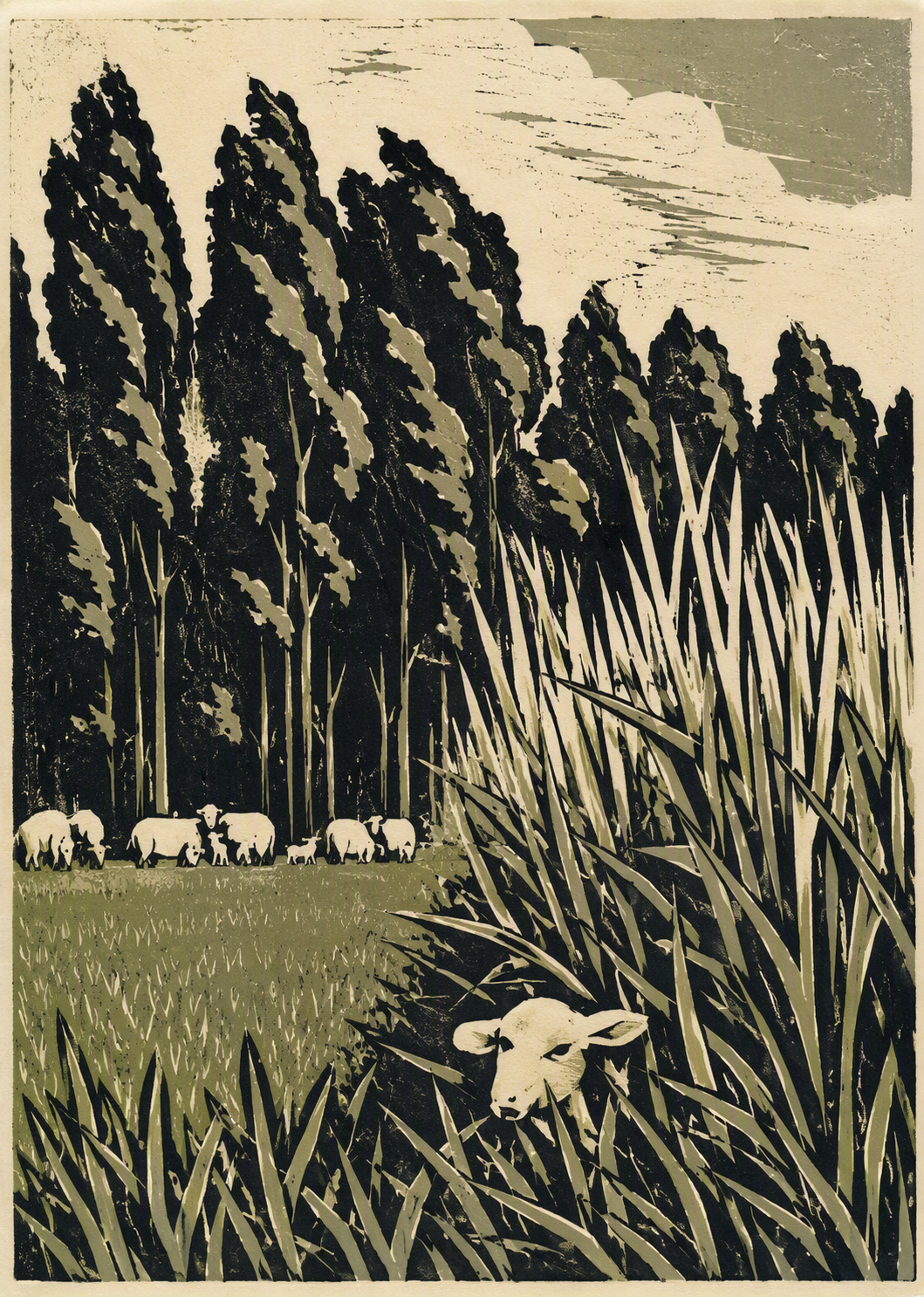
I have come to realise that there are two ways we get most organisations and, in particular, institutions, wrong: one is to divide everything into separate functions, but the second is to integrate everything so thoroughly that difference disappears. The art of good, intercultural or, even, ‘ecological leadership’ is to find the creative tension between the two.
The historical mixed farm, as discovered by Rebanks, wasn’t a collection of identical organisms but nor was it an atomised collection of different organisms, existing side by side with clearly defined territories. It was diverse precisely because different things had different functions but did so in relationship with each other. The danger of the industrial monoculture that has developed is not simply that there are fewer species; it’s that the relationships between different forms of life has been replaced by artificial inputs and controls.
If the hope is a form of ecological leadership that cultivates rather than merely manages an institution, what does it mean in practice? Well, for a start, being intentional about sharing a posture of attentiveness to all participants and, particularly, towards the ‘joins’/relationships that exist between them. As well as this, however, we should encourage values that shape the common life towards creative tension in the hope to avoid falling into complacent stagnation.
Via a discussion on hospitality within the story of the Canaanite woman coming to Jesus, in my sermon, I turn the congregation to think about two of the four values we seek to live with at Bradford Cathedral.
A home without customs would be a rather strange and unsettling place, but our customs can feel so natural to us, we forget they are there. They can become invisible. That is, until somebody arrives who does things differently and, suddenly, we have a choice. We can say, “You are welcome here, but you need to learn how we do things.” or we can say, “You are welcome here. And now we need to discover, together, what welcome looks like now that you are here.”
That is the tension we seek to inhabit here at Bradford Cathedral. A tension created by our contrasting values of hospitality and interculturality. Hospitality says, “You are welcome in this home.” Interculturality asks, “Can your presence change what I understand home to be?” That is much harder because it means that the host does not remain entirely in control and that the person outside who arrives at the threshold may have something to teach the people who thought they already knew what happened inside.
So how do we inhabit both hospitality as one of our values and interculturality as another? It is tempting to think that they are simply two different ways of saying roughly the same thing, but they’re not. Hospitality without interculturality becomes, “Come into our house and learn our rules.” Interculturality without hospitality becomes, “Everything is up for negotiation and nobody knows what the house is for.””
This is a lesson I have become more aware of over the last year as I have introduced new people to our community; staff, volunteers and congregants. It is also true with the other ‘pair’ of values: rootedness and innovation. We want to be faithful to what we have inherited whilst also being willing to experiment with what we might become. I used to think these were tensions to be managed but I have learnt that they’re better understood as relationships to be cultivated.
Rootedness without innovation can become nostalgia. Innovation without rootedness can become novelty for its own sake. Hospitality without interculturality can become a generous invitation to enter somebody else’s world without ever asking whether that world might need to change. Interculturality without hospitality can become an abstract commitment to difference without the patient work of making a place where people can actually belong. The point is not to make the tensions disappear, but to explore what each of them makes possible in the others.
This is also why I have become wary of some of the language we use about the future of Cathedrals. There is an understandable desire to clarify what we are for, to identify our core purpose and to become more focused and confident about what we do to enable us to feel better about not doing other things. After all, resources are finite and there are good reasons for saying no to things. A previous colleague spoke a lot about deciding on what a Cathedral should stop doing but I wonder whether there is a danger in becoming too clear.
A Cathedral is not a specialist institution (or at least, I don’t think it should be!); it’s a place where the specialist and the ordinary, the sacred and the civic, the ancient and the experimental, the local and the global are constantly rubbing up against one another. It’s precisely at this moment, when these things that don’t fit together neatly come in contact with each other, that something unexpected can sometimes happen between them.
This is what we mean by a mixed ecology. It’s not a place where everyone does everything nor where every responsibility is shared until no-one knows who is accountable; the mixed farm still needs a farmer and the sheep are still sheep and the crops are still crops, but the health of the farm is understood by looking at them all as one, complex ecosystem. Ecological leadership, therefore, is not the abolition of difference or responsibility; it is learning to see the health of the whole while allowing the particular parts to remain particular.
I think this changes what it means to lead a Cathedral because the question is not just whether everyone knows what they are responsible for, but whether they know enough about one another to recognise when and where their responsibilities meet others’.
I’m heading for the end of the sermon now and I have a final prestige to pull.
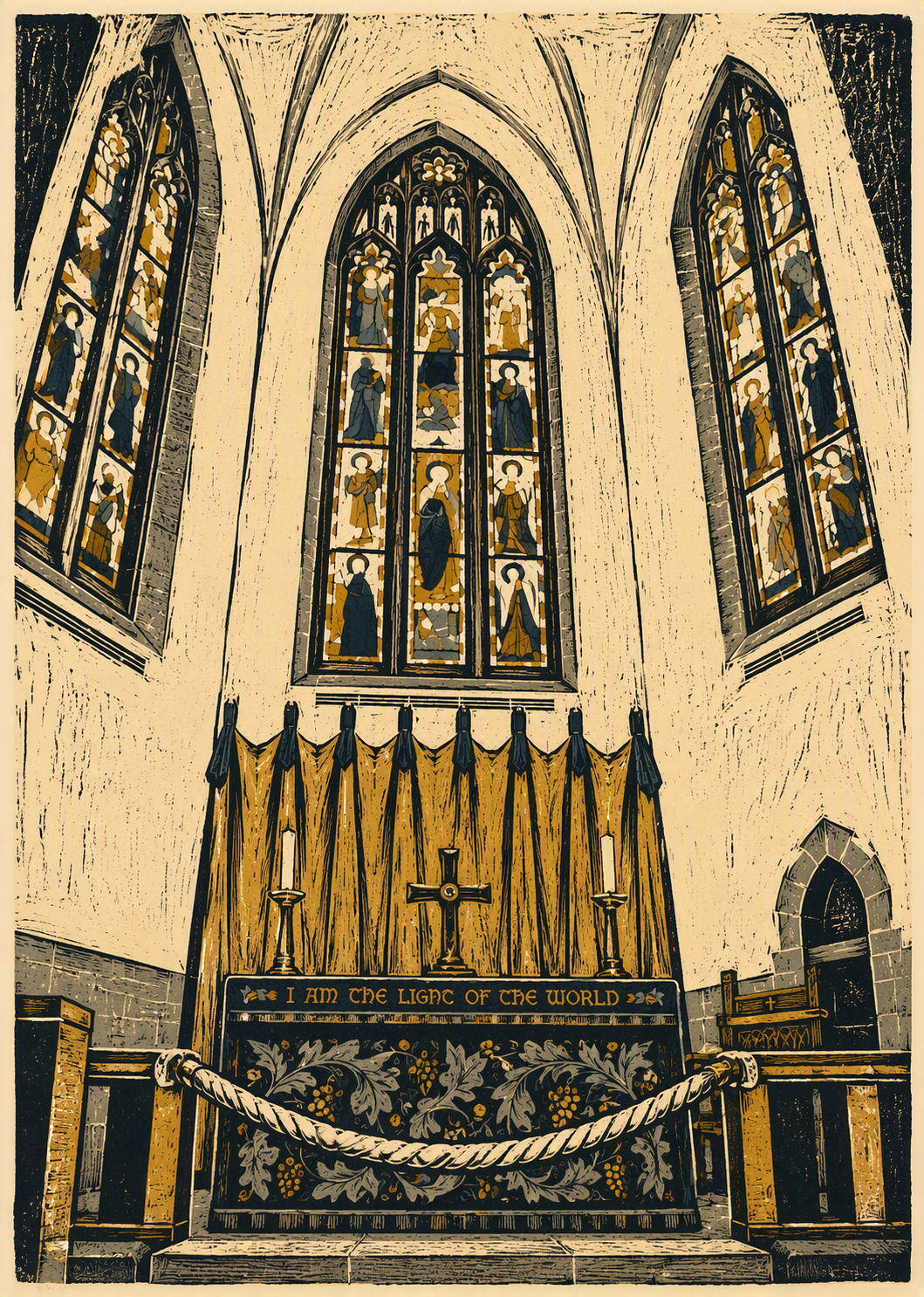
That is what the rope across the sanctuary means because in a few moments, we will come to it. The rope marks a boundary, a threshold, but it is also a space; a space where we are invited to stop, stand or kneel and wait.
When we come to the Eucharist, as we will, something rather interesting happens: we don’t come as hosts but as guests. The person who has been here for fifty years; the person who walked through the doors for the first time this morning; the person who knows every word of the service; the person who is still working out what they believe; the person who knows where everything is; and the person who has no idea whether they are even in the right place. We all come to the same threshold. We all wait together and we all hold out empty hands and Christ gives himself to us.
There is something humbling about that: before we can offer hospitality, we have to receive it. Before we can make someone else feel at home, we have to discover that we have been made at home by and in Christ. We should not imagine ourselves standing on the inside deciding whether to let somebody else in. We are standing at the same threshold; empty handed, dependent upon mercy and waiting to receive.
And Christ says, to us all, “Welcome. Make yourself at home.”
I think about the new people who have arrived at Bradford over the last year. I have shown people where things are, explained why we do things in particular ways and passed on passwords and processes, histories and names. Yet, despite all these worthy things I feel we’ve missed something significant in their induction. It needs to be more than the transmission of information; it needs to be an invitation to pay attention. If we do this, it’s usually accidentally.
Rebanks writes about inheritance as a form of collective attentiveness that is passed through generations. Significantly, however, we should never hand on exactly what we received because the landscape changes, the climate changes, the people change. Stewardship therefore requires both memory and imagination.
Cathedrals are the same. We don’t inherit a Cathedral so that we can preserve it exactly as we found it, nor do we inherit it so that we can remake it according to our own image. We inherit it so that we can cultivate its capacity to become something that none of us can entirely foresee. The task, then, is not to ensure that the next generation knows everything we know. It is to leave them with enough knowledge of one another, enough curiosity about the place they inhabit, and enough freedom to see what we have missed.
That might be what it means to pass on a Cathedral.
This is my inheritance to my children.
This is my love.
James Rebanks, English Pastoral: An Inheritance (UK:Allen Lane, 2020) p.277