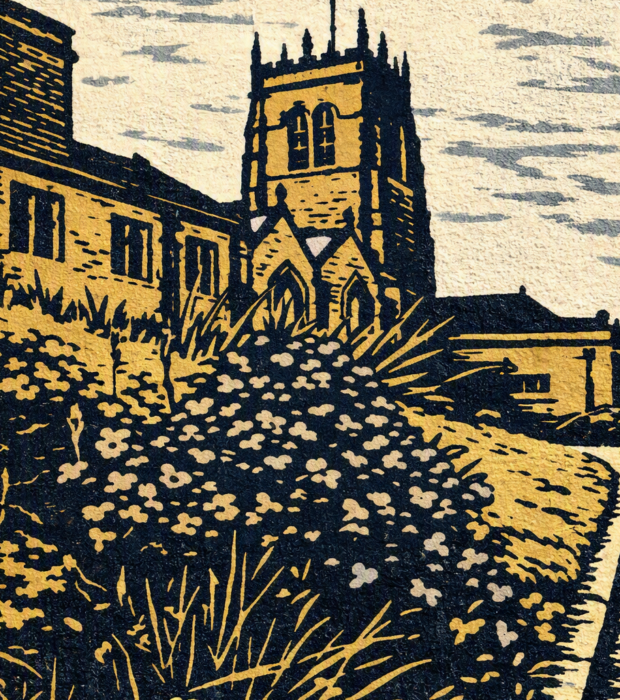

What does it mean to know a Cathedral? Or any place for that matter? How does one describe it to others?
As I cross the Cathedral precinct in the relative quiet of the early morning, I instinctively survey the Close seeing the usual two cars parked in their customary places. There has never been set spots for each staff member but these two always park in the same spaces; they belong to the administrative staff and it pleases me that they are creatures of habit.
I unlock the back door of the Cathedral and, despite having seen the cars of staff who arrive earlier than I can tear myself away from my toddling son, I still feel an instinctive alertness awaiting the alarm to go off. I head straight to the Lady Chapel that is awash with unbalanced summer morning light. This is caused by a mixture of William Morris & Co. windows, required to take pride of place at this east end position despite the architect of the 20th century extension’s dislike against stained glass, and a single clear window that acts as his perpetual protest against this historic stipulation. I automatically flick on the two bottom light switches regardless of the sun. I stopped using the top light switch as that unit hums above and I know we have not got the money or inclination to fix it or replace it with an LED strip, although I did commission a free and thorough design and quote to replace lots of our old lighting system when I was responsible for our Net Zero planning and strategy. That, like many other things has sat in the metaphorical long grass for years; the plans gathering electronic dust in a folder on my computer.
After setting up the technology required to host the online prayer community in half an hour’s time, I head to pick up the prayer folder that sits in the sacristy due to it previously holding confidential information but hasn’t done so for months. The sacristy is named as a place that holds the ‘sacred’ things and I can tell a lot about staff, volunteers and members of our congregations if they call it a vestry. I don’t blame them for calling it a vestry as it is the place where clergy and vergers vest (robe) themselves but historically the clergy robed in the main office on a Sunday in order to be at the west end to process at the start of our main service; a practice that died out before I arrived at the Cathedral.
As I enter the sacristy I notice that our Head Verger isn’t sat at her desk and I know that something is not right. Monday is the day when both full time vergers are in due, again, to a historic pattern that, in this time of transition, hasn’t been kept to and is unclear as to whether we are due to return to it or find another new form of working shifts. With two vergers in the building the Head Verger usually takes the opportunity to do desk work whilst her deputy goes and does the practical things necessary to open our building to the public after morning prayers. I notice my stomach churn as I prepare myself for pastoral chat with the Head Verger who, like me, finds ambiguous and unintentional change difficult. We have been in such a state for over a year now and it is taking its toll on the both of us.
By the time I sit in my stall in the Lady Chapel, chosen by me when we first moved prayers here over three years ago; the seat which has a clear view of the depiction of the prophet Ezekiel, hands clasped together imploring God, my mind is already racing with what might have caused the usually dependable, predictable Head Verger to be away from her morning post. Instead of opening up my theological reading for the morning (at the moment, a commentary and reflections on ARCIC II) I scroll through the shared calendars to try and deduce what has happened since I left the building after the Sunday morning service the day before.
I miss the gentle shuffling movement of our Education and Visitors Director who, during term time, would be setting up for a school visit. I wait for the Finance Assistant to arrive usually with a podcast or Youtube video blaring out of her phone as she descends the stairs and enters the otherwise quiet peace of the Cathedral in early morning.
I never set out to notice all of this. I never intended to inhabit these idiosyncrasies of this building and the people who live and move within it. Yet here I am; and despite feeling, at times, lost, frightened and frustrated with serving in this place, I still feel my heart stir when I think about what a Cathedral like ours could do to change the narrative of a city like Bradford.
When you stay somewhere long enough you do begin to notice things. You begin to know why they are there, to see what has been lost, what has been inherited and what might yet be possible.
I have been thinking about this since reading James Rebanks’ book, English Pastoral. In his usual autobiographical style, Rebanks blends his personal experiences of farming his inherited land in the Lake District with reflections and insights on the wider agricultural industry. This particular book circles around issues of inheritance and the attempt to salvage something of the traditional in an ever-complex world that requires innovation in order to survive.
By the end I found myself inspired and challenged at the deep knowledge Rebanks has of his ‘valley’. He doesn’t, however, end by proclaiming answers to the many remaining questions about the future shape of farming despite the inherited wisdom he possesses. Instead, he finds that the more he knows the more he has learnt to accept the complexity of the landscape he is called to steward; he resists the simplification that so many have tried to enforce onto farmers that have, in the longer term, wreaked havoc on the soil, crops and animals.
I’m in a conversation with the new Dean of Bradford and he has just used the phrase that he repeats: ‘a singular point of dependency’. It is one of his main observations and critiques of the way we have been working in Bradford. Since he started pointing it out, I have found myself noticing it more and more. I nod in agreement as we come to this same conclusion to the particular problem we are discussing in this conversation. I note, as I have increasingly done in recent weeks, my uncertainty as to whether this diagnosis is for a symptom or a cause and, at the same time, what my colleague’s answer to that question is. The difference will be born out in our proposed solutions to this problem.
It is absolutely true that Bradford Cathedral, like most others, suffers from a silo-ing tendency. The causes of this are many and varied and so recent attempts at counteracting it in our context have been likewise. When we have failed to solve it in the specific cases we go back to the drawing board but when we have been successful, we struggle then to implement it in another situation. This suggests to me that we are talking about this problem of isolation as a symptom rather than a cause.
My recent personal wrestling with questions of vocation and role is, perhaps, an acute case of ‘single point of dependency’. I have become someone who knows how quite a lot of things work and why. Some of that is simply the consequence of having been here for a while and some of it relates to personal struggles with my sense of responsibility. All of that, however, has been further compounded by the particular shape my role has taken during this period of considerable transition; when people leave, someone has to pick things up and remember in order to pass it on to the next person. In addition, I find that when people leave relationships are broken and when those relationships sit between two parts of an organisation it is easy for that to get forgotten. I have unconsciously tried to take on the role of trying to hold the shape of those relationships until there is time to work out their new shapes.
You might already see why I’m finding it so hard to stop. I have recently sent to the Dean, at his request, a list of tasks that I’d like to pass to someone else. The creation of that list was hard and the result: meagre. Two of the four suggestions cannot be passed on as the person is not yet in post and it will take time for them to embed. The other two I struggle to see how the person being given the task will know how to do it or why. So, as I stand with the new Dean as he discusses how he has implemented those proposed changes; my first reaction is gratitude that he is trying to help me break an embedded pattern of work but then there’s that secondary feeling; I don’t feel better for it. I know I am a single point of dependency and that I don’t want to be a single point of dependency, but I’m not convinced that simply removing that dependency from me and reminding me that everything doesn’t or shouldn’t solely rely upon me is the solution.
The deeper questions might be why I was the person who knew? What relationships did I happen to be holding together? What institutional memory has accumulated in one place? Why was I left to remember the reasons behind decisions? How do we induct new staff into our common life so that these things can be more freely shared?
I do not think the answer is that everyone should know everything; that would simply create a kind of collective exhaustion. The Head Verger does not need to become the Finance Assistant. The Finance Assistant does not need to run a school visit. I still think distinct roles are good and that responsibility should sit somewhere but I am trying to name the reality that exists between everyone doing their own thing and everyone being able to do everyone else’s thing. I think it’s found by encouraging the ability to know how your thing belongs to theirs.
What makes English Pastoral so compelling to me is not simply his criticism of industrial agriculture, but his description of what happens when a landscape is divided into increasingly specialised functions. The agricultural revolution brought extraordinary gains in productivity, but it also separated things which had once lived together: crops from livestock, fields from hedgerows, farming from wildlife, production from the wider health of the soil. The problem was not that any one part stopped working but that the relationships between the parts were weakened.
The old mixed farm was not efficient in the way an industrial farm could be efficient. Sheep grazed the fields and fertilised them; crops fed the animals; hedgerows provided shelter and habitat. Water, soil, plants, animals and people existed within the same ecological system. The point wasn’t that everything did everything; it was that the different things belonged to the same ecology.
The problem with a “single point of dependency” is not simply that too many tasks sit with one person. It is that, over time, knowledge about how the different parts belong together can accumulate in one place. And that cannot always be solved simply by moving the tasks.
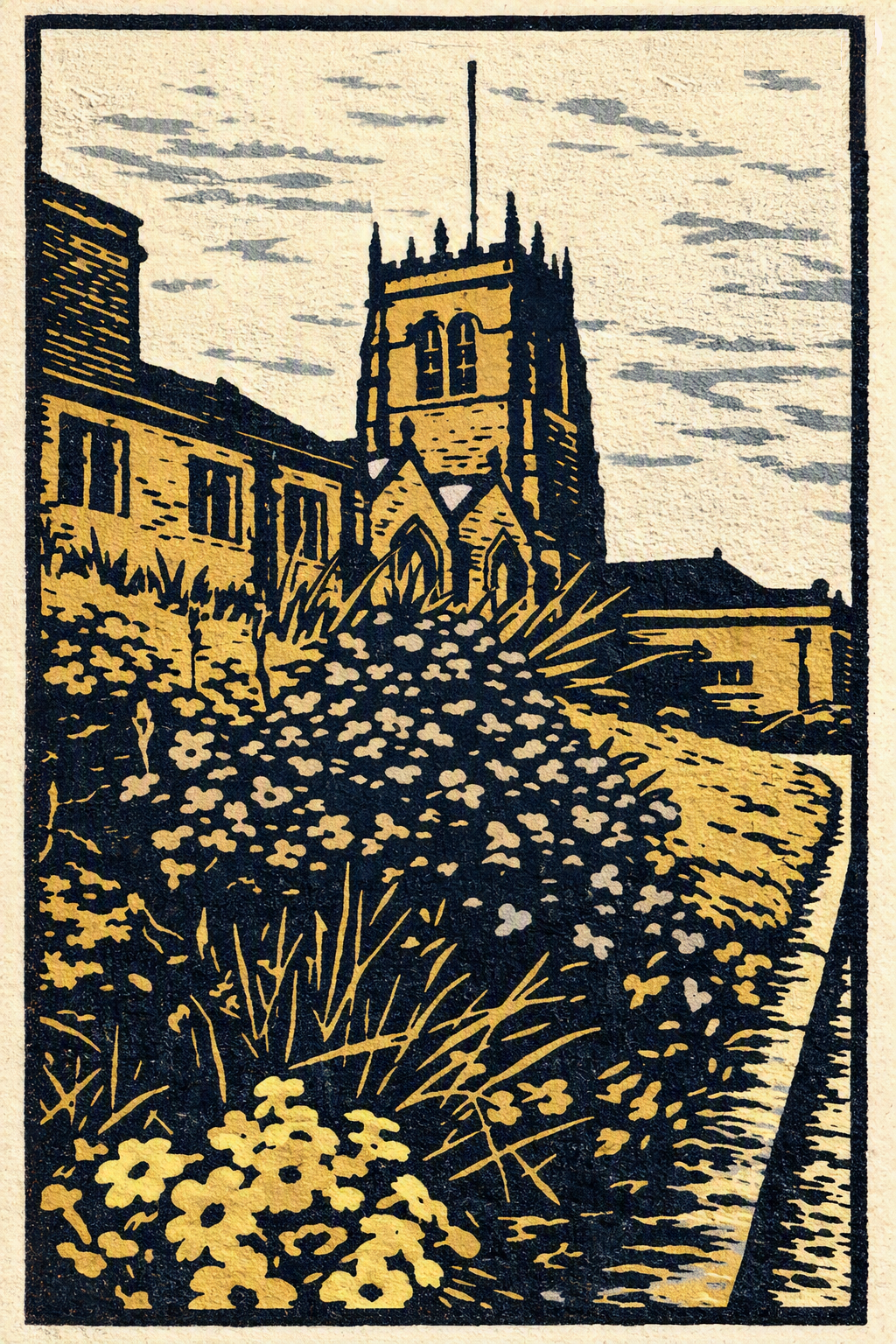
We tend to solve organisational problems by making them more abstract. We talk about roles, tasks and processes because these are the things we can describe, delegate and measure. If someone leaves, we identify their tasks and list them on a handover document. Someone then holds them on an interim basis and they fulfil the urgent jobs and leave the longer term development tasks to the unknown person who will take on this role more permanently. I think I have become a single point of dependency because my official role is less about tasks and more about long term development and imagination. I have put those on ice in order to hold some more immediately pressing, more tangible jobs.
As we adopt a more role, task and process lens to our life together, roles like mine become confusing and inefficient. What do I actually do when I am not performing tasks that should sit elsewhere in a more definable role?
Organisations do need roles and processes. People need to know what they are responsible for and how we know whether something is working but something gets lost when we remove the people and their relatedness from the picture. Our Head Verger is not simply her role. The Finance Assistant is not simply a list of her tasks. All of us are particular people, with particular histories, personalities, habits, motivations and ways of seeing the place. What’s more, we work alongside other particular people with their own histories, personalities, habits, motivations and ways of seeing.
I haven’t simply been remembering tasks: I have been remembering people and the relationships between them; why this person needs that conversation handled in a particular way; why that relationship matters; why something that looks insignificant on a spreadsheet is important to somebody who has been part of the Cathedral for twenty years. This can seem impossibly complex, and it is.
The mixed farm is not a collection of interchangeable units. Its strength comes from particular things being in relationship with other particular things; the sheep are not simply livestock; the hedgerow is not simply a habitat; the soil is not simply a medium for production. The same is true of a Cathedral.
Its resilience depends upon cultivating the relationships between the particular people who inhabit their different roles. This is why, I think, after several years at Bradford, I find myself noticing things I never intended to notice. The cars in the Close, the faulty light, the rhythm of the different staff and the predictable dance they perform around our shared space on a Monday morning. None of these things appear on our organisational chart but, together, they are important and telling things within its ecology.
What cannot be passed on as part of a six week induction is this way of seeing beyond the structures and to become attentive to notice the relationships that make a place what it is. Rebanks has made me realise that this kind of attention is not incidental to stewardship. It is the primary part of it.
A landscape, so Rebanks concludes, can be managed from a distance but it has to be known, over time, to be truly cultivated. The same is true of a Cathedral and so the question cannot simply be how do we keep Cathedrals alive?: it’s how do we cultivate them and pass them on?
Part II can be read here.
I look forward to seeing further reflections on our disparate system & the eclectic way in which it functions.
Not a criticism Ned, having observed the Cathedrals cyclical and yet functional growth into the 21c I often wonder ‘Where next’ on our journey?