
Fool(ish), the long form improv group I am a part of, returned to York Theatre Royal’s Old Paint Shop season last month. We decided to abandon the last vestiges of the safety net of short-form improv: the quick-fire sketches based on games that reflect the pace and fashions of our social media culture. Instead, we committed to the slower discipline of long-form, trusting that an audience who might never have seen it could stay with us through discovery rather than direction.
The second half was a Lugares, a form we have adapted that begins with us ‘painting’ the outline of several spaces in a location: describing in detail the discreet environments that we will then populate with pairs of characters. We then discover, through inhabiting the spaces and responding to how we interact with the context and the other person, ordinary people whose lives overlap in small, surprising ways. Over 40 minutes, those fragments of stories return and interweave. A shared world emerges almost imperceptibly until, in the final scene, everyone gathers in the one location left untouched, and the web reveals itself. There’s no script, no plot to aim for, only attention, listening, and trust that meaning will arise from relationship.
My first scene that night in York began in silence. I sat, flicking through a mimed Yellow Pages; my fellow performer entered, quietly miming the ritual of making tea. For nearly a minute we said nothing but all were aware that that didn’t mean nothing was happening. When I finally spoke, a comment about a plumbing firm’s bad pun based name, the audience laughed because it came from an established place not explained to them but still known. Something human had appeared amongst us without words.
In that minute of silence, I remembered why I love improvisation. It isn’t the cleverness of invention but the trust of discovery: the way characters and relationships come alive before plot, the way truth surfaces when no one forces it. The scene was mimed, yet it spoke volumes.
Later, I found myself wondering why that silence had felt so alive. Why do we spend so much of our lives trying to explain, defend, and declare what we mean, when sometimes meaning only emerges when we stop speaking?
So much of what passes for communication today feels like the opposite of that moment. Everywhere, we are told to “find our voice,” “make our case,” “speak our truth.” We live in a culture that prizes expression above all else. Virtue has become performative. To care rightly, one must post about it. To belong, one must declare allegiance. Even silence must be justified with a statement explaining why one is silent.
It is not that speaking out is wrong. It’s that the moral imagination of the West has become addicted to visibility. We equate articulation with authenticity. The louder and more urgent the performance of virtue, the more ethically alive we feel. But like short-form improv, this constant performance of moral clarity leaves little space for depth or discovery. The characters we play are two-dimensional, designed to land a point rather than reveal a person.
In my previous Into Culture reflection, A Communion Between Trenches, I described the growing pressure on Church leaders and cathedrals to take stances on every issue. There is an expectation that bishops must act as moral activists and cathedrals as platforms for campaigns. The assumption is that if the Church isn’t making a public noise about justice, it isn’t being faithful. Yet this demand to perform moral virtue can easily become another form of cultural conformity: a noisy mimicry of the world’s way of being right.
Our culture’s obsession with moral expression often disguises a fear of interiority. We prefer the quick applause of alignment to the slow work of conversion. The philosopher Byung-Chul Han notes how modern life has abolished mystery: everything must be made visible, explained, confessed. Silence is treated as guilt; opacity, as deceit. This insistence on total expression, Han warns, leads not to truth but to exhaustion.
And yet, truth often hides itself in silence. The deepest transformation is rarely able to be declared. Think of the stillness before dawn or in a monastery, where prayer takes the form of breathing; or the long pauses at a deathbed, when words fall away and only presence remains; lovers reconciling not through eloquence but through the quiet willingness to stay in the room. In each case, silence is not absence but gestation (note the same etymological root to gesture) where meaning gathers itself before being spoken.
The mimed improv scene at York wasn’t about withholding speech; it was about trusting the silence enough to let meaning arise. The audience wasn’t excluded; they were invited in. They became co-creators in the quiet. There’s something profoundly ethical in that. It’s a shared act of vulnerability: will we stay with this moment long enough for it to become real?
That same question haunts our public life. Can we, as a society, stay with ambiguity long enough for genuine understanding to emerge? Or are we too impatient, too anxious to demonstrate that we are on the right side of history, theology, or politics?
Ethics in our time has become an exercise in performance anxiety. We are constantly auditioning for moral approval. The Church, too, risks confusing proclamation with performance; mistaking the saying of good news for the showing of costly grace.
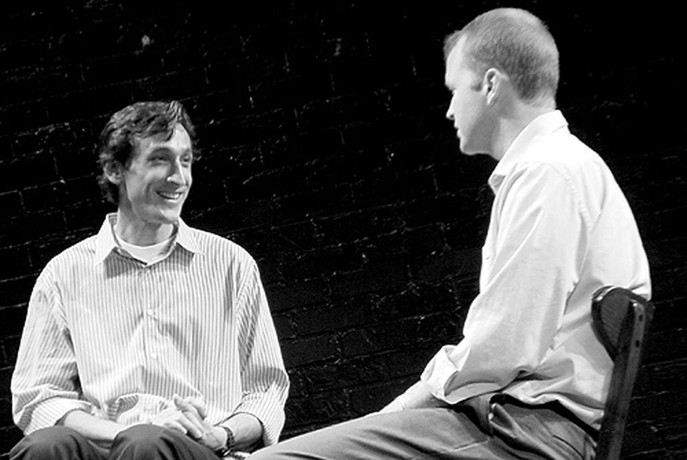
Improvisation offers another way. It begins with listening. TJ and Dave, the Chicago duo whose work is shaping our group’s ethos, start every show with the words, “Trust us, this is all made up.” But what they model is not chaos; it’s attentiveness. They prove that the richest meaning comes not from premeditated plots or premises but from a deep faith in relationship. Every gesture, every silence, every hesitation becomes an invitation. The ethic is not “How do I express myself?” but “How do I attend to what’s being offered?”
It’s here that I find both inspiration and tension with theologians like Stanley Hauerwas and Samuel Wells, who have long drawn on improvisation as a model for Christian ethics. For them, the Church’s moral life is like an act of improvisation: we inhabit a story whose script is Scripture, learning the habits of virtue by rehearsing within its narrative. This has been a deeply generative image, restoring ethics to the communal, embodied, and narrative. Yet the language of “script” carries a danger. A script, however sacred, can become a closed text tempting us to control rather than trust, using it as a mechanism of checking each move against a fixed storyline. In theatre, such ‘blocking’ kills the scene; in theology, it can stifle the Spirit.
Scripture, by contrast, is not a theatrical prompt. It is not a set of lines waiting to be recited, nor even a set of stage directions. It is embodied story: the living account of God’s continual improvisation with creation. It is a rule in the older sense of regula: a dynamic pattern that guides growth, not a fence that polices boundaries; not to shut down improvisation, but to form us in the habits of divine responsiveness. To live by Scripture, then, is not to recite it but to breathe with it, to let its rhythm tune the body’s movements. We do not protect the story by freezing it; we keep it alive by trusting that God still speaks through its silences.
To treat Scripture as script risks turning the moral life into a performance of correctness. To receive it as rule is to participate in God’s ongoing offer. In theatrical terms, Scripture is not the script that dictates our next line; it is the offer that invites our faithful “yes, and.” It’s the grace to respond.
Walter Burghardt writes that contemplation is “a long, loving look at what is real” (Walter Burghardt, Graying Gracefully (Kentucky: Westminster John Knox Publishing, 1997) p.19-26). It’s a description that could just as easily define good long-form improv. Both demand patience, attention, and the courage not to fill the air too quickly. The contemplative, like the improviser, learns to wait for meaning to arise rather than manufacture it. Hauerwas is right when he writes,
…performance that is truly improvisatory requires the kind of attentiveness, attunement and alertness traditionally associated with contemplative prayer.
Stanley Hauerwas, Performing the Faith (London: SPCK, 2004) p.81
Thomas Merton echoes this rhythm of attentiveness when he says,
When we have really met and known the world in silence, words do not separate us from the world nor from other men, nor from God, nor from ourselves because we no longer trust entirely in language to contain reality.
Thomas Merton, Thoughts In Solitude (Boston: Shambala Publications, Inc., 1993) p.93
Silence, then, is not the absence of language but the condition in which real communication becomes possible.
Our culture, by contrast, performs a kind of short-form improv with truth. Scenes begin with bold declarations: “This is who I am,” “This is what I believe,” “This is what’s wrong with the world”. The problem is, no one stays long enough to see what might unfold if we simply waited, listened, or allowed another to reshape our offer. Each line must land a punch or signal virtue before the next topic begins. The result is what improvisers call talking heads: scenes where characters explain themselves rather than relate to one another. We mistake articulation for authenticity, commentary for connection.
In the monastery (and in good improv) something different happens. Words become secondary to presence. The silence between gestures is not dead space but the field where relationship takes root. Both the monk and the improviser resist the temptation to control the scene. They trust that truth will appear if they attend to what is given rather than impose what they expect.
This contemplative stance is the exact inversion of our cultural instinct. We are trained to perform certainty; the monk learns to dwell in unknowing. We seek applause for instant clarity; the contemplative waits for grace to surface through obscurity. Where society rewards the loudest voice, the monastic tradition honours the quietest attention.
Such silence is profoundly active. It refuses to reduce encounter to statement; it withholds commentary long enough for communion to happen. It resists the violence of words that restlessly attempt to make reality yield its meaning too soon. In both theatre and theology, the urge to explain everything can kill what is alive. The scene dies the moment we decide what it’s “about.”
To be silent before God, as in good improvisation, is to trust that the next moment will come as gift. It is a prophetic refusal to play the world’s favourite game of short-form virtue: a noisy succession of moral one-liners, choosing instead the long-form patience of divine story.
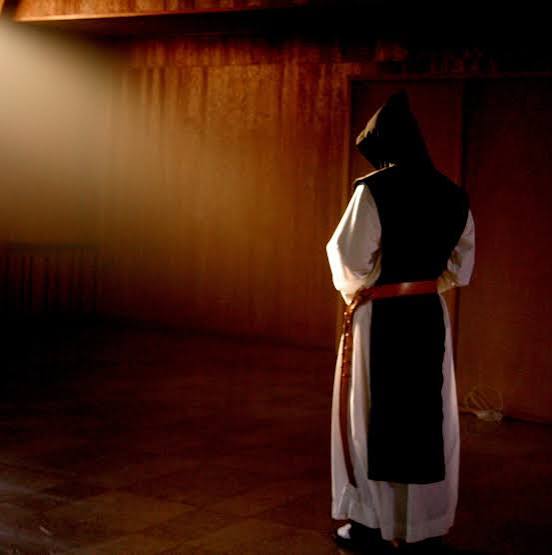
This long-form attention is not reserved for monks or improvisers. It is the moral imagination our culture has forgotten, and one the Church must remember on behalf of the world. If the monastery is where this discipline is learned, then the cathedral is where it must be shown. What the cell cultivates in solitude, the nave can offer in public: a space large enough for silence to be shared.
Perhaps cathedrals could become cathedrals of attention: places that teach the city how to listen. Their very architecture already whispers this vocation. The high nave slows the body; the echo of footsteps demands patience. Light and stone conduct a kind of liturgical silence even when no service is taking place. Yet we too often rush to fill that space with programming, commentary, and noise, as though stillness were failure.
Cathedrals, like many institutions, face pressure from media, dioceses, and even from within, to prove relevance through activism. Every controversy demands a statement; every crisis, a campaign. But prophetic witness may require a different kind of courage: the courage not to perform.
What if cathedrals offered, instead, a public quiet: a civic silence that neither withdraws nor shouts but reveals another rhythm of being human? In a fragmented world, silence might be the most inclusive language we share. It holds the possibility of what I have called inclusive othering: acknowledging difference without domination, presence without possession. Silence says, “you belong, even when I do not understand you.”
This is not retreat but engagement at depth. In the hush of Evensong, strangers sit side by side, their differences suspended in the resonance of unforced harmony. The choir’s pauses are as important as the notes. The silence after the final “Amen” lingers longer than any sermon. That silence, like the minute on stage at York, is charged with meaning.
If cathedrals are to be schools of virtue for the common good, perhaps they must first re-learn the virtue of quietness: the strength to resist immediacy, the grace to wait for sense to emerge. Their witness could be less about declaring truth and more about showing what patient attention looks like.
Improvisation teaches that meaning is never manufactured; it is revealed through trust. The best scenes are those in which each player honours what has been given rather than chasing what they want to say. Likewise, holiness may be less about articulating right doctrine than about receiving reality as gift.
In a culture of performance, this can sound like weakness. But the Incarnation itself begins in silence; the Word spoken into the stillness of Mary’s consent. The resurrection dawns in the wordless awe of an empty tomb. The Church’s story is born from pauses between sentences.
Perhaps ethics, too, begins in those pauses. Moral life is the art of waiting upon meaning, of allowing the world to speak before we answer. It is improvisation in its truest form: neither chaos nor control, but consent.
In Lugares, the show ends when all the scattered characters finally gather in the one location. Stories intersect; fragments cohere. What began in silence ends in a chorus of presence. Yet even then, the best groups know when to stop speaking. The scene resolves not with a punchline but with a breath.
I imagine the Church in that closing tableau: a community gathered, many voices, yet listening. No spotlight, no closing speech, just the stillness of recognition: something human, something holy, has appeared between us without words.
And so we wait.
And breathe.
And trust that meaning is already here …
waiting to be revealed …
in the silence…